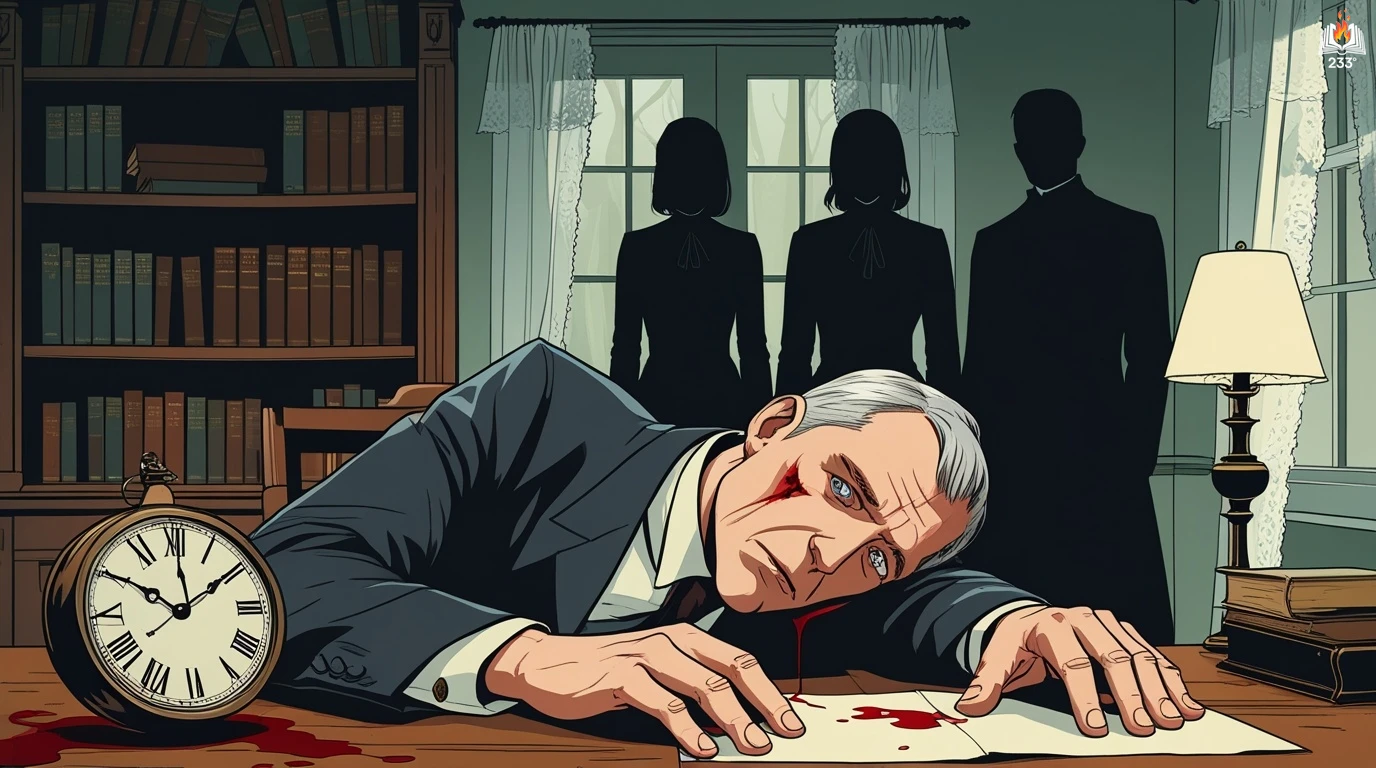
Curtain (1975) by Agatha Christie is the final novel featuring the iconic Belgian detective Hercule Poirot, and it’s part of the world-famous Poirot series. Set at Styles Court, the country house where Poirot solved his first English case (The Mysterious Affair at Styles), the novel reunites Poirot with his dear friend Captain Arthur Hastings. Though elderly and physically frail, Poirot is determined to catch a murderer whose cunning makes them particularly dangerous – perhaps the most dangerous adversary of his career.
Plot Summary
At Styles Court, the old manor house now converted into a guesthouse, time seemed to stand still, as if the ivy-covered walls remembered the dark secrets of years past. Captain Arthur Hastings arrived once more, a widower now, his heart heavy with memory. He had come at the call of his old friend, Hercule Poirot, the brilliant detective whose body had been betrayed by age but whose mind remained as sharp as ever. Poirot, now confined to a wheelchair, hinted at a threat lurking within the walls of Styles, a shadow poised to strike again.
The house was filled with an odd mix of residents. There was the bickering Colonel Luttrell and his sharp-tongued wife, their marriage teetering on the edge of resentment. Sir William Boyd Carrington, a distinguished and genial man, carried the weight of old affections for Barbara Franklin, the delicate wife of the distracted Dr. Franklin, who was absorbed in his research on tropical diseases. Barbara, frail and wistful, floated like a ghost through the house, watched over by the quiet, flame-haired Nurse Craven. There was Stephen Norton, the shy and observant birdwatcher, Elizabeth Cole, composed yet haunted by past grief, and Major Allerton, the smooth-talking, dangerous charmer who set hearts stirring. Hastings’ own daughter, Judith, was there too – fierce, intelligent, and caught between admiration for Dr. Franklin and the reckless allure of Allerton.
Poirot confided in Hastings that behind the ordinary faces at Styles, one concealed a monstrous talent: the power to bend others to commit murder. This person, whom Poirot called X, had orchestrated at least five deaths before and now planned to strike again. The challenge lay in uncovering both the identity of X and the intended victim before it was too late. Yet Poirot kept his suspicions close, leaving Hastings to circle the household, watching, guessing, but never quite touching the truth.
The atmosphere in the house grew heavy with unspoken tension. Barbara Franklin clung to Sir William, whose protective affection stirred jealousy in Dr. Franklin. Judith drifted closer to Allerton, to Hastings’ growing alarm, her fierce independence masking vulnerability. Elizabeth Cole carried a private sorrow, still shadowed by a sister’s tragic death. Norton, quiet in the corners, watched the household with his field glasses, eyes sharp beneath his mild exterior. Poirot, all the while, watched them all.
One night, the house was jolted by tragedy. Stephen Norton was found dead, shot in his locked room. The appearance was that of suicide – a gentle man unable to bear life any longer. Yet Poirot did not accept the easy answer. Locked in his chair, his eyes saw deeper than anyone suspected. Hastings, still kept in the dark, was left to grapple with his daughter’s entanglement with Allerton, his own worries compounding as suspicion thickened around the house.
Poirot’s health continued to decline, and Curtiss, his quiet valet, tended to him with calm efficiency. Hastings fretted, torn between his friend’s silence and his own growing unease. Poirot revealed that the key to X’s power lay not in direct action but in suggestion – the ability to plant thoughts, to push others toward murder while remaining outwardly innocent. It was this subtle and diabolical control that had allowed X to elude justice so long.
Then, as Hastings wrestled with uncertainty, Poirot died. The great detective passed in the night, leaving behind a world dimmer for his absence. His death struck Hastings with a grief sharpened by confusion, for Poirot had died with the secret still locked in his heart. The household reeled, mourning the strange little man who had been both guest and guardian, and Hastings felt a crushing sense of failure. Yet Poirot had left behind a sealed confession, to be opened after his death.
As Hastings read Poirot’s final words, the truth unfolded like a dark blossom. The murderer was Stephen Norton. Shy, overlooked Norton, whose quiet nature concealed a dangerous skill – the power to manipulate, to plant the idea of murder in the minds of the susceptible. He had been the hand behind the five murders Poirot had tracked. Hastings, reeling, realized that Poirot had known all along. Yet Poirot had also known that bringing Norton to justice was nearly impossible. To accuse him without proof would only warn him away, to let him continue his deadly work elsewhere.
Poirot, already dying from his heart condition, had chosen to be both judge and executioner. He had arranged the appearance of suicide, dosing Norton with a sedative before using Norton’s own gun. It was an act that tore at Poirot’s soul but one he deemed necessary to stop further bloodshed. In his letter, Poirot begged Hastings for understanding, expressing his deep love for his friend and his sorrow at having hidden the truth. Hastings, devastated, was left to grapple with the price of justice and the loneliness of survival.
Judith, freed from the shadow of Allerton, chose to leave Styles, and Hastings, though his heart ached, watched her go with a father’s bittersweet pride. Styles itself seemed to exhale, its walls tired of violence and ready at last for peace. Poirot was laid to rest in the garden, a small figure who had loomed so large in the lives of those around him. Hastings stood by his grave, the weight of loss pressing on his chest, but also a quiet awe for the brilliance and sacrifice of the friend who had shaped his life.
The house grew still, the guests departed, and Hastings, alone at last, walked through the empty rooms of Styles Court. Outside, the garden stirred in the wind, the past slipping gently into memory. The curtain had fallen, and in its final silence, the house whispered of endings, of love and loyalty, and of the small, fierce man who had given all to ensure that no more blood would stain its walls.
Main Characters
Hercule Poirot: The legendary detective, now wheelchair-bound and weakened by arthritis, retains his sharp intellect and determination. Poirot’s physical decline contrasts with the brilliance of his mind as he works to outwit a murderer he calls “X.” His profound friendship with Hastings adds emotional weight to his final case.
Captain Arthur Hastings: Poirot’s loyal companion, now a widower, returns to Styles Court at Poirot’s request. Though sometimes slow to grasp Poirot’s reasoning, Hastings’ warmth, sincerity, and courage make him an essential partner in the investigation. His relationship with his daughter Judith is strained but affectionate.
Judith Hastings: Hastings’ daughter, a cool, intelligent, and independent young woman, works as a research assistant to Dr. Franklin. Judith is emotionally complex, passionate about her beliefs, and becomes a figure of both admiration and suspicion in the story.
Colonel and Mrs. Luttrell: The new owners of Styles Court, they run it as a guesthouse. Colonel Luttrell is mild and submissive, while Mrs. Luttrell is domineering and sharp-tongued, often belittling her husband in public.
Sir William Boyd Carrington: A distinguished and likable guest, once a colonial governor, who shares a past with Barbara Franklin. He embodies old-school British charm and decency.
Dr. John Franklin: A brilliant but absent-minded scientist deeply immersed in his research on tropical diseases. His marriage to Barbara Franklin is strained.
Barbara Franklin: An ethereal, sickly woman confined mostly to her room, Barbara is delicate and wistful, clinging to memories of a brighter past.
Nurse Craven: Barbara Franklin’s nurse, cool and efficient, whose quiet presence adds to the household’s tensions.
Stephen Norton: A shy, birdwatching enthusiast whose mild manner hides deeper layers, making him one of the novel’s most ambiguous characters.
Major Allerton: A charming but morally questionable guest, known for his womanizing ways, who exerts a troubling influence over Judith.
Elizabeth Cole: A reserved, intelligent woman with a troubled past, Elizabeth observes the household dynamics with quiet perceptiveness.
Theme
Mortality and the End of Life: The novel is saturated with a sense of ending – Poirot’s physical decline, Hastings’ widowhood, and the final return to Styles Court all evoke reflections on aging, death, and legacy. Poirot’s awareness of his mortality shapes his decisions, making this investigation deeply personal.
Justice vs. Moral Complexity: The book explores whether justice is always synonymous with the law. Poirot grapples with whether it’s acceptable to take extreme measures when legal avenues fail, raising profound ethical questions.
Deception and Identity: Throughout the novel, Christie plays with hidden identities and deceptive appearances. Characters are not who they seem, and Poirot’s challenge lies in discerning truth from expertly concealed lies.
The Nature of Evil: Rather than focusing on physical violence, Curtain examines psychological manipulation. The murderer’s ability to corrupt others and incite them to kill probes the chilling idea of evil as an infectious force.
Writing Style and Tone
Agatha Christie’s writing in Curtain is somber, reflective, and infused with nostalgia. The tone is markedly more elegiac than her earlier works, acknowledging the passage of time and the twilight of beloved characters. Christie balances a deeply emotional undercurrent with her signature crisp, dialogue-driven prose and intricate plotting.
Christie’s style is marked by precision and economy; she never wastes a word, yet her descriptions carry vivid weight, particularly in conjuring the decaying grandeur of Styles Court. Her use of misdirection remains masterful, guiding the reader through red herrings and subtle clues, while the underlying emotional resonance – particularly in Poirot’s and Hastings’ bond – gives the novel rare poignancy.
Quotes
Curtain – Agatha Christie (1975) Quotes
“Everyone is a potential murderer-in everyone there arises from time to time the wish to kill-though not the will to kill.”
“Underneath the quarrels,the misunderstandings, the apparent hostility of everyday life, a real and true affection can exist. Married life, I mused, as I went to bed, was a curious thing.”
“I will not look through keyholes,” I interrupted hotly. Poirot closed his eyes. “Very well, then. You will not look through keyholes. You will remain the English gentleman and someone will be killed.”
“I don't want to write about it at all. I want, you see, to think about it as little as possible. Hercule Poirot was dead - and with him died a good part of Arthur Hastings.”
“Curious, sometimes, how one’s thoughts seemed to swing in a kaleidoscope. It happened to me now. A bewildering shuffling and reshuffling of memories, of events. Then the mosaic settled into its true pattern.”
“The darkest day, lived till tomorrow, will have passed away?”
“Open your mouth and shut your eyes and see what the fairies will send you—”
“I was tired of this silly joking about my 'speaking countenance'. I could keep a secret as well as anyone. Poirot had always persisted in the humiliating belief that I am a transparent character and that anyone can read what is passing in my mind.”
“The delicate exotic flower has to have the shelter of the greenhouse—it cannot endure the cold winds. It is the common weed that thrives in the wintry air—but it is not to be prized higher on that account.”
“Hercule Poirot was dead
“He notices a good deal. Those quiet people often do.”
“Now you must realize this, Hastings. Everyone is a potential murderer. In everyone there arises from time to time the wish to kill—though not the will to kill. How often have you not felt or heard others say: ‘She made me so furious”
“I have always believed that a love of nature was essentially a healthy sign in a man.”
“He has a clear-cut, black and white mind, with an exact knowledge of his own feeling—and a complete disregard for outside pressure.”
“Yes, my friend—it is odd—and laughable—and terrible! I, who do not approve of murder—I, who value human life—have ended my career by committing murder.”
“Cher ami!" Poirot had said to me as I left the room. They were the last words I was ever to hear him say. For when Curtiss came to attend to his master he found that master dead.”
“Two people who have suffered unhappiness have a great bond in common.”
“My limbs they are paralysed, my heart, it plays me the tricks, but my brain, Hastings, my brain it functions without impairment of any kind. It is still of the first excellence my brain.”
“Ah! Have I got to tell you thirty-six times, and then again thirty-six, that there is no need of physical effort? One needs only-to think.”
“No greater mistake than to think that because a man's tied by the leg it affects his brain pan. Not a bit of it.”
“Some day she will know how wise old men are.”
“You and I, Hastings, are going hunting once again.”
“I do not complain," said Poirot, and proceeded to do so.”
We hope this summary has sparked your interest and would appreciate you following Celsius 233 on social media:
There’s a treasure trove of other fascinating book summaries waiting for you. Check out our collection of stories that inspire, thrill, and provoke thought, just like this one by checking out the Book Shelf or the Library
Remember, while our summaries capture the essence, they can never replace the full experience of reading the book. If this summary intrigued you, consider diving into the complete story – buy the book and immerse yourself in the author’s original work.
If you want to request a book summary, click here.
When Saurabh is not working/watching football/reading books/traveling, you can reach him via Twitter/X, LinkedIn, or Threads
Restart reading!