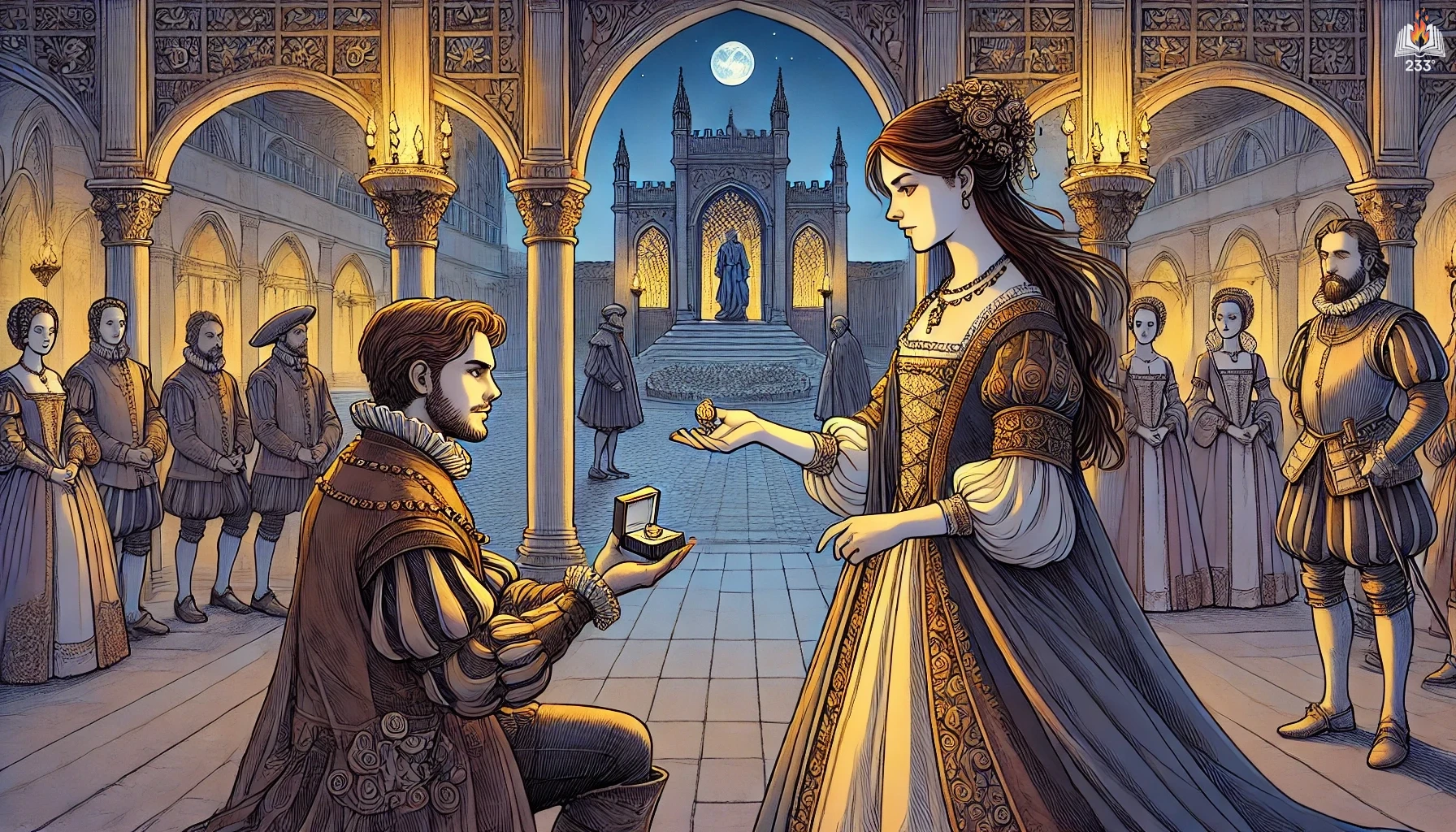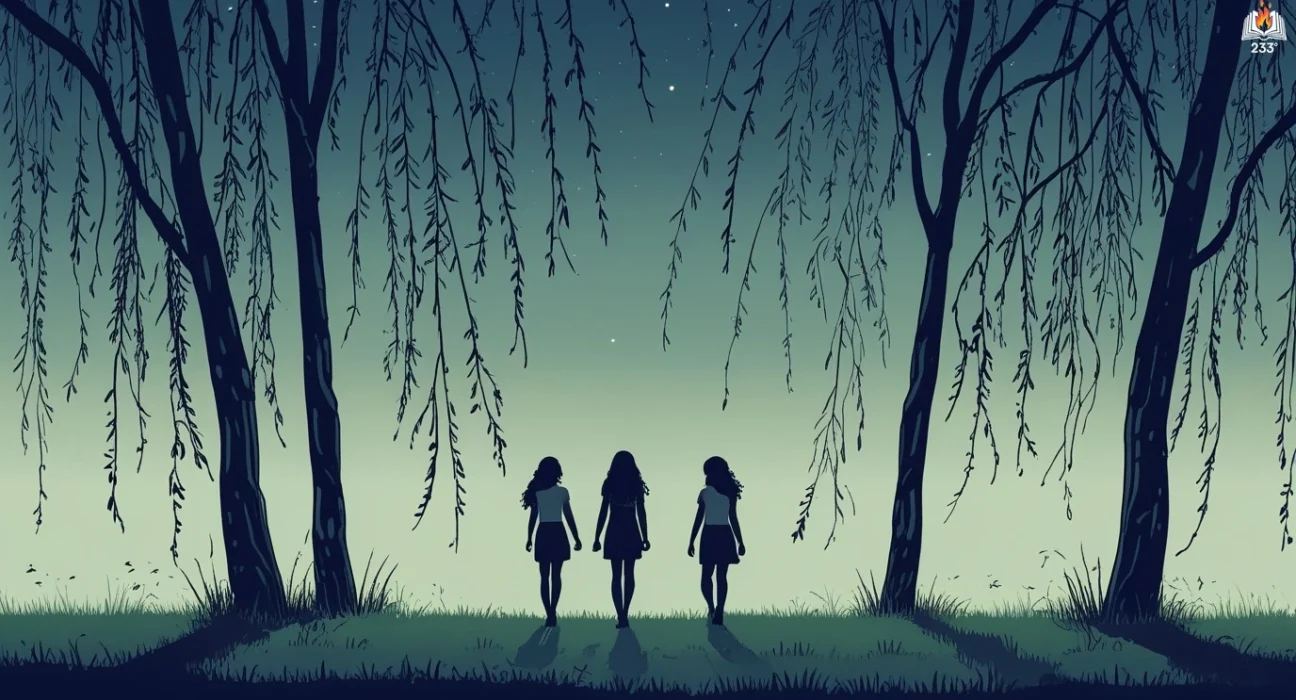
3 Willows: The Sisterhood Grows by Ann Brashares was published in 2009 and is a companion novel to the bestselling Sisterhood of the Traveling Pants series. While the original Sisterhood has moved on, this book introduces a new generation of three young girls – Ama, Polly, and Jo – as they step into the uncertain world of high school and adolescence. The novel is deeply rooted in the legacy of the original Sisterhood, making frequent references to its members, while establishing its own heartfelt coming-of-age narrative. The symbol of the three willow trees planted by the girls in childhood becomes a subtle metaphor for their growth, divergence, and interconnectedness.
Plot Summary
On the last day of eighth grade, three girls who had once been inseparable walked home together, not quite by design, but not entirely by accident either. Ama, Polly, and Jo – they had grown apart over the years, splintering in slow, quiet ways, and yet there they were, crossing East-West Highway as they had so many times before. The sidewalks felt familiar under their feet, but so much had shifted. Ama, who clung to structure like it was air, Polly with her worn shorts and wistful stare, and Jo, polished and popular, all moving forward and not once looking back to the place where they had planted three willow trees long ago.
They had once believed those trees would grow strong and tall just like them, tethered by the dirt and their promises. They met in third grade after being left behind at school on the same strange day. Strangers at first, they ran away together with their potted trees in hand and crossed the street into something new. They gorged on candy, got caught in the rain, and planted the trees by a creek behind a playground, hoping their roots would take hold. Time passed and they visited the trees less and less, just as they slowly stopped seeing each other after school. The trees, like their bond, were left to the whims of the seasons.
Now, as summer began and high school loomed, each of them stood at a crossroads.
Ama Botsio was meticulous, goal-driven, and proud. Her older sister Esi was a Princeton-bound academic star, and Ama intended to follow in her footsteps. She had applied to a prestigious academic summer program, dreaming of Andover or Johns Hopkins. Instead, she opened the envelope to find she’d been selected for an outdoor wilderness trip through Wyoming and the Tetons. It felt like a mistake – a betrayal even. Ama didn’t hike. She didn’t camp. Her life was ruled by clean notebooks and straight As. Still, her parents, full of pride and trust in the system that had shaped Esi, urged her to go.
Jo Napoli, golden-haired and confident, headed for a very different summer. She and her mother packed up for their beach house in Rehoboth, her father conspicuously absent. Jo tried not to ask why, but silence was often more painful than answers. She took a job as a busgirl at the Surfside Crab House, hoping to find freedom, adventure, maybe even romance. At school, she had started to drift into the orbit of more glamorous girls, leaving behind her childhood friends. At the beach, she tried to cement her new identity, styling her hair like the older waitresses and watching the social currents of the summer crowd with careful eyes.
Polly MacKenzie stayed behind in their suburban neighborhood, piecing together fantasies of reinvention. Her mother, an artist, was loving but distant, and her father’s identity was a closed door. A visit with her aging relative Uncle Hoppy opened a window into a forgotten past – he told her that her grandmother had been a model. The idea bloomed in Polly’s mind like a secret garden. Maybe beauty, maybe greatness, ran in her blood. Maybe she could become something extraordinary. She started skipping meals, studying fashion, and imagining herself transformed into someone worthy of notice.
While Ama packed reluctantly for a trip into the wild, she clung to hair products and reading lists, only to have her straightener confiscated upon arrival. In a group of mostly white teens, she stood out in every way and felt it. The leader, Jared, was cheerful but relentless. Hiking through forests and sleeping in tents felt like punishment. Yet slowly, amid the discomfort and sore muscles, Ama began to see new possibilities. A boy named Noah noticed her. He was funny, patient, and kind, and Ama, used to being invisible outside of academics, was startled by how much that meant. They talked about Ghana and languages and backpacks and slowly, she began to laugh, even when she tripped. Even when she ached.
Jo, meanwhile, threw herself into work and social life. She bonded with Bryn, the confident and sometimes careless girl from school, and met boys who flirted and teased. She basked in their attention but also started to feel hollow. Her father hadn’t come to the beach and her mother avoided mentioning his name. The empty spaces in her life were louder than ever. One night, after a boy touched her without care or warmth, Jo felt herself unraveling. She missed her friends, missed the simplicity of feeling seen and safe. But she didn’t know how to go back.
Polly’s reinvention consumed her. She researched modeling schools, obsessed over her diet, and hungered for a connection to her grandmother. When she brought it up to her mother, Dia shut her down with sharp finality. Polly was left grasping at air, the dreamy image of her grandmother slipping through her fingers. Lonelier than she had been in years, Polly called Jo, called Ama, hoping to piece something together again. The calls didn’t go as she’d hoped. Neither of them seemed to have time for her anymore.
Then came a small moment, almost nothing – Ama asked for a bandana she’d lent Jo, and Jo brought it over. Polly had a pair of socks Ama needed and came too. All three girls ended up in Ama’s room, surrounded by old clothes, borrowed DVDs, trinkets from a friendship that had once filled their lives. They returned each other’s things, sorting and bagging them like closing a chapter. No one quite said what it meant, but they all knew. The silence between them was heavy and strange. There were invitations not offered, dinners politely declined. They had grown apart. And yet, for a moment, they were all there.
As summer stretched on, Ama pushed herself to keep up on hikes and discovered she could do more than she believed. Jo worked through long shifts and slowly saw the emptiness behind the popularity she’d chased. Polly, nursing her aching hunger and disappointment, began to let go of the dream and see herself more clearly. Each girl moved forward alone, but something subtle began to shift. They weren’t who they had been – they were growing.
The willows they planted years ago still stood somewhere behind the playground at the base of Pony Hill. No one visited them anymore. Maybe one girl stopped, maybe another kept walking. The paths were no longer the same. But the trees were there, roots deep, still growing.
Main Characters
- Ama Botsio: A brilliant and academically driven girl of Ghanaian descent, Ama is fiercely determined and somewhat rigid in her pursuit of excellence. She idolizes her older sister Esi and seeks to emulate her academic achievements, leading her to apply for an elite summer program. To her horror, she is instead sent on a wilderness adventure in Wyoming, far outside her comfort zone. Ama’s journey is marked by reluctant self-discovery as she confronts her fears, opens herself to unexpected friendships, and finds strength in unfamiliar terrains. Her arc is one of emotional loosening and learning that not all value is found in perfection or preparation.
- Jo Napoli: Jo is confident, physically mature, and increasingly invested in social status and appearance. Spending the summer at her family’s beach house and working as a busgirl, Jo navigates peer pressure, emerging sexuality, and the fallout of her parents’ strained marriage. Her once-close friendships seem to fade as she tries to fit into a more glamorous social crowd. Beneath her composed exterior lies a girl dealing with the grief of losing her brother and the instability of her home life. Jo’s story examines the conflict between external image and inner emotional needs.
- Polly MacKenzie: Polly is imaginative, dreamy, and deeply curious about her heritage. She is raised by an unconventional artist mother and often feels like an outsider. Polly yearns for transformation and reinvention, particularly after learning that her estranged grandmother was once a model. Her journey involves physical changes and aspirations of glamour, but also painful confrontations with familial truths and identity. Polly’s struggle lies in reconciling fantasy with reality and finding validation beyond surface beauty.
Theme
- Friendship and Change: At the heart of the story is the fragile, shifting dynamic between the three girls. Their friendship, once solid and simple, is tested by the transformations of adolescence. The book explores how connections can fray with time but still hold deep roots. Their individual paths force them to redefine what friendship means and whether it can endure through separation and change.
- Identity and Self-Discovery: Each girl embarks on a journey that challenges her sense of self. Ama confronts physical limitations and social fears, Jo deals with emotional isolation and questions of loyalty, and Polly wrestles with her past and body image. These struggles underscore the novel’s central theme: self-discovery through adversity, discomfort, and desire.
- Growth and Nature as Metaphor: The willow trees they planted together as children serve as a recurring motif. Their growth, abandonment, and uncertain fate parallel the girls’ relationships and individual maturation. The book uses nature – from the vast landscapes of Wyoming to Polly’s botanical dreams – to symbolize emotional and personal development.
- Family and Belonging: Each protagonist faces unique familial challenges: Ama with her high-expectation immigrant parents, Jo with her fracturing home, and Polly with her emotionally absent mother and unknown paternal lineage. These relationships shape their sense of security, self-worth, and drive much of their internal conflict.
Writing Style and Tone
Ann Brashares writes with an intimate, perceptive voice that captures the tremors of adolescence with quiet authenticity. The prose is smooth and often lyrical, especially when she lingers on memory or emotional introspection. Brashares excels at crafting the internal landscapes of her characters, revealing their insecurities, hopes, and silent fears with tender realism. The novel shifts between the three girls’ perspectives, allowing a multifaceted view of their emotional worlds and how they each perceive the others.
The tone of 3 Willows is reflective and emotionally nuanced. While it delves into light moments of teenage fun and daydreaming, it is unafraid to explore serious topics like grief, family estrangement, and the pain of drifting friendships. There is a palpable melancholy beneath the narrative, a sense that childhood is ending and nothing will be the same – but also a quiet resilience, a budding strength as each girl faces her own future. Brashares infuses the narrative with a hopefulness that growth, though painful, brings grace and meaning.
Quotes
3 Willows: The Sisterhood Grows – Ann Brashares (2009) Quotes
“Love didn't necessarily look the way you expected it to.”
“Please don't judge me too much until you are older and know more things. (Spoken from mother to daughter)”
“No matter how far back you cut a willow tree, it will never really die.”
“Polly was pretty good at dieting, all right, but she was beginning to wonder whether you ever lost the parts of your self that you wanted to lose.”
“There are moments in your life when the big pieces slide and shift. Sometimes the big changes dong happen gradually but all at once. That's how it was for us. That was the day we discovered that friends can do things for you that your parents can't.”
“What was this compulsive need to be loveable?”
We hope this summary has sparked your interest and would appreciate you following Celsius 233 on social media:
There’s a treasure trove of other fascinating book summaries waiting for you. Check out our collection of stories that inspire, thrill, and provoke thought, just like this one by checking out the Book Shelf or the Library
Remember, while our summaries capture the essence, they can never replace the full experience of reading the book. If this summary intrigued you, consider diving into the complete story – buy the book and immerse yourself in the author’s original work.
If you want to request a book summary, click here.
When Saurabh is not working/watching football/reading books/traveling, you can reach him via Twitter/X, LinkedIn, or Threads
Restart reading!