Wicked: The Life and Times of the Wicked Witch of the West by Gregory Maguire, published in 1995, reimagines the classic world of Oz from L. Frank Baum’s The Wonderful Wizard of Oz series. As the first book in The Wicked Years series, it tells the untold story of Elphaba – the infamous Wicked Witch of the West – offering a dark, politically nuanced, and morally complex tale that turns the familiar fairy tale on its head. Through Maguire’s narrative, readers are invited to examine the nature of evil, identity, and societal judgment in a land that is far from magical harmony.
Plot Summary
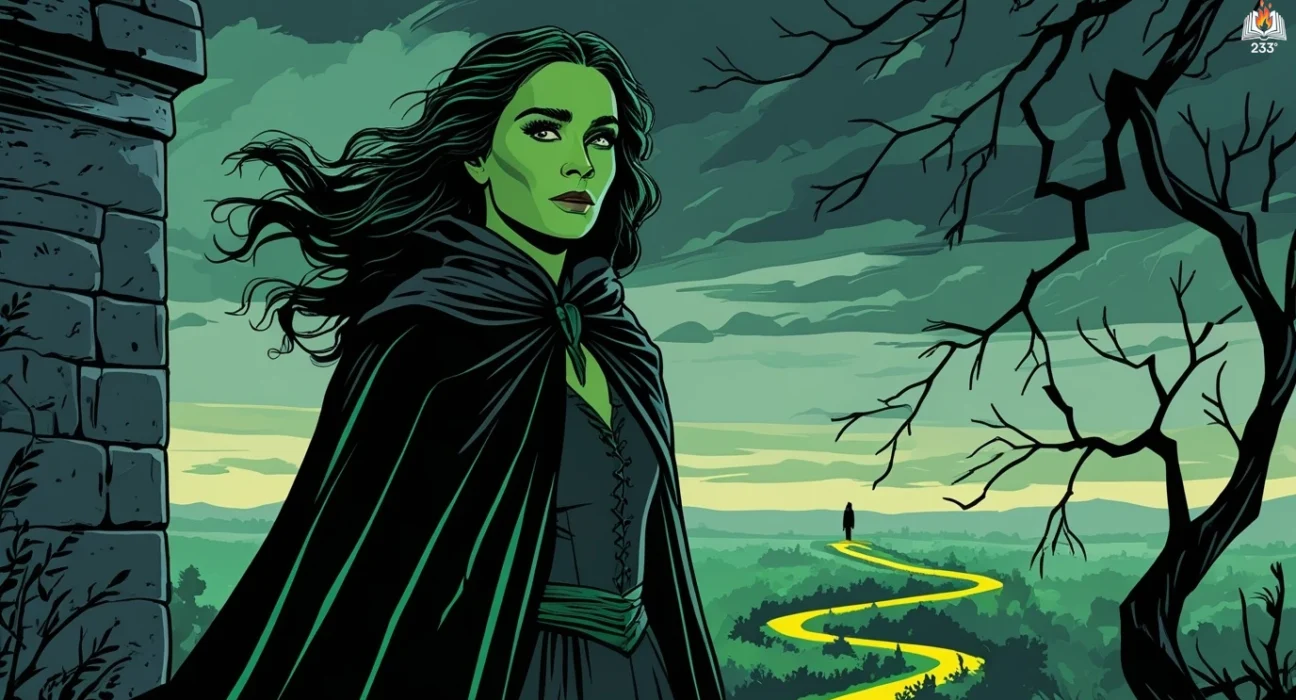
A mile above the crooked lands of Oz, where thunderheads rolled like tyrants and winds whispered secrets through black willow trees, a Witch balanced at the sky’s edge. She had waited long – her green skin catching the gloaming light, her eyes fixed on the Yellow Brick Road winding toward the Emerald City like a noose drawn loose. Below, oblivious travelers picked their way forward: a tin man, a lion, a scarecrow, and a girl. The Witch’s prey. The girl with the shoes.
But Elphaba had not always been a witch. She had not even always been feared.
Born in the remote reaches of Munchkinland, Elphaba came into the world wrapped in mystery and scandal. Her mother, Melena, aristocratic yet idle, gave birth amid chaos – sedated by pinlobble leaves, whispering half-remembered lullabies, and never quite certain whether her child’s green skin was a curse, a joke of the gods, or the result of some elixir passed by a traveling stranger. Her father, Frex, a rigid Unionist minister, saw the child as punishment or prophecy. Her cries, when they came, were not like a baby’s – more like a whisper through stone.
From her earliest moments, Elphaba resisted touch. She bit through bindings and suckled only on her own fierce terms. Her teeth came early, sharp as guilt. Her body grew long and angular. She hated water, feared its touch, and never learned to cry.
In the broken house of faith and bitterness, her sister Nessarose arrived – armless, pink, pious, their father’s favorite. While Elphaba studied the world’s cruelty with eyes like mica, Nessarose was adorned with religion and sanctity, painted as a martyr from birth. Between them stretched a river of unspoken envy and a deep, aching bond.
Years later, Elphaba stepped into Shiz University, where she met Galinda – delicate, vain, shining with privilege. The two girls, an unlikely pairing, became something of companions. In shared quarters and late-night debates, their disdain gave way to recognition. Galinda softened in the presence of Elphaba’s relentless logic, while Elphaba learned that not all beauty was hollow. They watched the world shift around them. Animals – sentient beings – lost their rights. Doctor Dillamond, a Goat and professor, was silenced. Elphaba’s fury bloomed.
The girl of green skin transformed, not with spells but with purpose. Her brilliance turned political. She could not sit quietly. She vanished from Shiz, leaving behind Galinda, who reshaped her name into Glinda and rose in the ranks of civility and public favor.
Elphaba walked into the world’s rot and tried to cut through it.
She crossed deserts and cities, unrecognizable in her black cloak. She met Fiyero – a prince with tattoos and haunted eyes. Their love unfolded in the silence of shadows, a rebellion written in stolen nights. With him, Elphaba found something almost human in herself. But happiness was an illusion that crumbled too easily. Fiyero disappeared, presumed murdered by those who hunted her. Grief did not shatter her – it calcified her.
Whispers of a Witch grew. The Wizard – a fraudulent tyrant with charm like a curse – saw her as a threat. His order spread through Oz like ink in milk. Elphaba, hunted and hated, retreated into the western lands. She built her walls high and her silences higher. The people called her wicked, and so she became it.
Nessarose ruled the East, propped up by religious fervor and cursed slippers that made her walk. But power twisted her spine and sharpened her tongue. She chained her people with divine right and made Elphaba question the nature of morality. When Nessarose died – crushed beneath a farm girl’s falling house – Elphaba did not weep. She knew too much about grief to bother.
The girl, Dorothy, wore the silver shoes now. Elphaba could not let them go. Not because they sparkled, but because they were her sister’s, and because they had power, and because the world had taken so much already.
She tried to retrieve them. Once gently, through parley. Then forcefully, through spell. But the shoes would not leave the girl, and the girl would not stay.
Alone in her tower, Elphaba raised monkeys into flight. She cast no curses but bent wind and sky to her will. She watched the skies for signs, the fires for answers. Her magic was not light or dark – it was desperate, born of questions and pain.
In her solitude, she cared for a boy named Liir – perhaps her son, perhaps only an orphan she claimed out of guilt or love. But she never said his name aloud, never admitted the fragile tether between them. When he left, she let him go without a word.
Her fall came quietly. Not with armies, but with a girl and a bucket. The Witch who could command the sky could not withstand water. The wetness she had always feared reached her skin and stole her life.
No great war. No final words.
Only steam rising, and silence.
The Witch was gone, and the world sighed with relief, never asking who she had been, or why she had tried.
In a land of magic, the true magic had always been her stubborn, aching humanity.
Main Characters
Elphaba Thropp – Born with emerald green skin and strange physical sensitivities, Elphaba grows into a fiercely intelligent and misunderstood woman. From her troubled childhood to her activist youth and ultimately her transformation into the “Wicked Witch,” she wrestles with morality, justice, alienation, and destiny. Her arc is defined by a desire for truth and equity in a world that rejects her, making her both tragic and heroic.
Galinda/Glinda – Initially self-centered and shallow, Galinda becomes Elphaba’s college roommate and unlikely friend. Over time, she matures into the “Good Witch of the North,” though her moral choices often reflect political convenience. Her complex relationship with Elphaba underscores the tension between image and substance, duty and empathy.
Fiyero Tigelaar – A charismatic prince from the Vinkus, Fiyero appears aloof but reveals deeper loyalties and vulnerabilities. He becomes romantically involved with Elphaba, playing a pivotal role in her emotional awakening and personal rebellion. His fate marks a crucial turning point in Elphaba’s transformation.
Nessarose Thropp – Elphaba’s younger sister, born without arms and later known as the Witch of the East. Nessarose is deeply religious and increasingly authoritarian, symbolizing a dangerous mix of piety and control. Her life and death directly influence Elphaba’s trajectory.
Madame Morrible – A cunning headmistress at Shiz University, Morrible manipulates politics and prophecy to advance her own agenda. Her exploitation of young women like Elphaba, Glinda, and Nessarose makes her one of the novel’s clearest antagonists.
Doctor Dillamond – A Goat and a professor at Shiz, he serves as Elphaba’s early mentor. His murder becomes a symbolic act of injustice, reinforcing Elphaba’s drive to fight systemic oppression against sentient Animals.
Theme
The Nature of Evil: Maguire interrogates what it means to be “wicked,” showing that evil is not inherent but often constructed by society. Elphaba’s label as the Wicked Witch emerges not from malevolence, but from fear, misunderstanding, and political scapegoating.
Identity and Otherness: Elphaba’s green skin and social alienation underscore the theme of otherness. Her journey is one of self-definition against societal expectations, exploring how identity is shaped by both internal convictions and external prejudice.
Power, Politics, and Corruption: Oz is rife with political intrigue and moral ambiguity. Maguire explores how institutions manipulate truth, how power corrupts, and how activism can be both noble and self-destructive. Characters must choose between complicity and resistance.
Destiny and Free Will: The role of prophecy and manipulation raises questions about autonomy. Elphaba struggles against the roles imposed on her, questioning whether she is a product of fate or her own choices.
Love and Loss: Emotional intimacy and sacrifice are central to the story. Elphaba’s rare moments of love – with her sister, Glinda, and Fiyero – are often tinged with tragedy, reinforcing the cost of connection in a hostile world.
Writing Style and Tone
Gregory Maguire’s writing is richly layered, lyrical, and often baroque. His prose marries classical diction with psychological depth, creating a narrative that is both fantastical and intellectually provocative. The language veers between poetic introspection and biting satire, often embedding political critique within character introspection or descriptive world-building. Dialogues are sharp, sometimes theatrical, and imbued with ideological tension.
The tone of the novel is decidedly dark and philosophical. Unlike the whimsical charm of Baum’s original Oz, Maguire’s version is morally ambiguous, steeped in realism and tragedy. There is a pervasive sense of melancholy and irony, as the narrative deconstructs familiar tropes to reveal the complexities behind myth. It challenges the reader to empathize with the villain, to consider the personal cost of public labels, and to question the line between heroism and monstrosity.
Quotes
Wicked – Gregory Maguire (1995) Quotes
“People who claim that they're evil are usually no worse than the rest of us... It's people who claim that they're good, or any way better than the rest of us, that you have to be wary of.”
“Remember this: Nothing is written in the stars. Not these stars, nor any others. No one controls your destiny.”
“Where I'm from, we believe in all sorts of things that aren't true... we call it history.”
“One never learns how the witch became wicked, or whether that was the right choice for her~is it ever the right choice? Does the devil ever struggle to be good again, or if so is he not a devil?”
“And girls need cold anger. They need the cold simmer, the ceaseless grudge, the talent to avoid forgiveness, the side stepping of compromise. They need to know when they say something that they will never back down, ever, ever.”
“So he stalked her again. Love makes hunters of us all.”
“There was much to hate in this world and too much to love.”
“You confuse not speaking with not listening.”
“She dropped her shyness like a nightgown, and in the liquid glare of sunlight on old boards she held up her hands-as if, in the terror of the upcoming skirmish, she had at last understood that she was beautiful. In her own way.”
“The body apologizes to the soul for its errors, and the soul asks forgiveness for squatting in the body without invitation.”
“People always did like to talk, didn't they? That's why I call myself a witch now: the Wicked Witch of the West, if you want the full glory of it. As long as people are going to call you a lunatic anyway, why not get the benefit of it? It liberates you from convention.”
“Because no retreat from the world can mask what is in your face.”
“No one controls your destiny. Even at the very worst - there is always choice.”
“The wickedness of men is that their power breeds stupidity and blindness.”
“I know you don't want to hear this but someone has to say it! You are out of control! I mean they're just shoes... let it go!”
“I never use the words HUMANIST or HUMANITARIAN, as it seems to me that to be human is to be capable of the most heinous crimes in nature.”
“That was such a wonderful time, even in its strangeness and sadness-and life isn't the same now. It's wonderful, but it isn't the same.”
“I shall pray for your soul,' promised Nessarose. I shall wait for your shoes,' Elphie answered.”
“Animals are born who they are, accept it, and that is that. They live with greater peace than people do.”
“In summer moonlight, she was dangerously, inebriatingly magnified. ”
“They moved together, blue diamonds on a green field.”
“There were more ways to live than the ones given by one's superiors”
“The answer of course, is that the clock isn't meant to measure earthly time, but the time of the soul. Redemption and condemnation time. For the soul, each instant is always a minute short of judgment. ”
“Always the bridesmaid , never the bride." Always the godfather, never the god".”
“It's unbecoming," she agreed. "A perfect word for my new life. Unbecoming. I who have always been unbecoming am becoming un.”
“The world unwraps itself to you, again and again as soon as you are ready to see it anew.”
We hope this summary has sparked your interest and would appreciate you following Celsius 233 on social media:
There’s a treasure trove of other fascinating book summaries waiting for you. Check out our collection of stories that inspire, thrill, and provoke thought, just like this one by checking out the Book Shelf or the Library
Remember, while our summaries capture the essence, they can never replace the full experience of reading the book. If this summary intrigued you, consider diving into the complete story – buy the book and immerse yourself in the author’s original work.
If you want to request a book summary, click here.
When Saurabh is not working/watching football/reading books/traveling, you can reach him via Twitter/X, LinkedIn, or Threads
Restart reading!