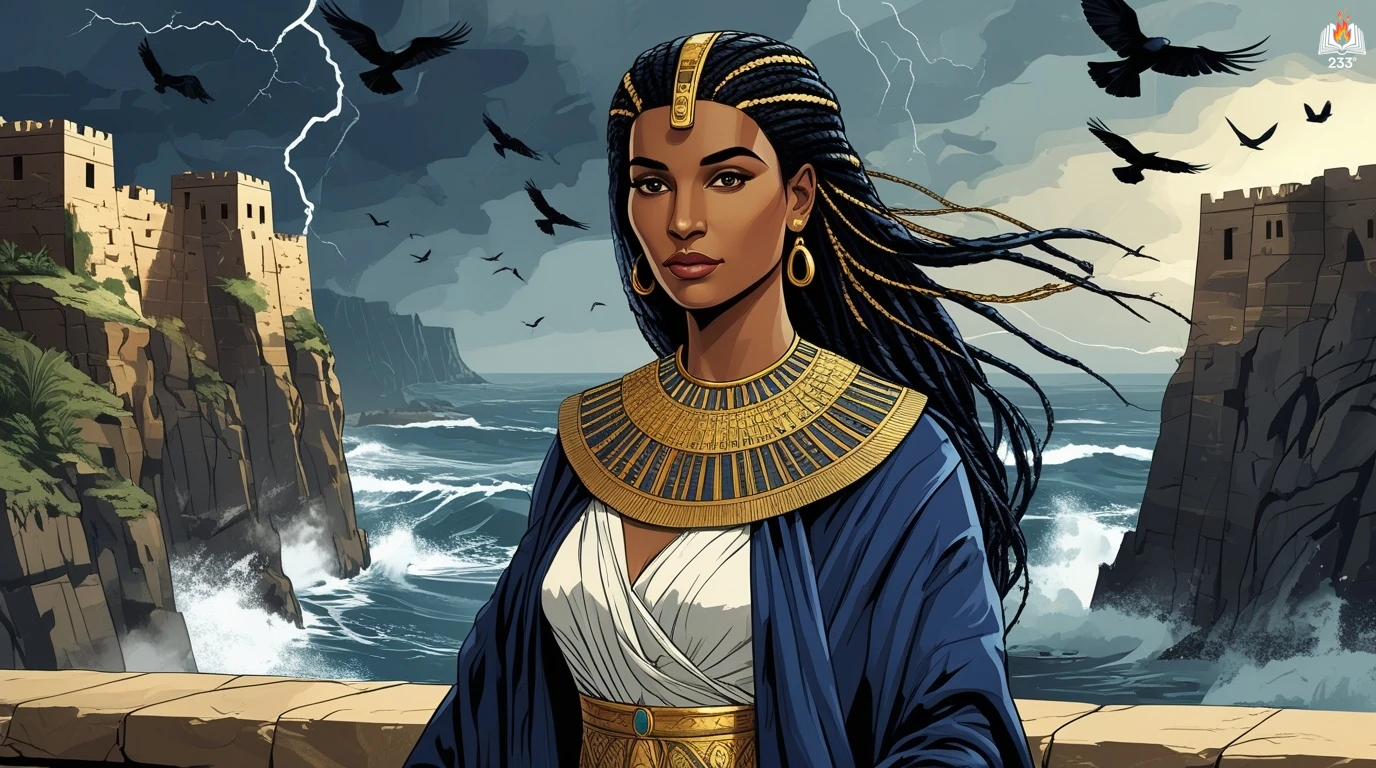
The Mummy, or Ramses the Damned, written by Anne Rice and published in 1989, is a lushly imagined historical fantasy set during the Edwardian era, blending Gothic horror with Egyptian mythology and romance. Though not part of The Vampire Chronicles, this novel stands as one of Rice’s signature explorations of immortality, identity, and the modern world clashing with the ancient. The story revolves around the resurrection of Ramses II, a pharaoh who had ingested an elixir granting eternal life, and his reawakening in the early 20th century, where he struggles to reconcile his immortal memories with a transformed world.
Plot Summary
In the dry hills south of Cairo, under a violet sky veiled in torchlight, archaeologist Lawrence Stratford uncovered a tomb unlike any seen before. The marble door bore warnings etched in hieroglyphs, Latin, and Greek – all cautioning against awakening the one who lay within: Ramses the Damned. Unsettled yet exhilarated, Lawrence disregarded the ancient threats. He descended into the chamber, and there, among alabaster jars and scrolls, beneath dust and golden rays, lay a mummy case surrounded by Graeco-Roman relics. A painted bust of Cleopatra stared with half-lidded eyes, and within the case rested a figure shrouded in linen – Ramses, immortal guardian of Egypt’s dead.
Lawrence, drunk on wonder, failed to see danger in the eerie perfection of the scene. He spent the night transcribing scrolls, believing he had discovered an immortal pharaoh who had walked with Pericles, stood in Carthage, and loved Cleopatra. But his discovery would never be shared. His nephew, Henry Stratford – a debauched gambler and heir to the Stratford fortune – had come not for history, but for money. Poison slipped into Lawrence’s coffee silenced the old man, and Ramses, bathed in sunlight, began to stir.
Death passed quickly through Lawrence, but something else awakened. As Henry forged documents and claimed control of the estate, the mummy opened its eyes, body filling out with life. Ramses, once king of kings, lived again. The elixir of life had preserved his soul and body for two millennia. With burning blue eyes and the mind of an ancient god, he emerged into a world of automobiles, telegrams, and ballrooms. And in that world, he met Julie Stratford – Lawrence’s daughter, intelligent and determined, who questioned marriage and chased knowledge as fiercely as her father had chased tombs.
Julie saw in Ramses not only mystery, but vitality. He spoke every language, devoured books, marveled at trains and breakfast pastries. Yet he remained haunted by Cleopatra, whose death had driven him to entomb himself in darkness. Now, surrounded by gas lamps and gramophones, he longed for her again. But his presence drew danger. Henry, ever watchful, feared exposure. As Ramses uncovered the truth of Lawrence’s murder, vengeance brewed behind his immortal eyes.
In London, as Julie introduced Ramses to society under the guise of cousin Reginald, whispers stirred. The Earl of Rutherford, Elliott Savarell, Julie’s godfather and former lover of Lawrence, sensed something strange. A quiet man with sharp eyes and a weary heart, Elliott watched Ramses closely, drawn to his mystery and unnerved by his unnatural strength and ancient bearing.
Henry’s ambition festered. When Cleopatra’s golden bust and coins appeared in Julie’s home – relics too pristine to be ignored – suspicion erupted. Museum men and the British press came sniffing. Ramses, desperate to protect Julie, fled with her to Cairo. There, beneath the moonlit sky and among date palms, his past reached for him with skeletal fingers.
In the Cairo museum, Ramses found her – the body of Cleopatra herself, preserved by mud and time, her face untouched by decay. Grief and longing became obsession. He poured the last drops of the elixir upon her corpse, whispering prayers older than Christianity. A tremor shook the hall. The empress of Egypt stirred. Bones cracked, breath wheezed, flesh regenerated. She rose in agony, transformed but incomplete.
Cleopatra, wild-eyed and half-living, screamed into the dawn. Her skin patched with decay, her limbs trembling, she wandered like a ghost through the museum halls. Ramses tried to soothe her, but the memories were broken shards in her mind – of Antony, of snakes, of betrayal. She did not know the man who called to her, and when guards entered, rifles drawn, she vanished into the city like a shadow.
Panic surged. Ramses was arrested. News of the desecrated tomb spread. Julie and Elliott, desperate to protect him, tried to maneuver through diplomatic webs and museum claims. Meanwhile, Cleopatra wandered through Cairo, half-beast, half-queen, her power unchecked. She left behind death and confusion, a trail of ruined men in brothels and gardens. Her soul clashed with the world’s pace, with noise, with language she no longer understood.
When Ramses escaped captivity, he hunted her – not to possess, but to free her from madness. She saw only torment in his face. The immortality he gifted her had robbed her of peace, of finality. Her wrath turned to vengeance, and her path crossed again with Henry Stratford. She lured him with promises of pleasure, only to burn his flesh and force the truth of Lawrence’s murder from his lips. Henry, broken and scarred, fled into darkness.
Back in Cairo, Elliott – weakened by age and burdened by secrets – followed Ramses once more. In silence, he witnessed the confrontation in the museum as Cleopatra, newly clothed in stolen silk, faced the man who had raised her from death. Words passed between them like fire. She accused, mourned, and laughed in fury. He offered understanding. And at last, she fled again, weeping, vanishing into the maze of the city.
Julie, now fully entangled in the mystery of Ramses and his past, stood at a crossroads. Love for Ramses blossomed slowly, painfully, even as she doubted his nature. He was no longer a relic or curiosity. He was a man – ancient, sorrowful, and full of impossible tenderness. But danger loomed, and Egypt was no longer safe. Henry, still clinging to delusion and drink, turned violent. He held Julie hostage, desperate to reclaim what he believed was his. But Cleopatra found them. She set the house ablaze and left Henry to die in the flames.
Julie survived. Ramses, with Elliott’s aid, whisked her away. But Egypt could no longer hold them. The British authorities closed in, the museum’s fury peaked, and whispers of the supernatural became loud enough to demand action. Ramses and Julie boarded a ship, leaving behind tombs and betrayal, seeking refuge in the unknown. Cleopatra, wounded but undying, lingered in Cairo, her heart scorched by memories and her eyes ever watchful for the man who loved her – and cursed her – with immortality.
Elliott Savarell, frail and coughing blood, remained behind. In his final days, he marveled at what he had seen – gods walking among men, love resurrected and twisted by time. He watched the sunrise from a balcony in Cairo and knew that some hearts are too ancient to die.
Main Characters
- Ramses the Damned (formerly Ramses the Great): Once the Pharaoh of Egypt, Ramses is awakened in 1914 after centuries of self-imposed slumber. Cursed with immortality, his character is complex – brilliant, weary, passionate, and haunted by past loves and choices. His romantic obsession with Cleopatra and philosophical musings about time and humanity drive much of the novel’s emotional weight. As he enters the modern world, his intellect and curiosity both elevate and isolate him.
- Julie Stratford: The independent and intelligent daughter of archaeologist Lawrence Stratford, Julie inherits her father’s estate after his mysterious death. Strong-willed and forward-thinking, she is a suffragette and a scholar in her own right. Julie becomes central to Ramses’ emotional journey, representing a bridge between his ancient past and the modern world. Her evolving relationship with Ramses is tender, conflicted, and transformative.
- Lawrence Stratford: A distinguished archaeologist and patriarch of the Stratford family, Lawrence is the initial discoverer of Ramses’ tomb. His scholarly passion and integrity are evident, but his life is cut short by poison in a conspiracy involving his own nephew. His death sets the plot in motion and reveals the depths of greed and betrayal within his family.
- Henry Stratford: Lawrence’s nephew, Henry is a deeply flawed and desperate character, driven by gambling debts and a thirst for wealth. His actions are pivotal – he murders his uncle to gain financial control and triggers Ramses’ resurrection. Henry’s arc is one of moral disintegration, and his confrontation with the supernatural leads to his eventual downfall.
- Elliott Savarell, Earl of Rutherford: An aging nobleman with a complex personal history, Elliott is a former lover of Lawrence and father to Alex. Reflective and melancholic, Elliott represents the old world grappling with modern values. His loyalty and quiet strength ground the story, and he plays a critical role in navigating the fallout of Ramses’ reappearance.
- Alex Savarell: Julie’s suitor and Elliott’s son, Alex is earnest, romantic, and idealistic. Despite his noble title, he lacks financial means and is swept into family ambitions for a strategic marriage. His love for Julie is genuine, but her resistance to marriage reflects her desire for autonomy.
- Cleopatra: Though long dead at the story’s outset, Cleopatra’s presence looms large through memories, inscriptions, and ultimately, resurrection. She is depicted as fierce, sensual, and deeply human in her flaws. Her return from the dead late in the novel adds a shocking twist and a potent complication to Ramses’ journey.
Theme
- Immortality and Its Consequences: At the heart of the novel lies the elixir of life and the burden it imposes. Ramses, gifted with eternal life, experiences immortality as both a gift and a curse. Through his eyes, the narrative explores the psychological and emotional cost of never aging, of watching civilizations rise and fall, and of enduring endless grief.
- The Clash of Eras – Ancient vs. Modern: Ramses’ reawakening in Edwardian England sets the stage for a rich contrast between ancient wisdom and modern progress. The novel explores how timeless knowledge is both powerful and alienating in a rapidly changing world. Through Ramses’ observations, Rice critiques modernity’s arrogance and forgetfulness of history.
- Love and Obsession: Ramses’ obsession with Cleopatra and his growing affection for Julie create a tension between past and present. The novel scrutinizes different forms of love – passionate, tragic, and redemptive – and questions whether true love can transcend centuries.
- Colonialism and Exploitation: Set against the backdrop of British imperialism in Egypt, the novel critiques the exploitation of ancient cultures for Western gain. Through characters like Lawrence and Henry, Rice interrogates the ethics of archaeological discovery and cultural appropriation.
- Death and Resurrection: The dual motifs of death and rebirth appear repeatedly, not just physically (with Ramses and Cleopatra) but spiritually. Characters are forced to confront what it means to live again, to love again, and to transform through suffering and enlightenment.
Writing Style and Tone
Anne Rice’s prose in The Mummy is opulent, atmospheric, and richly descriptive, in keeping with her hallmark style. The novel exudes an immersive quality – readers are enveloped in the colors, scents, and textures of both ancient tombs and stately ballrooms. Her use of evocative language enhances the mystique of Egypt and lends a Gothic sensibility to even the most modern scenes.
Narratively, Rice employs a third-person omniscient voice that shifts fluidly between characters, allowing deep interiority and emotional nuance. The tone varies from contemplative and mournful in Ramses’ reflections to ironic and biting in scenes involving social satire or familial betrayal. There is a lush romanticism at play, mingled with dark philosophical undertones that explore power, memory, and fate. The novel carries the weight of a myth retold in decadent detail, filled with drama and existential longing.
Quotes
The Mummy – Anne Rice (1989) Quotes
“when we are weary, we speak lovingly of dreams as if they embodied our true deisres-What we WOULD have when that which we DO have so sorely disappoints us”
“I picture heaven as a vast library, with unlimited volumes to read. And paintings and statues to examine galore. I picture it as a great doorway to learning...rather than one great dull answer to all our questions”
“You haven’t found all the answers yet. Electricity, telephones, these are lovely magic. But the poor go unfed. Men kill for what they cannot gain by their own labour. How to share the magic, the riches, the secrets, that is still the problem.”
“Be Warned: I sleep as the earth sleeps beneath the night sky or the winter’s snow; and once awakened, I am servant to no man.”
“Grief, she thought. It’s a strange and a misunderstood emotion.”
“I picture heaven as a vast library, with unlimited volumes to read. And paintings and statues to examine”
“This was that lucid and dangerous state with drinking, when everything began to shimmer; when there was meaning in the grain of the marble; when one could make the most offensive speeches.”
“She felt herself turning inward, away from all of it, back into the darkness, into the dark water whence she’d come.”
“When we are weary, we speak lovingly of dreams as if they embodied our true desires—what we would have when that which we do have so sorely disappoints us”
“I picture heaven as a vast library, with unlimited volumes to read. And paintings and statues to examine galore. I picture it as a great doorway to learning. Do you think the hereafter could be like that?”
“Ah, yes, beautiful English bones.”
“If one cannot be immortal, one should at least be young,”
“Cowards can be more dangerous than brave men, Julie,” he said.”
“I found her irresistible, as I found you irresistible. It was the mystery. I wanted to seize it. Move into it. Besides...” “Yes.” “She was...a living thing. A being in pain.”
“The man just stood there, looking at him; and Elliott had the weirdest sense of being listened to, studied. It made him aware of how inattentive most human beings were in general.”
“It was so simple to smile at him; he deserved one’s tenderest smile.”
“His throat felt like marble. She could not snap the bones! But he could not throw her off, either, no matter how hard he tried.”
“Lying is actually an underated social skill. Some clever person should write a polite guide to lying. And all the charitable principles which justifiy lying so well.”
“Ah, the nipples of men, so tender; such a key to torment and ecstacy; how he writhed as she twisted then ever so gently, her tongue daring in and out of his mouth.”
“You’ve learned to express yourselves too well for anything to remain veiled or mysterious.”
We hope this summary has sparked your interest and would appreciate you following Celsius 233 on social media:
There’s a treasure trove of other fascinating book summaries waiting for you. Check out our collection of stories that inspire, thrill, and provoke thought, just like this one by checking out the Book Shelf or the Library
Remember, while our summaries capture the essence, they can never replace the full experience of reading the book. If this summary intrigued you, consider diving into the complete story – buy the book and immerse yourself in the author’s original work.
If you want to request a book summary, click here.
When Saurabh is not working/watching football/reading books/traveling, you can reach him via Twitter/X, LinkedIn, or Threads
Restart reading!