

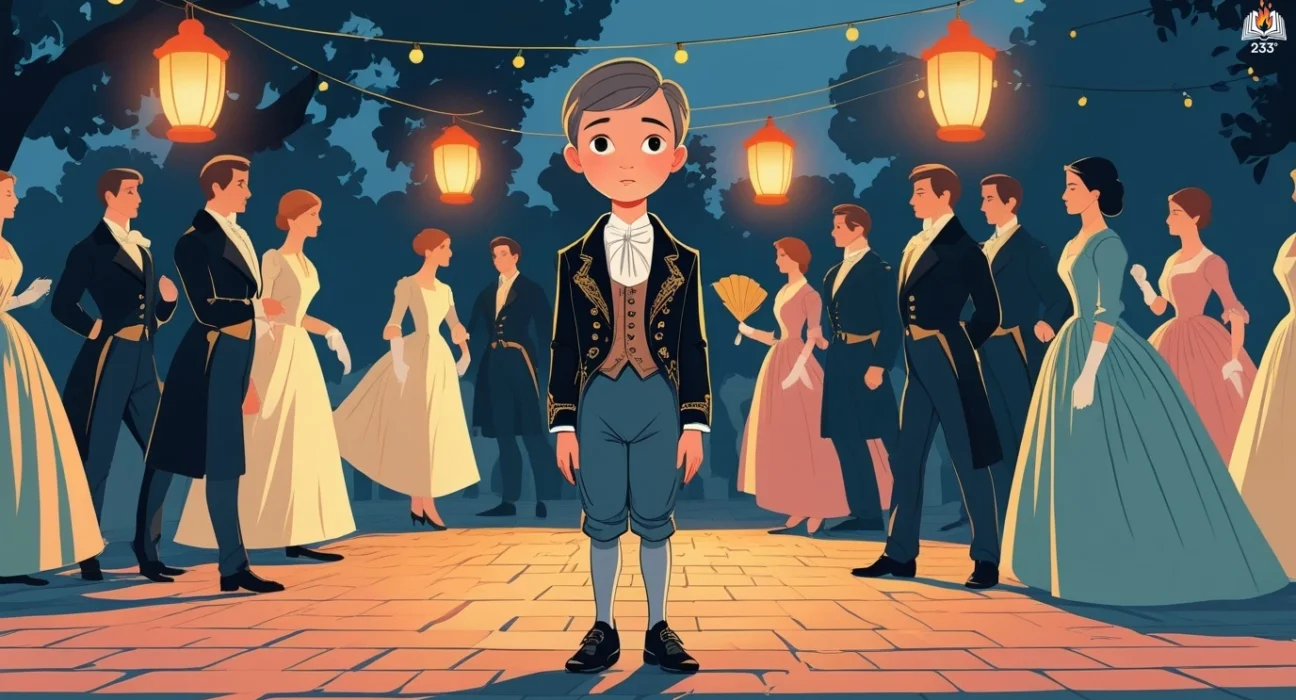
A Little Hero by Fyodor Dostoevsky, first published in 1849, offers a rare glimpse into the Russian literary master’s early foray into psychological introspection, prior to the monumental works that would define his legacy. Though lesser-known than Crime and Punishment or The Brothers Karamazov, this short tale carries Dostoevsky’s signature empathy, irony, and exploration of internal consciousness, presented through the eyes of an eleven-year-old boy. The story unfolds over a single, emotionally charged summer holiday in a vibrant Russian country estate, blending innocent awe, unspoken love, and profound moral awakening.
Plot Summary
In the heart of a vibrant Russian summer, the countryside estate of a wealthy host near Moscow brims with festivity. Dozens of guests gather for endless amusements – music, theatricals, dancing, laughter, and whispers that trail behind silk gowns and embroidered coats. Among them wanders a boy of eleven, a visitor too young to be noticed yet old enough to feel everything. He drifts through the chaos, astonished and overwhelmed, his senses bombarded by lights, scents, and voices that flicker like fireflies. But the revelry leaves him strangely lonely, and his wide, wondering eyes search for something deeper beneath the surface of this endless holiday.
She appears like a calm melody amid noise – Madame M., a tall, pale woman whose presence quiets the air. Graceful and reserved, she carries an aura of sadness in her dark eyes, as if memories weigh heavily behind her serene smile. The boy is drawn to her without understanding why. She speaks little, but her silence speaks more than any laughter. Around her, even the chatter fades, and the boy, without knowing her, feels that he belongs near her, though he dares not approach.
In contrast, another figure burns brightly – a fair-haired beauty with eyes like sparks and a spirit like wind. Married and wild, she teases the boy mercilessly. She laughs at his confusion, pinches his fingers for amusement, and basks in the attention it brings her. She calls him a doll, a page, a little lover, in jest and in cruelty. Her games draw attention and giggles, but behind the mirth, the boy squirms, humiliated and flushed with shame. He becomes her favorite toy, her private performance, and all his attempts to retreat only feed her delight.
The days roll on, scented with roses and wine, as preparations for a great birthday celebration begin. A tableau is planned – a medieval scene of a lady and her page. The boy is cast as the page, and Madame M. as the noblewoman. At the rehearsal, she is distant and distracted. Her face, usually calm, is clouded. Her eyes search shadows. The boy watches her closely, longing to comfort her, yet frightened by her sorrow, which seems too vast for him to name.
One morning, Madame M. walks toward the copse alone. Her husband, a man of red cheeks and fashionable phrases, questions her gently, his smile polite and eyes sharp. She answers quickly, nervously, saying she is not alone – the boy is her companion. Surprised by her sudden mention of him, he joins her, though she barely acknowledges his presence. Her steps are hurried, her glance over her shoulder frequent. Then, from the thundering path behind, a cavalcade appears – riders escorting a young man, N., who had left the estate only a day earlier. He rides past without a word, and Madame M., seeing him, turns pale. Tears roll down her cheeks, though she quickly hides them.
Later that day, the fair lady reigns in the drawing room, her laughter louder than ever, her wit sharper. Her jests target Madame M.’s husband, who responds with equal flair, though signs of strain betray his good humor. In a cruel twist, she turns her gaze upon the boy, mocking his admiration for Madame M., declaring before all that he is in love with her. The boy, burning with confusion and pain, bursts out, tears in his voice, shaming her for making a spectacle of his feelings. The room erupts in laughter, but something unexpected happens. The fair lady, touched by the boy’s sincerity, embraces him, tears glimmering in her mischievous eyes. Her jest transforms into affection, and she declares herself his friend.
The boy, once invisible, becomes a hero in their eyes. Later, when an outing is planned and all seats are filled, he is left behind. His disappointment is deep until the fair lady challenges him, daring him to mount the vicious stallion, Tancred, whom no adult dares approach. With courage that surprises even himself, he leaps onto the horse, and it bolts. For moments that stretch like eternity, he clings to the beast as it thunders across the yard. Hearts stop, voices cry out, and then, just as suddenly, the boy is saved by gentlemen who seize the reins.
All eyes turn to him – not in mockery now, but in awe. Even Madame M., pale and trembling, looks at him, and something wordless passes between them. The fair lady, genuinely moved, declares that this is no joke – the boy is truly brave. Her teasing vanishes, replaced by warmth and protectiveness. That evening, when a chill sets in, she tucks him into bed, brings him tea, and strokes his brow. The boy, dazed with emotion, clings to her and almost weeps. Their enmity, melted by the day’s flame, becomes quiet friendship.
The next morning dawns golden. The boy, healed and hopeful, walks into the copse. Among the rustling leaves and shimmering light, he finds himself near the road. There stands Madame M., speaking in hushed tones to N., who has returned once more. He leans from the saddle, kisses her hand, presses an envelope into her palm, and then vanishes. She turns back, grief etched into her face.
Hidden behind branches, the boy watches her retreat. A glint on the path draws his eye – the envelope, fallen unnoticed. He picks it up, uncertain. It is unaddressed, sealed, fat with unwritten truths. Torn between fear and duty, he follows her, hoping she will turn back. She does not. At the house, she walks the verandah, searching the path with desperate eyes, her face tight with dread. He cannot return the letter – to do so would reveal everything. So he stands, helpless, the secret heavy in his pocket, the mystery pressing against the tender threshold of his youth.
And so ends a summer of aching growth, where a boy glimpsed love and sorrow, danced with shame and valor, and found in his heart both wounds and wonder that time would never quite erase.
Main Characters
The Narrator (The Little Hero): An unnamed eleven-year-old boy, quiet, sensitive, and inwardly tumultuous. The story is told entirely from his perspective, offering deep insight into his complex emotions as he navigates both admiration and humiliation in a world of adult intrigues. His journey is not only physical but emotional, as he experiences shame, awe, unrequited love, and the first blush of maturity.
Mme. M.: A tall, gentle, melancholic woman with an air of quiet suffering and grace. Her character exudes compassion and spiritual beauty. She becomes the silent object of the narrator’s affection and longing. Through her, the boy experiences admiration that borders on reverence, and she, in turn, shows him kindness that lingers in his memory.
The Fair Lady (The Blonde Beauty): A vibrant, mischievous woman, married yet playful to the point of cruelty. She teases the young narrator mercilessly, oscillating between flirtation and torment. Her unpredictable behavior both embarrasses and thrills him, becoming a symbol of the chaotic adult world he doesn’t yet understand.
Mme. M.’s Husband (M. M.): A pompous, self-satisfied man, painted with satirical exaggeration. He exemplifies the vacuous “modern man” – self-congratulatory, shallow, and domineering. His presence looms as a threat to the delicate spirit of Mme. M., adding a subtle note of tragedy to the story.
N. (Mme. M.’s Friend/Paramour?): A mysterious, passionate young man, possibly in a secret romantic relationship with Mme. M. His sudden departure and secret meeting with her fuel the narrator’s curiosity and emotional turmoil, becoming a catalyst in his personal growth.
Theme
Childhood Innocence vs. Adult Complexity: The crux of the narrative lies in the juxtaposition between the boy’s unfiltered emotional purity and the morally ambiguous, often performative adult world. This gap forms the wellspring of his confusion, fascination, and disillusionment.
Awakening to Love and Desire: The narrator’s feelings for Mme. M. represent a formative awakening – not merely romantic but deeply emotional and idealistic. He perceives her as a Madonna-like figure, embodying an unattainable grace and virtue.
Shame and Self-Consciousness: One of the strongest psychological undercurrents in the story is the narrator’s acute sensitivity to embarrassment and shame. Whether tormented by the fair lady or overwhelmed by his feelings for Mme. M., his internal life is defined by a growing self-awareness that verges on existential.
Heroism and Identity: The boy’s longing to prove himself culminates in the daring episode with the wild horse Tancred. This act, filled with both danger and pride, becomes his defining moment of transformation – a metaphorical rite of passage from childlike passivity to agency.
Empathy and Emotional Maturity: Through observing others’ suffering – especially Mme. M.’s silent anguish – the narrator begins to feel deep empathy. This is Dostoevsky’s subtle moral thread: real heroism lies not in spectacle but in the capacity to feel and to care.
Writing Style and Tone
Dostoevsky’s prose in A Little Hero is delicately tinted with romanticism, irony, and psychological sensitivity. The narrative unfolds as a stream of consciousness, marked by long, winding sentences that mirror the boy’s frantic inner monologue. This stylistic choice gives readers intimate access to his shifting moods – from awe to humiliation, confusion to elation. The language is richly descriptive, often lyrical, especially in depictions of the natural world and the subtle gestures of Mme. M., painting emotion as vividly as scenery.
The tone oscillates between tender introspection and biting social satire. Dostoevsky gently mocks the adult world – its theatricality, vanity, and shallowness – through the innocent yet piercing eyes of a child. At the same time, there is a deep pathos underlying the tale. The emotional weight never turns heavy-handed; instead, it ripples subtly beneath the surface, much like the unspoken feelings the boy grapples with.
Quotes
A Little Hero – Fyodor Dostoevsky (1849) Quotes
“for a heart which loves much grieves much”
We hope this summary has sparked your interest and would appreciate you following Celsius 233 on social media:
There’s a treasure trove of other fascinating book summaries waiting for you. Check out our collection of stories that inspire, thrill, and provoke thought, just like this one by checking out the Book Shelf or the Library
Remember, while our summaries capture the essence, they can never replace the full experience of reading the book. If this summary intrigued you, consider diving into the complete story – buy the book and immerse yourself in the author’s original work.
If you want to request a book summary, click here.
When Saurabh is not working/watching football/reading books/traveling, you can reach him via Twitter/X, LinkedIn, or Threads
Restart reading!


