

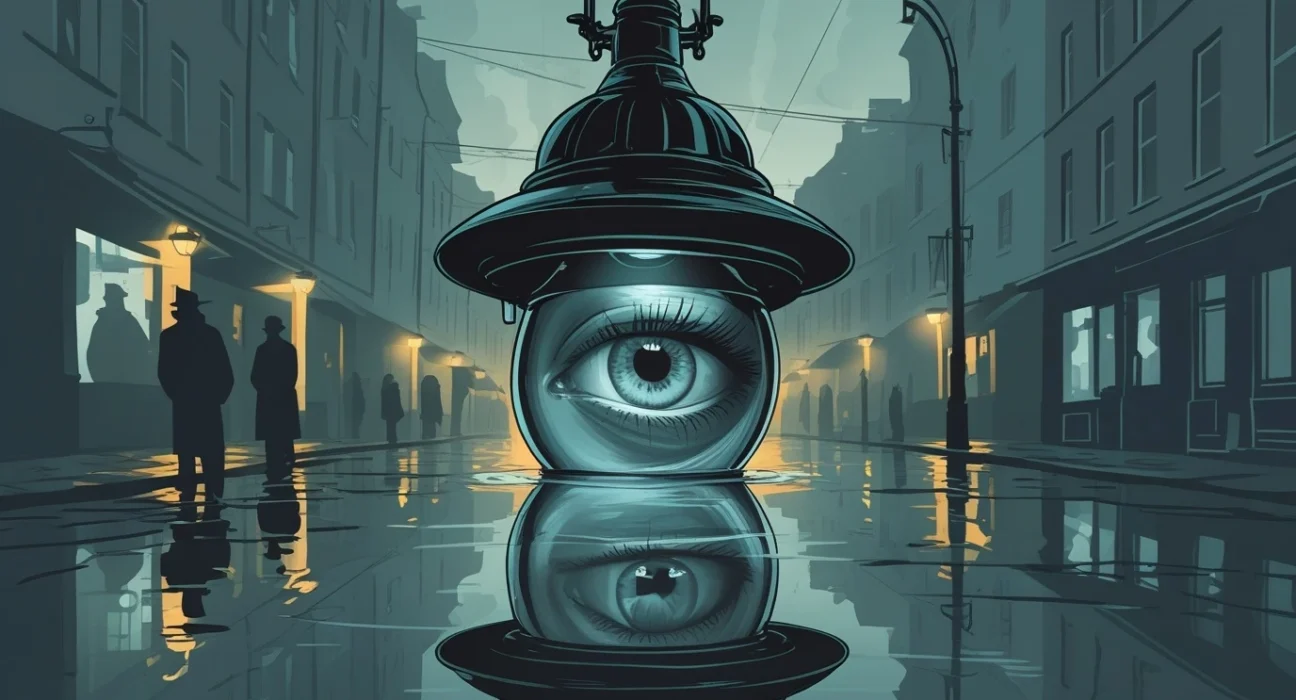
The Eye by Vladimir Nabokov, originally published in Russian in 1930, is a slender yet richly layered psychological novel that foreshadows many of the themes and narrative innovations found in Nabokov’s later works. Set among the émigré Russian community in Berlin during the 1920s, the novel tracks the surreal journey of a man who, after a humiliating public beating and a failed suicide attempt, becomes a spectral observer of his own life. Translated into English by Dmitri Nabokov in collaboration with the author, The Eye transforms existential despair into a dazzling metafictional exploration of identity, perception, and reality.
Plot Summary
In the twilight of Berlin’s émigré underworld, where dislocated Russians clung to the tatters of their former lives like threadbare coats, a man named Smurov drifted in quiet, sullen orbit. He was a tutor by necessity, a wanderer by temperament, and a ghost long before he ever pulled the trigger. Amongst aging colonels, disillusioned doctors, and hysterical mystics, he carved his place on the periphery, walking with the weightless grace of the unseen.
His affair with Matilda, a florid, perfumed woman with a volcanic voice and an obsession with her husband’s rage, marked the beginning of his unraveling. She drew him in with her fleshy warmth and theatrical pouts, but her constant monologues about Kashmarin – that brutish husband with a cane like a scepter and a temper that preceded him like lightning – began to tire the already wavering tutor. When Kashmarin arrived and dealt Smurov a brutal, cane-wielding beating in front of his young pupils, something in him fractured. He fled through Berlin’s cold streets, trailing humiliation like a second coat.
In a borrowed room, with a revolver meant for the Bolsheviks or perhaps ghosts, Smurov carefully located his heart and fired. The recoil of the shot resounded like the tolling of a bell, and everything shifted. He awoke not in another world, but in the same one, filtered through a trembling glass of posthumous imagination. He believed himself dead, yet his thoughts moved with shocking clarity. The city was still there – its streets, its booksellers, its ghostlike émigrés – but now he was merely a spectator, unbound from the burden of self. A phantom with the privilege of observing himself.
And so Smurov began again. He returned to the world under the illusion of death, yet more alive in his curiosity than ever before. He wandered back to familiar places – the bookshop of the paranoid Weinstock, who conjured spirits and conspiracies with equal devotion, and the drawing rooms of 5 Peacock Street, where Russians clung to their borrowed nobility like children clutching old toys.
There he met Vanya. Her sister Evgenia, practical and stately, ran the household with quiet authority, but it was Vanya, dark-eyed and myopic, who shimmered before him like something remembered from a dream. Around her clustered a cast of recurring figures: the worldly Mukhin with his pince-nez and precision, the gruff and gallant Roman Bogdanovich, the steely Marianna Nikolaevna, a doctor with revolutionary ideals and a disdain for martial glory. And Smurov, newly spectral, inserted himself into their circle with ease, smiling with faint sadness, speaking little, and allowing the others to project onto him the aura of a wounded soul.
He built his reputation delicately, like a spider stitching an invisible web. He shared fragments of a daring past – tales of Yalta, of partisan warfare, of bullets that grazed but did not kill. In his recounting, he became a man of action, a tragic figure whose courage had been misunderstood. And they listened, captivated by his quiet melancholy and the crisp elegance of his presence. Vanya’s gaze, half-hidden behind lashes and silence, seemed to rest longer on him each evening.
But reality, slippery and cruel, always returns. It came in the form of a simple remark from Mukhin, the most rational of the lot, who pointed out, with an air of casual correctness, that Yalta had no railway station. The soap bubble of Smurov’s narrative burst without ceremony. Mukhin’s voice was not angry or accusatory – merely precise – but it was enough. The quiet charm faded. The black suit, once evocative of mystery, now seemed merely worn. The talcum powder no longer hid the blemish.
The spell was broken, but not completely. A second Smurov began to surface elsewhere. At one of Weinstock’s spiritualist gatherings, amid flickering candles and alphabet boards, the name of a traitor surfaced from beyond. A spy, a betrayer of men, a man in black. The message, spelled out by ghostly fingers and trembling porcelain, pointed unmistakably to him. Whether it was a trick, or a manifestation of Weinstock’s suspicions, or merely another mask of the ever-shifting Smurov, no one could say. But the room grew colder, and eyes began to turn more sharply in his direction.
Then came the most subtle transformation. Smurov, the man who thought himself dead, began to study the version of himself that others saw. He found comfort in detachment. Watching his own gestures, rehearsing his own voice, he tried to learn who he might have been through the reflections in others. He became obsessed not with living but with being perceived – not with truth, but with the consistency of illusion.
He filled the hours at the bookshop, attending to customers with hands too elegant for commerce. He offered book recommendations not for content but for effect. He inserted himself delicately into conversations, not to participate but to see how his presence shifted the balance. Even his jokes became strategic, like a magician slipping a card into a sleeve.
But beneath the carefully arranged surface, cracks widened. The rumors grew – some thought him a scoundrel, others a hero, still others a cipher with no core at all. His presence became a litmus test for others’ projections. To Vanya, perhaps, he was still the gallant figure from the tale of bullets and betrayal. Or perhaps she too had begun to see through the velvet fog.
In a city where exile distorted time and memory like ripples in a pond, Smurov became less a person and more a question – a dark pupil reflecting every gaze. He was no longer the man who had tried to end his life in a borrowed room. He was not the victim of Kashmarin’s cane or the ghost gliding through Berlin. He was not the soldier of Yalta, nor the spy of séances, nor the tragic hero of whispered admiration. He was the eye that watched, the presence that lingered, the figure shaped by others’ perceptions and his own wish to vanish within them.
And so, amid the shadows of café windows and the smudged halos of gas lamps, he continued to walk Berlin’s trembling sidewalks – no longer seeking truth or redemption, only the dim outline of who he might appear to be in the fading reflections of other people’s eyes.
Main Characters
Smurov: The narrator and central figure, Smurov begins the novel as a disillusioned tutor in Berlin. After a dramatic beating by a jealous husband and a subsequent suicide attempt, he continues to exist—or imagines himself to—as an invisible, disembodied observer. His arc is one of self-erasure and confused identity, as he becomes obsessed with how others perceive him. His journey is marked by self-loathing, introspection, and ultimately a descent into psychological fragmentation.
Matilda: A sensuous, self-indulgent woman with whom Smurov has an affair. She is married, flirtatious, and curiously obsessed with her husband’s violent jealousy. Her relationship with Smurov is both passionate and shallow, serving as the catalyst for his downfall. Matilda’s contradictions—warmth and cruelty, candor and manipulation—exemplify Nabokov’s gift for creating psychologically complex women.
Kashmarin: Matilda’s brutish husband, a man of force and menace who physically assaults Smurov in a scene that sets the psychological spiral of the novel into motion. His very presence becomes emblematic of shame and humiliation in Smurov’s mind.
Weinstock: The eccentric owner of a Russian bookshop and Smurov’s employer after his suicide attempt. He embodies paranoia, conspiracy, and mysticism, surrounding himself with spiritual séances and black-market whispers. He sees agents and plots everywhere, possibly projecting his own fears, but also mirroring Smurov’s growing unreality.
Vanya and Evgenia: Sisters from the Russian émigré circle. Vanya becomes an object of romantic fascination for Smurov, representing idealized love and emotional refuge. Evgenia, more grounded and matronly, hosts many of the social gatherings that allow Smurov’s alter ego to emerge and interact with others.
Marianna Nikolaevna: A politically engaged and morally assertive doctor, Marianna offers an intellectual and ethical counterweight to Smurov’s evasive, ghostlike nature. Her directness and compassion clash with Smurov’s elusive character.
Mukhin: A skeptical and observant émigré who ultimately unmasks Smurov’s fabricated heroism, catalyzing the protagonist’s final emotional collapse. His quiet rationality disrupts Smurov’s constructed identity.
Theme
Identity and Self-Perception: The central theme of The Eye revolves around the fragility and illusion of identity. Smurov’s attempt to view himself through the eyes of others turns the narrative into a kaleidoscope of shifting reflections, raising profound questions about selfhood and subjectivity.
Death and Afterlife as Metaphor: Smurov’s failed suicide leads him to believe he is dead, and much of the novel unfolds as if narrated by a ghost. This conceit allows Nabokov to explore posthumous consciousness as a metaphor for detachment, guilt, and self-exile.
Isolation and Exile: Set in the interwar period among displaced Russian émigrés in Berlin, the novel taps into a deep sense of cultural and personal dislocation. The characters hover between worlds—old Russia and new Europe, past and future, reality and imagination.
Deception and Performance: Characters, especially Smurov, adopt false personas or present facades to the world. The novel examines the tension between appearance and reality, culminating in the exposure of lies that others have seen through all along.
Voyeurism and Surveillance: The act of watching—implied by the novel’s title—is omnipresent. Smurov not only watches others obsessively but imagines being watched himself, blurring the line between observer and observed.
Writing Style and Tone
Nabokov’s prose in The Eye is lyrical, ironic, and tightly controlled. The narrative voice—witty, intelligent, and emotionally volatile—is suffused with a self-aware elegance that belies the rawness of the subject matter. His sentences flicker between high aestheticism and cold introspection, embodying the novel’s psychological tension. Nabokov plays deftly with ambiguity, crafting scenes that invite multiple interpretations and destabilize the reader’s sense of truth.
In tone, The Eye is at once tragic and slyly comic, imbued with the melancholy of exile and the sharp sting of satire. There is a chilling detachment in the narrator’s self-observation, a sense that he is always one step removed from his own pain. The novel’s post-suicide perspective enables Nabokov to blend existential horror with metafictional playfulness, yielding a mood that oscillates between surreal whimsy and philosophical despair. The reader is left to navigate the fragmented terrain of Smurov’s psyche, with no clear signposts, only Nabokov’s shimmering, elusive prose to guide the way.
Quotes
The Eye – Vladimir Nabokov (1930) Quotes
“I really knew nothing about her, blinded as I was by that burning loveliness which replaces everything else and justifies everything”
“For I do not exist: there exist but thousands of mirrors that reflect me. With every acquaintance I make, the population of phantoms resembling me increases.”
“For I do not exist: There exist but the thousands of mirrors that reflect me.”
“What further concentration is needed, what added intensity must one's gaze attain, for the brain to enslave the visual image of a person?”
“Oh, to shout it so that all of you believe me at last, you cruel, smug people...”
We hope this summary has sparked your interest and would appreciate you following Celsius 233 on social media:
There’s a treasure trove of other fascinating book summaries waiting for you. Check out our collection of stories that inspire, thrill, and provoke thought, just like this one by checking out the Book Shelf or the Library
Remember, while our summaries capture the essence, they can never replace the full experience of reading the book. If this summary intrigued you, consider diving into the complete story – buy the book and immerse yourself in the author’s original work.
If you want to request a book summary, click here.
When Saurabh is not working/watching football/reading books/traveling, you can reach him via Twitter/X, LinkedIn, or Threads
Restart reading!


