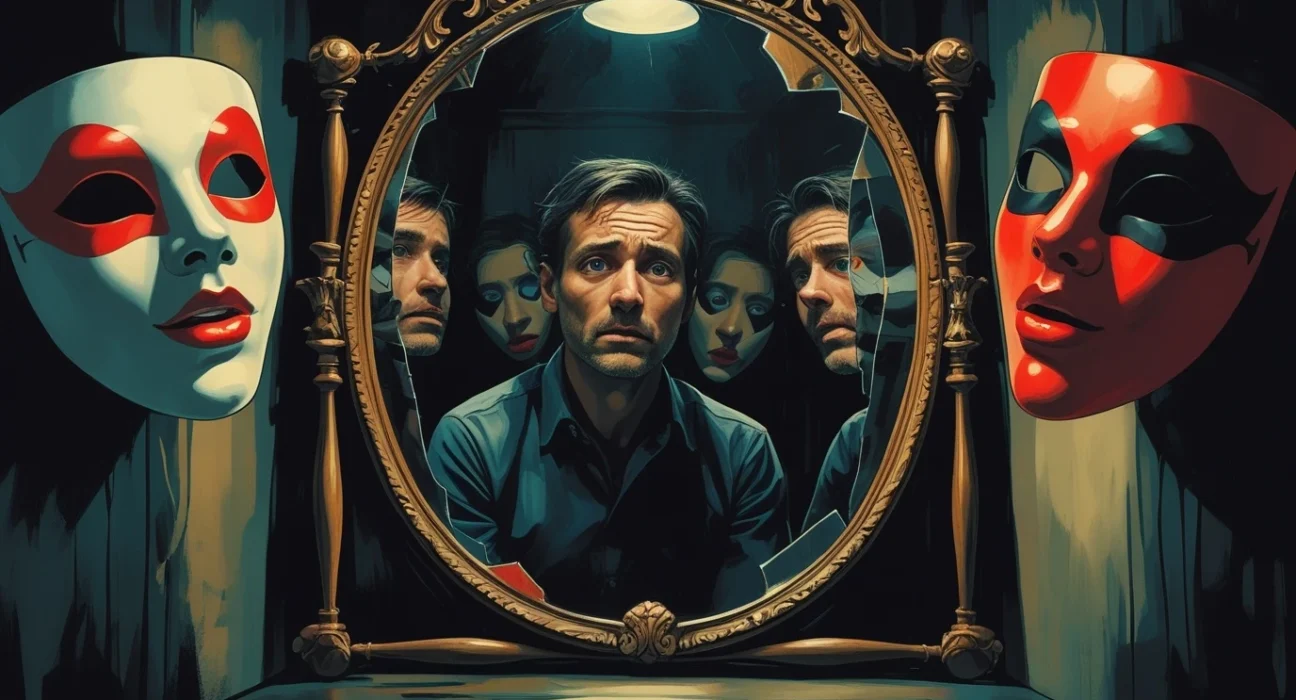
Look at the Harlequins! by Vladimir Nabokov, published in 1974, is a richly layered novel that blends metafiction with psychological introspection, inviting readers into the kaleidoscopic mind of a narrator who closely mirrors Nabokov himself. This labyrinthine narrative unfolds as a mock autobiography of Vadim Vadimovich N., a Russian émigré writer whose life and career reflect a distorted yet deliberate parody of Nabokov’s own. The novel, published late in Nabokov’s career, is filled with literary games, unreliable narration, and autobiographical inversions, making it both a psychological study and a satirical meditation on identity, memory, and art.
Plot Summary
Vadim Vadimovich entered the world as a child not so much born as displaced – a soul torn from the fabric of time and stitched back with trembling hands. His childhood unfolded beneath the vast skies of old Russia, clouded not by thunder but by something far stranger: an eerie dislocation from reality. Dreams bled into waking life, strange patterns haunted his vision, and his thoughts spiraled into other dimensions where mathematics and madness met in shadowed corridors. A baroness with a limp and a cane, distant yet vivid, once told him to look at the harlequins – that trees and sums and words were harlequins if one only chose to see them. So he did. And the world never appeared the same again.
Time moved in leaps and blurs, and after the Bolshevik storm ripped his country apart, Vadim wandered across Europe like a soul in search of a body. Cambridge gave him a brief semblance of structure. There, through a tangled web of miscommunications and an eccentric fellow student named Ivor Black, Vadim found himself at a summer villa on the Côte d’Azur. The place, suffused with the kind of languid decadence that only southern sunlight can cultivate, housed a hidden presence that drew Vadim into a fateful current. Iris.
Iris Black – sun-kissed, mute, enigmatic – appeared not as a girl but a silent song. Vadim, adrift in his own fractured perception, saw in her the one human form that matched the contours of his dreams. She signed with her hands in a private language crafted with her brother. Her gestures painted stories in the air, and Vadim, himself a conjurer of realities, read into those signs all the longing of an exile for belonging.
They danced on beaches without touching, their closeness wrapped in ritual. Vadim recited Pushkin, Lermontov, and obscure strophes spun in his native tongue. Iris listened like Desdemona might have – absorbing poetry as if it were prophecy. Yet he held back. Madness loomed behind his every phrase, an invisible condition he called his “numerical nimbus,” which made perception untrustworthy and space a trap. When he tried to picture a road and turn his gaze, something in his mind refused to shift. The world remained fixed. That fixity terrified him.
Still, the days at Villa Iris unfurled like scenes from a kaleidoscope. Vadim watched Iris smear sun cream on his back while the light shimmered like broken glass across the sea. They spoke of books and butterflies, family and dreams, as if constructing a shared myth with each conversation. Kanner, a famous pianist and butterfly hunter, emerged as a symbol of cruel beauty – a man who crushed wings for the sake of rarity, then brought those same hands to the keys in sublime concerts. Iris, tormented by the sight of a mutilated insect, sobbed softly – yet marveled at Kanner’s music days later, the contradiction echoing something within Vadim himself.
One day, while swimming in the sea, Vadim saw another man flirt with Iris from a motorboat. A sudden panic overwhelmed him – not jealousy, but a pulse of something darker. He swam too far, forgotten terrors coiled in his limbs, threatening to consume him as they had once before. But sand returned beneath his feet just as the world threatened to vanish. The sea, like time, had nearly taken him. Instead, it reminded him of fragility.
On the wharf, as Iris dried herself in the sun, Vadim confessed – not his love, but the illness he feared would render him unfit for love. She laughed softly, called him a genius, and turned her back to him, bare and golden under the sky. He watched her spine curve like the line of a forgotten poem. Then came the marriage proposal, murmured more with eyes than lips, wrapped in the glow of a summer afternoon. Iris, in her own shy pantomime, accepted. It was a moment not of triumph but of quiet inevitability.
Marriage followed, then children. Yet joy moved with a limp. Vadim loved deeply but not wisely. He betrayed Iris with spectral women, literary muses who shimmered through the margins of his pages. Each affair – sometimes real, sometimes imagined – fractured the unity he had briefly known. He began to drift again, across countries and languages, chased by the ghosts of his own fictions.
His daughter Bel sought freedom and fire, a girl of sharp eyes and sharper departures. She left him, like his other wives would later, with only the echo of their names lingering in the rooms he rented. Iris died young, her silence eternalized, her beauty reduced to memories Vadim could not trust. Yet she never truly left him. She reappeared in other forms – a smile on a stranger, the shadow of a harlequin dancing behind a tree, the softness of a shoulder in a dream.
Vadim moved through marriages like through passports. Annette, Louise, and others followed, women who tried to love a man half-invented and wholly lost. They bore his children, nursed his neuroses, translated his mutterings into patience. But none could anchor him. His writing grew stranger – worlds nested within worlds, identities swapped like overcoats, lives mirrored and distorted until they became illegible to any but himself.
He never stopped writing. His books – real or not, remembered or misremembered – followed a trajectory of obsession. One mirrored Nabokov’s The Gift. Another resembled Lolita. Yet each bent reality until meaning became a house of mirrors. Readers searched for truth in the lines, but Vadim only offered reflections – of himself, of them, of no one.
Old age brought no peace. Time frayed. Vadim saw ghosts. He believed assassins trailed him. One wife, maddened by his delusions, locked him in a hotel room and left. Doctors misdiagnosed, priests shrugged, editors hesitated. Yet he kept composing the world – pages upon pages where memories, inventions, and madness interlaced like ivy on stone.
In the end, as he sat by a window watching the light tremble on a garden path, he saw them again – the harlequins. They danced among the leaves, skipped across puddles, and climbed into the trees. They were not phantoms but possibilities. And in that final flicker of understanding, Vadim recognized the secret he had spent a lifetime translating: reality was never a single line, but a mosaic of illusions, a game of light, a carnival of selves. The harlequins had always been there. One simply had to look.
Main Characters
Vadim Vadimovich N. – The enigmatic and unreliable narrator whose fictional life parallels Nabokov’s in uncanny and often contradictory ways. A novelist haunted by childhood trauma, identity crises, and romantic entanglements, Vadim is alternately sympathetic and deluded. His reality is a labyrinth of memory, invention, and misdirection, making him as much a subject of psychological inquiry as he is a literary architect.
Iris Black – Vadim’s first wife, a deaf-mute beauty whose enigmatic presence and elusive character leave a deep imprint on Vadim. Their relationship blends sensuality, miscommunication, and idealization, symbolizing both lost innocence and unattainable love. Iris’s peculiar poise and quiet intelligence render her one of the novel’s most haunting figures.
Ivor Black – Iris’s brother, a sardonic and flamboyant figure who serves as a foil to Vadim. With his theatricality, homosexual overtones, and social critiques, Ivor embodies a destabilizing force in Vadim’s life, both challenging and provoking the narrator’s self-image.
Baroness Bredow – Vadim’s eccentric great-aunt, a Tolstoy descendant who serves as both caretaker and inspiration. Her refrain, “Look at the harlequins!”, becomes the novel’s thematic and symbolic nucleus, urging Vadim toward a hallucinatory engagement with reality.
Dr. and Madame Junker – A husband-and-wife psychoanalytic team emblematic of early 20th-century bourgeois science, they serve as part of the surreal social fabric that surrounds Vadim, blurring lines between diagnosis, caricature, and existential commentary.
Theme
Unreliable Narration and Fragmented Identity: Vadim’s narrative is riddled with contradictions, false memories, and invented episodes, showcasing the instability of identity. Nabokov uses this device not just to challenge the reader, but to expose the constructedness of autobiography and the illusion of a coherent self.
Exile and Displacement: Vadim’s life mirrors that of the Russian émigré experience — rootless, reflective, and haunted by nostalgia. This theme permeates the novel, from his childhood in pre-revolutionary Russia to his European and American wanderings, underscoring a life defined by absence and yearning.
Madness and Perception: The novel presents mental illness not as an affliction but as an alternate lens through which reality is processed. Vadim’s “numerical nimbus” and cognitive peculiarities are rendered with poetic intensity, drawing readers into the rift between perception and reality.
The Role of the Artist: Through Vadim’s literary career, Nabokov satirizes both the critic and the creator. The novelist becomes a prism for discussing the responsibilities and delusions of the artist — a creator of fictions who mistakes invention for truth and truth for fiction.
Harlequins and Doubles: The harlequin becomes a recurring symbol of illusion, play, and multiplicity — a metaphor for the writer, the actor, and the trickster. Doubling is pervasive, from character traits to narrative arcs, suggesting parallel realities and mirrored selves.
Writing Style and Tone
Nabokov’s prose in Look at the Harlequins! is baroque, richly allusive, and playfully intricate. He infuses the narrative with linguistic acrobatics — puns, neologisms, self-referential jokes, and erudite allusions. The language constantly draws attention to itself, reflecting the novel’s metafictional core. The narrator’s voice is self-aware yet delusional, oscillating between confession and fabrication, memory and invention. Each sentence is carefully constructed to both dazzle and destabilize.
The tone throughout is ironic and layered, often juxtaposing lyrical beauty with grotesque absurdity. Nabokov toys with reader expectations, blending genuine pathos with biting satire. The humor is cerebral and tinged with melancholy, especially when confronting the failures of love, art, or sanity. The narrator’s self-mythologizing is both comic and tragic, resulting in a tone that is elusive — hovering between mockery and mourning, enchantment and estrangement.
Quotes
Look at the Harlequins! – Vladimir Nabokov (1974) Quotes
“We are liable to miss the best of life if we do not know how to tingle, if we do not learn to hoist ourselves just a little higher than we generally are in order to sample the rarest and ripest fruit of art which human thought has to offer.”
“Look at the harlequins! [...] All around you. Trees are harlequins, words are harlequins. So are situations and sums. Put two things together—jokes, images—and you get a triple harlequin. Come on! Play! Invent the world! Invent reality!”
“Every author believes, when his first book is published, that those that acclaim it are his personal friends or impersonal peers, while its revilers can only be envious rogues and nonentities.”
“Yet I have known madness not only in the guise of an evil shadow. I have seen it also as a flash of delight so rich and shattering that the very absence of an immediate object on which it might settle was to me a form of escape.”
We hope this summary has sparked your interest and would appreciate you following Celsius 233 on social media:
There’s a treasure trove of other fascinating book summaries waiting for you. Check out our collection of stories that inspire, thrill, and provoke thought, just like this one by checking out the Book Shelf or the Library
Remember, while our summaries capture the essence, they can never replace the full experience of reading the book. If this summary intrigued you, consider diving into the complete story – buy the book and immerse yourself in the author’s original work.
If you want to request a book summary, click here.
When Saurabh is not working/watching football/reading books/traveling, you can reach him via Twitter/X, LinkedIn, or Threads
Restart reading!