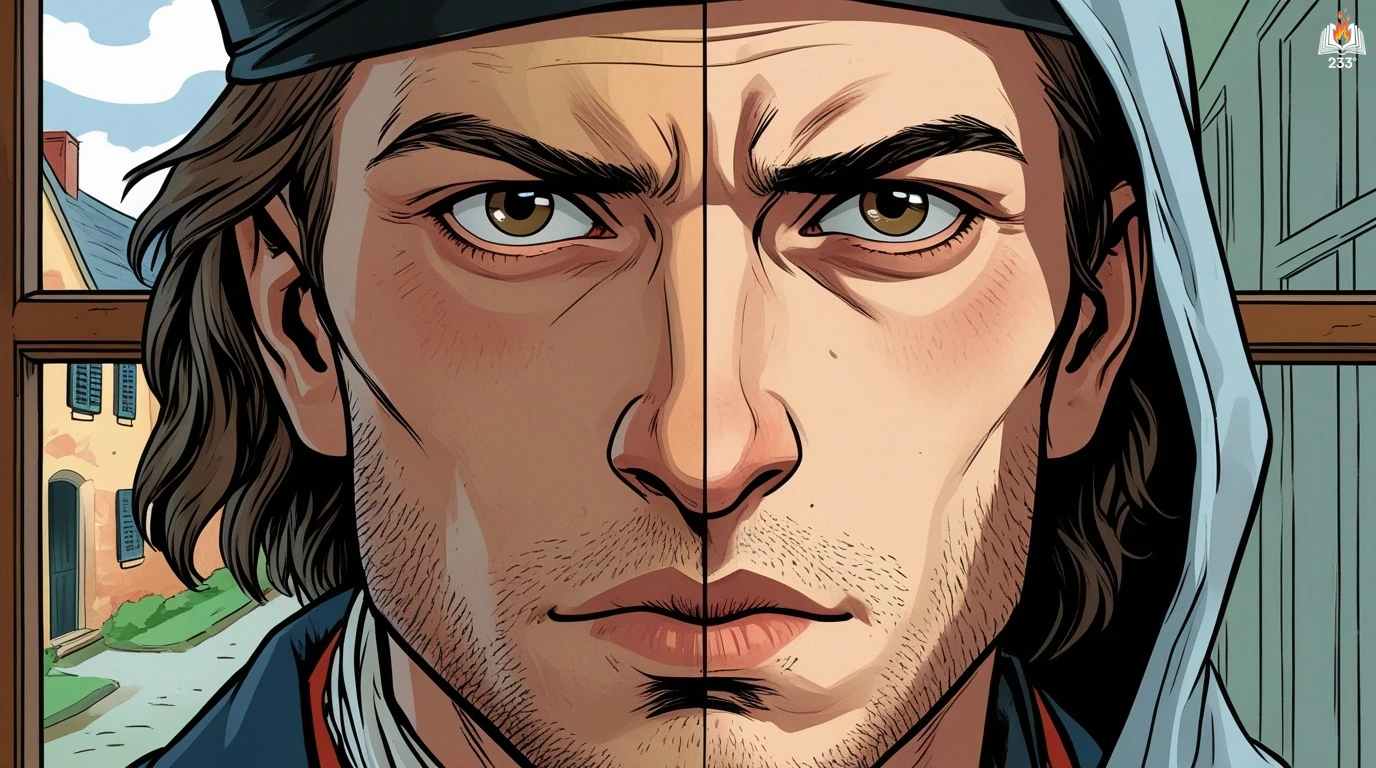


The Marble Faun, or The Romance of Monte Beni, published in 1860, is Nathaniel Hawthorne’s final completed novel and stands as a unique hybrid of romantic mystery and philosophical exploration. Set predominantly in Rome and later in the Tuscan countryside, the novel follows four central characters through a journey entangled with beauty, sin, art, and redemption. Though often grouped with Hawthorne’s earlier American romances, The Marble Faun is distinctly European in setting and inspiration, and reflects his fascination with the haunting legacy of the Old World, particularly its art and historical decadence.
Plot Summary
Beneath the arches of Rome, where time speaks in broken marble and shadowed frescoes, four souls walked amid statues older than their faith. Donatello, youthful and lithe, bore a striking resemblance to the Faun of Praxiteles – an innocent creature of mirth and forest stillness. His hair curled like wild vines, and his laugh was untouched by guilt. At his side moved Miriam, a painter with dark eyes and a shadowed past, beauty etched into her like lines of charcoal. She carried with her a brooding companion who never spoke, whose presence seemed stitched to her fate like a ghost trailing the living.
Kenyon, a sculptor with the thoughtful eye of a craftsman, saw the world through chisels and form, translating sorrow into stone. And Hilda, gentle as doves and pure in spirit, lived high above the city in a white tower, her conscience delicate, her vision clear. The four moved in harmony, yet were bound by invisible threads – some spun from affection, others from doom.
In the Capitol Museum, where the ancient world kept watch in cold repose, they stood before the Faun. Miriam’s voice, touched with laughter and a bitter undercurrent, pronounced Donatello its living echo. And in that moment of jest and awe, something stirred – an ancient echo, a stirring of fate – and what had been a life of light-hearted youth began to shift beneath Donatello’s feet.
Miriam was hunted. The dark figure who watched her from colonnades and alley corners was no ordinary man. His gaze held accusation, and though none knew his name or cause, his very presence turned warm Roman light into frost. One night, as the four wandered through the shadowed depths of the catacombs, where early martyrs once whispered prayers into stone, Miriam’s fear took shape. Donatello, quickened by a desire to defend her and perhaps to impress her, struck the man from a ledge. There was no cry – only the heavy fall of a body and the silence that follows death. And with that single act, the Faun was lost.
Something within Donatello cracked. Once overflowing with vitality, he now carried a sorrow that bowed his frame. His laughter no longer echoed in the groves of Monte Beni, his ancestral estate hidden among the Apennines. There he fled, and Kenyon, seeking his friend and the reason behind the transformation, followed into the green hills. Monte Beni was a vast and silent place – its towers watching the valley like sentinels of forgotten revels. Donatello greeted Kenyon with warmth, but the old mirth was a mask, and his eyes were hollowed by thought.
In the halls of Monte Beni, painted with fauns and nymphs dancing to music long faded, Donatello confessed nothing yet revealed everything. His soul had grown heavier than his lineage, and while the wine of his vineyard – golden and fragrant – still bore the name Sunshine, he himself had become a creature of twilight. He paced the battlements at night, seeking answers among the stars, and stared long at frescos that once had danced and now seemed like faded memories of joy too distant to revive.
Kenyon saw the change and offered to sculpt his friend’s likeness, hoping to capture what remained of that lost innocence. Donatello, reluctant but resigned, allowed it. Yet even as Kenyon shaped clay, he felt the presence of another – a guilt that could not be carved away.
Meanwhile, Hilda, back in Rome, was burdened by a truth she had witnessed. She had seen Donatello’s crime. Her innocence, once like the doves that circled her tower, now trembled beneath the weight of that knowledge. She withdrew from the world, seeking solace in prayer and art, trying to wash away the stain not of her own making, but of her awareness. Her faith remained, but it flickered.
Miriam, too, wandered. Though she had been the cause – or the catalyst – she felt neither peace nor exoneration. Her love for Donatello was a tangled thread of remorse and passion. She returned to Rome, and there met with Kenyon and Hilda. Between the three, sorrow was a shared currency. Each carried a fragment of that fatal night – one as actor, one as witness, one as interpreter.
As time wore on, Donatello’s torment grew too loud to bear. He chose not to flee, not to forget, but to surrender. He turned himself in to the law, placing himself in the hands of justice not because he was found, but because he could no longer hide from the eyes within his own soul. Miriam, faithful to his suffering, followed him, not to plead or protest, but to bear the weight alongside him.
Kenyon and Hilda, in their own silence, found solace in each other. Love grew not from passion, but from understanding, and their union was a quiet act of hope. They left Rome for the Tuscan hills, not to escape the past, but to walk beside it, each step a remembrance, each moment a soft redemption.
Donatello’s prison was no less a tower than the one in Monte Beni, but this time its walls were not adorned with fauns or joy. Miriam remained by his side, her own soul no longer seeking absolution, but offering companionship in suffering. She, who had once hidden from truth in shadows and masks, now stood fully in the harshest light.
Thus the four who once walked Rome as seekers of beauty and playfellows of ancient art, now found themselves as pilgrims of conscience. Their paths, forever altered by a single act, wound through the ruins of history and into the recesses of the human heart, where innocence, once lost, might still give rise to wisdom.
Main Characters
Donatello – A young Italian nobleman and the titular “Marble Faun,” Donatello is presented as an almost mythic figure, possessing an eerie resemblance to the Faun of Praxiteles. His character embodies innocence, joy, and a primitive harmony with nature—until a pivotal act of violence transforms him. This moral fracture becomes the core of his character arc, shifting him from a creature of pure instinct into one burdened by conscience and change.
Miriam – Mysterious and brooding, Miriam is a gifted painter whose beauty and charisma mask a turbulent past. She is pursued by a shadowy model who represents both guilt and threat. Her connection with Donatello becomes the narrative’s dark engine, as their fates entwine in a moment of irreversible sin. Miriam is a deeply symbolic figure—intelligent, anguished, and ever haunted—possibly the most psychologically complex character in the novel.
Hilda – A devout and innocent American artist, Hilda stands as a moral and spiritual foil to Miriam. She embodies a kind of angelic purity and lives in a Roman tower surrounded by doves. Her confrontation with the world’s sin, especially through Miriam’s and Donatello’s acts, challenges her own idealism and innocence. She represents the possibility of moral constancy in a decaying world.
Kenyon – An American sculptor and close friend to Hilda, Kenyon serves as the novel’s grounding presence. Rational, observant, and artistic, he offers a lens through which to view the novel’s moral dilemmas. His eventual romantic involvement with Hilda parallels Donatello’s descent, though his path remains unmarred by sin. Kenyon stands as a mediator between art and life, reason and passion.
Theme
The Fall from Innocence: Donatello’s transformation after committing a murder underlines the novel’s central theme—the fall from a state of natural, untroubled innocence into a life burdened by guilt and moral awareness. Hawthorne explores this as both tragic and redemptive, suggesting that sin may awaken the soul to deeper truths.
The Burden of the Past: Set among Rome’s ruins, catacombs, and art, the novel constantly invokes history as a force pressing upon the present. The characters are dwarfed and influenced by this weight of legacy—artistic, moral, and personal. Miriam’s past, in particular, haunts her modern life like a classical specter.
Art as Reflection and Revelation: Sculpture, painting, and architecture serve not just as backdrop but as active elements that reflect the characters’ psyches. The Faun statue is not merely symbolic of Donatello; it prefigures his nature and destiny. Art becomes a mirror, sometimes painful, of the human condition.
Guilt and Atonement: The novel dwells on the psychological toll of guilt. Donatello’s remorse alters his very soul, while Miriam is long acquainted with this inner torment. Hilda’s secondhand guilt—born of witnessing sin and being unable to prevent it—tests her idealism. Hawthorne interrogates the path toward redemption, if such a path exists.
The Duality of Human Nature: Echoing Hawthorne’s lifelong theme, the novel delves into the contradictions within the self. Donatello’s animalistic joy is tempered by hidden savagery; Miriam’s noble qualities co-exist with terrible secrets; even Hilda, seemingly pure, is not untouched by the shadow of moral ambiguity.
Writing Style and Tone
Nathaniel Hawthorne’s prose in The Marble Faun is meditative, richly descriptive, and steeped in allegory. He blends the romantic and the gothic with philosophical inquiry, often pausing the narrative to reflect on beauty, morality, and the human soul. The settings—catacombs, ruined villas, and antique towers—are described with an almost dreamlike exactitude, anchoring the story in a liminal space between myth and modernity. The rhythm of his sentences is languid and sculpted, mimicking the contemplative atmosphere of Rome itself.
The tone is one of elegiac melancholy, shadowed by moral uncertainty and awe before the mysteries of sin, punishment, and forgiveness. Yet there is also warmth in his treatment of the characters, particularly in their friendships and love. Hawthorne’s tone fluctuates between grave reverence for the inner workings of the human soul and a kind of wistful detachment, as though he himself stands like a solitary visitor among Rome’s ruins, unsure of the past’s hold on the present.
Quotes
The Marble Faun – Nathaniel Hawthorne (1860) Quotes
“A forced smile is uglier than a frown.”
“Nobody, I think, ought to read poetry, or look at pictures or statues, who cannot find a great deal more in them than the poet or artist has actually expressed.”
“It is the surest test of genuine love, that it brings back our early simplicity to the worldliest of us.”
“Oh Hilda, what a treasure of sweet faith and pure imagination you hide under that little straw hat!”
“They stopped on the bridge to look into the swift eddying flow of the yellow Tiber, a mud puddle in strenuous motion;”
“It depresses me to look at old frescos," responded the Count; "it is a pain, yet not enough of a pain to answer as a penance.”
“Donatello, you had better take one of those gay, boyish artists for your companion,” said Miriam, when she found the Italian youth at her side.”
We hope this summary has sparked your interest and would appreciate you following Celsius 233 on social media:
There’s a treasure trove of other fascinating book summaries waiting for you. Check out our collection of stories that inspire, thrill, and provoke thought, just like this one by checking out the Book Shelf or the Library
Remember, while our summaries capture the essence, they can never replace the full experience of reading the book. If this summary intrigued you, consider diving into the complete story – buy the book and immerse yourself in the author’s original work.
If you want to request a book summary, click here.
When Saurabh is not working/watching football/reading books/traveling, you can reach him via Twitter/X, LinkedIn, or Threads
Restart reading!