

“Only You Can Save Mankind” by Terry Pratchett, published in 1992, is the first book in the Johnny Maxwell Trilogy. Set against the backdrop of early ’90s video gaming culture and the Gulf War, the story unfolds when a seemingly ordinary computer game suddenly takes a strange and profound turn. Johnny Maxwell, a twelve-year-old boy, finds himself drawn into a surreal reality where the alien enemies from his game, the ScreeWee, surrender and plead for peace instead of fighting back. This twist launches him on a journey that challenges the very nature of games, war, and reality.
Plot Summary
Johnny Maxwell sat hunched before his computer, joystick clenched tight in his hand, dogfighting in space against alien fleets. The game was called Only You Can Save Mankind, and like every game before it, it promised an onslaught of enemies, destruction, and glory. He played because it was what one did after school, when parents whispered and argued in different rooms and teachers loomed with assignments that never really explained anything. He played because it was normal. Until it wasn’t.
As he advanced through the game, the ScreeWee – the alien race he was meant to destroy – did something no digital enemy had done before. They surrendered. With strange blinking messages and broken grammar, they asked for peace. They showed him pictures of their children. They begged not to be shot. The moment made his fingers hover over the Fire button, unsure. There wasn’t a Don’t Fire button, after all. Games weren’t meant to go like this.
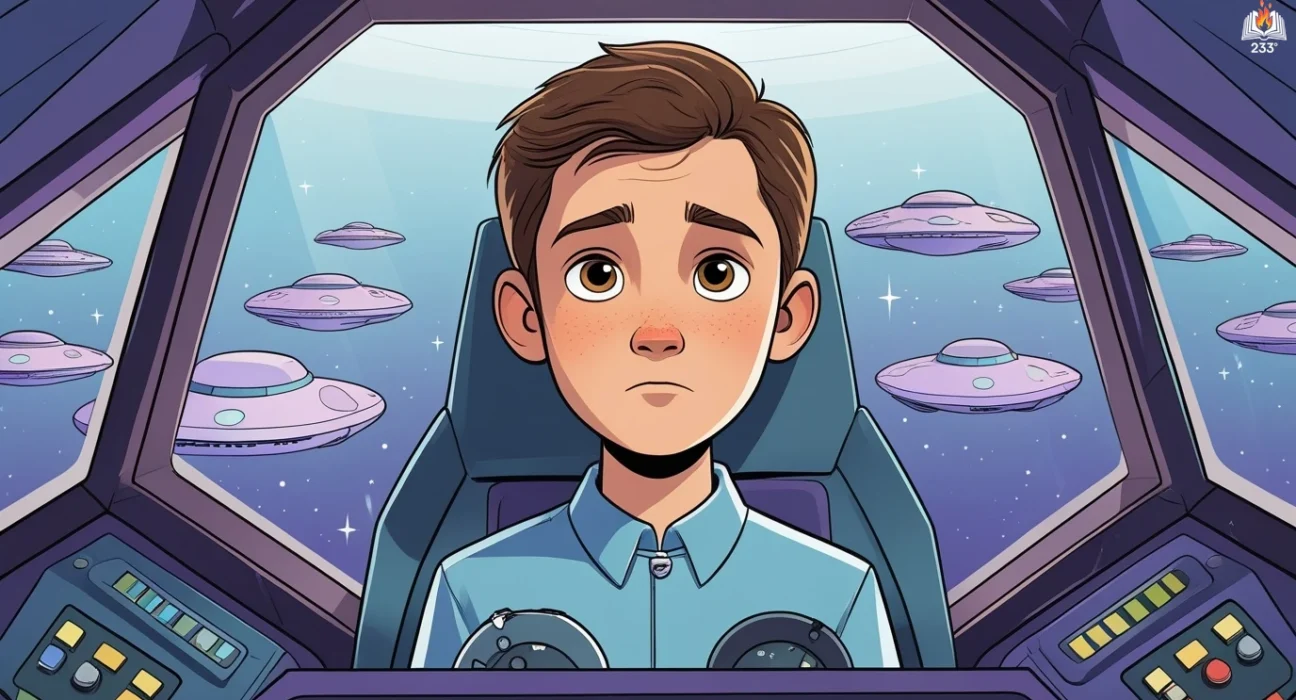
The ScreeWee Captain, looking like a cross between a newt and an alligator, pleaded with him through the screen. Johnny, confused and unsure of reality, agreed to their surrender and promised safe conduct. That should have been the end, but the game didn’t reset. Instead, Johnny began dreaming vividly – not the fuzzy logic dreams of flying and falling – but dreams where he was truly in the cockpit, where the ship hummed and the buttons blinked, and the ScreeWee fleet followed him like a hopeful shadow through space.
Each night he returned to this fleet, each morning he woke up exhausted and shaken. On the surface, life trudged on. At school, he dodged sports with forged notes and hung out with his odd collection of friends – Wobbler, the genius hacker with more illegal software than schoolbooks; Yo-less, the intellectual realist with an eye on everything; and Bigmac, the camouflage-clad bruiser with a fondness for things that go blam. They didn’t believe him at first. Yo-less explained it as a psychological projection. Wobbler blamed a time-delayed glitch or virus. Bigmac thought it was awesome.
Still, every time Johnny turned on the game, the ScreeWee weren’t there. They were in his dreams, waiting in the stars, expecting him to lead them home. The Captain trusted him. She called him the One. Johnny didn’t understand why. He was twelve, his parents were separating, his spaghetti came out of tins, and he couldn’t even figure out his geography homework without coloring in the wrong island.
But even in dreams, space wasn’t safe. Other players were still logging into the game – unknowingly chasing points, achievements, and the joy of destruction. When they arrived, guns blazing and lasers streaming, the ScreeWee, in their self-imposed ceasefire, didn’t fight back. Johnny tried to stop the new players. He flew after them, sent messages, tried to block their paths, but he was one boy. A user on a joystick.
When the attacks grew fiercer, Johnny did what he never thought he would do. He defended the ScreeWee. He fired back, not for points, but to protect the fleet. His conscience twisted every time he pulled the trigger. He told himself no one died – not really. Other players would just restart. But the ScreeWee didn’t respawn. When they died, they were gone. In their world, it was permanent.
The Captain, noble and weary, stood firm in her belief that peace was worth the risk. Even when her own Gunnery Officer accused her of betrayal. Even when her ships were bombarded by unaware humans playing a game that had become something else entirely. Her resolve didn’t break – not when Johnny failed to stop the attacks, not when he abandoned the fleet in anger, and not when the ScreeWee ship fired without her order, vaporizing a human attacker and shaking her command.
Johnny carried the weight of it all. The lines between screen and sky, real and imagined, blurred. The dreams no longer felt like dreams. His own ship was damaged, systems failed, and for a moment, he was sure he would die. Not reset. Die. But he woke up. Not in a triumphant glow, not with a high score, just cold and confused and holding a joystick too tightly.
And yet, he kept going back.
He tried explaining it. He talked to his friends, watched the news that mirrored the game too eerily – real missiles over real cities. The Gulf War flickered on TV in between programs about saving whales and cooking shows. The outside world made less sense than the digital one.
Even others noticed something was off. A girl returned her copy of the game to a computer shop, claiming the aliens had fled. No one believed her. But when Wobbler tested new, unplayed copies of the game, there were no enemies. Just space. The ScreeWee were truly gone – out of the game, following Johnny.
One night, camera strapped to his wrist, he went back. He photographed the ScreeWee fleet. The image faded into view slowly – unmistakable proof. That night, a human ship appeared and attacked. The ScreeWee begged for mercy. The Captain pleaded. Johnny hesitated. Then he fired. He didn’t want to, but he had to. To save someone.
More ships came. More players.
The ScreeWee retaliated – once. Without Johnny’s command. One human attacker became space dust. The Captain apologized, but Johnny knew something had changed. The weight of being the One, the person who could save or doom an entire race, pressed down harder. He snapped. He shouted. Why him? He was just a kid. He didn’t want to be responsible for anyone, let alone an interstellar convoy of giant newts.
The Captain asked a simple question – why not?
Angry and overwhelmed, he turned his ship away from the fleet. The ScreeWee stayed behind, shrinking to distant dots on the radar. Johnny left them in silence, the space around him empty, but no less heavy.
He didn’t get a high score. He didn’t get the Scroll of Valor or a token from Gobi Software. He didn’t even get a thank-you screen. All he got was an empty cockpit, a quiet computer, and the understanding that somewhere in the stars, someone had trusted him – not as a gamer, not as a soldier, but as a person.
Main Characters
Johnny Maxwell – A reflective and introverted twelve-year-old boy, Johnny becomes the unexpected hero when the aliens in his video game break protocol by surrendering. He’s a reluctant savior, grappling with complex moral choices, and his internal world is shaped by Trying Times at home due to his parents’ separation. His sense of responsibility grows as he navigates this unprecedented digital dilemma.
Wobbler Johnson – Johnny’s tech-savvy friend, Wobbler is a chubby boy with a gift for breaking into and modifying computer games. He represents the archetype of the nerdy hacker and plays a crucial role in giving Johnny access to the game. His flippant, rule-breaking attitude contrasts with Johnny’s increasing sense of ethics.
The ScreeWee Captain – A surprisingly dignified and emotionally nuanced alien leader, the Captain personifies the game’s moral complexity. She’s tired of endless cycles of violence and wants peace for her species. Her solemn wisdom and desire for dialogue drive home the book’s key themes of empathy and understanding.
Yo-less and Bigmac – Two more of Johnny’s friends, they serve as sounding boards for Johnny’s experiences. Yo-less is logical and analytical, while Bigmac is aggressive and obsessed with military heroism. Their differing perspectives highlight society’s various responses to conflict.
Theme
War and Peace – A central theme, the book juxtaposes real-world war (mirroring the Gulf War) with the video game battlefield. The aliens’ desire to surrender forces Johnny and the reader to confront the human tendency toward conflict and the concept of victory without violence.
Reality vs. Illusion – Pratchett plays with the boundaries of what is real. Johnny’s experiences blur the line between video game and lived experience, prompting deeper questions about how media influences perception and morality.
Coming of Age – Johnny’s transformation from a passive boy to someone who shoulders immense responsibility reflects classic coming-of-age tropes. His journey is both literal and metaphorical, shaped by the external conflict and his internal growth.
Empathy and Understanding – The ScreeWee’s plea for mercy challenges the black-and-white morality typical of video games. Through their interaction with Johnny, Pratchett explores the importance of listening and recognizing the humanity – or personhood – in the ‘other.’
Writing Style and Tone
Terry Pratchett’s writing style in this book is marked by his trademark wit, irony, and satirical edge. He mixes humorous observations with poignant insights, creating a narrative that is both entertaining and thought-provoking. Dialogue is sharp, filled with youthful banter and cultural references, particularly to early ’90s computer culture. The language is accessible yet rich with subtext, often layered with meaning that reveals itself gradually as the plot unfolds.
The tone oscillates between comedic and contemplative. While much of the surface humor comes from the absurdity of the ScreeWee’s situation and Johnny’s bewildered reactions, Pratchett never trivializes the deeper moral issues at play. The juxtaposition of the war on TV with the simulated war in the game underscores a subtle, growing darkness. It’s a tone that invites readers to laugh while nudging them to think critically about violence, heroism, and responsibility.
Quotes
Only You Can Save Mankind – Terry Pratchett (1992) Quotes
“If Not You, Who Else?”
“How can you be the good guys if you're dropping clever bombs right down people's chimneys? And blowing people up just because they're being bossed around by a loony?”
“...'And you are the Chosen One? Huh! They could have chosen me .' 'They tried. But I was the one who listened,' said Johnny quietly.”
“Just because you've got a mind like a hammer doesn't mean you have to treat everyone else like a nail.”
“If you were away from home, you had to use a phone attached by a wire to the wall. It was terrible.”
“With humans, we have often found it essential to get our self-defense in as soon as possible.”
We hope this summary has sparked your interest and would appreciate you following Celsius 233 on social media:
There’s a treasure trove of other fascinating book summaries waiting for you. Check out our collection of stories that inspire, thrill, and provoke thought, just like this one by checking out the Book Shelf or the Library
Remember, while our summaries capture the essence, they can never replace the full experience of reading the book. If this summary intrigued you, consider diving into the complete story – buy the book and immerse yourself in the author’s original work.
If you want to request a book summary, click here.
When Saurabh is not working/watching football/reading books/traveling, you can reach him via Twitter/X, LinkedIn, or Threads
Restart reading!


