“Strata” by Terry Pratchett, first published in 1981, explores a universe where humans, with the help of advanced technology and corporate monopolies, build entire worlds from scratch. This early science fiction novel by Pratchett precedes his renowned Discworld series and bears hints of the humor and philosophical depth that would characterize his later work. The story follows Kin Arad, a seasoned planetary engineer working for the all-powerful Company, as she embarks on a mind-bending journey involving mysterious ancient artifacts, a flat Earth, and the enigma of the long-extinct Spindle Kings.
Plot Summary
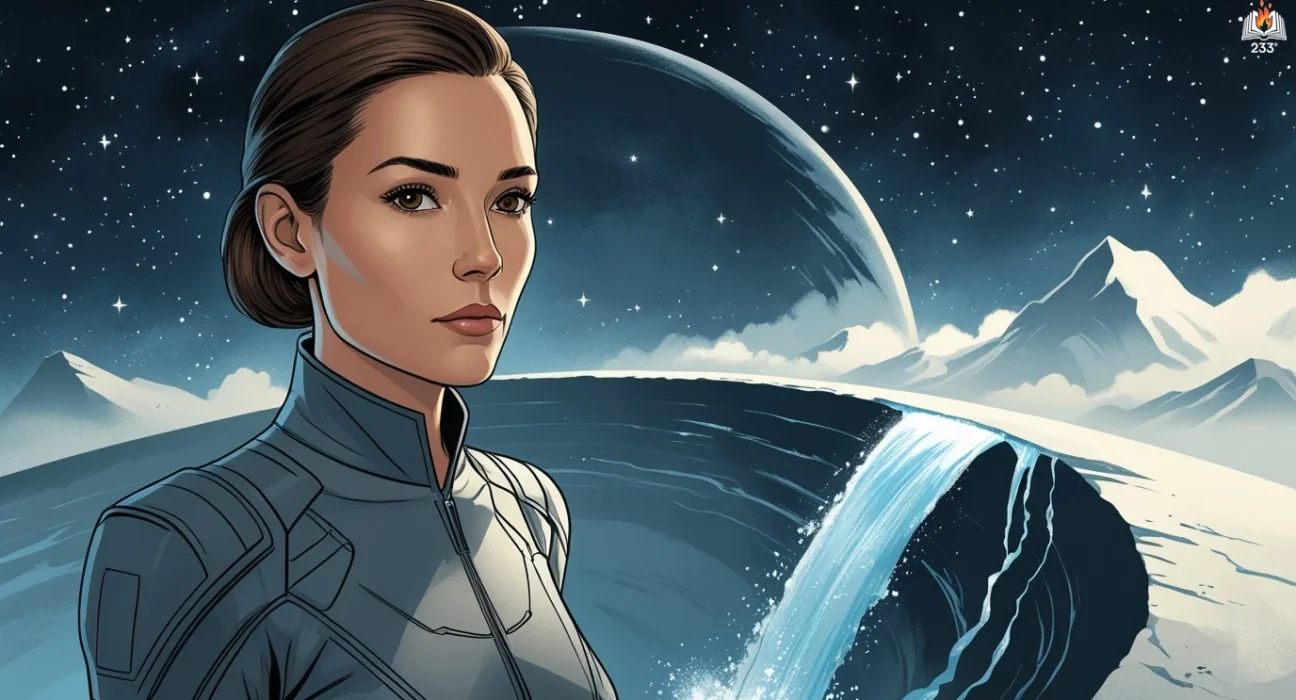
Kin Arad, senior engineer for the Company, had overseen the fabrication of entire worlds. Planets sculpted from bedrock and seeded with history were her daily bread – entire civilizations furnished with fictitious ancestors, fossilized legends, and weather cycles borrowed from extinct stars. The Company shaped these planets not for colonization alone, but for myth – for illusion. Kin had grown old in years but not weary, thanks to the synthetic days that could be bought and spent. Still, something ancient stirred in her curiosity when Jago Jalo appeared.
Jalo, a man who should not exist, claimed to be a pilot of the long-lost starship Antares. He brought tales of a flat Earth – a discworld, impossibly ancient and impossibly artificial – ringed with mountains and bordered by water that poured off the edge into nothingness. A world crafted like a stage set, unscarred by time yet built with impossible technology. And he offered Kin a place in the expedition to find it.
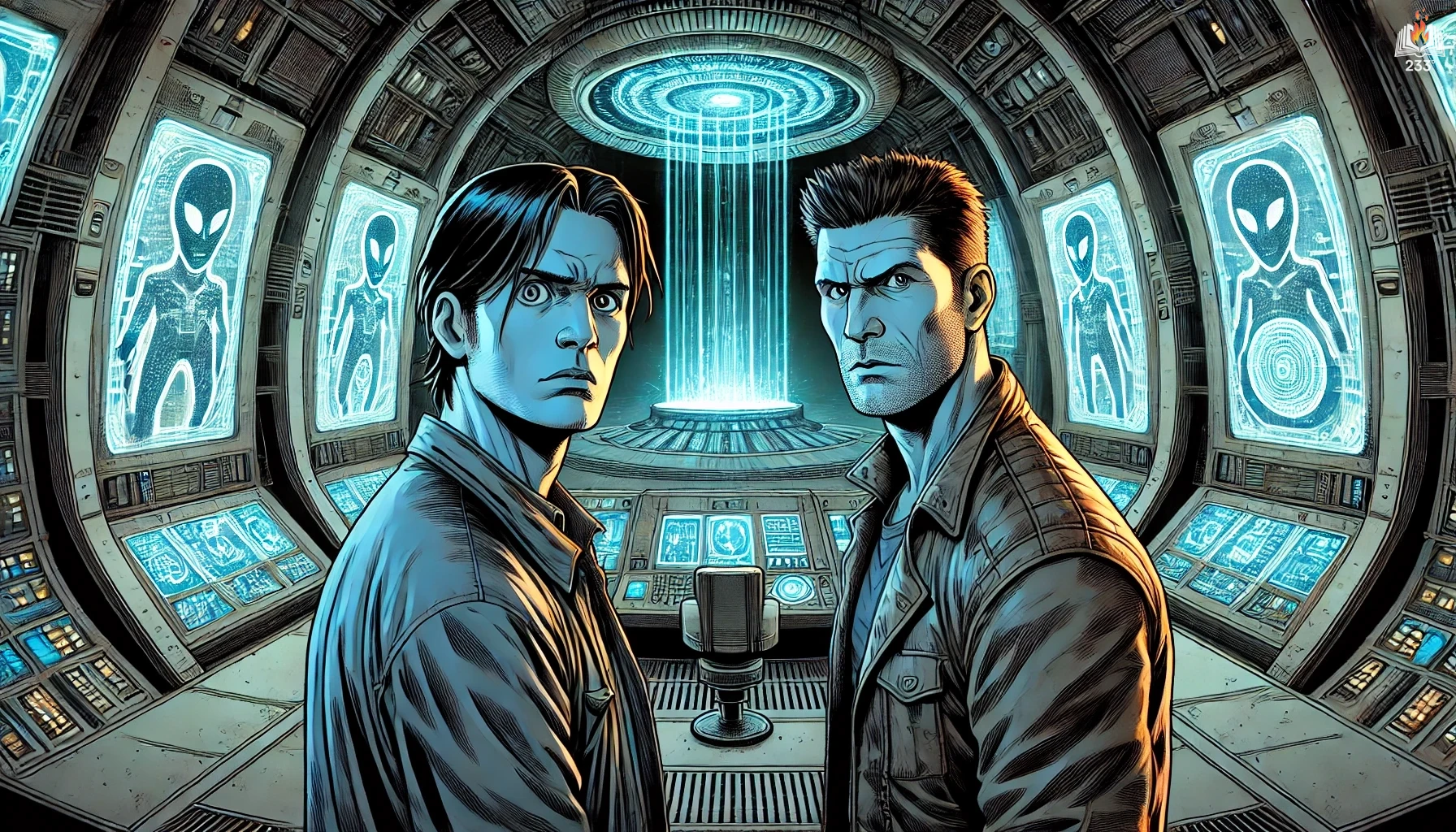
They departed on the ship Power of Suggestion, a curious crew: Kin, meticulous and skeptical; Marco Farfarer, a kung pilot with the manner of a Renaissance actor; and Silver, a lithe, furred creature of unknowable origins and startling perception. Together they slipped through stars, bent space, and probed the impossible edges of the universe – until they found it.
The world was flat. That alone was a heresy to physics, but the land beneath their feet offered further blasphemies: constructed strata that mimicked the layers of geological time, peculiar lifeforms that walked like men but thought in alien shapes, and a sun that circled in lazy arcs above a stationary sky. They descended into the world’s crust and found it hollow – not just in rock but in intention. This world had been made.
And it was breaking.
The expedition stumbled into a war of time and ideology. Machines moved of their own will, some ancient, others built in the image of ancient gods. They uncovered remnants of the Spindle Kings, beings who may have seeded the galaxy with life and myth. Their fingerprints – or claws, or pseudopodia – were etched across galaxies, in buried artifacts and languages forgotten even by stars.
Jalo’s betrayal came like a whisper in static. He had not brought them for discovery but for demonstration. The discworld was a trap – a construct within a construct. And Jalo, or the thing calling itself Jalo, was its servant. He wanted revelation, not exploration. He wanted to force the truth on Kin and her crew – to break their understanding of what was real.
But Kin, tempered by centuries and deceit, played her own game. She and Marco sabotaged the systems meant to imprison them. They fled into the underworld of the disc, chased by illusions and truths wearing each other’s masks. At every turn, the disc revealed more of itself: mechanisms embedded in continents, control panels disguised as temples, and language coded into the wind.
They reached the edge again, not of the world but of reason. The disc was not just ancient – it was a message. Someone, or something, had built it to be found, to shake the certainty of its discoverers. And in its center, they discovered the last beacon of the Spindle Kings – an intelligence, dormant and watching, waiting for its children to return.
But the message was not salvation. It was a warning.
The Spindle Kings, if they had ever truly existed, had feared something. Perhaps entropy, perhaps their own creations, or perhaps a deeper madness born from building too many illusions. The discworld was a reminder – that creators are often buried beneath their own myths.
Kin, Marco, and Silver returned not as explorers triumphant, but as survivors. They left behind the discworld, its secrets unresolved, its truths too vast to hold. The Company would hear of it, and they would come. They always did. But Kin carried something deeper now – a question that refused to fade.
The stars were old. The universe was layered like her artificial strata, and somewhere, beneath it all, something watched.
Kin retired from planetary design. She no longer shaped worlds from bedrock and dreams. Instead, she sat beneath real stars, listening to the wind, and wondered who might be listening back.
Main Characters
Kin Arad – A seasoned planetary engineer from Earth, Kin is intelligent, practical, and morally complex. With over two centuries of life experience and a reputation in planetary construction, she represents both the power and disillusionment of long-lived humanity. Kin is curious and daring, traits that compel her to pursue the mystery of a supposedly artificial flat world. Her leadership and introspection anchor the narrative.
Jago Jalo – A mysterious figure claiming to be a Terminus probe pilot from over a thousand years ago, Jalo is cunning and enigmatic. He lures Kin into investigating the flat world, offering technological marvels and cryptic truths. His motivations remain opaque, contributing to the story’s tension and philosophical undertones.
Marco Farfarer – A kung (an alien species) and pilot with human cultural integration, Marco is witty, flamboyant, and competent. His blend of alien physiology and human sensibility provides both comic relief and critical insight into cultural plurality and identity. He joins Kin in her journey, becoming an essential part of the trio.
Silver – An intelligent and mysterious woman from a wolf-like species, Silver’s appearance later in the novel introduces deeper existential questions. She is both alluring and alien, with an intuitive understanding of the strange world they are exploring.
Theme
Creation and Authorship – The novel repeatedly questions what it means to build a world and who has the authority to define reality. Through planetary engineering and the layers of fictional artifacts, Pratchett examines the power and responsibility of creators.
Time and Mortality – Long lifespans and the currency of “Days” reflect the human desire to control death. Yet, through characters like Kin and Joel, Pratchett highlights the eventual ennui and existential crises that immortality brings.
Truth and Illusion – With forged fossils, invisible cloaks, and a seemingly impossible flat world, the narrative challenges the notion of objective reality. Pratchett plays with perception, questioning what is real and how much truth is shaped by belief.
Corporate Monopolization and Ethics – The omnipotent Company represents a critique of unchecked capitalism and the commodification of life itself. It controls longevity, knowledge, and exploration, leading to ethical dilemmas about individual agency and freedom.
Cultural Relativism and Identity – Through species like the kung and the rediscovered Spindle Kings, the story explores how identity and culture are constructed. Kin’s interactions with other species reflect tensions between assimilation, prejudice, and mutual understanding.
Writing Style and Tone
Pratchett’s prose in “Strata” is richly descriptive, laced with irony, wit, and a deep sense of curiosity. The narrative blends hard science fiction elements with satirical observations, using Kin’s world-building job as a metaphor for deeper philosophical inquiries. His vocabulary is precise and often technical, reflecting the story’s speculative setting, yet it’s offset by humorous commentary and vivid imagery.
The tone of the novel shifts fluidly between playful and profound. Pratchett balances intellectual skepticism with wonder, often drawing the reader into moments of deep reflection only to break the tension with a dry aside or absurd scenario. This tonal interplay enhances the novel’s exploration of reality, meaning, and the human (or post-human) condition. “Strata” reads like a science fiction thought experiment filtered through a sardonic lens, inviting readers to question the world around them – and the ones they build.
Quotes
Strata – Terry Pratchett (1981) Quotes
“Death had no balls.”
“what did it prove? That men were slightly stupid and very egocentric? Aliens already knew that.”
“It meant everyone learned how to press buttons, and no one remembered how to dive for pearls”
We hope this summary has sparked your interest and would appreciate you following Celsius 233 on social media:
There’s a treasure trove of other fascinating book summaries waiting for you. Check out our collection of stories that inspire, thrill, and provoke thought, just like this one by checking out the Book Shelf or the Library
Remember, while our summaries capture the essence, they can never replace the full experience of reading the book. If this summary intrigued you, consider diving into the complete story – buy the book and immerse yourself in the author’s original work.
If you want to request a book summary, click here.
When Saurabh is not working/watching football/reading books/traveling, you can reach him via Twitter/X, LinkedIn, or Threads
Restart reading!