

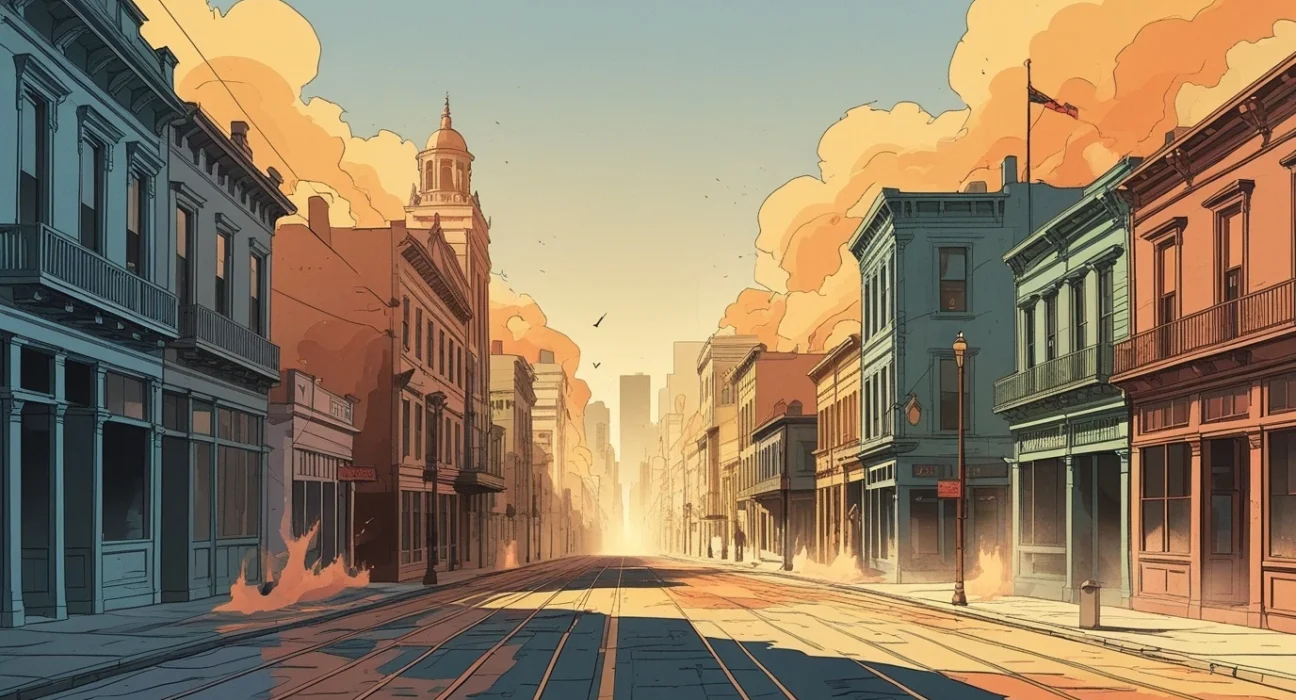
Frog Music by Emma Donoghue, published in 2014, is a lushly imagined historical crime novel inspired by the real-life unsolved murder of Jenny Bonnet in San Francisco during the summer of 1876. The novel opens in a heatwave-stricken city, sweltering under the threat of a smallpox outbreak, and plunges the reader into a feverish, kinetic world teeming with dancers, outlaws, eccentrics, and immigrants. The story is told from the perspective of Blanche Beunon, a French burlesque dancer, whose accidental collision with the enigmatic frog-catching cross-dresser Jenny Bonnet sets off a chain of events culminating in violence, betrayal, and a desperate pursuit of truth.
Plot Summary
The heat hangs over San Francisco like a fever, heavy and unrelenting in the summer of 1876. Streets shimmer with disease and desire, and into this sweltering chaos comes the sharp crack of gunfire at the Eight Mile House. A woman lies dead, a bullet-spattered specter in a torn nightshirt. Jenny Bonnet – frog catcher, outlaw, and friend – lies still on the wooden floor, her body a final punctuation in a life of contradictions. Beside her, Blanche Beunon, bloodied and dazed, remains alive, heart thundering not only from the ambush but from the realization that someone was aiming for her.
The days rewind like a song played backward. Only weeks ago, Blanche had ruled the stage at the House of Mirrors, her skirt a satin tempest, her voice a lullaby dipped in gin. A Parisian transplant, Blanche lives by the grace of her beauty, her dance, and the willing wallets of men. Her world is shared with Arthur and Ernest – lovers, business partners, parasites – who orbit her like twin moons, feeding off the light she earns and the shadows she hides. Blanche believes herself in control, mistress of her choices, until a bicycle slams into her on Kearny Street and a grinning stranger, dressed in men’s clothes, offers her a hand.
Jenny Bonnet arrives like a storm: brash, androgynous, careless with laws and fearless with words. She hunts frogs in the marshes and lives by no one’s rules. Her presence unsettles Blanche, but also stirs something dormant – curiosity, laughter, the faint ache of something freer. Jenny has no tolerance for Blanche’s gilded cage, no patience for Arthur’s charm or Ernest’s weakness. She asks questions no one dares to ask. Why did Blanche leave her baby with strangers? Why does she let Arthur steal her earnings? Why does she call this life her own?
The friendship grows in fragments – over shared wine, frog legs, lullabies in bars. Jenny, reckless with her truth, draws out Blanche’s. She takes Blanche to the boarding house where Blanche’s baby, P’tit, has been left with a cruel wet nurse. The truth lands hard. P’tit, no longer the chubby infant Blanche remembers, is malnourished, covered in sores, and barely recognizes her. Fury and guilt strike Blanche in equal measure. She removes her child and rents a shack on the edge of the city, determined to reclaim motherhood and sever ties with Arthur and Ernest.
But ties, once bound in flesh and favor, do not snap easily. Arthur’s possessiveness sharpens into menace. Ernest, complicit and cowardly, watches as tempers boil and threats grow bolder. Jenny, ever the provocateur, remains close, visiting Blanche and the baby in their new refuge, bringing laughter and frogs and defiance. They plan, they dream. Blanche will dance no more. She’ll earn her living with her hands, not her hips. She’ll raise her son without debts owed to dangerous men.
September rises, humid and yellow-toothed. The city, groaning under the weight of heat and smallpox, watches Blanche as she tries to stitch a new life together. Jenny’s presence becomes a shield, a reminder that a different life is possible. Yet danger creeps closer. Blanche senses it in Arthur’s silences, in the strange glances from men who once adored her, in the way the door creaks too long when closed.
Then comes the night at the Eight Mile House.
Jenny, bruised but laughing, sings with Blanche as the candle flickers low. Outside, dogs howl. A train moans. In the darkness, bullets tear through glass, through flesh. Jenny falls, and the light goes out.
In the aftermath, Blanche staggers, soaked in blood that is not hers. McNamara and his wife, shaken but unsympathetic, whisper blame in corners. Blanche becomes both witness and suspect. The police arrive late, shrugging off the murder as just another crime in a city teeming with them. But Blanche knows. She knows whose fury cracked the night. She knows who followed her to that shack at the city’s edge, who wanted her dead.
Fear drives her back to Arthur, seeking answers, not safety. He is smooth, dismissive. His denials hang like cobwebs – visible, useless. Blanche’s questions earn her threats. The baby is stolen. Blanche panics, suspects everyone, trusts no one. Each step into the city feels like walking through quicksand.
Jenny’s absence grows louder than her presence ever was. Blanche haunts the alleys they once walked, questions those they knew. Maria, the one-eyed former dove, hints at secrets with a sneer. Madame Johanna, keeper of Blanche’s former world, offers silence and scorn. The police, uninterested, let the case wither.
But Blanche won’t let go.
She follows Arthur to the countryside, to the house of mirrors he’s built out of lies. The confrontation is brittle, the truth slippery. Arthur denies the murder, but his eyes tell other stories. Blanche finds P’tit, filthy and frightened, and escapes with him into the night.
Grief and guilt anchor her days. Jenny’s laughter echoes through every lullaby Blanche sings. She files charges, presses forward, dares the world to listen. But justice limps in San Francisco. The courts delay, the witnesses vanish, and Arthur, slippery as oil, evades the noose.
Seasons turn. The city exhales. Blanche, changed in marrow and mind, takes what little she has and leaves. P’tit, heavier now, wraps his arms around her as the train pulls away. Behind her, the city hums on, indifferent.
Jenny Bonnet remains, buried but not silenced, a girl in men’s clothes who lived her truth until it cost her everything. And Blanche, once a dancer wrapped in satin and shadows, carries her name like a talisman, like a wound that time won’t close.
Main Characters
Blanche Beunon – A Parisian burlesque dancer and occasional prostitute, Blanche is fiery, independent, and deeply conflicted. Fiercely protective of her independence and reputation, she is also vulnerable, carrying emotional scars from her past. Her encounter with Jenny sets her on a journey of self-discovery and ultimately exposes her to danger. Blanche’s narrative voice drives the novel with its blend of sensuality, wit, and poignant introspection.
Jenny Bonnet – A gender-nonconforming, bicycle-riding frog catcher, Jenny is spirited, clever, and utterly unorthodox. She wears men’s clothing and frequently challenges societal norms, which often lands her in trouble with the law. Her charisma and fierce honesty disarm Blanche, and their brief but intense friendship leaves a lasting impact. Jenny’s murder forms the central mystery of the novel.
Arthur Deneve – Blanche’s lover and the de facto head of their ménage, Arthur is manipulative and self-serving. A failed acrobat turned opportunist, he exerts control over Blanche’s life, particularly in financial matters, often to her detriment. His ambiguous morality and jealous nature make him a prime suspect in Jenny’s murder.
Ernest – Arthur’s companion and fellow immigrant from France, Ernest is both less domineering and more cowardly than Arthur. He plays a supporting role in Blanche’s domestic situation and is complicit in the darker aspects of their lifestyle.
Maria – A grotesquely disfigured former prostitute who lingers on the fringes of society. Though a minor character, Maria provides an unsettling mirror of what Blanche might become if she loses her beauty, freedom, or status. Her presence adds to the novel’s atmosphere of peril and decay.
Theme
Freedom and Constraint – The tension between personal liberty and societal expectations is a central theme. Jenny’s insistence on dressing and living as she pleases contrasts with Blanche’s more conventional yet compromised life. Their differing notions of freedom highlight the costs and risks of autonomy, particularly for women.
Gender Identity and Roles – Jenny’s masculine presentation and irreverence for gender norms are both a source of fascination and danger. The novel interrogates rigid gender binaries and celebrates the fluidity of identity, portraying Jenny as both a challenge to and a victim of her era’s norms.
Survival and Exploitation – Set amid the fringes of society, Frog Music depicts characters surviving through performance, deception, and prostitution. Blanche’s story is one of exploitation masked as agency, and her arc involves recognizing and confronting the structures that bind her.
Friendship and Trust – The sudden and deep connection between Blanche and Jenny is one of the novel’s emotional cores. Their relationship explores the potential for transformation through intimacy, and how trust can be both salvational and fatal in a world of shifting alliances.
Justice and Injustice – Inspired by an unsolved real-life crime, the book critiques the failures of the legal system, especially regarding marginalized individuals. The search for Jenny’s killer is also a symbolic quest for truth in a city rife with corruption, classism, and moral ambiguity.
Writing Style and Tone
Emma Donoghue’s prose in Frog Music is vivid, immersive, and sensual, brimming with period detail and linguistic flavor. She alternates between urgent present-tense action and more reflective past-tense recollections, crafting a layered narrative that oscillates between the chaos of the present and the unfolding mystery of the past. The use of French phrases, slang, and musical lyrics weaves cultural authenticity into the story and roots the reader in the vibrant milieu of 1870s San Francisco.
The tone is lyrical yet raw, a mixture of grit and beauty that mirrors Blanche’s own contradictions. Donoghue does not shy away from bodily realities, whether it’s violence, sex, illness, or poverty. This tactile approach lends immediacy and realism to the narrative. Simultaneously, there’s a theatricality to the dialogue and structure – fitting given the burlesque world Blanche inhabits. The novel reads like a waltz of memory and urgency, with passion, horror, and sorrow entwined in every step.
Quotes
Frog Music – Emma Donoghue (2014) Quotes
“People have no idea of the things that don't happen to them—the lives they're not living, the deaths stalking them—and thank Christ for that. Hard enough to get through each day without glimpsing all the hovering possibilities, like insects thickening the air.”
“better keep your mouth shut and seem stupid than open it and remove all doubt.”
“Jenny was easy to enjoy but hard to know.”
“Happiness as un-pin-downable as a louse: you feel the tickle of its passage but your fingers close on nothing.”
“If you're sorry, folks can tell. No use piling on the verbiage.”
“[She] was easy to enjoy but hard to know.” ... “It’s unbearable, the not knowing.”
“She wants to slap everyone today, to pick up the whole sweat-slick City and punch its lights out.”
“Well, they don’t make their music just to pass the time,” says Jenny, grinning. “Got to want something to sing about it, no?”
“Men never feel quite the same about a woman's body once they know it's done that thing: widened and torn to push out a baby's head.”
“Same old notes, Blanche thinks at one point, but arranged into unfamiliar music.”
“ Unknown Assassin , says the headline. Blanche skips over the details she already knows. How bizarre to see what she lived through last night turned into an item tucked between stock prices and Crazy Horse whupping the army at Little Bighorn.”
“I'm just preparing the way, just like John the Baptist for Our Lord.”
“Jenny wouldn't be dead if she'd never crashed into Blanche on Kearny Street. P'tit wouldn't exist if Blanche had never met Arthur. Facts as hard as rocks, and Blanche has to pick her way among them, find her balance, with an acrobat's cocky smile.”
“(Blanche has already steeled herself, knowing that the Irish can’t cook.)”
“she feels that surge of warmth, and this time she remembers what it means: not love but piss. Or the love that's mixed with piss and can't be separated from it.”
We hope this summary has sparked your interest and would appreciate you following Celsius 233 on social media:
There’s a treasure trove of other fascinating book summaries waiting for you. Check out our collection of stories that inspire, thrill, and provoke thought, just like this one by checking out the Book Shelf or the Library
Remember, while our summaries capture the essence, they can never replace the full experience of reading the book. If this summary intrigued you, consider diving into the complete story – buy the book and immerse yourself in the author’s original work.
If you want to request a book summary, click here.
When Saurabh is not working/watching football/reading books/traveling, you can reach him via Twitter/X, LinkedIn, or Threads
Restart reading!


