

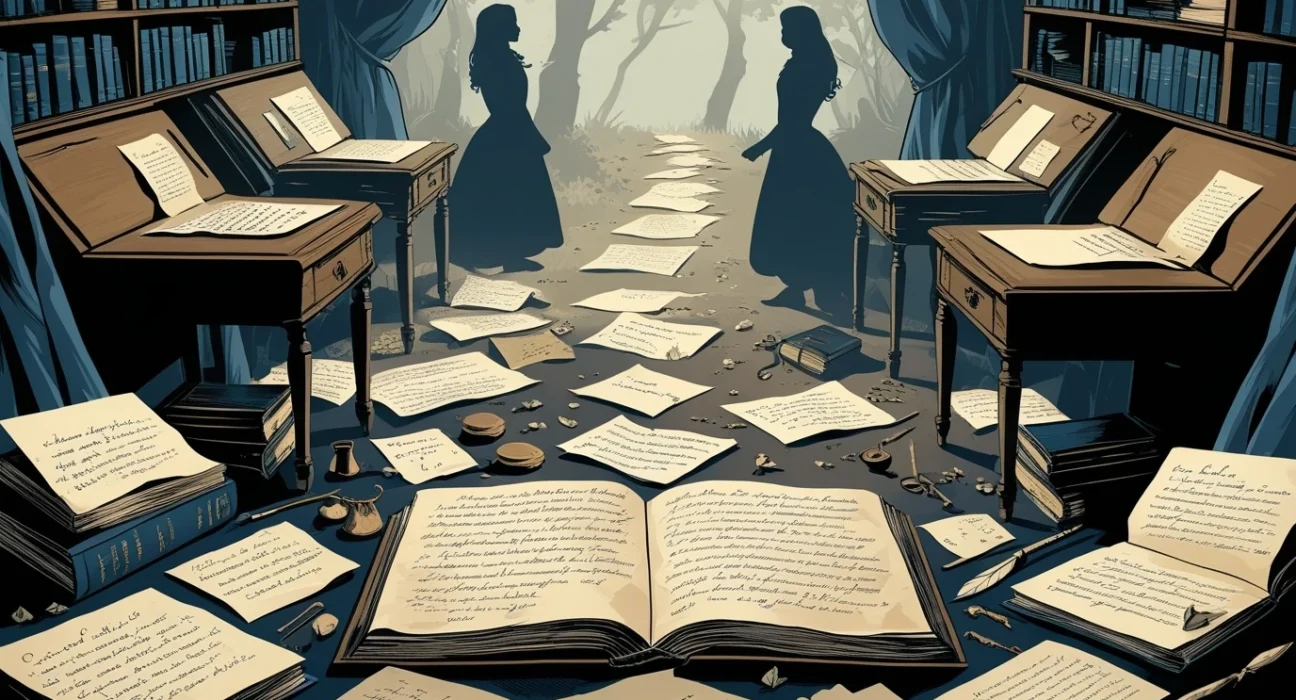
Learned by Heart by Emma Donoghue (2023) revisits the youthful years of Anne Lister – the famed diarist and trailblazing lesbian figure of the 19th century – and her intense, formative relationship with Eliza Raine. Set within the cloistered walls of the Manor School in York in the early 1800s, Donoghue’s novel unfurls a moving portrait of adolescent longing, identity, and rebellion. Inspired by true events and the actual historical figures of Lister and Raine, Donoghue blends historical fiction with epistolary storytelling to explore forbidden love within the boundaries of societal norms.
Plot Summary
In the damp, rule-laden halls of the Manor School in early 19th-century York, a girl named Eliza Raine wakes each morning under the slanted ceiling of a lonely garret. Half-English, half-Indian, she walks the fine line between propriety and invisibility, a ward of distant relatives who rarely speak her name. Her days pass in quiet obedience, her smile rehearsed, her words measured, her missteps few. She reads the silence between rules and navigates the narrow corridors of girlhood surrounded by classmates whose curiosity and cruelty flicker like candlelight.
Into this enclosed world steps Anne Lister – rain-soaked, self-assured, and unlike anyone the Manor has known. She strides through the school’s refectory as if inspecting a foreign court, her Yorkshire accent rich with confidence, her spectacles smudged, her words precise. The other girls recoil or scoff, but Eliza watches. This new arrival, with her cropped hair, appetite for knowledge, and disdain for pretense, unsettles everything Eliza has built to survive.
At first, the two spar like wild ponies boxed in a paddock. Anne intrudes upon Eliza’s solitude by being assigned to her room. She talks too loudly, eats too quickly, questions too much. Yet something about her – the heat of her attention, the hunger behind her boldness – pierces Eliza’s practiced calm. Curiosity becomes conversation. Their silences grow companionable. They begin to share more than a room: glances, secrets, notebooks filled with scribbles and truths too delicate for daylight.
Anne devours books and theories with the same appetite she brings to life. Eliza, cautious and careful, finds herself swept into debates about philosophy and astronomy, the architecture of ruined abbeys, the pulse of empires. In stolen moments and whispered phrases, the walls of the Manor shrink, giving way to larger worlds made of ideas and longing. As the school’s relentless order continues – marks for deportment, meals served with military precision, punishments doled out in silence – Anne and Eliza create a private rebellion in thought, in gaze, in growing affection.
They walk the school’s grounds as if charting new territory. Among crumbling towers and half-forgotten courtyards, they speak the unspeakable: desires unnamed, hopes unshared. Eliza, shaped by loss and distance, begins to unfold under Anne’s relentless light. Anne, in turn, reveals a heart beating furiously beneath her bravado. Their friendship slips into intimacy, quiet touches and hidden letters exchanged under the cold discipline of the school’s eye. Behind locked doors and beneath strict linen sheets, their love ignites, fervent and forbidden.
But love in such a place cannot remain hidden for long. Whispers bloom among their peers, eyes narrow, and accusations settle in the air like dust. Their classmates, quick to judge what they do not understand, measure Anne and Eliza against standards they themselves barely grasp. Anne’s brazenness draws scrutiny, while Eliza, ever the model pupil, finds herself torn between loyalty to her love and the safety of her reputation.
Their nights, once filled with shared stories and stolen kisses, begin to fray under the strain. Anne, always hungering for more – more knowledge, more freedom, more life – pushes at the boundaries of their world. She dreams of escape, of climbing society’s ladders with her intellect and wit. Eliza clings to what they have built, frightened by the looming shadow of separation.
The school’s discipline tightens. Anne’s refusal to conform, to soften her sharpness or hide her ambitions, brings punishment. Eliza, too, begins to falter under the weight of their closeness, the dual burden of love and secrecy pressing heavily on her shoulders. What was once a sanctuary of shared breath and murmured dreams becomes a battleground between fear and defiance.
Letters become the lifeline between them – notes tucked into books, smuggled under pillows, written in code. Even as they sit side by side in lessons, across from each other at meals, the gap between them widens. Anne grows restless. Eliza grows anxious. The world beyond the Manor – marriage, inheritance, propriety – begins to call, louder than ever.
Eventually, the school and the society it mirrors deliver their judgment. Anne is removed. Eliza remains, alone once again in her attic room, the shape of Anne’s absence like a bruise on the air. Life resumes its measured pace, but nothing within Eliza is unchanged. She has known love, not as something whispered about in poetry, but as a force that rewrote the boundaries of her being. And she has known loss, sharper than any reprimand or exile.
Years pass. Eliza writes, not to any real recipient but to the memory of the girl who taught her how to see. She conjures their shared time like a play performed behind her eyelids. The smell of wet stone, the thrill of an argument, the press of another’s breath in the dark – these become her refuge. The world has closed around her again, but somewhere in its quiet corners, she still walks alongside Anne.
At the Manor, the seasons change. Girls arrive and leave. Rules are taught and enforced. But the stone remembers. The ancient walls that once held the weight of two girls in love still stand, weathered and watching. The spirit of that place – of laughter under scrutiny, of love in defiance – lingers, quiet as breath.
Main Characters
- Eliza Raine – A young woman of mixed heritage, Eliza is intelligent, introspective, and burdened by her otherness in British society. As an orphan from Madras raised under English guardianship, she walks a tightrope between visibility and erasure. Her internal monologue reveals a fierce yearning for belonging, stability, and intimacy. Eliza’s experience at the Manor School is shaped by her difference—racial, social, and emotional—making her deeply conscious of hierarchy and rules. Her attachment to Anne Lister is both revelatory and redemptive, forming the emotional core of the novel.
- Anne Lister – Brash, brilliant, and unapologetically unconventional, Anne bursts into Eliza’s life like a comet. With her cropped hair, strong opinions, and sharp intellect, Anne defies the rigid expectations of 19th-century femininity. Her voracious hunger for knowledge and independence sets her apart from her peers. Anne’s relationship with Eliza is at once tender and transgressive, challenging not just social norms but Eliza’s own guarded heart. Lister’s charm lies in her audacity and fierce individuality, which both liberates and unsettles Eliza.
- Frances Selby, Margaret Burn, Betty Foster, Nan Moorsom, Mercy Smith, Fanny Peirson – These classmates of Eliza and Anne function as a social microcosm within the school. They reflect varying degrees of privilege, conformity, cruelty, and kindness. Some serve as foils, others as allies or antagonists, but each shapes the environment in which Eliza and Anne navigate their closeted love and personal growth.
Theme
- Forbidden Love and Queerness: The heart of the novel beats with Eliza and Anne’s romantic and emotional connection, set against a backdrop that demands silence, denial, and repression. Their desire is not only illicit but linguistically and culturally unnameable in their world, which gives their love a heightened fragility and fervency. Donoghue explores the cost of love that must be hidden, and the power of intimacy to validate one’s very being.
- Race and Belonging: Eliza’s biracial identity marks her as an outsider in every context—racially, socially, and geographically. Her navigation of predominantly white, class-conscious British society reveals the layers of prejudice she endures. The motif of “difference” recurs as she constantly assesses how she is seen by others, often internalizing and resisting assumptions placed upon her.
- Memory and Retrospection: The novel unfolds in a retrospective frame, with Eliza writing to Anne from the future, haunted by what was and what might have been. Memory becomes a refuge and a theatre of self-definition. The interleaving of past and present deepens the poignancy of Eliza’s voice and underscores the permanence of fleeting moments.
- Education and Intellect: Knowledge—formal and self-taught—becomes both a means of liberation and exclusion. Anne thrives on intellectual pursuit, wielding it as armor, while Eliza finds herself caught between curiosity and constraint. The rigid schooling system, with its emphasis on decorum and conformity, contrasts sharply with the girls’ subversive learning and imaginative lives.
- Confinement vs. Freedom: The Manor School is both a sanctuary and a prison, physically and emotionally. The motif of locked rooms, confined spaces, and forbidden zones contrasts with Anne’s fantasies of travel and escape. Donoghue uses space—attic rooms, forbidden courtyards, ruined towers—as metaphors for the internal and external restrictions placed on young women.
Writing Style and Tone
Emma Donoghue’s prose in Learned by Heart is lyrical, immersive, and richly textured with historical detail. She writes with emotional precision, capturing the intensity of adolescent inner life while maintaining a faithful rendering of early 19th-century language. The novel moves with the cadence of personal memory, its epistolary frame allowing for a deeply introspective and intimate tone.
Donoghue’s tone is elegiac and tender, imbued with both nostalgia and quiet fury. Her historical sensitivity never dampens the narrative’s vitality – the world of the Manor School is conjured with all its smells, silences, and daily indignities. Through Eliza’s measured reflections and Anne’s brash interjections, Donoghue creates a contrapuntal voice that sings with sorrow, yearning, and resistance. Her evocation of queer desire within rigid societal confines is quietly radical, and her character-driven storytelling remains emotionally resonant throughout.
Quotes
Learned by Heart – Emma Donoghue (2023) Quotes
“P.S. Do you only frown now, when the rain says my name? Or does it not say it anymore?”
“Can’t the past be a sort of present too, if I plunge into memory and swim like a fish? Since every moment is fleeting, gone as soon as noted, so perhaps past, present, and future are all thin slices of reality, all flickering, all equally (in some sense) true.”
“the only lesson I learned, or at least the only lesson I remember, was you.”
“After all, breakage can be blamed on the brittleness of the China as much as the rough handling”
“We both held on, but I held harder, longer, more desperately”
“It’s a sad story; if it happened to another girl, I’d weep for her”
“Human beings have invented so many new sources of pain”
“That luxurious feeling of indulging gin soft sadness for no good reason, like a girl in a romance”
“A trouble shared is a trouble halved”
“Hypotheticals, impossibilities. The dreams of youth rarely come to pass, I remind myself.”
“My waking thoughts and dreams are all occupied by you.”
“This play from two hundred years ago is somehow blabbing their secrets.”
“Who wouldn't want to look at you? Perhaps it's envy, perhaps plain worship.”
“Margaret's qualities are so much more shining than Eliza's. The notion of having to compete to keep her friend makes Eliza contract like a snail into its shell.”
“She can't remember why she ever thought she preferred to room alone.”
“Ah, clearly the vast Subcontinent is only to be allotted two cities, even though Europe's riddled with names.”
“No, I remembered you as the most beautiful girl I've ever seen.”
We hope this summary has sparked your interest and would appreciate you following Celsius 233 on social media:
There’s a treasure trove of other fascinating book summaries waiting for you. Check out our collection of stories that inspire, thrill, and provoke thought, just like this one by checking out the Book Shelf or the Library
Remember, while our summaries capture the essence, they can never replace the full experience of reading the book. If this summary intrigued you, consider diving into the complete story – buy the book and immerse yourself in the author’s original work.
If you want to request a book summary, click here.
When Saurabh is not working/watching football/reading books/traveling, you can reach him via Twitter/X, LinkedIn, or Threads
Restart reading!


