The Education of Henry Adams, published posthumously in 1918, is an autobiographical reflection on the complexities of modernity by American historian and writer Henry Adams. Known for its philosophical insights and innovative structure, the book explores Adams’ quest to understand the forces shaping his life and the evolving world around him. Unlike typical autobiographies, Adams presents his experiences not as personal achievements but as a journey to comprehend the historical forces shaping society, emphasizing the challenges and paradoxes of the 19th and early 20th centuries.
Plot Summary
The birth of Henry Adams in 1838 on Boston’s Beacon Hill seemed, to his young eyes, to secure his fate. With a lineage rooted in the American Revolution and a family steeped in the highest echelons of Boston society, his life was set to follow certain expectations. His great-grandfather was John Adams, the second U.S. President, and his grandfather, John Quincy Adams, had also presided over the country. But as Henry grew, he found himself wrestling with the sense that he was born into a world utterly different from the world of his ancestors—a world reshaped by railways, steam power, and telegraphs. This new world, he would come to realize, had no interest in the stable, old ideals his forebears upheld.
In childhood, Henry lived in Quincy, Massachusetts, a town laced with history. His youthful days were spent between the harsh Boston winters and the idyllic summers of Quincy, where the rigid structure of Beacon Hill life gave way to freedom and nature. Yet even as a child, Henry saw the contrasts that shaped his life: Boston stood for law and discipline, Quincy for liberty. As he grew older, he would find his spirit caught in this tension between duty and freedom, between a world of strict order and the widening possibilities of his time.
Following his grandfather’s death, Henry was sent to Boston schools, where he was educated among children of Boston’s elite. His father, Charles Francis Adams, though always a part of this society, was an individualist, and Henry admired his father’s quiet independence, learning from him an aloof skepticism of popular opinion. His father’s career took them to Washington, D.C., during the Civil War, where he served as Lincoln’s ambassador to Britain. Henry joined him there, observing the diplomats and officials who filled their days with politicking. The young man’s mind was often fixed on how unprepared he felt for the rapidly evolving world, despite his family’s reputation and Boston education.
After returning to America, Henry took on a post as his father’s private secretary, traveling to Europe, where he observed the intellectuals and the old-world traditions that seemed to clash with the industriousness of modern America. Yet he returned to the U.S. with little sense of direction. In Boston, he attempted a career in law but found the occupation uninspiring. His mind, trained on ideas and history rather than practice, could not bend to the task. Seeking a different path, he turned to journalism, taking a position as an editor in Washington, D.C. Here, he found himself amidst debates and political squabbles that sharpened his wit and deepened his skepticism about politics and power.
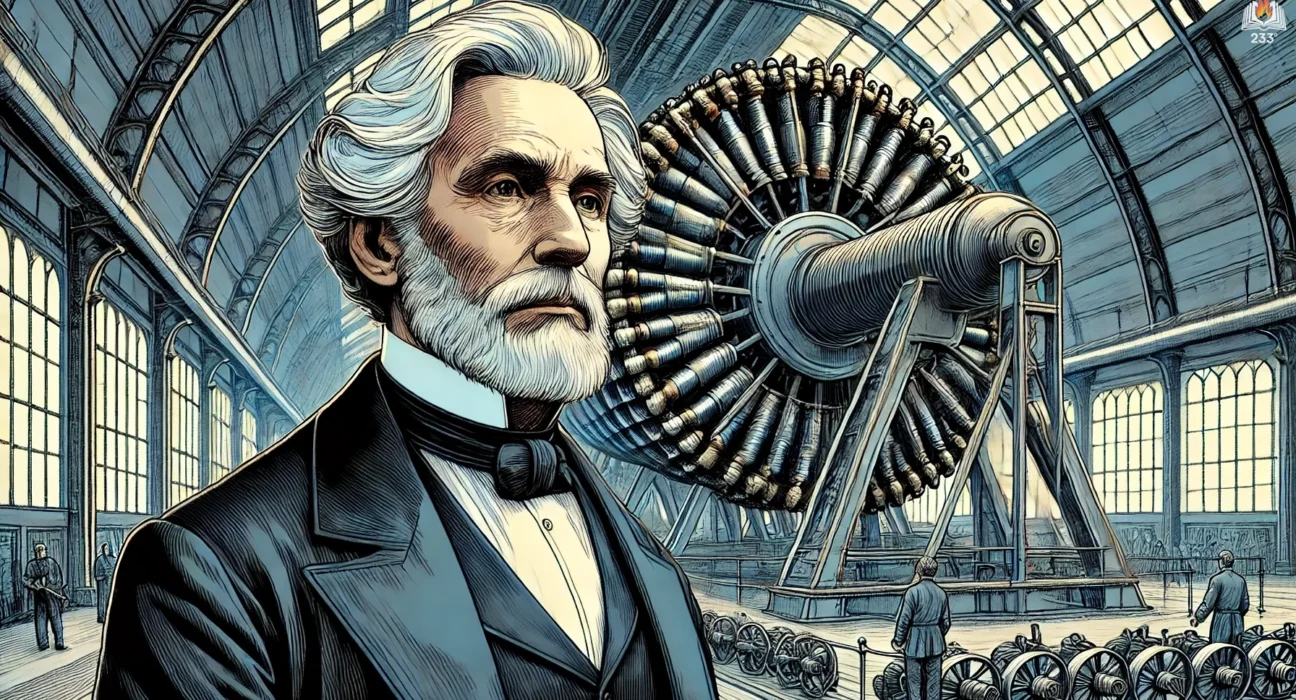
The years that followed saw him lecturing on history at Harvard and writing prolifically. But Henry’s mind was drawn increasingly to science and the technological forces shaping the age. He saw power moving away from the ideas that had structured the previous century—faith, tradition, unity—and toward the abstract and impersonal might of technology. The steam engine, the telegraph, and most intriguingly, the dynamo, fascinated him. The dynamo, in particular, symbolized a force beyond human control, a power that seemed almost godlike, yet alien. In it, Henry saw the dawn of a new age, one defined by forces humanity could barely understand, let alone master.
Despite his accomplishments and travels, Henry grew more troubled by the pace of change. Scientific advancements seemed to promise much yet left him with a sense of unease. The shift from an era of unity, embodied by the medieval cathedral of Mont Saint Michel—a subject of his study—to an era of multiplicity and fractured knowledge made him uneasy about the future. His time in Washington and at Harvard had not answered his deeper questions. What did progress truly mean? Could it bring meaning or understanding, or was it merely an accumulation of power without purpose?
His anxieties deepened when his sister, Clover, fell ill, and he watched helplessly as she withdrew from life, haunted by depression. Her death marked him deeply, shaking his belief in the ordered, rational world of his father’s time. From this point forward, Henry began to question not just the purpose of his education but of human education as a whole. What value was learning when it could not save the people he loved or provide solace in times of grief?
In response, he turned his attention to history with a new fervor, hoping to find in it a template for making sense of the world. In his later years, he became deeply engrossed in a study of medieval Europe, where he believed that a unifying force, the Virgin Mary, held society together. The Virgin, as he saw her, was a symbol of unity, an emblem of purpose that contrasted sharply with the cold, mechanical power of the dynamo. In this study, he traced the evolution of faith and unity in a world that no longer knew such certainties. It was an age that could grasp both science and faith without tearing itself apart, a skill he found increasingly rare in his own era.
But as he reached the twilight of his life, Henry found himself no closer to answers. The question of purpose in an era of relentless change, the tension between faith and science, left him in a kind of intellectual exile. The more he studied the dynamo, the more he felt himself estranged from the world around him. He saw others embracing new ideologies, new technologies, and yet he clung to the hope that perhaps history held answers, that by understanding the past, he might glimpse a way forward.
He died in 1918, leaving his reflections behind in this work—a record not just of one man’s life but of a quest to reconcile the past and future. Henry’s journey through history and science, faith and skepticism, ends unresolved, capturing the uncertainties of a new age that he would not live to see fulfilled. His life, shaped by privilege, history, and intellect, was a search for education that would grant understanding in an era of contradictions. And so his education, unfinished and incomplete, mirrors the journey of a world that continues to wrestle with the same forces today.
Main Characters
Henry Adams – The narrator and main character, Adams is a thoughtful and introspective historian whose intellectual and personal journey underpins the work. With a strong family legacy of political involvement, he feels both privileged and burdened by his heritage. His curiosity and critical perspective on modernity and science shape his experiences and reflections.
Charles Francis Adams Sr. – Henry’s father and a prominent diplomat, Charles is a balanced figure, imparting traditional values while supporting his son’s intellectual development. His political and diplomatic career during turbulent periods significantly influences Henry’s worldview.
John Quincy Adams – Although not a central figure in the narrative, Henry’s grandfather, the sixth U.S. President, represents an ancestral legacy that shapes Henry’s sense of duty, identity, and the weight of history.
Brooks Adams – Henry’s younger brother, a fellow intellectual and historian, provides a contrast to Henry’s perspective on progress and modernity. Brooks’ critical view of capitalism and history influences Henry’s reflections on societal evolution.
Theme
Education and Knowledge – Central to the narrative, Adams examines the inadequacy of formal education to prepare individuals for the complexities of modernity. Through various “educations” across countries, disciplines, and experiences, he questions the ability of traditional learning to address contemporary societal shifts.
Science and Technology – Adams is fascinated and often overwhelmed by the scientific advancements of his time. He uses the metaphor of the “Dynamo” to illustrate the new, almost mystical power of technology, contrasting it with the static “Virgin” symbol of medieval stability, which he explored in a preceding book, Mont-Saint-Michel and Chartres.
Historical Relativism and Change – Throughout the book, Adams highlights the transition from the unity of the medieval world to the multiplicity of the modern age, reflecting a world increasingly driven by conflicting forces. His theory of “Multiplicity” underscores his perception of accelerating changes and complexities.
Crisis of Identity and Legacy – Adams grapples with his place within the historical legacy of his family and country, questioning how one should live and contribute meaningfully in an era vastly different from his ancestors’.
Writing Style and Tone
Henry Adams employs a reflective and analytical narrative style, using third-person self-reference to create a sense of distance and objectivity, which lends a philosophical quality to his personal reflections. This choice of perspective frames Adams’ life as a case study in adaptation—or failure to adapt—to the modern world. His language is formal, yet he introduces humor and irony to engage readers with his critiques of society, tradition, and the educational system.
The tone throughout is one of ambivalence. Adams frequently oscillates between awe and skepticism toward scientific progress, feeling that modern advancements offer both empowerment and disorientation. His detached yet critical voice embodies the introspective uncertainty of a man from one era attempting to understand another, revealing an underlying anxiety about the durability of values, identity, and wisdom in an age of constant change.
Quotes
The Education of Henry Adams – Henry Adams (1918) Quotes
“Chaos was the law of nature; Order was the dream of man.”
“No man means all he says, and yet very few say all they mean, for words are slippery and thought is viscous.”
“A parent gives life, but as parent, gives no more. A murderer takes life, but his deed stops there. A teacher affects eternity; he can never tell where his influence stops.”
“Unity is vision; it must have been part of the process of learning to see.”
“A new friend is always a miracle, but at thirty-three years old, such a bird of paradise rising in the sage-brush was an avatar. One friend in a lifetime is much; two are many; three are hardly possible.”
“The chief wonder of education is that it does not ruin everybody concerned in it, teachers and taught.”
“A friend in power is a friend lost.”
“He never labored so hard to learn a language as he did to hold his tongue, and it affected him for life. The habit of reticence
“Knowledge of human nature is the beginning and end of political education.”
“Of all studies, the one he would rather have avoided was that of his own mind. He knew no tragedy so heartrending as introspection.”
“Nature, to be commanded, must be obeyed. The imagination must be given not wings but weights.”
“Philosophy . . .consists chiefly in suggesting unintelligible answers to insoluble problems.”
“The difference is slight, to the influence of an author, whether he is read by five hundred readers, or by five hundred thousand; if he can select the five hundred, he reaches the five hundred thousand.”
“The tourist was the great conservative who hated novelty and adored dirt.”
“The study of history is useful to the historian by teaching him his ignorance of women.”
“The habit of expression leads to the search for something to express. Something remains as a residuum of the commonplace itself, if one strikes out every commonplace in the expression.”
“Double standards are inspiration to men of letters, but they are apt to be fatal to politicians.”
“In practice, such trifles as contradictions in principle are easily set aside; the faculty of ignoring them makes the practical man.”
“the problem of life was as simple as it was classic. Politics offered no difficulties, for there the moral law was a sure guide. Social perfection was also sure, because human nature worked for Good, and three instruments were all she asked
“In Paris and London he had seen nothing to make a return to life worth while; in Washington he saw plenty of reasons for staying dead.”
“Everyone must bear his own universe, and most persons are moderately interested in learning how their neighbors have managed to carry theirs.”
“Charles Francis Adams was singular for mental poise
“The habit of looking at life as a social relation
“General Grant seriously remarked to a particularly bright young woman that Venice would be a fine city if it were drained.”
“When one thinks what one leaves in the world when one dies, Only silence is strong, - all the rest is but lies.”
We hope this summary has sparked your interest and would appreciate you following Celsius 233 on social media:
There’s a treasure trove of other fascinating book summaries waiting for you. Check out our collection of stories that inspire, thrill, and provoke thought, just like this one by checking out the Book Shelf or the Library
Remember, while our summaries capture the essence, they can never replace the full experience of reading the book. If this summary intrigued you, consider diving into the complete story – buy the book and immerse yourself in the author’s original work.
If you want to request a book summary, click here.
When Saurabh is not working/watching football/reading books/traveling, you can reach him via Twitter/X, LinkedIn, or Threads
Restart reading!