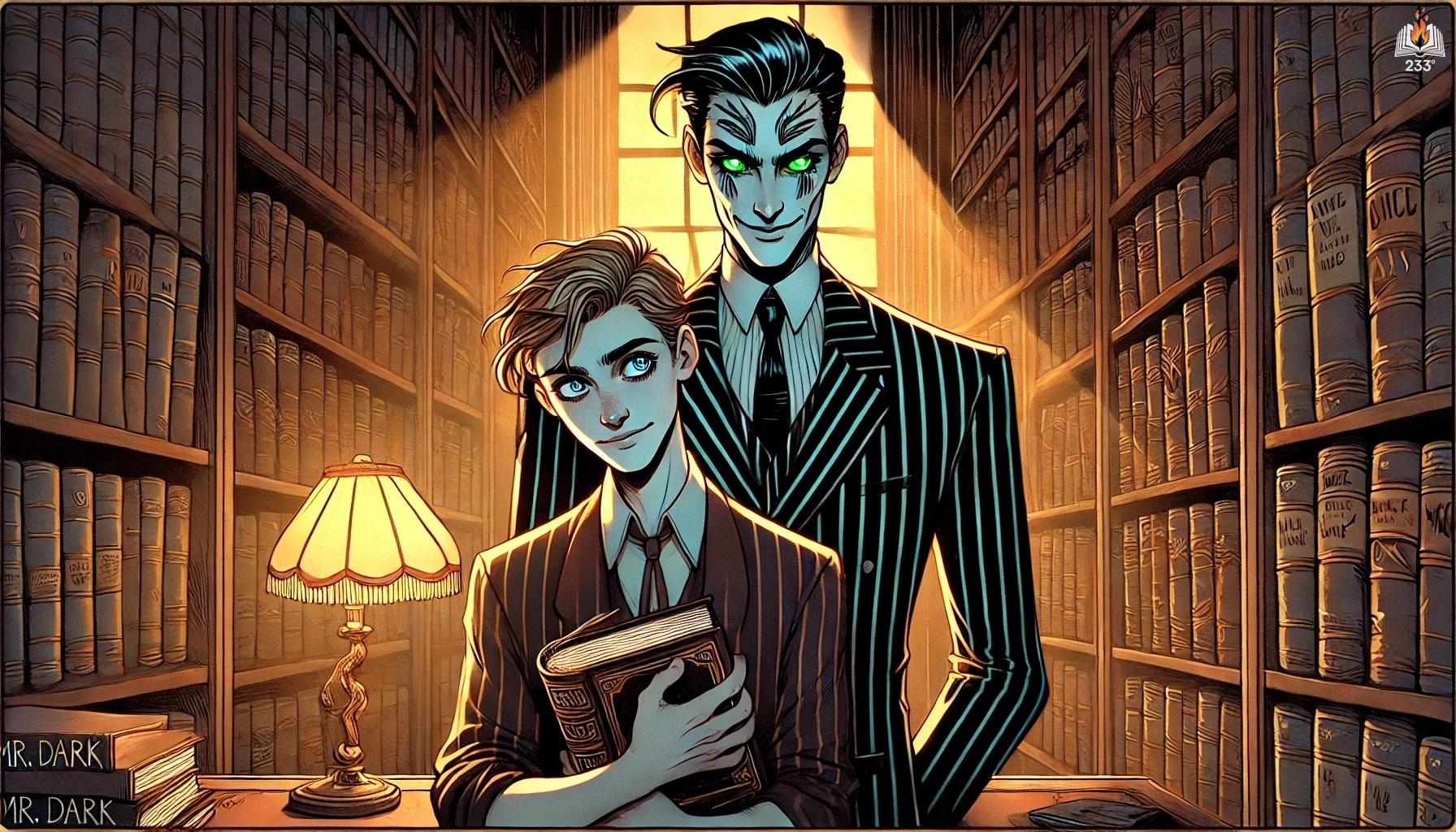

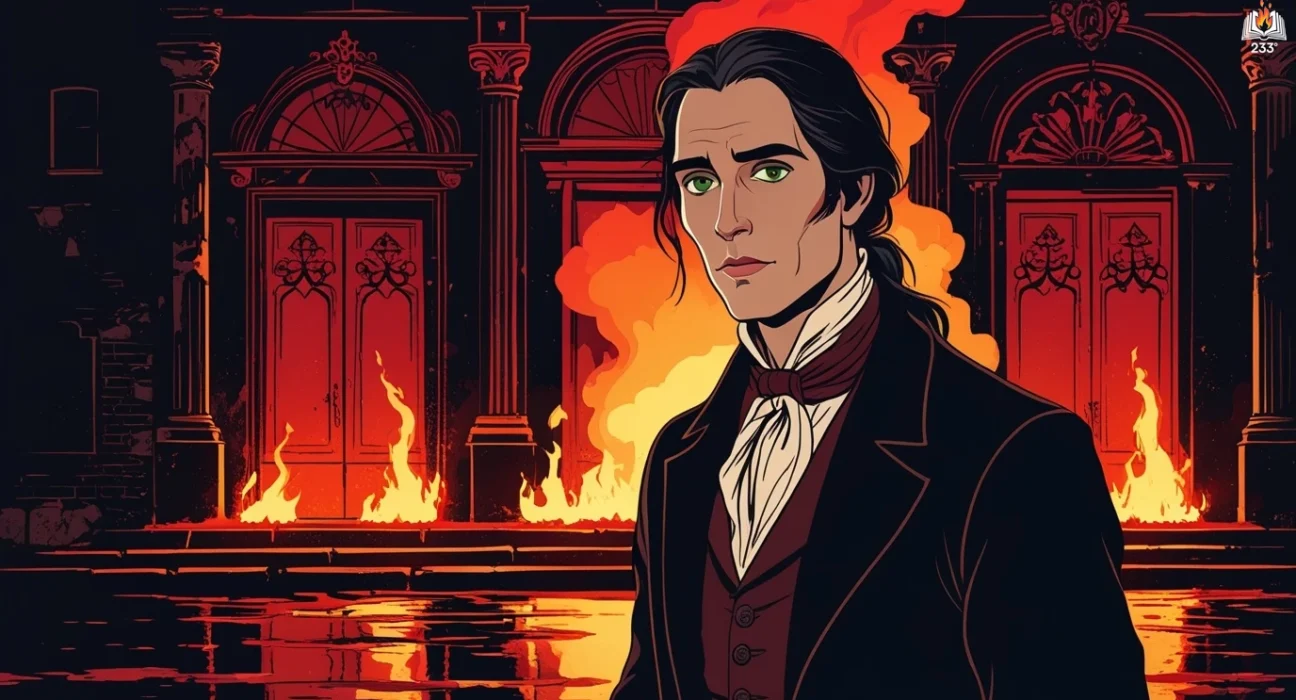
Interview with the Vampire, written by Anne Rice and first published in 1976, is the debut novel in her iconic The Vampire Chronicles series. Framed as a confessional interview, the novel chronicles the life of Louis de Pointe du Lac, a 200-year-old vampire, as he recounts his transformation, existential anguish, and complex relationships with other vampires, particularly the enigmatic and manipulative Lestat de Lioncourt. With its gothic tone and philosophical undertones, the book reshaped vampire fiction and established Rice as a master of modern horror.
Plot Summary
In the dim stillness of a San Francisco room, beneath a weak yellow light and the drone of passing cars outside, a young journalist listens as a pale stranger begins to speak. The man’s voice is calm, patient – his face whiter than bone, his green eyes like living flame. He is a vampire, and he wishes to tell the tale of his life.
He had once been Louis de Pointe du Lac, a mortal man in Louisiana in the year 1791. Mourning the death of his younger brother, haunted by guilt, Louis sought escape in ruin. Alcohol, violence, and the wish for death consumed him. It was then that he encountered Lestat – radiant, cruel, captivating – who offered him a new life. Or rather, a different death. Louis accepted, not out of desire, but despair, and in doing so began the slow descent into immortality.
Louis awoke to a world newly born. Shadows pulsed with secrets, light burned like truth, and sound became a symphony of nuance. Yet beauty could not mask the horror. To live, he must kill. To endure, he must abandon his soul. But Louis could not surrender so easily. Lestat, who cared little for questions of morality or suffering, fed with ease, laughing through the centuries like a man drunk on his own invincibility. Louis, bound to him by dependence and uncertainty, lingered in doubt, feeding on rats and livestock, resisting the abyss.
Their home became Pointe du Lac, the plantation that once belonged to Louis in his human years. There, under the heavy Southern air and among moss-draped oaks, Louis watched the days turn to decades. The slaves whispered of devils in the house. Servants fled. The plantation grew quiet, broken only by Lestat’s fits of dominance and Louis’s long silences.
Time moved like smoke through a sieve. Lestat, desperate to keep Louis close, brought a gift – a five-year-old girl orphaned by plague, left crying beside her mother’s corpse. He turned her, and Claudia was born into darkness. Though her mind matured, her body remained frozen in its childlike form, and so she became the perfect paradox: a predator cloaked in innocence.
Claudia and Louis formed a bond – one of affection, shared sorrow, and the loneliness of eternity. She despised Lestat, saw in him the architect of her prison, and in time, she acted. Poisoned with the blood of the dead and finished with a blade, Lestat was left for ruin. The house burned, the past consumed in flame, and Claudia and Louis fled across the sea.
They wandered Europe, searching for others like themselves, seeking knowledge, purpose, perhaps even salvation. Their journey led them to Paris, to the Théâtre des Vampires – a company of undead who masked their nature behind elaborate performances. There they met Armand, an ancient creature who moved with elegance and spoke of truth buried beneath centuries.
Armand saw in Louis a purity, a yearning untouched by time. He extended an invitation – stay with him, learn from him, and perhaps find the meaning Louis had always sought. But Claudia, with her ageless body and mature will, threatened that balance. She could not be a part of Louis’s future. The vampires of the Théâtre, led by the capricious Santiago, took her away. Accused of the ultimate sin – killing one of their own – she was condemned.
Louis found her ashes in the morning sun, her small form clinging to that of another woman, Madeleine, whom she had begged Louis to turn as a companion. The grief shattered him. With fire and blade, he returned to the Théâtre, destroyed the coven, and left the stage awash in flames and death. Only Armand survived.
Louis stayed with Armand for some time, drifting through shadows and ruins, never finding peace. The centuries dulled his pain but did not silence it. He returned to New Orleans in the twentieth century, alone, a wanderer among mortals. There, one evening, he found Lestat again.
But Lestat was no longer the luminous figure of before. He had withered, weakened by time and solitude, hiding like a wounded animal in a decaying house. His pride was cracked, his voice reduced to memories. Louis felt no vengeance, only the cold echo of something that might have been pity.
The vampire concludes his tale, the tape nearly full. The boy, wide-eyed and enthralled, offers himself – to be turned, to join this eternal dance, to never die. But Louis only watches him, indifferent to such desires. He vanishes, leaving behind silence and an empty chair.
And yet, the boy runs from the room, the tapes clutched to his chest, searching for Lestat. He wants more than the story. He wants the life that never ends.
Main Characters
Louis de Pointe du Lac: Louis is the deeply introspective and guilt-ridden protagonist whose transformation into a vampire is marked not by power or liberation, but by grief and spiritual torment. Haunted by the death of his brother and his subsequent loss of faith, Louis serves as both narrator and tragic figure, constantly seeking meaning in his immortal existence. His struggle defines the emotional core of the novel, as he clings to remnants of his humanity even while succumbing to his vampiric nature.
Lestat de Lioncourt: Lestat is the vampire who turns Louis, driven by his own selfish needs and desire for companionship and control. Charismatic yet callous, he thrives on manipulation and chaos, embodying a hedonistic view of vampirism. Though initially seen through Louis’s bitter perspective, Lestat later reveals layers of insecurity and desperation, making him an ambiguous figure who oscillates between antagonist and tragic antihero.
Claudia: A young girl turned into a vampire by Lestat to anchor Louis’s loyalty, Claudia becomes a central and haunting figure. Though eternally trapped in the body of a child, her mind matures into that of a cunning, frustrated, and ultimately vengeful woman. Her existence defies nature and exposes the cruelty of immortality, culminating in a devastating arc that reflects the consequences of power without consent.
The Boy (Daniel Molloy): A mortal journalist conducting the interview, the Boy serves as the reader’s surrogate, reacting to Louis’s story with fascination and disbelief. His presence frames the narrative and subtly shifts in tone from admiration to obsession, suggesting a broader commentary on the allure of the vampire myth.
Theme
Immortality and Existentialism: The novel delves into the psychological toll of eternal life. Louis’s philosophical reflections raise profound questions about the nature of the soul, morality, and the value of existence. Immortality is not romanticized but presented as an existential burden that magnifies loneliness and despair.
The Loss of Faith and the Search for Meaning: After the death of his brother, Louis grapples with his Catholic upbringing and spiritual beliefs. His transformation into a vampire further alienates him from God and humanity, turning his life into a ceaseless quest for redemption, purpose, and understanding.
Power, Control, and Dependency: The relationship between Louis, Lestat, and Claudia explores themes of manipulation, dominance, and codependency. Lestat’s control over Louis, Claudia’s rebellion, and the cyclical abuse among the trio reflect a toxic dynamic where love is often indistinguishable from control.
The Gothic and the Grotesque: Anne Rice revitalizes gothic conventions with lush, baroque prose and macabre beauty. The motif of decaying elegance pervades the novel, from crumbling mansions to the grotesque contrast of Claudia’s childlike appearance and mature mind, reinforcing the horror that lies beneath the seductive surface.
Alienation and Otherness: As vampires, the characters exist on the fringes of society, eternally separated from the world they observe. This outsider status intensifies their introspection and creates an enduring metaphor for those who feel estranged from humanity, be it due to queerness, trauma, or ideology.
Writing Style and Tone
Anne Rice’s writing style in Interview with the Vampire is ornate, lyrical, and deeply immersive. She crafts the narrative with poetic flourishes and evocative imagery that transport readers into the lush decadence of 18th and 19th-century settings. The prose mirrors Louis’s introspective and tormented voice, oscillating between moments of sublime beauty and stark horror. The pace is meditative rather than action-driven, emphasizing atmosphere and internal conflict over traditional plot structures.
Her use of first-person narration imbues the novel with a confessional tone, drawing readers into Louis’s psychological landscape. This technique lends an intense intimacy to the storytelling, allowing philosophical digressions and moral debates to feel organic. The tone is somber, reflective, and at times mournful, anchoring the supernatural elements in emotional realism. Despite its gothic grandeur, Rice’s narrative remains grounded in human anguish, making the horror all the more resonant.
Quotes
Interview with the Vampire – Anne Rice (1976) Quotes
“Evil is always possible. And goodness is eternally difficult.”
“The world changes, we do not, therein lies the irony that kills us.”
“Consequently, if you believe God made Satan, you must realize that all Satan's power comes from God and so that Satan is simply God's child, and that we are God's children also. There are no children of Satan, really.”
“The only power that exists is inside ourselves.”
“People who cease to believe in God or goodness altogether still believe in the devil... Evil is always possible. And goodness is eternally difficult.”
“It was as if when I looked into his eyes I was standing alone on the edge of the world...on a windswept ocean beach. There was nothing but the soft roar of the waves.”
“Like all strong people, she suffered always a measure of loneliness; she was a marginal outsider, a secret infidel of a certain sort.”
“Do you know what it means to be loved by Death?... Do you know what it means to have Death know your name?”
“And what constitutes evil, real evil, is the taking of a single human life. Whether a man would die tomorrow or the day after or eventually... it doesn't matter. Because if God does not exist, then life... every second of it... Is all we have.”
“And I realized that I’d tolerated him this long because of self-doubt.”
“As if the night had said to me, ‘You are the night and the night alone understands you and enfolds you in its arms’ One with the shadows. Without nightmare. An inexplicable peace.”
“How pathetic it is to describe these things which can't truly be described.”
“In the spring of 1988, I returned to New Orleans, and as soon as I smelled the air, I knew I was home. It was rich, almost sweet, like the scent of jasmine and roses around our old courtyard. I walked the streets, savoring that long lost perfume.”
“I was a newborn vampire, weeping at the beauty of the night.”
“Every moment must be first known and then savored.”
“Don't you see? I'm not the spirit of any age. I'm at odds with everything and always have been! I have never belonged anywhere with anyone at any time!”
“I lived like a man who wanted to die but who had no courage to do it himself.”
“I love you still, that's the torment of it. Lestat I never loved. But you! The measure of my hatred is that love. They are the same! Do you know now how much I hate you!”
“Don't be a fool for the Devil, darling.”
“Let the flesh instruct the mind.”
“I allowed myself to forget how totally I had fallen in love with Lestat's iridescent eyes, that I'd sold my soul for a many-colored and luminescent thing, thinking that a highly reflective surface conveyed the power to walk on water.”
“It was as if this night were only one of thousands of nights, world without end, night curving into night to make a great arching line of which I couldn’t see the end, a night in which I roamed alone under cold, mindless stars.”
“A starving child is a frightful sight. A starving vampire, even worse.”
“That is the crowning evil, that we can even go so far as to love each other, you and I. And who else would show us a particle of love, a particle of compassion or mercy? Who else, knowing us as we know each other, could do anything but destroy us? Yet we can love each other.”
We hope this summary has sparked your interest and would appreciate you following Celsius 233 on social media:
There’s a treasure trove of other fascinating book summaries waiting for you. Check out our collection of stories that inspire, thrill, and provoke thought, just like this one by checking out the Book Shelf or the Library
Remember, while our summaries capture the essence, they can never replace the full experience of reading the book. If this summary intrigued you, consider diving into the complete story – buy the book and immerse yourself in the author’s original work.
If you want to request a book summary, click here.
When Saurabh is not working/watching football/reading books/traveling, you can reach him via Twitter/X, LinkedIn, or Threads
Restart reading!