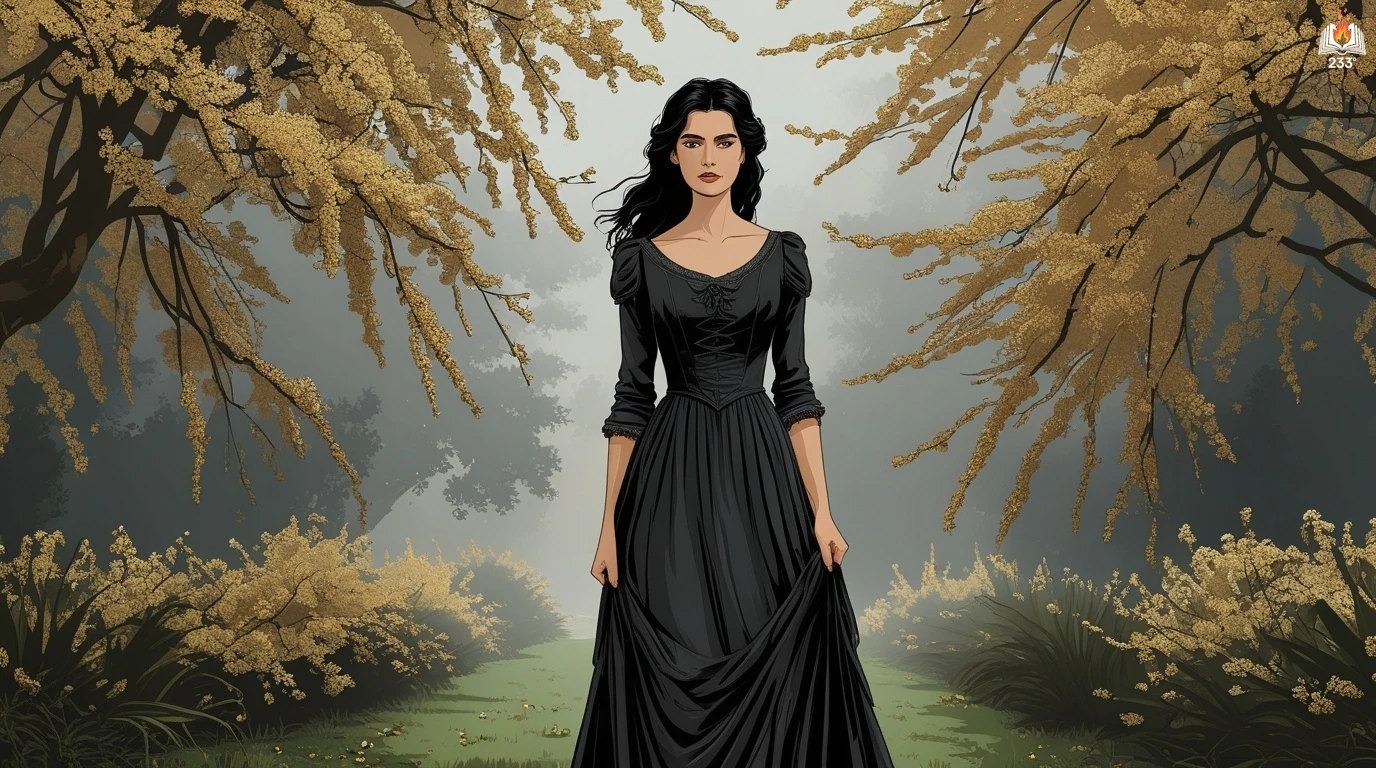


The Blithedale Romance by Nathaniel Hawthorne, published in 1852, is a richly allegorical novel rooted in the author’s personal experience at Brook Farm, a short-lived utopian community in Massachusetts. The novel blends social critique, psychological depth, and gothic intrigue through the lens of an experimental society called Blithedale. Though infused with idealism, the narrative quickly unravels into betrayal, passion, and tragedy, making it one of Hawthorne’s most psychologically intricate and thematically layered works. As part of Hawthorne’s major literary canon, alongside The Scarlet Letter and The House of the Seven Gables, this novel offers a brooding and introspective examination of 19th-century American reformist movements and personal moral complexities.
Plot Summary
Beneath a flurry of snowflakes and the ashen sky of a Massachusetts April, a young poet named Miles Coverdale journeyed from his warm, indulgent city apartment into the rustic unknown of Blithedale – a communal farm born of utopian ambition. Seeking renewal and purpose, he joined three others in this endeavor: the zealous philanthropist Hollingsworth, the radiant and forceful Zenobia, and the frail, mysterious Priscilla. Though cloaked in shared idealism, the atmosphere at Blithedale soon thickened with secrets, desires, and the unseen weight of past lives.
Zenobia shone among them like a figure cast from marble and fire, her beauty as formidable as her wit. She moved with regal confidence and commanded attention, often clashing with the stern Hollingsworth, whose singular devotion to his vision – the reform of criminals through an edifice built for their redemption – brooked no deviation. Into this simmering mix arrived Priscilla, a silent girl draped in timidity, clutching a fragile chain of connection that none yet understood. Her presence, seemingly meek, shifted the balance in imperceptible ways. She gravitated toward Hollingsworth with blind devotion, while Zenobia looked upon her with a blend of protectiveness and resentment.
Beneath Blithedale’s idealistic mission festered disillusionment. The men and women who toiled there, hoping to find harmony in labor and moral clarity in reform, gradually sensed the weight of the very world they meant to leave behind. The soil they tilled proved stubborn. Gender roles persisted beneath the thin veneer of equality, and the camaraderie of brotherhood waned as passions tangled into possessiveness and veiled rivalries.
Coverdale, who had fallen ill shortly after arrival, watched much of this from the periphery, increasingly seeing the community not as a collective dream but as a theater of fragile egos and failed intimacies. Zenobia, who had once been the queen of this pastoral stage, found herself fading from prominence, undone not by her ideals but by her heart. She loved Hollingsworth with a burning depth, and when he turned instead to Priscilla, her spirit began to fray.
The ghostly thread that bound Priscilla to the past emerged in the figure of old Moodie – a tattered and secretive man who wandered into Blithedale’s narrative with the weight of confession in his eyes. He was her father, long disgraced, and had sent her into the world under another name to escape a legacy of shame. But darker still was Priscilla’s connection to the world of mesmerism, embodied in the sinister Professor Westervelt, a man who had once manipulated her as the famed and veiled clairvoyant lady in city spectacles. Westervelt resurfaced like a shadow at noon, threatening to reclaim Priscilla, not for love or family, but for spectacle and control.
Zenobia, in a cruel gesture wrapped in despair, handed Priscilla over to Westervelt, sealing an unspoken betrayal that mirrored the greater one already consuming her heart. Yet Priscilla’s tether to Hollingsworth proved stronger than Westervelt’s enchantments. In a dramatic confrontation at the wooded site called Eliot’s pulpit, the strands of deception, love, and identity finally wove into a painful knot. There, Hollingsworth renounced Zenobia, declaring his allegiance to Priscilla. His choice, offered without tenderness, struck Zenobia like a thunderbolt. Her composure shattered.
That night, the icy stillness of the forest was broken by the soundless fall of Zenobia’s body into the river. Her death was neither theatrical nor gentle. It carried the weight of solitude – not just in her final act but in the years that had preceded it. She had borne herself like a queen, but in the end, no throne remained beneath her feet.
The river gave up her form only after a harrowing search. Hollingsworth, once noble in purpose, now stood hollow beside her body. Guilt etched his features deeper than time ever could. Priscilla knelt beside them both, her love no longer an innocent offering but a complicated tether of salvation and grief.
Coverdale, in his quiet return to the world beyond Blithedale, bore the memories like embers that refused to die. Time passed, and his bachelorhood thickened into solitude. His mind, once occupied by verse and philosophy, now turned to regret and silence. Of all the roles played in that remote New England experiment, his had been the most spectral. He had watched and chronicled, dissected and mused, but never touched the heart of the flame. In the end, he confessed only one truth – that he too had loved Priscilla. But his love was buried beneath layers of hesitation, masked by irony, too thin to pierce the veil of her devotion to another.
Blithedale faded into memory. Its ideals, once wrapped in the fresh linen of spring, were stained by passion and loss. The soil remained. The trees still whispered in the breeze. But the experiment had collapsed under the weight of its own unacknowledged desires. In the quiet ashes of that endeavor lingered the ghost of what might have been – a brotherhood, a sisterhood, a sanctuary – now dissolved.
And so the curtain of snow that had fallen at the beginning now rose again in memory, shrouding the fields, the farmhouse, the old ideals. The fire that had once burned in the hearth sputtered into smoke. No warmth remained for the poet who had watched it all and left untouched. The story ended not with revelation, but with a sigh – the long exhale of dreams undone.
Main Characters
Miles Coverdale: The narrator and central consciousness of the story, Coverdale is a poet who joins the Blithedale community in search of purpose and inspiration. Despite his initial enthusiasm, he remains emotionally detached and observant rather than involved. Coverdale’s retrospective narration reveals a deep ambivalence – he is simultaneously curious, passive, skeptical, and, at times, intrusive. His emotional inertia and failure to commit to the ideals or people around him make him a compelling but unreliable narrator.
Zenobia: A passionate, charismatic, and outspoken woman, Zenobia symbolizes feminist independence and sensuality. Her presence dominates the community with her beauty, intellect, and confidence. However, beneath her strength lies vulnerability, particularly in her unreciprocated love for Hollingsworth and her ultimate tragic fate. Zenobia is modeled partially on Margaret Fuller, and her arc explores the tension between public empowerment and private despair.
Hollingsworth: A grim and single-minded philanthropist, Hollingsworth dedicates himself to the reformation of criminals. He is intense, persuasive, and ultimately manipulative, demanding total allegiance to his cause. His rigidity alienates those closest to him, particularly Zenobia, whose love he ultimately spurns. Hollingsworth embodies the danger of idealism untempered by empathy or balance.
Priscilla: A delicate, ethereal figure, Priscilla is introduced as a mysterious girl with ties to mesmerism and the enigmatic figure of the Veiled Lady. She is weak and submissive, serving as a foil to Zenobia. Priscilla’s devotion to Hollingsworth and her submissive nature raise questions about the costs of innocence and dependence. Her eventual triumph over Zenobia is quiet but morally ambiguous.
Old Moodie (Fauntleroy): A shabby, secretive old man with a mysterious past, Moodie is Priscilla’s father and the key to understanding her connection to the aristocratic world. He represents themes of disguise, shame, and the buried secrets of class and identity.
Professor Westervelt: A sinister mesmerist and manipulator, Westervelt is linked to Priscilla’s past as the Veiled Lady. He serves as a gothic figure of power and exploitation, and his machinations underscore the darker undercurrents of control and illusion.
Theme
Idealism vs. Reality: The novel scrutinizes the tension between utopian aspiration and human imperfection. Blithedale promises equality and brotherhood, but the reality becomes mired in ego, desire, and betrayal. The narrative questions whether noble ideals can ever truly thrive amidst human frailty.
Gender and Power: Zenobia and Priscilla represent conflicting female archetypes – the assertive feminist versus the submissive angel. Through their rivalry and relationships, the novel interrogates the roles imposed on women and critiques a patriarchal society’s fear of female autonomy.
Alienation and Detachment: Coverdale’s role as an observer rather than participant reflects a broader theme of emotional detachment. His failure to connect deeply with others, despite intense curiosity, speaks to the limits of introspection without engagement.
Secrets and Masks: Disguises – both literal and metaphorical – pervade the story. From the Veiled Lady to pseudonyms and hidden pasts, characters are cloaked in mystery. This motif reflects the tension between public identity and private truth.
Betrayal and Disillusionment: Personal betrayals – Zenobia’s by Hollingsworth, Priscilla’s by Zenobia, and Coverdale’s self-betrayal – mirror the larger failure of the Blithedale project. Hawthorne suggests that betrayal is inevitable when people project their ideals onto imperfect others.
Mesmerism and the Supernatural: Hawthorne uses the then-popular fascination with mesmerism to explore themes of control, manipulation, and the porous boundaries between illusion and reality.
Writing Style and Tone
Nathaniel Hawthorne’s prose in The Blithedale Romance is characteristically dense, introspective, and symbolic. Employing a first-person narrative through Miles Coverdale, Hawthorne crafts a voice that is at once elegant and elusive. The language is richly descriptive and often poetic, filled with metaphors and philosophical asides that reflect the narrator’s reflective nature. The structure is nonlinear, peppered with digressions and memories that emphasize the filtered and subjective nature of storytelling.
The tone of the novel is melancholic, ironic, and emotionally restrained. While the early chapters exhibit a pastoral warmth and gentle humor, the tone darkens as the narrative unfolds, descending into tragedy, cynicism, and regret. Hawthorne maintains a critical distance from his characters, often highlighting their flaws and contradictions with subtle irony. Coverdale’s unreliability as a narrator deepens this ambiguity, making the reader question the truth beneath the surface. This pervasive ambiguity, paired with gothic overtones, lends the novel a haunting quality that lingers beyond its final page.
Quotes
The Blithedale Romance – Nathaniel Hawthorne (1852) Quotes
“Death should take me while I am in the mood.”
“No summer ever came back, and no two summers ever were alike. Times change, and people change; and if our hearts do not change as readily, so much the worse for us.”
“The greatest obstacle to being heroic is the doubt whether one may not be going to prove one's self a fool; the truest heroism is, to resist the doubt; and the profoundest wisdom, to know when it ought to be resisted, and when to be obeyed.”
“I sometimes fancy," said Hilda, on whose susceptibility the scene always made a strong impression, "that Rome--mere Rome--will crowd everything else out of my heart.”
“Times change, and people change; and if our hearts do not change as readily, so much the worse for us.”
“For, has not the world come to an awfully sophisticated pass, when, after a certain degree of acquaintance with it, we cannot even put ourselves to death in whole-hearted simplicity?”
“Or this:—that the whole universe, her own sex and yours, and Providence, or Destiny, to boot, make common cause against the woman who swerves one hair's breadth out of the beaten track.”
“Honesty and wisdom are such a delightful pastime, at another person's expense!”
“Let us choose the rudest, roughest, most uncultivable spot, for Death's garden ground; and Death shall teach us to beautify it, grave by grave.”
“I rejoice that I could once think better of the world's improvability than it deserved. It is a mistake into which men seldom fall twice, in a lifetime; or, if so, the rarer and higher is the nature that can magnanimously persist in error.”
“In short, there has seldom been seen so depressed and sad a figure as this young girl's; and it was hardly possible to help being angry with her, from mere despair of doing anything for her comfort.”
“And the higher and purer the original object, and the more unselfishly it may have been taken up, the slighter is the probability that they can be led to recognize the process by which godlike benevolence has been debased into all-devouring egotism.”
“How can she be happy, after discovering that fate has assigned her but one single event, which she must contrive to make the substance of her whole life?”
“But real life never arranges itself exactly like a romance.”
“worldly society at large, where a cold scepticism smothers what it can of our spiritual aspirations, and makes the rest ridiculous.”
“unless there be real affection in his heart, a man cannot,—such is the bad state to which the world has brought itself,—cannot more effectually show his contempt for a brother mortal, nor more gallingly assume a position of superiority, than by addressing him as "friend.”
“A man—poet, prophet, or whatever he may be—readily persuades himself of his right to all the worship that is voluntarily tendered.”
“the terrible egotism which he mistook for an angel of God.”
“Intellectual activity is incompatible with any large amount of bodily exercise.”
We hope this summary has sparked your interest and would appreciate you following Celsius 233 on social media:
There’s a treasure trove of other fascinating book summaries waiting for you. Check out our collection of stories that inspire, thrill, and provoke thought, just like this one by checking out the Book Shelf or the Library
Remember, while our summaries capture the essence, they can never replace the full experience of reading the book. If this summary intrigued you, consider diving into the complete story – buy the book and immerse yourself in the author’s original work.
If you want to request a book summary, click here.
When Saurabh is not working/watching football/reading books/traveling, you can reach him via Twitter/X, LinkedIn, or Threads
Restart reading!