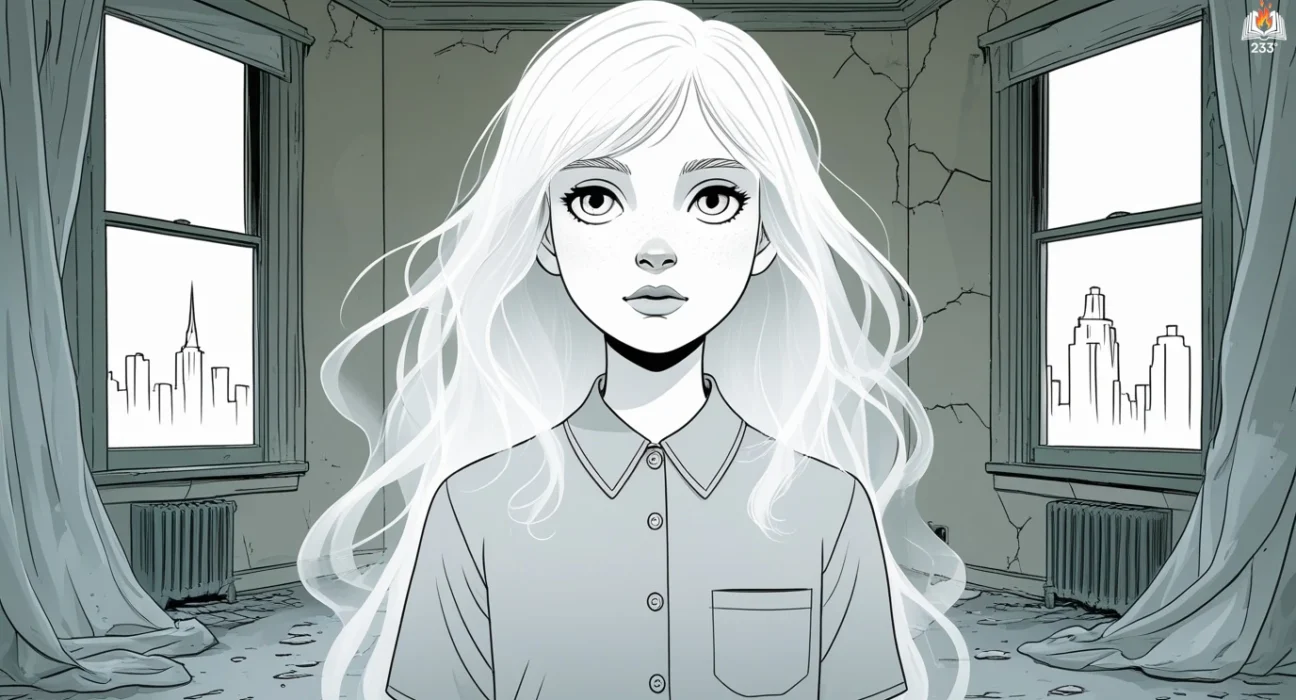
Doomed, written by Chuck Palahniuk and published in 2013, is the sequel to Damned and the second installment in a darkly comedic trilogy centered on the afterlife of thirteen-year-old Madison Spencer. The novel continues Madison’s adventures after her stint in Hell, placing her in a spectral limbo – Purgatory – where she observes the living world as a ghost. Blending grotesque satire with biting social commentary, Palahniuk crafts a twisted narrative filled with absurdist horror, irreverent humor, and cultural parody.
Plot Summary
In the damp and tangled space between the living and the truly dead, a thirteen-year-old girl named Madison Spencer hovers, not quite here, not quite gone. Once a resident of Hell, now a spectral observer of Earth, she drifts through the streets of New York City like a discarded thought. Her ghostly presence returns her to the Rhinelander Hotel, a towering slab of privilege and antiseptic decorum, where her parents keep a penthouse suite shrouded in white dustcloths and emotional neglect.
Madison’s life – or rather, her death – was no accident. On Halloween, the one night when Hell’s gates loosen just enough, she missed her curfew. A cursed trick-or-treat run gone awry landed her back on Earth, marooned in purgatory. Her Town Car evaporated like mist, her link to the underworld severed by Satan himself, who seems disturbingly invested in her destiny. Left with nothing but a haunted PDA and a ragged Coach knockoff bag, Madison sets out to uncover why she was denied re-entry into Hell and what role she now plays in the slow, awful crawl toward Doomsday.
Her journey through the liminal is a grotesque pilgrimage through memory, technology, and existential adolescence. She watches the world – or more precisely, her family – carry on in garish, unblinking detail. Her father, Antonio Spencer, billionaire with a taste for new philosophies and younger women, is caught mid-tryst with Babette, Madison’s one-time friend and now a flesh-clad betrayer. Her mother, Camille Spencer, a Hollywood oracle who wraps activism in sequins and silicone, is filming a self-righteous epic titled Sperm Whales in the Mist, blurring the line between conservation and cinematic narcissism.
Babette, who once guided Madison through the bureaucracies of damnation, now writhes in silk sheets with her father, whispering sweet heresies between chocolate-smudged lips. She claims allegiance to neither God nor Satan, instead serving something slippery and anarchic – a collective of ghosts refusing judgment, calling themselves emancipated entities. They believe in chaos, in disobedience, in rejecting any cosmic final grade.
As Madison watches the flickering screens of Earth’s theater, she stumbles into a ghastly reunion. Nana Minnie, her long-dead grandmother, reappears in her childhood bed, resurrected in full glamor cadaver mode – rhinestones, botched tattoos, and all. Nana’s been pulled from Heaven, exiled for smoking, now haunting the penthouse suite like a cranky relic with secrets and warnings. She mentions a man – a spiritualist, a ghost hunter – lurking in the hotel. Someone Camille has hired to trap Madison’s spirit and cast it out. The man, rumored to abuse ketamine like holy water, conjures death by chemical pilgrimage, slipping between worlds in search of wayward souls.
Madison’s presence becomes both peril and prophecy. As she trails Babette and Antonio from room to room, she uncovers the stink of betrayal, not just of lust but of truth. Her father, who once watched her through security cameras at boarding school, calls her a coward, a lonely, friendless child. Her mother, who staged mourning like an awards show, left her grave as clean and curated as her Instagram feed. Even Babette, who once whispered solidarity in the underworld, now twists fate to suit her own climb toward power.
Every hallway, every conversation, bleeds revelation. Madison learns she is part of a prophecy – not a savior nor a destroyer, but the fulcrum upon which the apocalypse balances. She is the hinge in a cosmic door. Her presence on Earth sets off chain reactions of darkness. Power flickers across Los Angeles. Rats rain from the sky. A red-fringed Lincoln slithers through Beverly Hills like a demonic tongue. A young girl – no, a vessel – descends from the car and spills her candy, blood, and seed onto a Hollywood star bearing the name Camille Spencer. A ritual. A sacrifice. A beginning.
The blogosphere becomes her confessional. Madison blogs from the afterlife with sardonic precision, each entry stitched with wit, bile, and brilliance. She addresses an invisible audience – the “Gentle Tweeter” – chronicling her existential crisis in digital staccato. Through these posts, the world learns not just of her fate, but of its own unraveling. Madison processes pain like a digestive tract. Thoughts become bile. Grief becomes reflux. Memory is fat – indelible, metabolized slowly, stored forever in ghostly cellulite.
As days pass, the lines blur between ghost and godhead. Madison realizes she is more than a casualty of some divine prank. She is the match and the fuse. Her time on Earth – even in death – begins to ripple through the living world. A false religion rises in her wake. Boorism – the worship of shamelessness, vulgarity, and convenience – infects her parents and their disciples. The world bends toward idiocy and indulgence, a grotesque parody of enlightenment.
Madison’s body may be dead, but her presence galvanizes monsters and messiahs alike. Her own past haunts her more viciously than the dead. A kitten, drowned. A fish, lost. Her own murder – messy, shocking, and wrapped in juvenile hands – still clings to her spirit like a mildew of guilt. Yet she presses forward, unraveling each lie, each betrayal, each dark force in drag.
Camille returns, a diva in disguise, now teamed with the ghost hunter. Satan too, steps from the shadows, less horned beast than silk-voiced narrator, claiming authorship of Madison’s life as if she were merely a character in his infernal epic. He insists her fate was penned before her conception – every betrayal, every heartbreak, just another paragraph. But Madison is tired of being a puppet.
What begins as haunting becomes confrontation. Madison faces her demons – literal and parental – armed not with purity or vengeance but with the grotesque, glorious honesty of someone who has nothing left to lose. Her defiance becomes her salvation, not in a traditional sense, but as a reclamation of narrative. No longer content to be damned or saved, she chooses to be known.
And so, in a world collapsing under the weight of its own absurdity, a fat, dead thirteen-year-old girl floats unseen through cities and memories, rewriting the rules of good and evil with every keystroke. Her story does not end in flames or redemption, but in the quiet certainty that she exists – not as anyone’s puppet or prophecy, but as herself. And that is enough to shake the heavens.
Main Characters
- Madison Spencer – The thirteen-year-old protagonist and narrator, Madison is a plucky, overweight girl who is now a ghost after previously being condemned to Hell. Sarcastic, whip-smart, and fiercely self-aware, Madison’s voice is a blend of precocious intellect and bitter teenage angst. Her arc is one of reluctant heroism as she tries to uncover her purpose in the afterlife, decipher the manipulations of divine and infernal forces, and eventually understand her own death and identity.
- Nana Minnie – Madison’s dead grandmother who reappears in the world of the living, Nana Minnie is a comically crass yet loving figure. She smokes incessantly, complains about her posthumous cosmetic alterations, and provides cryptic guidance to Madison. Their relationship is tinged with familial tension, disappointment, and affection.
- Babette – A former friend and fellow damned soul, Babette betrays Madison and becomes her rival. Despite previously acting as a mentor figure in Hell, Babette seduces Madison’s father and is revealed to be working in service of darker, manipulative forces. Her character represents the seduction of conformity and false friendship.
- Antonio Spencer (Madison’s Father) – A morally compromised billionaire and Madison’s father, Antonio is portrayed as shallow, opportunistic, and emotionally distant. His betrayal of Madison through his words and actions serves to highlight the novel’s themes of parental neglect and narcissism.
- Camille Spencer (Madison’s Mother) – A glamorous and self-absorbed movie star, Camille embodies performative activism and celebrity hypocrisy. She seeks public validation while exploiting personal tragedies for fame, including the death of her own daughter.
Theme
- Existential Purgatory – Much of Doomed unfolds in a liminal space between life and death. Madison is caught in purgatory, and this metaphor extends to the emotional stagnation, isolation, and yearning experienced by many characters. This state becomes a lens through which Palahniuk examines how people deal with guilt, purpose, and spiritual inertia.
- Satire of Modern Culture and Religion – Palahniuk skewers everything from New Age spirituality to consumerism and celebrity culture. Religion is mocked not for its beliefs but for how people perform faith as a lifestyle accessory. The Spencers’ Earth Day celebrations and rejection of traditional holidays are symbolic of vacuous virtue-signaling.
- Dysfunctional Family Dynamics – Madison’s tragicomic relationship with her parents and grandmother exposes emotional neglect, generational trauma, and the failure of modern parenting. The absence of real love and attention shapes Madison’s sense of worth and ultimate fate.
- False Salvation and Manipulation – The idea that systems (Heaven, Hell, Boorism, media) are arbitrary and manipulable threads throughout the novel. Characters are constantly tempted to conform to grand narratives that strip them of agency. Madison’s resistance becomes an act of self-definition.
- Media as Afterlife – Madison blogs from beyond the grave, and many key events are broadcast, blogged, or tweeted. The novel blurs the boundary between living and dead by filtering every experience through the lens of digital commentary, suggesting that consciousness is now inseparable from performance.
Writing Style and Tone
Chuck Palahniuk’s writing in Doomed is marked by his trademark black humor, fragmented narrative style, and gleefully grotesque imagery. Madison’s voice dominates the book in a diaristic, blog-style format that is both intimate and performative. She addresses the reader directly, often calling them “Gentle Tweeter,” blending the confessional tone of a teenage diary with the grandiosity of a moral reckoning.
Palahniuk uses repetition, irony, and over-the-top metaphors to underscore Madison’s disjointed existence and the absurdity of the world she observes. The language is rich with biting sarcasm and tragicomedy, juxtaposing childlike observations with advanced vocabulary and existential despair. His tone is often confrontational, even mocking, particularly toward institutions like family, religion, and fame. Yet beneath the satire lies an authentic grief – a genuine search for connection, truth, and self-acceptance.
Quotes
Doomed – Chuck Palahniuk (2013) Quotes
“It's exhausting, the energy it takes to unknow a truth.”
“Religions exist because people would rather have a wrong answer than no answer at all.”
“The avant-garde in every field consists of the lonely, the friendless, the uninvited. All progress is the product of the unpopular.”
“When you die, trust me, the most difficult person to leave behind is yourself.”
“I irritate; therefore I am.”
“The only thing that makes the present palatable is the fact that the past was, at times, torture.”
“How could you ever bring yourself to love so deeply if you truly knew how brief a lifetime could be?”
“Set yourself a goal so difficult that death will seem like a welcome reprieve.”
“Good and evil have always existed. They always will. It’s only our stories about them that ever change.”
“Writing an honest blog is how you unlive your life.”
“WHat I learned is, it's never too late to save anybody. And it's always too late. And what are the chances you'll make any difference?”
“Civilization is a condition which unsocial misfits impose on the rest of popular, easygoing, family-oriented humanity. Only the miserable, the failures, the outcasts will crouch for days to observe the mating habits of a salamander.”
“I love and adore all of my family, except when I'm with them.”
“Do you believe in an afterlife? Do your personal beliefs include a life after death?—no matter how they phrase their snotty test, do the following. Simply look them in the eye, snort derisively, and retort, “Frankly, only a provincial ignoramus would even believe in death.”
“How could you let me love something that was going to die?”
“The body ages, grows, passes through near-lunatic phases of reproductive frenzy, but you are born and die essentially the same person. That... that is proof of your deathless soul.”
“because the rubber, too, is bulletproof. And so relentless is the wind that it rakes the street, pushing along this burden of crippled vermin, trundling this tide of suffering always in the wake of the Town Car as it reaches Spaulding Square. Fissures of lightning”
“Every unkind remark or crude gesture by others is a blessing, an opportunity to exercise our own capacity to forgive.”
“I'm thirteen years old, and I'm somewhat overweight. Meaning: I'm dead and fat. Meaning: I'm a piggy-pig-pig, oink-oink, real porker. Just ask my mom. I'm thirteen and fat - and I will stay this way forever. And yes, I know the word ulcerate. I'm dead, not illiterate.”
“It’s exhausting, the energy it takes to unknow a truth.”
“This isn't anywhere I haven't been before. I've given up. In words muffled with exhaustion I whisper a prayer for my heart to stop.”
“Even after you're dead it hurts just as bad when your heart swells up, stretched bigger and bigger like an aneurysm of tears getting ready to boom.”
“Between wiener juice and lung blood, I’d say that chambray shirt was a goner.”
“Purgatory is where you unwrite the book of your life story”
“Precious souls as young as three or four, raised on the misplaced multicultural priorities of Sesame Street,” he claims, “are doomed before they even enter the godless morass of the public school system.”
“People in love—with nurturing, attentive non-movie-star parents—they would never invent gravity. Nothing except deep misery leads to real success.”
“By the middle of the novel I decided that what two people don't say to each other forges a stronger bond than honest.”
“People in love -with nurturing, attentive non-movie-star parents- they would never invent gravity. Nothing except deep misery leads to real success.”
“How could you ever bring yourself to love so deeply if you truly knew how brief a lifetime can be?”
We hope this summary has sparked your interest and would appreciate you following Celsius 233 on social media:
There’s a treasure trove of other fascinating book summaries waiting for you. Check out our collection of stories that inspire, thrill, and provoke thought, just like this one by checking out the Book Shelf or the Library
Remember, while our summaries capture the essence, they can never replace the full experience of reading the book. If this summary intrigued you, consider diving into the complete story – buy the book and immerse yourself in the author’s original work.
If you want to request a book summary, click here.
When Saurabh is not working/watching football/reading books/traveling, you can reach him via Twitter/X, LinkedIn, or Threads
Restart reading!