
God Knows by Joseph Heller, first published in 1984, is a fiercely imaginative and darkly humorous retelling of the biblical story of King David, rendered in a wildly anachronistic and deeply personal voice. Known primarily for his seminal war satire Catch-22, Heller turns his acerbic wit and philosophical insight inward, delving into the psyche of the aging David as he reflects on a life filled with divine favor, political intrigue, lust, betrayal, grief, and disillusionment. Far from a traditional religious narrative, God Knows subverts expectations by blending ancient history with modern sensibilities, irony, and irreverence.
Plot Summary
King David lay dying, old and cold and angry. His blood no longer kindled at the warmth of women, though Abishag the Shunammite – soft, young, and scented with oils – bathed him and crept into his bed nightly. She was there not for his pleasure, which had long since fled, but to chase the chill from his brittle bones. Yet all the heat in Israel could not melt the frost that had settled inside him. His mind, still sharp, wandered back through the vivid years of battle, betrayal, and bedchambers, through a life that had felt too full and too fast, until God Himself stopped speaking to him.
He remembered the moment he became famous – the instant the stone left his sling and cracked Goliath’s skull like a clay jug. He hadn’t even hesitated. His brothers had mocked him, but he had fought. That victory made Saul smile and then made Saul mad. A king could not stomach competition, not even in the form of a ruddy boy with a harp and a pretty face. Saul offered him his daughter, sent him to war, and flung spears at his head. It was the beginning of a long run from death, during which David grew cunning, collected allies, and grew into the man God had marked for the throne.
The prophet Samuel had said he was chosen. That should have meant something. For a time it did. God answered him then – clearly, firmly. Go here. Fight there. Take this city. Spare that life. But all of it – the slaughters, the singing girls, the sonnets of praise – had led him to this dim room, where even his reflection in a mirror frightened him. His fame had spoiled into regret. His children loathed him or wanted something from him. His wives had either died or turned cold. The one woman he truly loved had refused him again and again, even as she begged him to secure the throne for her son.
Bathsheba had caught his eye once, glistening with water on a rooftop. He had taken her, and when her husband refused to sleep with her to cover up the child, David had sent him to his death. It was the one thing God never forgave. The baby died. The silence from heaven that followed never lifted. David had pleaded, fasted, lain on the floor like an ox. Nothing helped. And then came Nathan with his story and his parables, and suddenly his sins were public, and his punishments were prophesied. His household would fall apart. His children would turn on one another. And so they did.
Amnon lusted after his half-sister Tamar and raped her. Absalom, David’s most beautiful son, took revenge by murdering him. For two years Absalom waited, then struck with cunning and fury. He banished David from Jerusalem and took the throne. He lay with David’s concubines on the roof, a performance of rebellion in the bright light of day. David fled barefoot and weeping, with Joab and the faithful behind him, and when the tide turned again, Joab ignored the king’s orders and killed Absalom. David mourned him more than any victory. His tears soaked the floor. Would God he had died instead.
Yet power had to be maintained. David ordered death with cold efficiency – Shimei, who had cursed him; Joab, who had disobeyed him; even Abiathar, who had stayed too long at the wrong side. Solomon was to do the work for him. Kill Joab, he said, not with sorrow, not with honor, but with a blade. Blow the bastard away. Solomon nodded, solemn and slow. He was smart but not wise, David thought – and not nearly as clever as people said. The business with the baby and the sword had been earnest, not cunning. The mother had saved the child, not the king.
Adonijah, another son, thought himself heir by default. He threw a banquet, declared himself king, and lined up supporters. But he didn’t invite Solomon. Bathsheba and Nathan pounced. They stirred David from his sickbed and reminded him of promises they swore he had made. David, amused or resigned or merely bored, went along. He declared Solomon king, sent the boy riding on his own mule, and ordered Zadok and Nathan to anoint him with oil. The people rejoiced so loudly the earth shook. Adonijah’s party ended in fear. He clutched the altar and begged for his life.
David watched it all from his bed. He remembered his own coronation, the girls with tambourines singing of his ten thousands, and how Saul had narrowed his eyes at the sound. He remembered his years in exile, his love for Jonathan, his agony when the boy died. He remembered the psalms, the dances, the haunted sleep of his nights. No one had lived like him. No one had suffered quite the same. The Bible had flattened him, he thought, scrubbed him into a bland figure of obedience and praise. But he had cursed God, shouted at Him, refused to speak to Him for years. He had loved women, held grudges, killed friends, envied others, and longed for peace that never came.
Abishag watched over him in silence. She anointed his dry eyes, listened to his mutterings, and slipped beside him when he called. Her body was perfect, her presence gentle, and still, he wanted Bathsheba. He wanted one more night with the woman who had stolen his heart and crushed it. She refused, of course. She wanted power for her son. She wanted to be queen mother. She wanted her legacy, and he was just the vessel through which it would come.
Outside, Jerusalem flourished. The people traded and married and gossiped about succession. Inside, the king counted his regrets. He had sons too many to name. He had wives whose names he couldn’t remember. He had a crown that no longer fit and a God who no longer answered. He had written the greatest poetry, led armies, danced before the ark half-naked, and slaughtered men with songs on his lips. But the women he loved had slipped through his fingers. The children he raised had destroyed each other. The promises he made had rotted into politics.
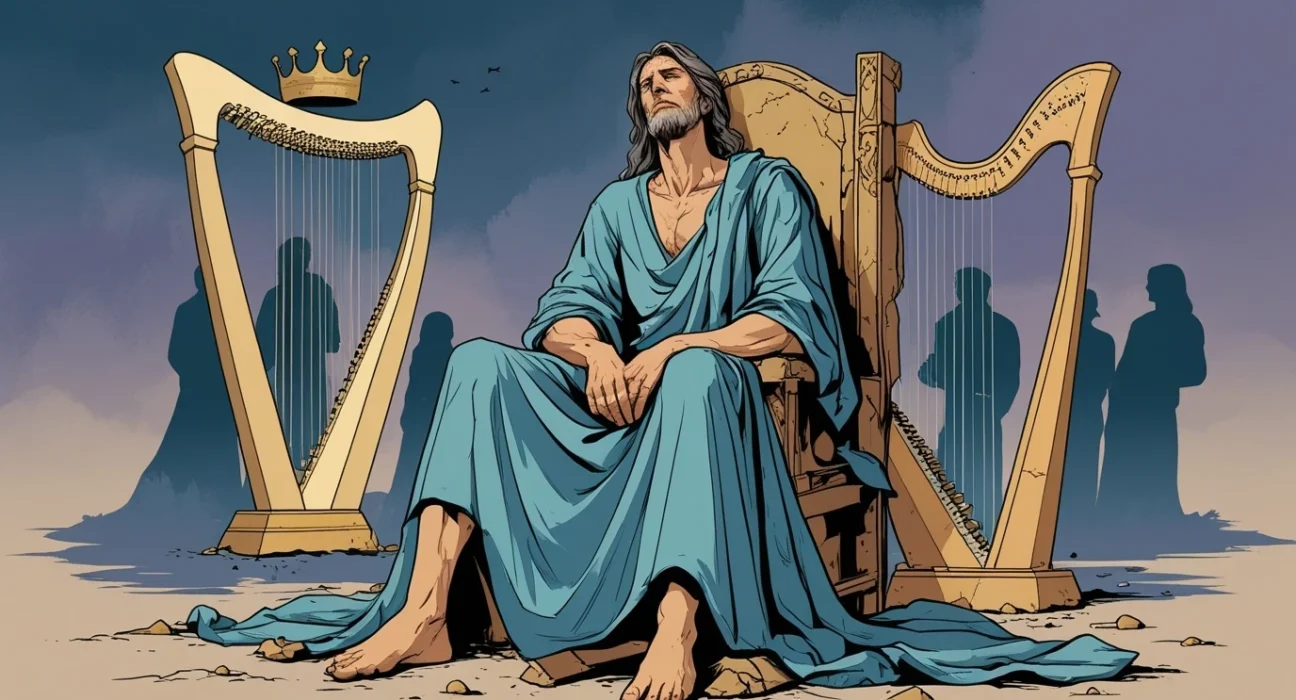
Night fell again. The oil lamps flickered. Abishag smoothed his brow. Somewhere, David heard the music of a harp – sweet and boyish, the notes pure and high. He looked and saw a young man sitting in a corner, ruddy and handsome, playing for the king. The boy looked like him. Strong, bright-eyed, foolish with hope. David smiled, then looked for a javelin to hurl. But he was too tired. The bed was too soft. The girl beside him smelled of apples and honey. It was almost time. He watched the shadows gather and wished for warmth. God had let him down again.
Main Characters
David – The protagonist and narrator, David is portrayed as a witty, bitter, and emotionally complex old king who speaks from his deathbed. Deeply introspective, he recounts his glories and failings with biting humor and philosophical insight. He is obsessed with legacy, haunted by past decisions, especially concerning his love for Bathsheba and his complicated relationship with God.
Bathsheba – David’s beautiful and ambitious wife, Bathsheba is sharp-tongued, manipulative, and single-minded in securing the throne for her son Solomon. Though David professes enduring love for her, she remains emotionally distant, strategic, and self-interested.
Abishag the Shunammite – A young virgin assigned to warm the aging David, Abishag is gentle, beautiful, and dutiful. Though physically present, she symbolizes the futility of comfort and desire in David’s final days. Her innocence and care contrast starkly with the political machinations around the dying king.
Solomon – David and Bathsheba’s son, destined to be king. David regards him with ironic detachment, mocking his seriousness and misinterpreted wisdom. Despite being chosen as heir, Solomon remains largely a vessel for others’ ambitions, including Bathsheba’s.
Adonijah – David’s older son and Solomon’s rival for the throne. Vain and politically ambitious, his presumptive actions spur the final struggle over David’s succession. David views him with disdain, using him as a pawn in his final acts of control.
Nathan – The prophet who confronts David with divine judgment. Stern and theatrical, Nathan serves as both spiritual guide and political manipulator. He acts on behalf of Bathsheba and Solomon in their bid for power.
Joab – David’s fiercely loyal and ruthless military commander. A complex figure, Joab serves David faithfully yet independently, and ultimately becomes a threat to Solomon’s reign. David’s parting command is to have him executed.
Theme
The Absurdity of Power and Legacy – David’s narration repeatedly mocks the political and divine pretensions of kingship. He reflects bitterly on his own ambitions, successes, and the fickle nature of legacy, especially in his rejection of the sanitized versions found in Chronicles.
Faith and Divine Betrayal – One of the novel’s most resonant themes is David’s broken relationship with God. Once blessed and chosen, he feels abandoned and angry, viewing God as arbitrary, cruel, and unfair. His disillusionment is both personal and philosophical.
Sexuality, Love, and Desire – David’s love for Bathsheba is portrayed as obsessive and ruinous. His sexual nostalgia is juxtaposed with his physical decay, and the sensual presence of Abishag underscores the futility of desire in old age. Love, in Heller’s telling, is often transactional or weaponized.
Memory and Storytelling – The act of storytelling is itself a theme, with David reinterpreting biblical events through a deeply subjective and often sarcastic lens. His monologue is unreliable, humorous, and poignant, raising questions about history, myth, and truth.
Death and Aging – David confronts mortality with a mix of rage, regret, and sarcasm. His reflections are steeped in bitterness over the loss of vitality, the deaths of his children, and the erosion of influence. Old age is rendered as both comic and tragic.
Writing Style and Tone
Joseph Heller’s style in God Knows is an exuberant fusion of biblical gravitas and modern sarcasm. The narrative voice is a masterstroke – David speaks directly to the reader in a tone that swings between lyrical, profane, tragic, and comedic. This anachronistic blend allows Heller to probe ancient themes with contemporary irony, creating a rich dialogue between past and present. His language is often bawdy and irreverent, but also capable of striking poetic beauty, especially in his elegies and lamentations.
The tone of the novel is deeply ironic and layered with dark humor. Heller uses satire to dismantle sacred history and humanize its figures. Yet beneath the comic surface lies a profound exploration of loss, faith, and futility. The tone veers between mockery and mourning, often in the same paragraph. David’s bitterness is not just for show – it reveals the emotional wreckage of a man who once held glory and now faces oblivion. This interplay of pathos and parody gives God Knows its distinctive voice: a soliloquy as tragic as it is hilarious.
Quotes
God Knows – Joseph Heller (1984) Quotes
“Destiny is a good thing to accept when it's going your way. When it isn't, don't call it destiny; call it injustice, treachery, or simple bad luck.”
“But how can one be warm alone?”
“That's another thing that pisses me off about that Michelangelo statue of me in Florence. He's got me standing there uncircumcised! Who the fuck did he think I was?”
“You’ve got to have a God. Without God, you might turn to something really crazy, like witchcraft, or religion.”
“First impressions die slowly, bad impressions take even longer”
“Moses has the Ten Commandments, it's true, but I've got much better lines - King David”
“It takes very little to make us [women] happy, and more than is contained in heaven and earth to keep us that way”
“The problem with the loneliness I suffer is that the company of others has never been a cure for it. Being at war, however, always has been.”
“A martyred look accompanied this reply, belying her air of passionless indifference.”
“Any possibilities that I might be mistaken about her humor were dispelled by her first words.”
“Show me anything whereof it may be said, "See, this is new," and I will show you it hath been.”
“Jerusalem is a very small town. And Bathsheba was a very loud woman. Maybe even Uriah knew.”
We hope this summary has sparked your interest and would appreciate you following Celsius 233 on social media:
There’s a treasure trove of other fascinating book summaries waiting for you. Check out our collection of stories that inspire, thrill, and provoke thought, just like this one by checking out the Book Shelf or the Library
Remember, while our summaries capture the essence, they can never replace the full experience of reading the book. If this summary intrigued you, consider diving into the complete story – buy the book and immerse yourself in the author’s original work.
If you want to request a book summary, click here.
When Saurabh is not working/watching football/reading books/traveling, you can reach him via Twitter/X, LinkedIn, or Threads
Restart reading!