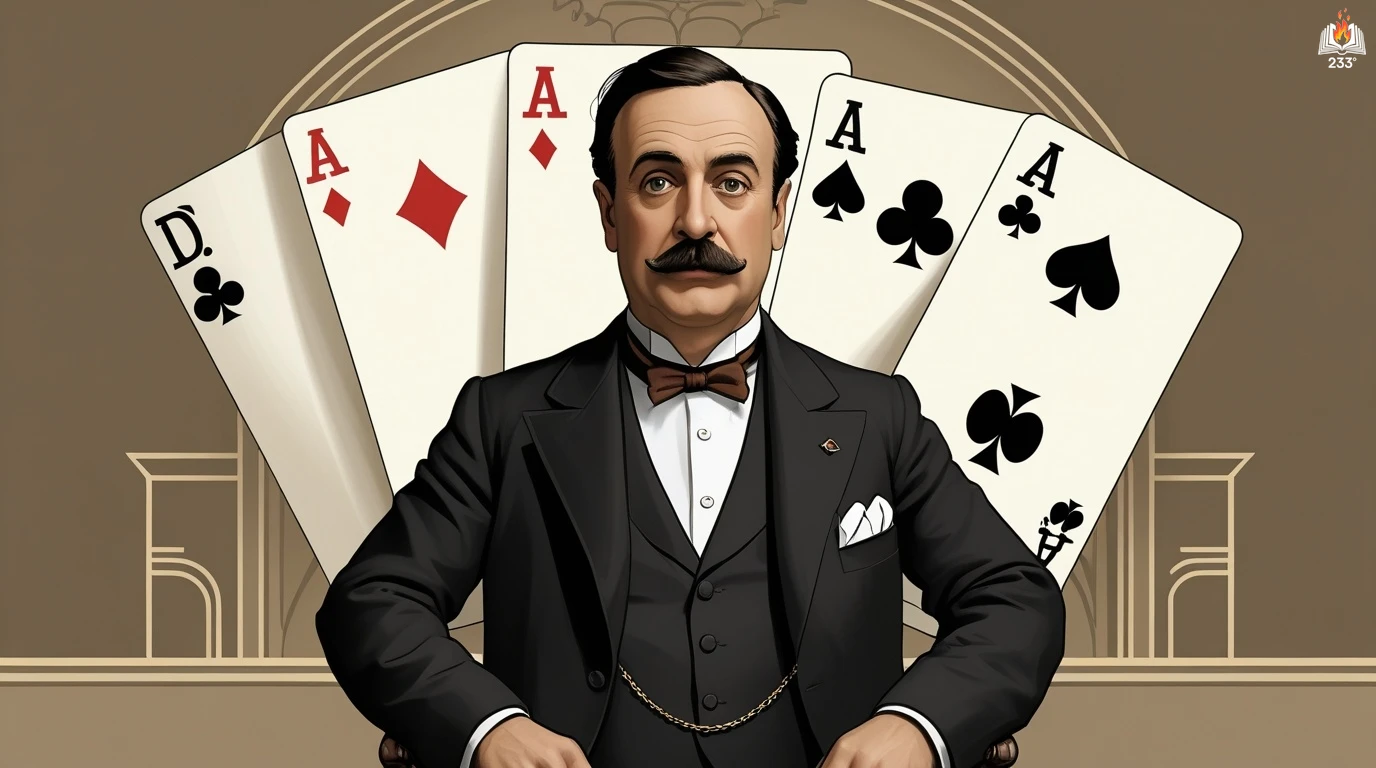


The Seven Dials Mystery by Agatha Christie, published in 1929, is one of her engaging and humorous mystery novels, set in the familiar world of British country houses and secret societies. It is part of the “Chimneys” series, following Christie’s earlier novel The Secret of Chimneys, and brings back several recurring characters. Combining elements of a classic whodunit with adventure and satire, the novel moves between stately homes and the shadowy underworld of a London secret society known as the Seven Dials.
Plot Summary
At Chimneys, the grand country estate now leased to the pompous Sir Oswald and Lady Coote, a prank among a group of young houseguests turns dark. Gerry Wade, the carefree and charming prank victim, fails to awaken from his drugged sleep. It seems a tragic accident: an overdose of sleeping tablets. But to Bundle Brent, the spirited and inquisitive daughter of Lord Caterham, the air around Gerry’s death hums with unease. The sight of seven clocks lined on the mantelpiece, one short of the intended eight for the prank, whispers of something more sinister. The mystery deepens when another friend, Ronny Devereux, is gunned down on a lonely country lane, his dying breath shaping the words Seven Dials.
With a restless determination, Bundle plunges into the heart of the puzzle, brushing aside warnings from Jimmy Thesiger, the smooth and clever friend of the dead men, and Bill Eversleigh, the affable but hapless young man always eager to help. Loraine Wade, Gerry’s sister, clings quietly to the periphery, her grief simmering beneath a gentle resolve. Yet even Bundle’s fearless energy cannot pierce the murky heart of the matter at first. The only clue is Seven Dials, a name that leads Bundle into the underbelly of London, to a disreputable nightspot and, as she soon discovers, to a secret society where masks conceal more than faces.
In the bustling chaos of the Seven Dials Club, Bundle’s sharp eye falls on Alfred, once a footman at Chimneys, now a watchful doorman for the club’s gambling den. A little pressure, a little charm, and Alfred’s loyalty wavers. Behind the heavy doors of the club lies a hidden room, lined with seven chairs marked only by the curious clockface masks that hang above each seat. The organization within is as elusive as it is dangerous. Bundle, with her usual mix of recklessness and brilliance, hides herself in a cupboard to eavesdrop on the masked gathering.
One by one, the members slip into the room – the bearded Mosgorovsky, elegant and foreign Five O’Clock, the easygoing American Four O’Clock, the beguiling Anna Radzky, her beauty as sharp as the glint of a knife, and others whose accents and manner suggest a reach far beyond English borders. Yet the most powerful figure, No. 7, remains unseen, a presence as much myth as man. They speak of Chimneys, of international plots, of secrets wrapped inside state documents. And when they leave, Bundle is left with a mind alight and a heart pounding.
Determined to break deeper into the web, Bundle’s path leads back to Chimneys, where the Coote household staff hold secrets of their own. John Bauer, the new footman, is not the harmless servant he appears. His military bearing, his German extraction, and his impeccable manners all shimmer with the suggestion of something concealed. Bundle’s suspicion sharpens as she learns that Bauer arrived just before Gerry’s death, replacing Alfred at the suggestion of Mosgorovsky. Even Superintendent Battle of Scotland Yard, a man of wooden expression but razor intellect, can no longer brush aside the rising tension.
Meanwhile, at Wyvern Abbey, the looming political house party of George Lomax, a strange current moves beneath the glittering surface. Jimmy, slyly maneuvered into the gathering under the guise of political ambition, rubs shoulders with diplomats and industrialists. Among the guests is Herr Eberhard, a German inventor, Sir Oswald with his steel empire, and the formidable Mrs. Macatta, a crusader for pure milk and child welfare. And within these walls, amid polite dinners and drawing-room chatter, the heart of the conspiracy beats.
Bundle, never one to sit patiently on the sidelines, charms her way into the party with help from her redoubtable Aunt Marcia. Once inside, she joins forces with Jimmy, their banter barely masking the gravity of their mission. But danger coils close. A stolen document, a missing blueprint, and the shadow of an international scandal all swirl into the Seven Dials’ scheme. And somewhere within the house, the unknown No. 7 waits, guiding the tangled game.
As the masked society tightens its grip, the dangers mount. There are chases through shadowed gardens, tense confrontations in glittering ballrooms, and secrets unspooled in whispered exchanges. Loraine, outwardly delicate, proves unexpectedly steadfast, her quiet strength anchoring the emotional weight of the investigation. Bill, for all his bumbling charm, steps forward as a loyal companion, while Superintendent Battle watches from the edges, his shrewd mind parsing every clue.
At last, the masks are torn away. The Seven Dials, so long shrouded in menace, are revealed not as criminals but as defenders. Their masked meetings, their coded operations, are all in service of protecting England from the very international threats they seemed to embody. Gerry Wade, far from the foolish playboy, had been a devoted agent, his death no accident but a murder born of betrayal. Ronny Devereux, following his friend’s trail, paid the same price. The real enemy lurked within the circle of trust, masked in plain sight.
The true villain emerges: none other than Jimmy Thesiger, whose easy charm hid ruthless ambition. Jimmy, long woven into the social fabric of the group, had turned traitor, his motives a bitter blend of greed and disillusionment. The revelation shatters the easy camaraderie, laying bare the cost of deception and the fragility of trust. Jimmy’s unmasking brings both justice and sorrow, the light of truth cutting through the lingering shadows.
In the end, Chimneys returns to its sleepy rhythms, Bundle’s sharp laughter ringing once more through its ancient halls. The secret society fades back into the mist, its mission accomplished, its existence slipping again into rumor. Bundle and Bill, their friendship deepened by danger, look toward a future filled with promise, while Loraine, her brother’s name restored, steps into the quiet solace of memory. Superintendent Battle departs with the satisfaction of a puzzle solved, his face as impenetrable as ever.
Above all, the countryside breathes again in peace, the menace that once darkened its lanes and drawing rooms dissolved like a dream at dawn. The clocks of Seven Dials, their hands set to different hours, mark not just the passage of time but the triumph of loyalty, courage, and wit over the shadowed ambitions of the disloyal few.
Main Characters
Lady Eileen “Bundle” Brent: Spirited, intelligent, and bold, Bundle is the daughter of Lord Caterham and the driving force behind unraveling the mystery. She displays resourcefulness, courage, and wit, determined to investigate a suspicious death despite being warned off.
Jimmy Thesiger: Charming, seemingly idle, but sharp-minded, Jimmy is one of the young aristocrats caught up in the intrigue. His easygoing nature masks deeper intelligence, and his relationship with Bundle evolves as they work together to uncover the truth.
Bill Eversleigh: Good-natured and somewhat bumbling, Bill is a loyal friend to Bundle and Jimmy. His affable but slightly clueless personality adds humor, but he proves useful in navigating social and political circles.
Loraine Wade: The sister of the victim Gerald Wade, Loraine is gentle but determined, showing quiet resilience and bravery. Her personal stake in the mystery gives an emotional anchor to the plot.
Superintendent Battle: A stoic and intelligent Scotland Yard detective, Battle exudes quiet competence. He provides the official investigative muscle and respects Bundle’s amateur efforts more than he lets on.
Sir Oswald and Lady Coote: The wealthy, self-important new owners of Chimneys, they bring comic relief with their social pretensions and obliviousness to the danger swirling around them.
George Lomax: A pompous political figure, George’s obsession with propriety and social position contrasts with the carefree younger characters and offers a satirical portrait of the establishment.
Theme
Appearances vs. Reality: The novel plays constantly with masks, both literal (with the Seven Dials) and social. Characters often hide true intentions, and those dismissed as fools prove to be clever, while respectable figures harbor secrets.
Class and Social Satire: Christie satirizes British upper-class society, from idle rich youths to pompous politicians. The gap between the servants and the gentry, and between old aristocracy and nouveau riche, offers a humorous social backdrop.
Amateur vs. Professional Detection: The tension between amateur sleuths like Bundle and official detectives like Battle reflects on the nature of detective work. Christie explores how passion and intuition can sometimes succeed where formal methods fail.
Loyalty and Betrayal: The mystery hinges on whom the characters can trust. Friendships and alliances are tested, and hidden loyalties play a crucial role in the resolution.
Secrecy and Espionage: The secret society at the heart of the novel mirrors larger anxieties about espionage and international intrigue in interwar Britain, blending crime fiction with elements of spy adventure.
Writing Style and Tone
Agatha Christie’s writing in The Seven Dials Mystery sparkles with wit, lightheartedness, and an undercurrent of suspense. She balances a breezy, almost comedic tone—particularly in the dialogue of Bundle and Bill—with moments of tension and foreboding. Christie is especially skilled here at parodying the conventions of country house mysteries and the “secret society” genre, poking fun at melodrama while still crafting an engrossing plot.
Her prose is crisp and economical, filled with sharp observations and clever character sketches. The pacing is brisk, with short chapters and frequent shifts between action, investigation, and social comedy. Dialogue carries much of the novel’s charm, with characters’ distinct voices and humorous exchanges building both plot and personality.
The tone throughout is playful but never dismissive of the stakes. Christie allows readers to laugh at her characters’ eccentricities while still pulling them into a genuinely suspenseful mystery. Her trademark misdirection is at play, lacing the story with red herrings, twists, and a final reveal that reorients the reader’s understanding of earlier events.
Quotes
The Seven Dials Mystery – Agatha Christie (1929) Quotes
“To rush into explanations is always a sign of weakness.”
“fiction is founded on truth... unless things did happen, people couldn't think of them.”
“In my opinion half the people who spend their lives avoiding being run over by buses had much better be run over and put safely out of the way. They're no good.”
“It's a rotten job, but somebody's got to do it.”
“I don't like anyone who comes and dies in my house on purpose to annoy me," said Lord Caterham obstinately.”
“It’s odd, isn’t it, why farce so often seems to get mixed up with tragedy?”
“What I think is a different matter. Maybe I think some rather curious things—but until thinking's got you somewhere it's no use talking about it.”
“Marriage, especially at my age, is not to be undertaken without full–er–consideration. Equality of birth, similarity of tastes, general suitability, and the same religious creed–all these things are necessary and the pros and cons have to be weighed and considered.”
“... he said "I simply can't believe it, that's all." "Oh, nonsense," said Jimmy. "You must get into the habit of believing six impossible things before breakfast...”
“Expect me when you see me.”
“I often find these self-made men are inconsiderate. Very possibly that is why they amass such large fortunes.”
“But nothing will suit him now but the best! He's got on wonderfully, and naturally he wants something to show for it, but many's the time I wonder where it will end.”
“You've brought out your best butter." [you're laying on the flattery thickly]”
“I attribute my success entirely to my habits of early rising, frugal living, and methodical habits.”
“Only to those who don’t know you–who are taken in by your delusive appearance of meekness and decorum.’ ‘I like your long words.’ ‘All out of crossword puzzles.’ ‘So educative.”
“Different kinds of danger suit different kinds of people...”
“The syndicate was inclined to be despondent about it.”
“Come and have a cocktail. It's nearly lunch time.”
We hope this summary has sparked your interest and would appreciate you following Celsius 233 on social media:
There’s a treasure trove of other fascinating book summaries waiting for you. Check out our collection of stories that inspire, thrill, and provoke thought, just like this one by checking out the Book Shelf or the Library
Remember, while our summaries capture the essence, they can never replace the full experience of reading the book. If this summary intrigued you, consider diving into the complete story – buy the book and immerse yourself in the author’s original work.
If you want to request a book summary, click here.
When Saurabh is not working/watching football/reading books/traveling, you can reach him via Twitter/X, LinkedIn, or Threads
Restart reading!