

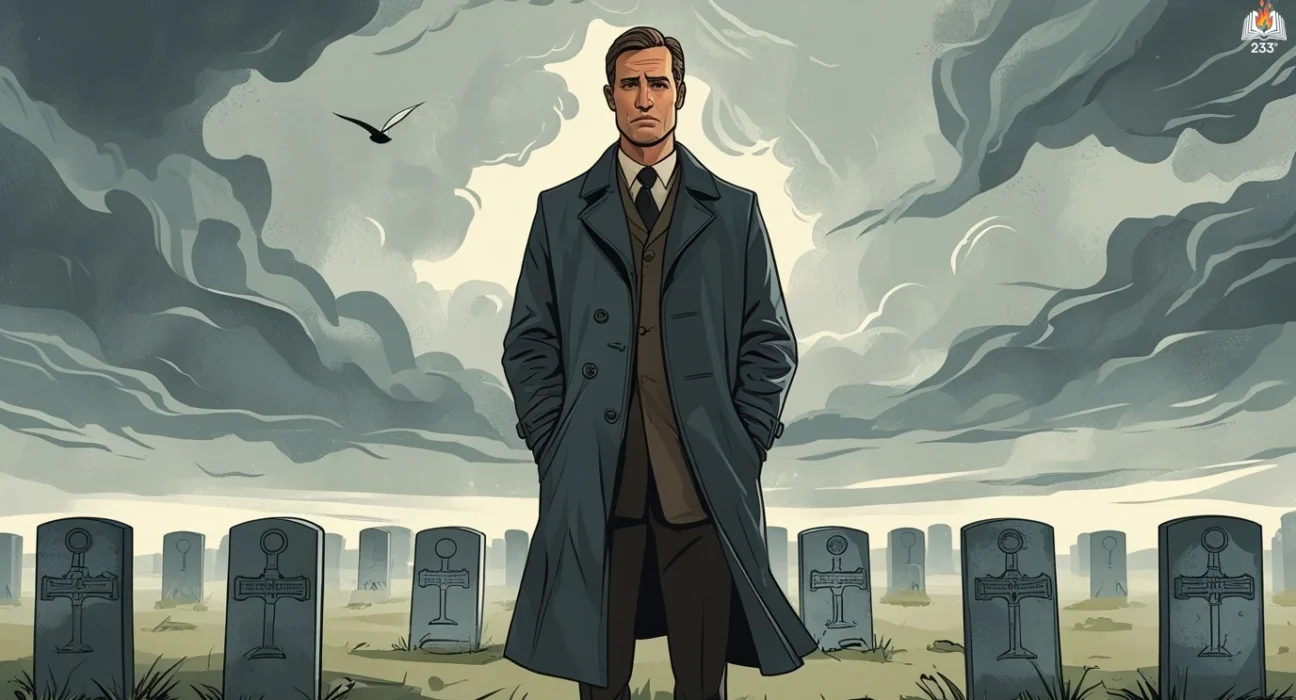
The First Man, written by Albert Camus and published posthumously in 1994, is a deeply autobiographical novel left unfinished at the time of Camus’s death in a car crash in 1960. The manuscript, discovered in his briefcase, offers an intimate portrait of Jacques Cormery – a character closely modeled on Camus himself – as he returns to Algeria in search of his father and his own origins. Intended as the first volume of a grand autobiographical cycle, The First Man bridges personal memory with philosophical reflection, painting a vivid picture of colonial Algeria while wrestling with themes of identity, poverty, war, and human legacy.
Plot Summary
The rain fell gently on the canvas roof of the wagon as it rolled through the Algerian night, carrying a small family toward a new life. Henri Cormery, a stocky Frenchman, sat beside the Arab driver, his expression stoic, his hand ready to reach for the pistol hidden in his pocket. Beside the luggage in the wagon sat his wife Lucie, weary and round with child, her four-year-old son Jacques sleeping against her. The road was rough, the night dark, and Lucie’s pain growing steadily stronger. By the time the scattered lights of Solferino village glimmered through the rain, she could barely speak. Henri chose to bypass the village and go straight to the isolated farmhouse that awaited them.
The house was cold, unprepared. The fire was dead, the rooms lifeless, and the storm still muttering overhead. Yet Lucie was laid on a mattress by the hearth, her face pale with labor, her body trembling. Henri rode through the rain to fetch a doctor, galloping alone on a farm horse through the muddy roads. He found a woman at the canteen and asked her to stay with Lucie, then summoned the doctor from the village, both men riding back together under the pounding rain.
When they arrived, the boy had already been born. The fire crackled, the child let out his first cry, and Lucie, exhausted, managed only a fleeting smile before sleep claimed her. Henri, looking at the fragile bundle and the quiet form of his wife, named the baby Jacques.
Years later, Jacques Cormery stood in a quiet cemetery in Saint-Brieuc, northern France, staring at the gravestone of the father he never knew. Henri had died at the Battle of the Marne when Jacques was less than a year old. The inscription on the stone struck him harder than expected. Henri was only twenty-nine when he died – younger than Jacques was now. The realization ruptured something deep inside him. Time collapsed. A son older than his father. The world tilted with chaos and compassion. All his life he had tried to forge an identity, to become something of himself, without ever understanding the man who had made that life possible. That name carved in stone was no longer distant. It was a cry, a silence, a presence haunting the borders of his memory.
In the corridors of memory, Jacques wandered through his childhood – a boy of silence and resilience raised in the dusty neighborhoods of Algiers. His home was sparse and whitewashed, filled with the smells of soap and kerosene, with a hard grandmother and a nearly mute mother whose fingers bore the marks of endless labor. The silence in their home was a wall, and behind it lingered the absence of a father never spoken of.
His days were shaped by poverty but carried the pulse of unyielding joy. He played in sunbaked streets, under the striped shadows of closed shutters, with boys who never had more than a stick or a worn marble. They turned cellars into fortresses, vacant lots into arenas of childish battles, scavenged fruit from experimental gardens, and tasted fried potatoes with the reverence of kings. Every summer brought salt in the air, bare feet on hot stones, and the thrill of reaching the sea, laughing beneath the sun as though the world owed them nothing but the moment.
School was the first rupture. In the classroom, Jacques found something he didn’t yet understand – the possibility of another life. His teachers, sensing a fierce brightness in him, guided him beyond the narrow walls of his upbringing. He read late into the night. He wrote. He thought. But he returned each evening to a home where no one could help him with his lessons, where books were alien and silence was the only inheritance.
In time, Jacques left Algeria for France, rising in a world that never quite felt like his own. But something always pulled him back – the dry heat, the dusty courtyards, the smell of manure and damp grapes, the voice of a mother who never changed, who never left the apartment in which time stood still. He returned to Algeria not with pride, but with longing – to know what had been hidden, to understand the man whose absence had shaped every part of his being.
He visited Malan, an old mentor who once opened the door of thought for him. Their conversations, slow and ironical, meandered through memory, death, meaning, and doubt. Malan warned him gently – the search for the past is not always kind. But Jacques was already caught in it. Not to rewrite the past, but to find something solid in a life that had slipped by with too few answers.
When he went to his mother and asked about Henri, she could not offer more than fragments. A few gestures, a remembered kindness. Nothing that shaped a man. Henri had died too soon, leaving behind no photographs that breathed, no stories that lived. Yet through the cracks in her memory, Jacques saw a glimpse – not of a hero or a stranger, but of a young man who laughed, who held a baby, who dreamed. A man who had walked this earth briefly and left his mark not through grand acts, but through the quiet persistence of life passed on.
The more Jacques uncovered, the less he understood. But the fog of not-knowing became a place of tenderness rather than torment. He imagined his father not as a ghost but as a boy – fragile, stubborn, human. And in that reversal, something in Jacques softened. The mystery remained, but the bitterness ebbed.
He stood again before the gravestone. The sky was pale, clouds dragging across it like questions. Around him lay row after row of markers, young men buried before their lives had truly begun. Henri among them. Jacques turned from the grave, the sound of an airplane cracking the sky above, and left the silence behind. Not in forgetting, but in acceptance. The boy born in rain now walked beneath a calmer sky, not certain, but less alone.
Main Characters
- Jacques Cormery: Jacques is the heart of the novel – an introspective, fiercely intelligent man burdened by the weight of a father he never knew and the poverty that shaped him. A schoolboy turned intellectual, his journey from Algiers to metropolitan France and back becomes a quest for roots, meaning, and emotional clarity. His return to his mother and childhood home serves as both an act of homage and a confrontation with the silence that surrounds his father’s memory. Jacques’s character evolves through deep reflection, revealing a sensitive soul torn between love for life and profound existential anguish.
- Lucie Cormery (Jacques’s Mother): Lucie is a quiet, nearly mute presence who embodies endurance and maternal strength. Though semi-literate and emotionally reserved, her unwavering love and hard labor are the backbone of Jacques’s survival and eventual success. Her silence about Jacques’s father becomes a poignant symbol of the emotional void Jacques attempts to fill.
- Henri Cormery (Jacques’s Father): Though dead before Jacques could know him, Henri’s shadow looms large over the novel. A casualty of World War I, his memory exists in fragments and documents, provoking in Jacques a complex blend of longing, resentment, and pity. The discovery that he is younger than Jacques now is becomes an emotionally devastating moment.
- Victor Malan: Jacques’s mentor and intellectual confidant, Malan provides a sounding board for Jacques’s musings about life, death, and meaning. Through philosophical dialogue and personal warmth, Malan anchors Jacques, encouraging him to seek answers while also cautioning against illusions.
Theme
- Search for Identity and Origins: At the novel’s core is Jacques’s attempt to reconstruct his father’s life and, by extension, his own. This search reflects Camus’s own feelings of disconnection and longing as a pied-noir French Algerian, emphasizing the fragmented nature of personal and cultural identity.
- Silence and Memory: Lucie’s silence about Henri symbolizes the generational gaps and the ineffability of grief. Throughout the novel, silence recurs as a motif: in the mother’s quiet, in the empty grave, in the dusty, impoverished homes. Memory, conversely, is the tool Jacques uses to reanimate these silences and reconstruct a narrative for himself.
- Colonialism and Class: Camus vividly portrays the harsh realities of growing up in poverty in colonial Algeria. The novel doesn’t preach but observes – the casual injustice, the social stagnation, the quiet dignity of the working class. It critiques colonial society subtly, from the inside, by focusing on human detail.
- Fatherhood and Masculinity: The book questions traditional notions of fatherhood. Henri, though absent, becomes the ideal, the mystery, and ultimately the childlike figure when Jacques realizes his father died younger than he is now. Masculinity is not portrayed through domination but through struggle, vulnerability, and reflection.
- Mortality and Time: Jacques’s visit to his father’s grave ignites an existential crisis rooted in the shocking reversal of generational roles. Time, in this novel, doesn’t flow linearly; it loops, fractures, and blurs, confronting Jacques with the surreal realization that the past is both unreachable and foundational.
Writing Style and Tone
Albert Camus’s prose in The First Man is luminous, tender, and deeply introspective. Though the manuscript was unfinished, it bears the unmistakable clarity of his style: understated but emotionally resonant, concrete yet philosophical. Camus blends the personal with the political, evoking entire worlds through a detail – a boy’s hand on his mother’s, the smell of Algerian soil, the quiet of a war cemetery. The narrative moves fluidly between memory and present experience, sometimes lyrical, often fragmentary, mimicking the piecing together of a life through recollection.
Camus’s tone in this work is gentler and more vulnerable than in his earlier, more overtly philosophical novels. While existential themes persist, they are filtered through lived experience rather than abstract inquiry. There’s a poignant humanity that pervades the narrative – the weariness of a man who has seen too much, who now seeks not answers but connection. The manuscript’s incomplete nature only adds to its power, giving it the sense of a voice reaching out from just beyond the veil, candid and searching.
Quotes
The First Man – Albert Camus (1994) Quotes
“When the soul suffers too much, it develops a taste for misfortune.”
“There is a terrible emptiness in me, an indifference that hurts.”
“And for all his life it would be kindness and love that made him cry, never pain or persecution, which on the contrary only reinforced his spirit and his resolution.”
“They hurt each other without wanting to, just because each represented to the others the cruel and demanding necessity of their lives.”
“There are people who vindicate the world, who help others live just by their presence.”
“Because,' Cormery went on, 'when I was very young, very foolish, and very much alone ... you paid attention to me and, without seeming to, you opened for me the door to everything I love in the world.”
“Remembrance of things past is just for the rich. For the poor it only marks the faint traces on the path to death.”
“Men like us are good and proud and strong...if we had a faith, a God, nothing could undermine us. But we had nothing, we had to learn everything, and living for honor alone has its weaknesses...”
“To begin with, poor people__s memory is less nourished than that of a rich; it has fewer landmarks in space because they seldom leave the place where they live, and fewer reference points in time throughtout lives that are grey and featureless.”
“You alone will know why I killed myself. You know my principles. I hate those who commit suicide. Besause of what they do TO OTHERS. If you have to do it, you must disguise it. Out of kindness.”
“At the age of 40, having ordered meat very rare in restaurants all his life, he realized he actually liked it medium and not at all rare.”
“There's always been war," said Veillard. "But people quickly get accustomed to peace. So they think it's normal. No, war is what's normal.”
“Even the most gifted person needs someone to initiate him. The one that life puts in your path one day, that person must be loved and respected for ever, even if he's not responsible. That is my faith!”
“Oh no, oh no,' she said through her tears, 'I'm so in love with love,' and, intelligent and outstanding in so many ways, perhaps just because she truly was intelligent and outstanding, she rejected the world as it was.”
“Mind you, do not think that my affection for you is blind. You have great, very great faults, at least in my eyes.”
“Poverty is a fortress without drawbridges.”
“So,' said Cornery, 'we never know anyone.”
“And then he knew that war is no good, because vanquishing a man is as bitter as being vanquished.”
“Few indeed are those who continue to be openhanded after they have acquired the means for it. Such as these are princes among men, before whom one must bow down”
We hope this summary has sparked your interest and would appreciate you following Celsius 233 on social media:
There’s a treasure trove of other fascinating book summaries waiting for you. Check out our collection of stories that inspire, thrill, and provoke thought, just like this one by checking out the Book Shelf or the Library
Remember, while our summaries capture the essence, they can never replace the full experience of reading the book. If this summary intrigued you, consider diving into the complete story – buy the book and immerse yourself in the author’s original work.
If you want to request a book summary, click here.
When Saurabh is not working/watching football/reading books/traveling, you can reach him via Twitter/X, LinkedIn, or Threads
Restart reading!


