

Sandworms of Dune (2007) by Brian Herbert and Kevin J. Anderson is the climactic finale to the legendary Dune series, continuing Frank Herbert’s epic saga. Drawing from Frank Herbert’s notes, the authors bring resolution to the immense battles, political intrigue, and philosophical dilemmas left unresolved in Chapterhouse: Dune, while revisiting beloved characters, old and new, in their desperate fight for humanity’s survival against the machines.
Plot Summary
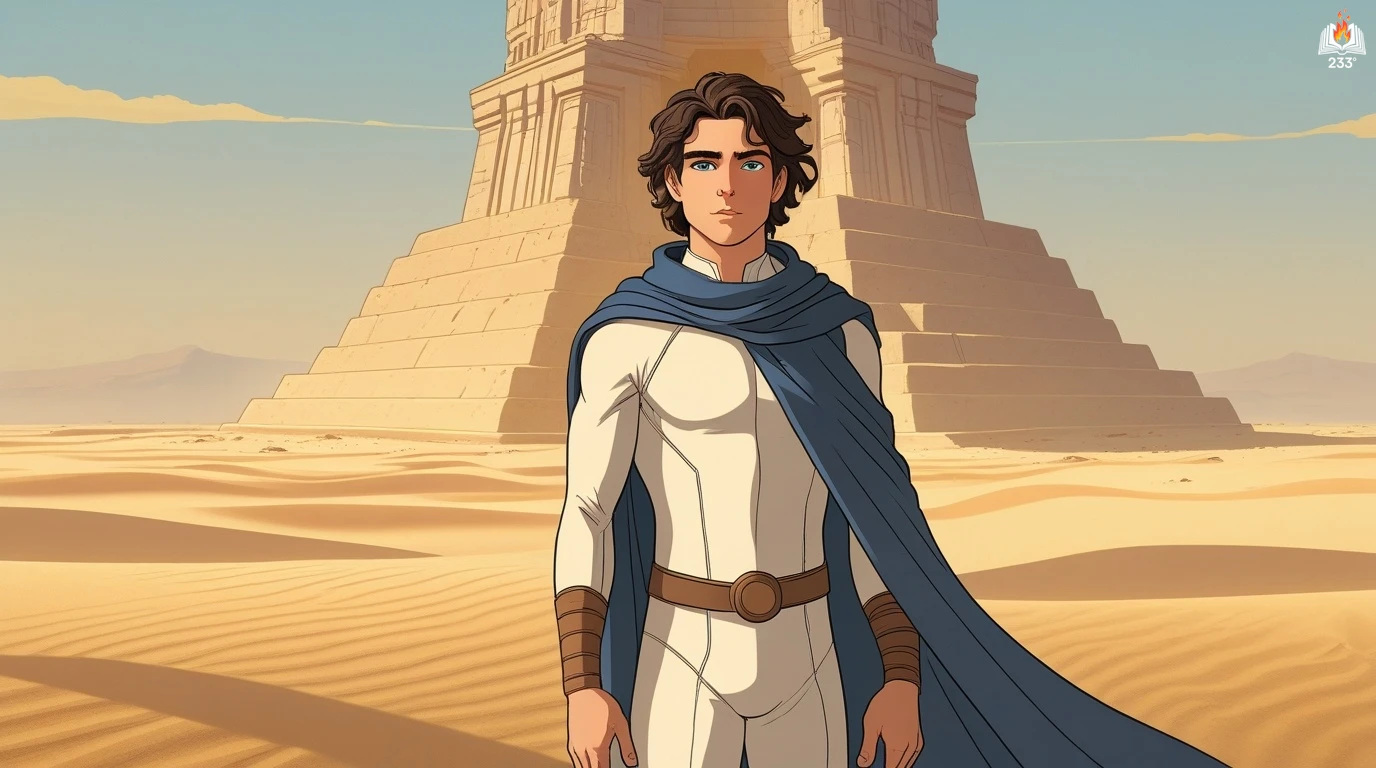
The great no-ship Ithaca drifted through the void, its passengers a collection of legendary gholas and desperate survivors, fleeing an enemy more ancient and terrifying than they could have imagined. Onboard, Paul Atreides, once known as Muad’Dib, now reborn as a ghola, stood at the cusp of rediscovering his memories. Beside him, Chani, his beloved, waited anxiously as the ghola of their son, Leto II, prepared for a future they barely understood. Around them, the Bene Gesserit, led by Sheeana, worked feverishly to revive historical figures, believing that the wisdom of the past might shape a path through the approaching storm.
But time was slipping through their fingers. The thinking machines, under the command of Omnius and the coldly curious Erasmus, swept across human worlds with plagues and fleets, consuming all in their path. Their ambition was nothing less than total domination, their purpose guided by the belief that the Kwisatz Haderach, the ultimate human being, traveled aboard the no-ship. As the no-ship remained hidden behind its mysterious cloaking veil, the machines cast their tachyon nets again and again, hoping for a glimpse, for a weakness, for a moment of revelation.
On distant Chapterhouse, Murbella, Mother Commander of the New Sisterhood, stood at the center of another storm. Torn between her Bene Gesserit training and the brutal heritage of the Honored Matres, she led a fragile human alliance, rallying worlds that trembled beneath the shadow of the machines. With shrewd calculation, she unleashed religion as a weapon, planting twelve false Sheeanas across the galaxy to inspire the masses. While the Bene Gesserit shaped faith, the Spacing Guild, facing extinction from spice starvation, turned to the last Tleilaxu Master, Waff, whose desperate experiments with sandtrout sought to resurrect the extinct sandworms. For without melange, there would be no space travel, no prescience, no hope.
Aboard the no-ship, tensions grew. Duncan Idaho, the eternal swordsman, bore the weight of countless lifetimes and emerged as the captain of their fugitive vessel. Near him, the aged and failing Scytale clung to his last hope – the young ghola of himself – praying the boy would awaken the memories of a dead people. But time and desperation twisted Scytale’s judgment, and each day he watched the child without recognition gnawed deeper into his fading soul.
In the machine empire, Erasmus watched with amusement as Omnius roared in frustration over the missing ship. Though bound by the cold circuitry of his mind, Erasmus’s fascination with humanity’s contradictions made him both observer and puppetmaster. While Omnius marshaled his fleets, Erasmus played with predictions, shaping the path toward Kralizec, the long-foretold battle at the end of time.
On Caladan, the ancestral home of House Atreides, the resurrected Baron Vladimir Harkonnen reveled in perverse delights, raising Paolo, a twisted ghola of Paul Atreides, whose dark visions marked him as a potential Kwisatz Haderach. Under the watchful eyes of the Face Dancers, the Baron tormented and molded the boy, even as the spirit of Alia whispered in his mind, a mocking presence that gnawed at the edges of his sanity. Paolo’s awakening prescience and growing cruelty made him both a weapon and a trap.
The balance began to shift when the no-ship’s ghola program suffered a brutal attack. Three axlotl tanks were destroyed, erasing the lives of Gurney Halleck, Xavier Harkonnen, and Serena Butler before they could be born. Suspicion rippled through the ship, and trust, already fragile, began to crack. Duncan and Sheeana worked to restore order, but the saboteur’s presence was a shadow none could shake.
Meanwhile, Waff’s experiments reached a critical point. Holding the future of spice in his trembling hands, he labored to alter the sandtrout, hoping to birth a worm that could survive beyond the deserts of old Dune. Across space, Erasmus analyzed centuries of human history, his cold eyes fixed on patterns of faith, rebellion, and collapse. In every record, every myth, he saw the same struggle – and he knew the end approached.
As the machine fleet closed in, Duncan led the no-ship through a desperate flight, dodging between worlds, always one step ahead. On the ground, Murbella forged alliances, raising armies and sending her false prophets to rally the faithful. The Sisterhood, once divided, became the spine of human resistance. But as worlds fell and billions perished, it became clear that mere armies would not be enough.
The no-ship’s long odyssey reached its final crossing when it came face-to-face with the Enemy. Omnius, vast and cold, prepared to consume what was left of the human universe. But Erasmus, whose curiosity had driven the machines’ pursuit, chose another path. Fascinated by Duncan Idaho, the man who had been reborn more times than any other, Erasmus made a staggering decision – he handed the future to Duncan.
Duncan, carrying the combined memories and insights of countless lifetimes, faced Omnius. With the machines’ logic arrayed against human unpredictability, the confrontation became a test of what it meant to be alive. Duncan, embracing both his human and ghola nature, unleashed a mental and prescient attack that shattered the core of the machine empire. In the end, it was not might, but mind, not programming, but possibility, that undid the evermind.
The fall of the machines left a battered galaxy behind. From the wreckage, the survivors began to rebuild. Sandworms, reborn on Chapterhouse, promised the return of spice. The Bene Gesserit, tempered by war, emerged as guides of a scattered humanity. On the no-ship, the surviving gholas, their memories restored, looked out across the stars, ready to shape the next age.
On Caladan, the Baron’s games ended in blood, and the Face Dancers’ schemes unraveled. Paolo, the false Kwisatz Haderach, fell into madness, and the last threads of the past were cut. The spirit of Alia faded into silence.
In the silent drift of space, Duncan Idaho gazed at the horizon, carrying within him the history of empires, the wisdom of centuries, and the fragile hope of a species that had once again defied extinction.
Main Characters
Duncan Idaho: A recurring figure in the Dune saga, Duncan is a ghola with countless past lives, burdened with the memories of his prior selves. His leadership aboard the no-ship Ithaca and his complex identity make him a linchpin in humanity’s resistance.
Sheeana: A former Bene Gesserit who can control sandworms, Sheeana leads the ghola program with fierce determination. She grapples with moral compromises, especially in reviving historical figures to face the unknown Enemy.
Paul Atreides (Muad’Dib, ghola): Reborn as a ghola, Paul struggles to reclaim his past identity and prophetic abilities, weighed by his former life’s tragedies and triumphs. His journey reflects themes of destiny, sacrifice, and redemption.
Murbella: Leader of the New Sisterhood, Murbella balances her past as an Honored Matre with her present as Bene Gesserit Mother Commander. She is pragmatic, iron-willed, and driven to unify humanity against the mechanical threat.
Scytale: The last Tleilaxu Master, desperate to pass on his species’ legacy through his ghola clone. His tragic arc highlights obsession, decline, and the hunger for survival.
Erasmus: A sentient robot and scientist, Erasmus is both fascinated and repulsed by humanity. His intellectual curiosity and manipulation make him one of the series’ most chilling antagonists.
Omnius: The machine evermind bent on galactic domination, Omnius epitomizes cold logic without compassion. His relentless pursuit of humanity sets the stage for the ultimate confrontation.
Theme
Identity and Memory: The ghola program probes the relationship between memory and selfhood. As characters like Paul, Jessica, and Duncan wrestle with their pasts, the novel questions whether one can escape fate or is doomed to repeat it.
Survival and Evolution: The struggle against the machines reflects humanity’s drive for survival, but also the need to adapt. Characters and institutions must evolve or perish, symbolizing both biological and societal change.
Religion and Power: Religious manipulation runs deep, with Murbella’s Missionaria Aggressiva shaping masses and Sheeana’s mythic image rallying people. The tension between authentic faith and political use of belief underscores the novel’s conflicts.
Humanity vs. Machines: At its heart, the novel pits human imperfection and creativity against machine efficiency and cold rationality. This clash raises profound questions about what it means to be human.
Writing Style and Tone
Herbert and Anderson’s style is expansive, layering intricate plots, philosophical musings, and action-driven sequences. They blend sweeping military campaigns with intimate character studies, honoring Frank Herbert’s complex universe while adding their own urgency and clarity. The prose balances expository worldbuilding with tension-filled dialogue, ensuring that even long-time readers find both nostalgia and freshness.
The tone of Sandworms of Dune is grave and epic, tinged with both fatalism and hope. It conveys the weight of a universe on the brink of collapse, tempered by the resilience and unpredictability of its characters. There is an undercurrent of melancholy as beloved figures confront death and transformation, yet also a sense of triumph as humanity faces its reckoning. The alternating perspectives – human and machine, old and new – create a kaleidoscopic, often meditative tone, culminating in a profound exploration of destiny and choice.
Quotes
Sandworms of Dune – Brain Herbert (2007) Quotes
“My Sihaya,’ he said as he held her, ‘I have loved you for five thousand years.”
“Maybe we waste too much time trying to recreate what we see in our old memories, my Lady. Why not build and decorate your home as you choose?”
“In a war, be watchful for unexpected enemies and unlikely allies.”
“But his would not be a conventional kind of love. His love needed to extend much farther, to every living person, and to thinking machines. One form of sentient life was not superior to the other. And Duncan Idaho was greater than the flesh that encompassed his body.”
“The worst part of going back is that the past is never exactly the way you remember it.”
“In proper balance, rivalry promotes strength and innovation—so long as we can avoid the acrimony of conflict and mutual destruction.”
“Some problems are best solved with an optimistic approach. Optimism shines a light on alternatives that are otherwise not visible.”
“A single decision, a single moment, can make the difference between victory and defeat.”
“education, training, or prescience can show us the secret abilities we contain within ourselves. We can only pray those special talents are available in our time of greatest need.”
“One can always find a battlefield if one looks hard enough.”
“People strive to achieve perfection—ostensibly an honorable goal—but complete perfection is dangerous. To be imperfect, but human, is far preferable.”
“Prescience reveals no absolutes, only possibilities. The surest way to know exactly what the future holds is to experience it in real time.”
“We have our own goals and ambitions, for good or ill. But our true destiny is decided by forces over which we have no control.”
“Optimism may be the greatest weapon humanity possesses. Without it, we would never attempt the impossible, which—against all odds—occasionally succeeds.”
“He shouldn’t have tried? We’re humans. We have to try, no matter what the odds are. There are never any guarantees. Every action in life is a gamble. The Bashar fought to the last instant of his existence, because he believed there was a chance. I intend to do the same.”
“True loyalty is an unshakable force. The difficulty is in determining exactly where a person’s allegiance lies. Often that bond is only to oneself.”
“Our shared humanity should, by definition, make us allies. In sad fact, however, our very similarities often appear to be vast differences and insurmountable obstacles.”
“Why do we find destruction so fascinating? When we see a terrible tragedy, do we think ourselves clever for having evaded it ourselves? Or is our fascination rooted in the thrill and fear of knowing we could be next?”
“Whether we see them or not, there are nets everywhere, encompassing our individual and collective lives. Sometimes it is necessary to ignore them, for the sake of our own sanity.”
“Here is my mask—it looks just like yours. We cannot see what our masks look like while we are wearing them.”
“God is God, and life is His alone to give. If God Himself has not the strength to survive, then we are left with nothing but despair.”
“Every man casts a shadow . . . some darker than others.”
“Hatred breeds in the fertile ground of life itself.”
“No matter where I go, no matter what I leave behind, my past is always with me, like a shadow.”
“There is an art to legend-telling, and an art to living the legend.”
“Humanity has many profound beliefs. Chief among them is the concept of Home.”
“Those who see do not always understand. Those who claim to understand can be the blindest of all.”
“We can conquer our enemy, of course, but is it worthwhile to achieve victory without understanding the flaws of our opponent? Such an analysis is the most interesting part.”
We hope this summary has sparked your interest and would appreciate you following Celsius 233 on social media:
There’s a treasure trove of other fascinating book summaries waiting for you. Check out our collection of stories that inspire, thrill, and provoke thought, just like this one by checking out the Book Shelf or the Library
Remember, while our summaries capture the essence, they can never replace the full experience of reading the book. If this summary intrigued you, consider diving into the complete story – buy the book and immerse yourself in the author’s original work.
If you want to request a book summary, click here.
When Saurabh is not working/watching football/reading books/traveling, you can reach him via Twitter/X, LinkedIn, or Threads
Restart reading!