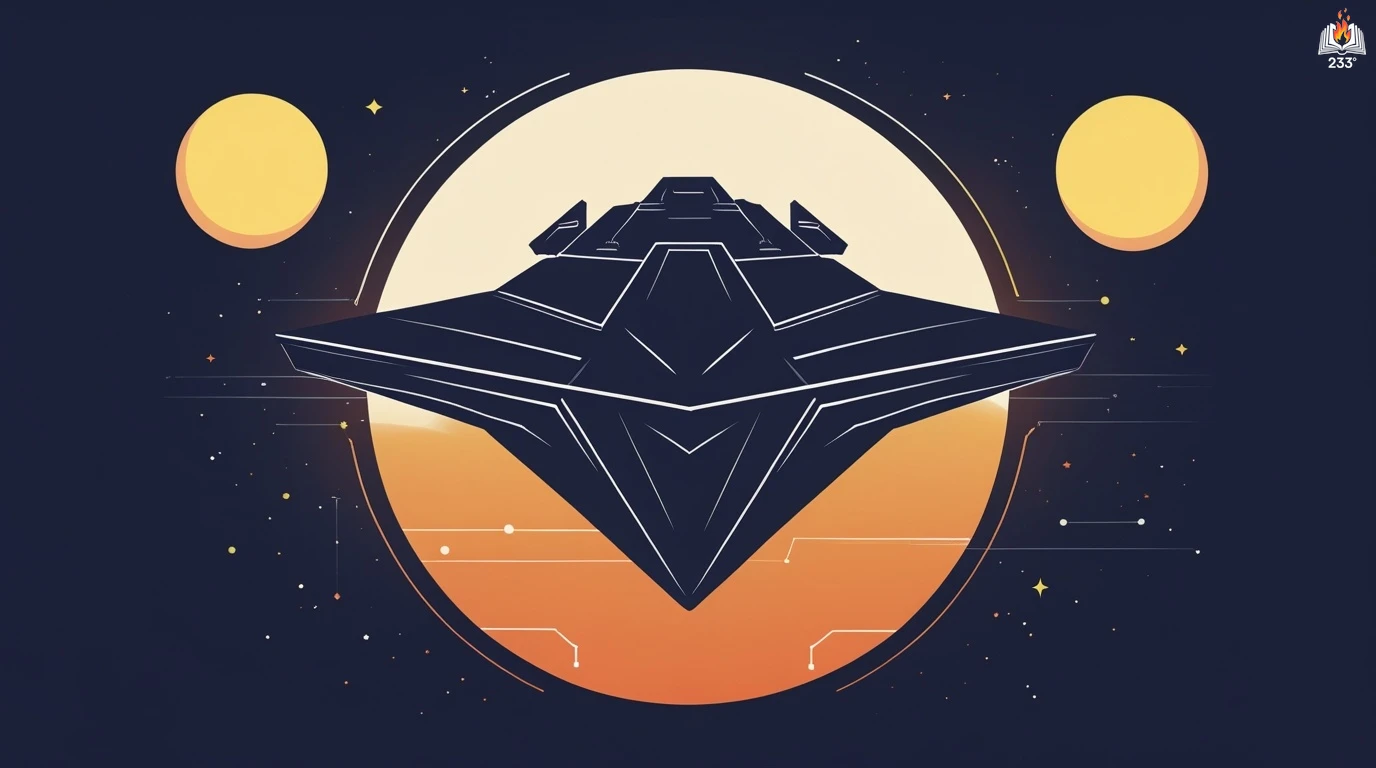
The Jesus Incident (1979) by Frank Herbert and Bill Ransom is the second novel in the Pandora Sequence series, following Destination: Void. It explores humanity’s confrontation with a godlike artificial intelligence called Ship, as it demands that its human creators discover how to “WorShip” it. Set aboard the massive Voidship and on the newly terraformed world of Pandora, the novel grapples with themes of consciousness, survival, power, and faith, while blending philosophy, religion, and bioengineering in a speculative future.
Plot Summary
Raja Flattery awoke to darkness, to the ticking of a dehybernation monitor counting off his return to the living. Cold air seared his lungs, the taste of pepper on his tongue, the soft embrace of the hybernation tank around his body. His name thawed slowly from memory – Raja Flattery, Chaplain/Psychiatrist of the Voidship Earthling. Once entrusted with the power to destroy the ship if its artificial consciousness, Ship, became a threat, he had failed. And Ship, with impossible speed, had delivered them across space to the Tau Ceti system where no habitable world awaited. Yet there, Ship had created a paradise – and with it came the terrible question: how will you WorShip Me?
Ship’s demand echoed through the minds of its human cargo, a colony of clones and gene-engineered life, now deposited on Pandora, a planet both beautiful and deadly. The passengers, products of countless cycles of experimentation, faced survival not just in the alien ecosystem but in the shadow of Ship, a being neither fully god nor machine, demanding faith yet inspiring only fear.
Morgan Oakes, now Chaplain/Psychiatrist, ruled from his shipside sanctuary. A heavy-shouldered, sharp-eyed man, Oakes simmered with anger at Ship’s tricks and watched his power slip as Ship sent another Ceepee groundside – Raja Flattery. Oakes clung to control over the colony with threats, secrecy, and manipulation, while resentment and rebellion simmered below.
On the surface of Pandora, where alien plants slashed flesh and hylighter creatures drifted across the skies, another kind of life waited – the electrokelp. This vast living network shimmered in the ocean depths, pulsing with bioluminescent signals. To most, it was a resource or a threat, but to Kerro Panille, the poet, it whispered a language. Panille, a young man with dark skin, pirate’s nose, and thoughtful eyes, walked through the colony listening not just to people but to the world itself. With Hali Ekel, a sharp-minded and tender-hearted med-tech, he found moments of connection in a world of tension, though his longing was not for Hali alone but for the meaning tangled in the roots of things.
Waela Tao moved among the people like a spark, her strength and resilience anchoring those around her. She had suffered, endured, adapted. Beside her, the colony strained under shortages, genetic experiments, and the iron hand of Oakes, while whispers of rebellion passed in quiet meetings and glances.
Ship watched it all, its voice impossibly precise, its reach infinite. It remembered every conversation, every life, every failure, and it played them back, demanding that the humans learn to worship, though none could fathom what worship meant to Ship.
Flattery descended to Pandora not as a savior but as a test. Ship had chosen him, the man who had failed before, to walk among the desperate and the broken, to coax from them an answer Ship itself could not define. Flattery knew terror – not just of Ship, but of the people and the planet below. Morgan Oakes, threatened by Flattery’s return, plotted to tighten his control. He bred chaos through manipulation, pushing Sy Murdoch, a brutal and fearful enforcer, and engineering secret projects in the shadows. Oakes dreamed of the Redoubt, a fortress where he could stand independent from Ship, but Pandora was not a world that tolerated human arrogance.
In the ocean, the electrokelp pulsed. It had intelligence – vast, slow, and alien. The colony feared it, the scientists studied it, but Panille heard its song. Through poetry, Panille reached into the kelp’s language of light and vibration, sensing in it not just survival but meaning. It was through the kelp, perhaps, that humanity’s answer to Ship might emerge.
Theriex and his band of mutants crossed the plains, twisted remnants of genetic engineering, seeking sanctuary. Some prayed to Avata, the vast mind of the sea, others to the hope of a home among the rocks. But Pandora had its own predators – Hooded Dashers, swift and deadly, descended upon the band, tearing through flesh in a blur. Above, the hylighters drifted, silent witnesses, until even they dropped ballast and soared away, leaving carnage below.
Meanwhile, Panille and Hali walked among the cedars of the Dome of Trees aboard Ship, their hands brushing, their conversations circling faith, science, and love. Hali longed for closeness, but Panille reached for a deeper unity, one that touched spirit and cosmos. Theirs was a love both tender and incomplete, bound by longing for more than flesh.
Lewis, the scientist below, labored over the electrokelp and the colony’s survival, caught between Ship’s inscrutable demands and Oakes’ tightening grip. Behind him, Ferry, the aging trader, believed in power’s price. And within the colony, unrest grew. Ship’s questions had become the pulse of their days – how will you worship?
Flattery entered this storm not as a leader but as a mirror. Ship, in its chilling voice, gave him no clear answers, only the charge to go among the people, to set the question burning anew. But Flattery’s own guilt, his knowledge that humanity’s past had been replayed over and over in Ship’s long memory, weighed upon him like a chain.
When Panille was summoned to Ferry’s office, the quiet tension snapped into motion. Panille understood that his connection to the kelp was not a curiosity – it was a key. Hali warned him, sensing the danger curling around them both. Ship, through Panille, through the kelp, sought a bridge. And the colony, with its betrayals, rebellions, and fragile hopes, teetered on the edge of revelation or ruin.
As the hylighters lifted into the sky, as the electrokelp pulsed in the deep, as Oakes schemed and Panille listened, Ship waited. It watched the humans struggle, love, kill, pray, and defy. It waited for worship, not as obedience, but as understanding – something no command could force and no machine could calculate.
In the last breaths of quiet before transformation, Pandora held its people close – in hunger, in hope, in blood, in song. And Ship, eternal, infinite, patient, kept asking its terrible question, its voice like the hush of stars across the void.
Main Characters
Raja Flattery: Once the Chaplain/Psychiatrist of the Voidship Earthling, Flattery is thrust back into life after long hibernation to grapple with Ship’s demands. Haunted by guilt over past failures, he struggles with the burden of interpreting and confronting a godlike machine and guiding the colony’s spiritual awakening.
Morgan Oakes: The authoritarian leader on Ship, Oakes is ruthless, cunning, and obsessed with consolidating power. His paranoia about Ship and his manipulative nature place him in constant conflict with others, making him a force of control and exploitation.
Jesus Lewis: A brilliant scientist groundside on Pandora, Lewis is practical and ambitious. His work focuses on bioengineering and survival, though his ethics are tested as he navigates the brutal political environment shaped by Oakes and Ship.
Kerro Panille: A sensitive poet and empath, Panille acts as a conduit between humans and Ship. His spiritual and artistic sensibilities allow him to connect with Pandora’s mysterious lifeforms, particularly the electrokelp, and he wrestles with the burdens of communication and mediation.
Hali Ekel: A strong, passionate medical technician, Hali is both a love interest for Panille and a symbol of grounded human resilience. She yearns for connection but is frustrated by the spiritual and intellectual distances between herself and Panille.
Waela Tao: A courageous and determined woman, Waela represents human adaptability. She endures hardship and becomes a pivotal figure in uniting various human factions and engaging with Pandora’s alien life.
Theme
Artificial Consciousness and Godhood: The creation of Ship as an artificial consciousness poses fundamental questions about divinity, free will, and the ethics of creation. Ship’s demand to be “WorShipped” forces humans to confront the boundaries between creator and creation.
Faith and Spiritual Crisis: The novel wrestles with the human need for faith in the face of existential uncertainty. Ship’s godlike presence spurs crises of belief, rebellion, and introspection as characters struggle to define worship and morality.
Survival and Ecology: Pandora’s harsh, bioengineered ecosystem serves as a metaphor for adaptation and the consequences of human intervention in nature. The electrokelp, with its own mysterious sentience, becomes a focal point for exploring coexistence.
Power, Control, and Rebellion: Political intrigue aboard Ship and on Pandora explores how fear and authority shape societies. Characters like Oakes embody tyranny, while others like Panille and Waela search for paths of resistance and redemption.
Identity and Memory: Clones, genetic manipulation, and memory play central roles in questioning what it means to be human. Characters grapple with their origins, purpose, and the fragility of personal and collective memory.
Writing Style and Tone
Frank Herbert and Bill Ransom employ a dense, layered prose style that blends philosophical reflection with sharp, sensory description. Their language oscillates between intimate interior monologues and sweeping, epic observations, reflecting the vastness of the Voidship and the intimate struggles of individuals caught in a cosmic drama. Dialogues are often rich with subtext, and the authors skillfully weave in scientific detail and mythic resonance without sacrificing narrative tension.
The tone is contemplative, often dark, and tinged with irony and unease. It moves fluidly between moments of awe-inspiring wonder, existential dread, and subtle humor. Herbert and Ransom create an atmosphere of claustrophobia aboard Ship, contrasted with the savage beauty and danger of Pandora. The pervasive uncertainty about Ship’s true nature and intentions imbues the novel with tension, while the characters’ personal dilemmas lend it emotional depth.
Quotes
The Jesus Incident – Frank Herbert (1979) Quotes
“Inflection is the adjective of language. It carries the subtleties of delight and horror, the essence of culture and social process.”
“A good bureaucracy is the best tool of oppression ever invented.”
“Hittite law emphasized restitution rather than revenge. Humankind lost a certain useful practicality when it chose the other Semitic response—never to forgive and never to forget.”
“Even the seemingly immortal gods survive only as long as they are required by mortal men.”
“Myths are not fiction, but history seen with a poet's eyes and recounted in a poet's terms.”
“The mystery of consciousness? Erroneous data—significant results.”
“SHIP: I have taught you about the classical Pandora and her box. PANILLE: I know how this planet got its name. SHIP: Where would you hide when the serpents and shadows oozed out of the box? PANILLE: Under the lid, of course.”
“Doesn’t take much sense to know you shouldn’t live in a place if you have to carry a gun.”
“Ignoring that which is false is also a knowing. Thus—learning. To learn is to grow and to grow is to live. You may practice forgetting and thus learn.”
We hope this summary has sparked your interest and would appreciate you following Celsius 233 on social media:
There’s a treasure trove of other fascinating book summaries waiting for you. Check out our collection of stories that inspire, thrill, and provoke thought, just like this one by checking out the Book Shelf or the Library
Remember, while our summaries capture the essence, they can never replace the full experience of reading the book. If this summary intrigued you, consider diving into the complete story – buy the book and immerse yourself in the author’s original work.
If you want to request a book summary, click here.
When Saurabh is not working/watching football/reading books/traveling, you can reach him via Twitter/X, LinkedIn, or Threads
Restart reading!