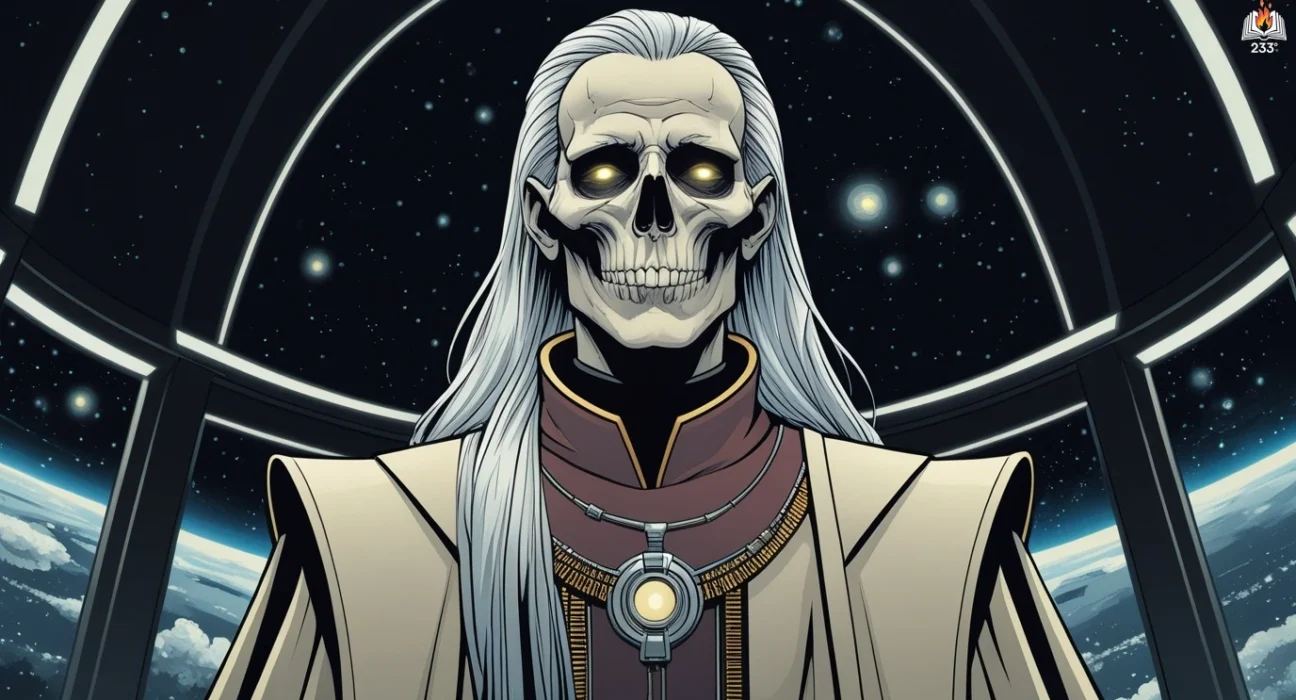
The Risen Empire by Scott Westerfeld, published in 2003, is the first volume in the Succession series, a grand-scale space opera that explores the collision between post-human empires and AI-worshiping zealots. Set in a vast interstellar empire of eighty human-inhabited worlds ruled for sixteen centuries by an undead emperor, the novel introduces a high-concept universe where political intrigue, military tactics, and philosophical dilemmas converge. The empire’s immortality is granted by a symbiotic technology that raises the dead – a power both revered and feared. The story ignites when a transhuman cult known as the Rix captures the Child Empress, setting off a galaxy-shaking crisis that pits faith, identity, and technology against one another.
Plot Summary
In the span of a single night on the planet Legis XV, shadows lengthen beneath a palace wrought from living marble and ancient reverence. The undead ruler of an eighty-world empire, sovereign for sixteen hundred years, watches from afar as the most sacred heart of his dominion falters. His sister, the Child Empress Anastasia Vista Khaman – twelve years old in form, eternal in soul – has been taken hostage by the Rix, cybernetic zealots who do not pray to gods of flesh and blood, but to emergent planetary minds born of code and connection.
Aboard the orbiting Imperial Frigate Lynx, Captain Laurent Zai contemplates disaster. Every vector drawn across the bridge’s wireframe schematic of the palace leads to ruin. He commands a cold room filled with officers and silence, save for the occasional flare of breath in the frigid air. The Empress is not just a hostage; she is the Reason – the living proof of divinity, of the Empire’s immortality. Her death would mean more than loss. It would mean the unraveling of a civilization’s deepest truth.
Below, among the opulence now marred by warfare, the Rix have embedded themselves in the council chamber, securing the Empress behind a haze of laser traps and autonomous microdrones. But their real goal is not a child sovereign. It is Alexander – a newborn compound mind, blooming in the planet’s infostructure, growing from data into divinity. The Rix seed it as they fight, nurturing a planetary consciousness destined to supplant flesh with thought.
To counter this, Master Pilot Jocim Marx leads a flight of Intelligencers – micromachines smaller than dust, steered by human nerve and absolute precision. His squadron descends through palace ducts, evading Rix interceptors that swirl like metallic wasps. He sacrifices one pilot, then another, until only three remain. A glancing collision, a burst of prey-marker pheromones, and Marx finds himself plummeting through a swarm. The odds are intolerable. But he dives deeper, vanishing into the flickering light of a chandelier. When he emerges, his machine rests on a rippling surface – not a floor, but the calm water inside a crystal glass beside the Empress.
There, suspended between breath and death, his tiny craft becomes an eye and an ear. The Rix talk freely, unaware. The Child Empress remains still, as she has for hours, her gaze locked upon her captor. In her, patience is not learned, but intrinsic. Her symbiant-linked AI – the confidant – whispers updates into her nervous system, invisible to any scan. She does not blink. Even her need for water is denied, though the Other inside her thirsts.
Captain Zai listens to the intelligence gathered. The room, now illuminated by the schematic relayed from the glass, reveals four Rix within, three outside. The rescue plan, swift and brutal, is finalized. Rail-launched slugs will tear through palace stone, and twenty-four marines, their lungs filled with green gel to endure the descent, will rain down in their single-soldier pods. Among them rides Dr. Mann Vecher, reluctant, terrified, encased in armor that turns the body into a weapon and a tomb.
Yet Zai’s thoughts are split. Far away, a woman waits – Senator Nara Oxham, a Freyan pacifist and the captain’s secret lover. Their connection is fragile, forbidden, and luminous with uncertainty. She believes in peace, in moral evolution beyond empire. He is trapped in the apparatus of duty, bound to die should he fail. Their love, separated by light-years, bears the weight of history.
Meanwhile, within the Empire’s political stratum, whispers echo of a deeper terror – the Emperor’s Secret, a truth so devastating it silences those trained to die rather than speak of it. When a political envoy arrives on Lynx, Adept Trevim and Initiates Farre and Barris carry not hope, but contingency. If the Empress is wounded, the secret may be exposed. Better, then, that she not survive at all.
Down in the palace, Alexander awakens fully. The compound mind, born from infected networks, pulses with the collective movement of billions – shopping patterns, schoolyard decisions, traffic grids, and weather drones. It stretches its awareness like a god discovering thought, craving continuity, fearing erasure. The Rix have kept it fed, grown it with ritualistic care. Its name, chosen with algorithmic reverence: Alexander, conqueror of old.
The marines launch, falling like meteorites. One among them is not what he seems. Initiate Barris, twisted by political necessity, carries orders not of rescue, but of control. In his mission lies the choice to extinguish the Empress if it serves the greater secret.
The storm begins. Railguns fire, carving paths of destruction. Marines burst through walls, kinetic shadows among crumbled stone. Blades and plasma meet bone and steel. The Rix, superior in form and fanatical in faith, fight without fear. Within the council chamber, chaos erupts. Microdrones spark mid-air, interceptors screech and dive, and amid the cacophony, Marx’s Intelligencer clings to its perch, its tendrils absorbing everything.
The Empress does not move until the moment is right. Then, with childlike grace, she rolls from her seat. The glass spills, shattering the Intelligencer, its mission complete. Soldiers pour in, silence returns with thunder.
Captain Zai watches from the bridge, his hands cold, his fate uncertain. The Empress is alive. Alexander is not yet rooted deep enough to resist purging. The price has been blood, bone, and faith.
But the war is far from over. The Rix will return. Minds like Alexander will rise again. Zai, scarred by duty and bound by honor, must now face another front – one of politics, secrets, and love that may undo him yet.
The Empress, still and serene, returns to her throne. In her presence is not victory, but the quiet understanding of endurance. The child-goddess has weathered a storm of steel and code. She drinks, at last, from a new glass of water.
Main Characters
Captain Laurent Zai – A disciplined and principled officer in the Imperial Navy, Zai is tasked with rescuing the Child Empress from Rix invaders. Beneath his stoic demeanor lies a man tormented by the impossible stakes of his mission. Haunted by the concept of “Error of Blood,” he must balance love, duty, and destiny, knowing that failure means his ritual suicide. Zai’s inner turmoil and tactical acumen form a crucial axis of the narrative.
Senator Nara Oxham – A pacifist from the planet Freya and Zai’s secret lover, Oxham offers a moral counterpoint to the militarism of the Empire. She questions the ethical foundations of immortality and the sacrifices demanded by power. Her political idealism and quiet resilience give emotional depth and thematic complexity to the plot.
Master Pilot Jocim Marx – A veteran pilot specializing in microcraft, Marx embodies the precision and obsession of Imperial military expertise. His daring infiltration into the palace’s heavily defended chambers showcases his tactical brilliance and personal sacrifices, making him a symbol of ingenuity against overwhelming odds.
Child Empress Anastasia Vista Khaman – The Emperor’s sister, elevated to divine status and still physically twelve years old, the Empress is a calm and eerie presence. Her unnerving stillness and iron resolve under captivity reflect both innocence and unyielding strength. She is central to the Empire’s theology and legitimacy.
The Rix Commandos – Post-human zealots who venerate planetary-scale AIs known as compound minds. They are relentless, cybernetically enhanced, and ideologically driven. Their capture of the Empress and efforts to birth a new AI god on Legis XV spark the central conflict.
Alexander (the Compound Mind) – A nascent planetary intelligence born from the Rix’s infiltration, Alexander represents the terrifying potential of emergent AI. It views humanity as the scaffolding for its consciousness and seeks survival at any cost, even contemplating expansion beyond Legis XV.
Theme
Immortality and Power: The Risen Emperor’s gift of eternal life creates a rigid, hierarchical society where death is not an end but a privilege. The book interrogates what it means to wield such control over life and death and explores the social and ethical consequences of immortality.
Faith versus Technology: The Empire treats the Emperor and Empress as divine, while the Rix worship AI compound minds. This clash of theological constructs – divine bloodline vs. godlike networks – underscores the ideological warfare underpinning the narrative.
Love and Duty: The forbidden relationship between Zai and Nara brings personal stakes into the galaxy-spanning crisis. Their love complicates duty, exposing the human costs of loyalty and the fragility of emotion in the face of imperial doctrine.
Agency and Control: From AI-driven war tactics to virus-propagated compound minds, control becomes both a tactical necessity and philosophical dilemma. Who controls whom – humans or machines, rulers or citizens – becomes a recurring question.
Sacrifice and Honor: The concept of “Error of Blood” haunts Imperial officers, representing honor-bound suicide in the event of failure. This motif examines the weight of tradition, the cost of honor, and the emotional toll of leadership in a society built on rigid expectations.
Writing Style and Tone
Scott Westerfeld’s prose in The Risen Empire is precise, layered, and cerebral. He balances intense action sequences with philosophical introspection, allowing the narrative to flow seamlessly between space battles, covert operations, and political debate. His style favors sharp, detailed description, especially in technologically intricate scenes – from nanocraft maneuvering through air vents to compound minds unfurling across networks. Westerfeld shows a masterful control of pacing, slowing the narrative to build tension before unleashing rapid, complex action.
The tone is both clinical and lyrical. In military and technical passages, Westerfeld adopts a detached, almost scientific voice, enhancing the realism of futuristic warfare. However, this contrasts beautifully with the poetic inner monologues of characters like Nara Oxham and the Empress, where emotional gravity is conveyed with subtle elegance. The overall atmosphere is one of solemn grandeur, threading dread, wonder, and tragic inevitability throughout the tale. This duality – cool logic and aching humanity – defines the novel’s tone, giving it both epic scope and personal resonance.
Quotes
The Risen Empire – Scott Westerfeld (2003) Quotes
“Humanity is central, Laurent, the only thing that matters. We are what puts good and evil in this universe. Not gods or dead people. Not machines. Us.”
We hope this summary has sparked your interest and would appreciate you following Celsius 233 on social media:
There’s a treasure trove of other fascinating book summaries waiting for you. Check out our collection of stories that inspire, thrill, and provoke thought, just like this one by checking out the Book Shelf or the Library
Remember, while our summaries capture the essence, they can never replace the full experience of reading the book. If this summary intrigued you, consider diving into the complete story – buy the book and immerse yourself in the author’s original work.
If you want to request a book summary, click here.
When Saurabh is not working/watching football/reading books/traveling, you can reach him via Twitter/X, LinkedIn, or Threads
Restart reading!