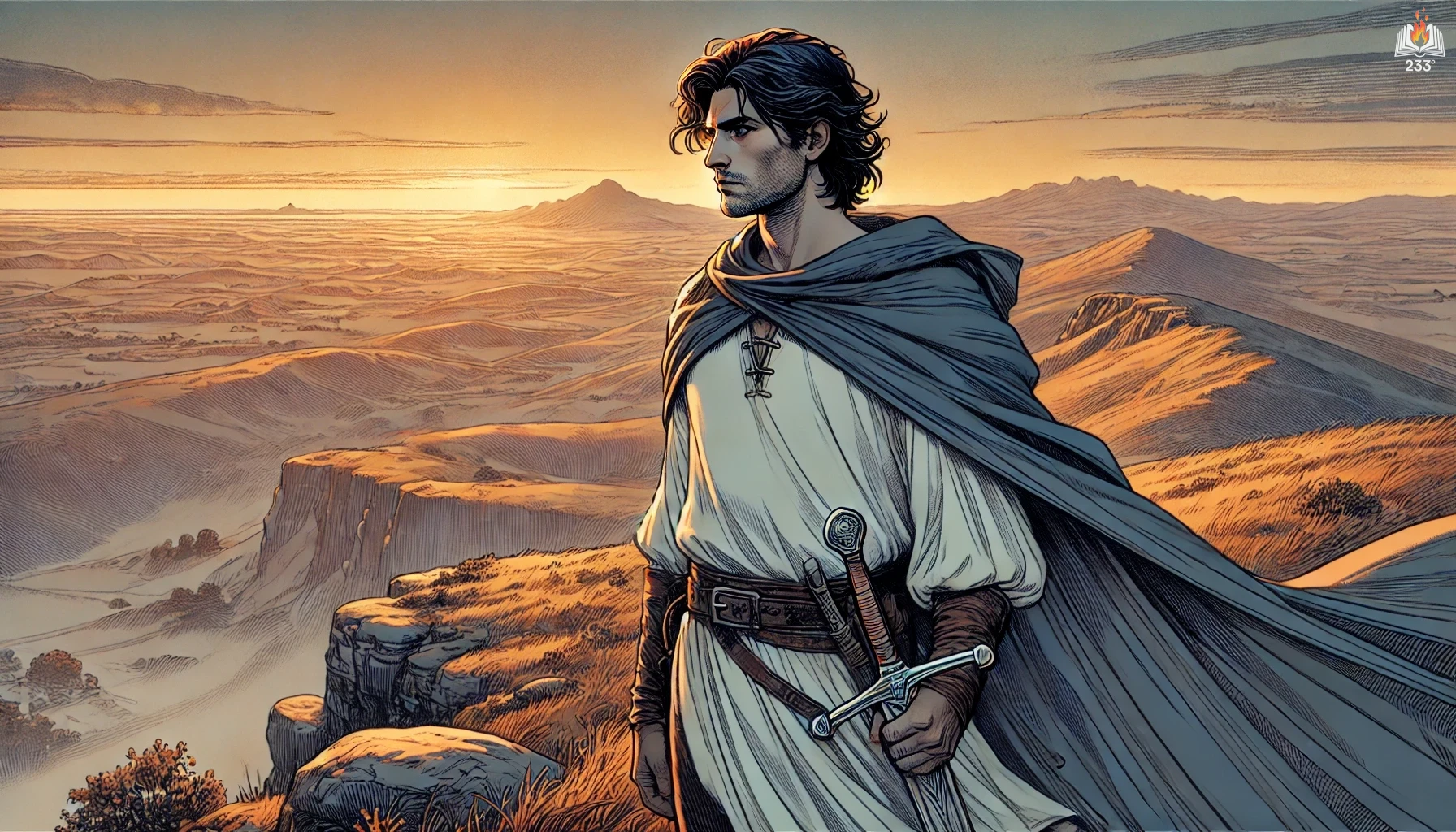
Treason by Orson Scott Card, first published in 1979, is a science fiction novel set on the planet Treason, where descendants of Earth’s exiles grapple with power, survival, and identity in a world divided by genetics, politics, and scarcity. Though it can be read as a standalone, it’s notable as part of Card’s early canon and showcases many of the themes he would develop throughout his career.
Plot Summary
On the isolated planet of Treason, where metal is rarer than virtue, kingdoms rise and fall on the strength of their bloodlines. In the kingdom of Mueller, the ruling family has mastered regenerative powers, their bodies capable of healing any wound, even regrowing lost limbs. But among them is a darker fate – radical regeneratives, those whose bodies mutate beyond control, sprouting excess limbs and organs, lost to madness and utility.
Lanik Mueller, heir to the Mueller throne, stands at the peak of this powerful dynasty. Skilled with sword, bow, and mind, Lanik seems destined to inherit his father Ensel’s dominion. But as adolescence passes, his body betrays him. Softness replaces muscle, and one by one, his body begins to sprout the marks of the radical regenerative. His lover, Saranna, withdraws; his brother, Dinte, circles like a vulture; and his father, though grieving, sees only the threat to the family line. Declared unfit to rule, Lanik is cast aside, his title stripped, his name cursed to ruin.
Yet Ensel Mueller, in a moment of conflicted mercy, sends Lanik east on a mission to the rising power of Nkumai, a distant nation suddenly rich in steel. Lanik, no longer a son, no longer a prince, sets out across the unforgiving lands of Treason. Pursued by assassins, betrayed by his own blood, Lanik rides away from Mueller, his throat nearly cut, his body battered, his will hardening into something neither man nor monster.
Across the desolate plains, Lanik flees toward the edge of the known world, where the vast Ku Kuei forest swallows light, sound, and memory. In the forest, time folds in on itself. Days stretch into weeks, hours into exhaustion. The air turns thick with unseen poisons, and even the mighty Mueller heir staggers beneath the trees. But within that darkness lies a secret no kingdom has grasped. The Ku Kuei, a reclusive people shaped by the forest’s strange magic, reveal to Lanik a power greater than regeneration – the ability to manipulate time itself.
Through pain and sacrifice, Lanik learns their art, touching the hidden strings of time, slipping between moments, mastering the quiet force that underpins all power. With this gift, the scars of his body become his weapon, and the rage that once burned for vengeance begins to cool into purpose.
Leaving the forest, Lanik traverses broken lands and battered cities. The kingdoms of Treason, once mighty, now crumble under their own greed. The Nkumai, thought to be mere tree-dwellers, have unlocked the secret of iron by trading with the Offworlders. Across the continent, the iron-fueled armies march, carving up kingdoms, rewriting the balance of power. But Lanik no longer seeks conquest. He seeks to unmake the chains that bind his world.
In the city of Allison, Lanik moves as a shadow, learning of the slave trade, the body harvests, the ceaseless hunger for metal. Men and women are bred not for love or legacy but for parts – a hand here, a heart there, all traded to the Offworlders for the precious scraps of iron that fuel the engines of war.
The journey drives Lanik into the heart of treachery. Among the Illuders, masters of deception and shapeshifting, he learns to walk unseen, to bend the mind’s eye as easily as time bends beneath his fingers. And among the Sowers, whose touch awakens life or calls death from the earth, he finds the power to heal or destroy entire kingdoms with a breath.
Each encounter strips away the old Lanik, the prince of Mueller, leaving behind something wilder, more elemental. He crosses deserts where sand drinks blood, seas where ships rot before they sail, and cities where no law holds but the hunger for power. And through it all, the memory of Saranna lingers – the taste of love lost, the ache of a world that could have been.
Lanik returns at last to Mueller, not as a son, not as an heir, but as a force beyond kings and bloodlines. Dinte, now lord of the family, sits upon a crumbling throne, his hands steeped in betrayal, his eyes fixed on conquest. But Lanik carries no sword for his brother’s heart. He brings something far sharper – truth.
With time bent at his will, Lanik unravels the fragile web of power holding Mueller together. The harvesters’ blades dull, the pens empty, the Offworlders’ trade crumbles. Across the kingdoms, the great families who once carved the earth for iron turn inward, their illusions pierced, their empire of flesh and metal undone.
And yet, as the walls fall, Lanik finds no triumph in ruin. In the ruins of Mueller, he faces Ensel, the father who cast him out, and Dinte, the brother who sought his death. But there is no revenge in his heart. Instead, there is a quiet, unshakable resolve – to rebuild, not in the name of one family, but for a world where no child is bred for slaughter, no body is currency, and no man or woman must twist themselves into a monster to survive.
Saranna’s memory leads him back to the woman who waited, whose love endured not the prince but the exile, the rad, the wanderer who became something more. Together, they stand at the edge of a world remade, watching as the first light of possibility pierces the long night of Treason.
In the east, the Ku Kuei forest whispers. In the north, the Nkumai steel glimmers. And in the heart of a land long broken, the first fragile promise of freedom stirs.
Main Characters
Lanik Mueller: The protagonist, heir to the powerful Mueller family, who possesses the gift of rapid regeneration. Lanik’s journey begins when his body betrays him by developing uncontrollable regenerative mutations, making him a “radical regenerative” and outcast. Driven by a mix of survival, curiosity, and moral awakening, Lanik’s arc transforms him from an ambitious heir to a reflective, self-sacrificing seeker of justice.
Ensel Mueller (Father): Lanik’s father and ruler of the Mueller domain. A pragmatic, ruthless leader who grieves Lanik’s fall from grace but ultimately prioritizes the family’s survival. His love for Lanik is complex, tangled with duty and legacy.
Dinte Mueller: Lanik’s younger brother and rival, eager to claim the heirship. Dinte is sly, opportunistic, and hungry for power, embodying the darker impulses of the Mueller line.
Saranna: Lanik’s lover, whose heartbreak and loyalty highlight the emotional cost of Lanik’s exile. Saranna’s tenderness contrasts sharply with the brutality of the Mueller court, and her love haunts Lanik throughout his journey.
Homarnoch: The family surgeon, who diagnoses Lanik’s condition and, though dutiful, becomes a figure of quiet sorrow in Lanik’s fall from grace.
The Ku Kuei: Mysterious inhabitants of an enchanted forest, representing an alternative vision of power and balance. Their unique abilities and perspective challenge Lanik’s understanding of control and transformation.
Theme
Identity and Transformation: Lanik’s physical transformations mirror his inner journey as he grapples with questions of selfhood beyond gender, power, and social status. The novel repeatedly asks: Who are we when stripped of title, body, or privilege?
Power and Corruption: Across Treason, power is tied to genetics, resources, and manipulation. Families like the Muellers harvest body parts for trade, revealing how deeply corruption shapes their survival. Lanik’s rejection of this system becomes a rebellion against inherited sin.
Exile and Belonging: Banished from his home, Lanik’s journey becomes both a literal and spiritual exile. His search for a place or community that will accept him without condition underscores the human longing for belonging.
Sacrifice and Redemption: As Lanik moves from vengeance to understanding, the theme of sacrifice deepens. His willingness to give up his privileges, his body, and eventually his ambitions signals his evolution toward redemption.
Nature vs. Control: The Ku Kuei and the enchanted forest introduce the motif of natural balance over domination. Their defiance of time and physics contrasts sharply with the human drive to exploit and conquer.
Writing Style and Tone
Orson Scott Card’s prose in Treason is intimate, vivid, and psychologically probing. He writes in the first-person perspective, allowing readers direct access to Lanik’s turbulent emotions, self-questioning, and gradual awakening. Card’s language is accessible yet layered, weaving philosophical reflection into sharp dialogue and brisk action. His use of vivid physical descriptions, particularly around Lanik’s mutations and the landscapes of Treason, gives the novel a visceral, almost mythic quality.
Card’s tone oscillates between dark and contemplative, with moments of biting irony and tender lyricism. He balances the brutality of Treason’s societies with flashes of human connection and unexpected grace. The narrative carries a sense of urgency and danger, but it is also laced with reflection on morality, identity, and destiny. As the plot unfolds, the tone evolves from political intrigue to mystical exploration, creating an atmosphere that feels both grounded in science fiction and elevated toward allegory.
Quotes
Treason – Orson Scott Card (1978) Quotes
“My master wishes to see you," said the mounted man. "When the planting's done," I said. "Lord Barton is unaccustomed to waiting." "Then he should rejoice, for he'll learn something new today." I went back to the garden. Soon the servant left.”
“I began to suspect that the ultimate sacrifice isn’t death after all; the ultimate sacrifice is willingly bearing the fullest penalty for your own actions.”
“And I began to suspect that the ultimate sacrifice isn't death after all; the ultimate sacrifice is willingly bearing the fullest penalty for your own actions.”
We hope this summary has sparked your interest and would appreciate you following Celsius 233 on social media:
There’s a treasure trove of other fascinating book summaries waiting for you. Check out our collection of stories that inspire, thrill, and provoke thought, just like this one by checking out the Book Shelf or the Library
Remember, while our summaries capture the essence, they can never replace the full experience of reading the book. If this summary intrigued you, consider diving into the complete story – buy the book and immerse yourself in the author’s original work.
If you want to request a book summary, click here.
When Saurabh is not working/watching football/reading books/traveling, you can reach him via Twitter/X, LinkedIn, or Threads
Restart reading!