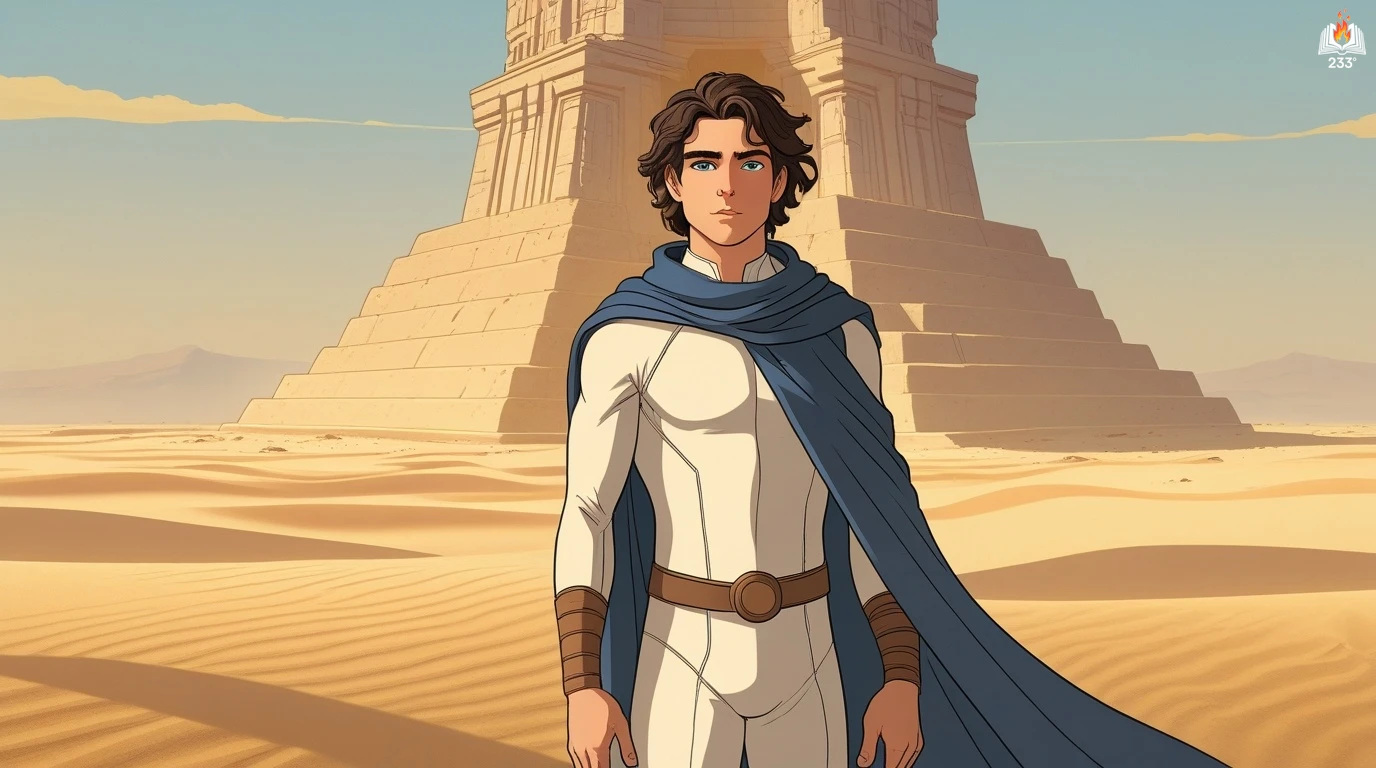
Dune: House Atreides (1999) by Brian Herbert and Kevin J. Anderson is the first novel in the Prelude to Dune trilogy, an official prequel to Frank Herbert’s classic Dune series. Set decades before the events of Dune, it explores the political, ecological, and personal forces that shape the destinies of House Atreides, House Harkonnen, House Corrino, and the desert world of Arrakis. This sweeping epic unravels the origins of the characters and tensions that will ignite one of science fiction’s most celebrated sagas.
Plot Summary
On the desert world of Arrakis, Baron Vladimir Harkonnen stands at the pinnacle of power and cruelty. Ruthless and calculating, he watches over spice production with an iron grip, determined to squeeze every grain of wealth from the barren sands. Yet beneath the surface of his dominion, danger brews. In the deep desert, an excavation site yields a massive spice hoard, but with it comes instability. Gases swell under the sands, sandtrout swarm, and a sudden explosion annihilates machinery and men alike. The Baron escapes by a thin margin, his ambition chastened but not broken. His plots against rivals continue to simmer.
Far from the scorching dunes, on the oceanic planet of Caladan, young Leto Atreides lives under the watchful eye of his father, Duke Paulus. Leto feels the weight of his family’s noble history pressing upon him, while his mother, Lady Helena, weaves her own web of influence, striving to uphold the dignity of House Atreides. The annual performance of Agamemnon, recounting tales of betrayal and vengeance, stirs something in Leto – a sense of his own place within the tides of history.
Meanwhile, the aged and cunning Emperor Elrood IX rules the Imperium from Kaitain, his decrees rippling through the farthest reaches of his domain. Recognizing the looming crisis on Arrakis, Elrood summons Pardot Kynes, an idealistic planetologist, to unlock the mysteries of the desert world. Kynes, a man of unyielding curiosity, dreams not of riches but of transforming Arrakis into a living world, nurturing the sands into fertility. Entrusted with this mission, he journeys to a land where water is myth, and survival itself is a rebellion against nature.
On Ix, the industrious world of machines, Earl Dominic Vernius faces a tightening noose. His innovations have drawn Imperial ire, and whispers of illegal technologies swirl through the court. Yet Dominic remains defiant, a brilliant mind unwilling to kneel, even as shadowy plots and hidden enemies threaten his house. His son, Prince Rhombur, and daughter, Kailea, live in the glow of his legacy, but danger lurks behind the gleaming walls.
Leto is dispatched to Ix, bound by the traditions of noble houses to forge alliances and expand his understanding of leadership. There, among machines and secrecy, Leto meets Rhombur, forming a friendship that will shape both their destinies. Leto learns not just the art of politics but the delicate dance of trust and loyalty, testing his ideals in a world where betrayal comes wrapped in smiles.
Back on Caladan, Duke Paulus, a larger-than-life figure with a booming laugh and an indomitable spirit, grapples with the quiet decay of age. His bond with Leto deepens, and he teaches his son the core of Atreides strength: that loyalty, earned and freely given, is worth more than fear. Yet the Atreides’ honor draws enemies. House Harkonnen, ever hungry for advantage, conspires to undermine them. Beneath the glittering surface of the Imperium, an invisible war unfolds, with assassins and agents moving as deftly as any army.
In the midst of this turmoil, Kynes arrives on Arrakis, stepping into the furnace of a world unlike any other. The Fremen, fierce and secretive desert dwellers, watch him from the shadows. Kynes, driven by his vision of ecological rebirth, wins their respect not through power, but through understanding. As he delves into the secrets of spice, sandworms, and the lifeblood of Arrakis, he sees a path where others see only wasteland. His work sows the seeds of change, even as the great houses plot their wars of ambition.
On Kaitain, Elrood’s days draw short, and within the walls of the palace, his son Shaddam Corrino maneuvers with cold precision. Hungry for the throne, Shaddam sets into motion schemes to accelerate his father’s decline. Alliances are forged in whispers, and betrayal coils like a serpent in the heart of the Imperium.
While Leto learns among the Ixians, tragedy strikes on Caladan. Duke Paulus, lured into a bullring spectacle, falls in a deadly confrontation, his death sending ripples of sorrow and anger through House Atreides. Leto returns, grief-stricken but resolute, the weight of leadership now resting on his young shoulders. With Helena’s sharp counsel and his own emerging wisdom, Leto takes his place as Duke, sworn to uphold the Atreides legacy of justice and compassion.
As the political storm builds, Baron Harkonnen faces his own reckoning. His past treachery returns in the form of Abulurd, his banished half-brother, whose sense of honor contrasts sharply with Vladimir’s greed. The Harkonnen grip tightens on Arrakis, squeezing its people and resources dry, even as rebellion smolders in the desert’s heart.
The Vernius family on Ix confronts catastrophe when the Emperor, pressed by Shaddam and his advisors, moves against them. Dominic and his family are forced into exile, their technological empire seized. Rhombur and Kailea flee, seeking refuge with the Atreides, their future bound now to Leto’s rising house. In the shelter of Caladan’s ancient halls, new alliances are forged, and the tapestry of fate grows ever more intricate.
Kynes, among the Fremen, discovers more than he expected. The sandworms, the spice, and the desert itself weave a tale of survival, adaptation, and hope. His vision sharpens, and with each passing day, he moves closer to transforming Arrakis, nurturing the dream that will one day reshape the fate of an empire.
As Shaddam ascends to the throne, the balance of power shifts. House Corrino’s grip tightens, the Harkonnens sharpen their blades, and the Atreides stand defiant, bound by honor and the memory of those they have lost. On Arrakis, the desert waits, its winds whispering of destiny, its sands ready to bear witness to the rise and fall of empires.
In the end, paths converge: Leto, hardened but not broken, leads his house with quiet strength; Kynes plants the seeds of a world yet to bloom; Rhombur and Kailea find new purpose among the Atreides; and across the empire, alliances fracture, betrayals unfold, and the shadow of the future looms. The stage is set, the players in motion, and the desert, timeless and unforgiving, holds its secrets close.
Main Characters
Leto Atreides: A young noble heir of House Atreides, Leto is intelligent, thoughtful, and earnest. His coming-of-age journey includes political training, moral testing, and the deepening of his innate sense of honor. His compassionate leadership style foreshadows the qualities that will define his future rule.
Baron Vladimir Harkonnen: Ruthless and cunning, Baron Harkonnen governs Arrakis with cruelty, driven by greed and a thirst for control over spice production. His machinations and corruption plant seeds of long-standing enmity with House Atreides.
Pardot Kynes: An Imperial Planetologist, Kynes is passionate about Arrakis’ ecology and dreams of transforming the desert world. His visionary ideas and alliance with the native Fremen shape the planet’s future and reflect his blend of scientific brilliance and human empathy.
Emperor Elrood IX: An aging and manipulative ruler, Elrood clings to power while scheming to secure his legacy. His decisions ripple across the empire, stirring unrest and setting political wheels into motion.
Dominic Vernius: Earl of House Vernius on Ix, Dominic is proud, defiant, and inventive. His rebellious spirit clashes with imperial authority, making him a pivotal figure in the web of interplanetary tensions.
Lady Helena Atreides: Leto’s mother, a woman of protocol and political savvy, balances her loyalty to House Atreides with the ambitions and burdens of her own lineage from House Richese.
Theme
Power and Corruption: The novel dissects the corruptive nature of power through political conspiracies, betrayal, and exploitation, contrasting the moral integrity of House Atreides with the depravity of House Harkonnen and the manipulations of the Emperor.
Destiny and Legacy: Characters wrestle with the weight of ancestral legacies and the shaping of future generations. Leto’s growth, Kynes’ ecological mission, and the dynastic ambitions of noble houses all reflect a preoccupation with shaping destiny.
Environmental Transformation: Pardot Kynes’ dream of terraforming Arrakis highlights themes of ecological stewardship and adaptation. The harsh desert environment becomes a symbol of both challenge and hope.
Loyalty and Betrayal: Loyalty, whether to family, house, or ideals, becomes a central test for many characters. Betrayals—political, personal, or ideological—drive much of the narrative tension.
Human Nature vs. Technological Control: The tension between humanity and technology, especially in the shadow of the Butlerian Jihad, surfaces in the scrutiny of Ixian innovations and the fear of overreaching progress.
Writing Style and Tone
Brian Herbert and Kevin J. Anderson employ a grand, cinematic style that mirrors the scale and complexity of Frank Herbert’s original universe. The prose is rich with detail, blending political intrigue, ecological wonder, and personal drama into a cohesive tapestry. The authors use alternating perspectives to give readers a multifaceted view of the Dune universe, offering deep insight into motivations, fears, and ambitions.
The tone ranges from foreboding and philosophical to intimate and emotional. The narrative balances high-stakes political gamesmanship with moments of human vulnerability, creating an atmosphere of both grandeur and intimacy. There’s a constant undercurrent of tension and inevitability, as characters navigate the shadows of an empire on the brink of transformation. The language often leans into the mythic, foreshadowing the epic destinies that await.
Quotes
Dune: House Atreides – Brain Herbert (1999) Quotes
“It's so much more interesting to study a ... damaged world. I find it difficult to learn anything in a place that's too civilized.”
“Let pressure pass over and through you. That way you can't be harmed by it.”
“In adverse circumstances, every creature becomes something else, evolving or devolving. What makes us human is that we know what we once were, and, let us hope, we remember how to change back.”
“Brilliant, Piter! I'm glad I didn't execute you all those times when you were so annoying.' 'So am I,' de Vries said.”
“A requirement of creativity is that it contributes to change. Creativity keeps the creator alive.
“If you are born to power, you must prove you deserve it through good works—or give it up. To do any less is to act without conscience.”
“Address the solvable first, instructs the father by way of teaching his son crisis management. That way, he counsels, there is less distraction to tackle more daunting issues.”
“High Priest proudly sprinkled the iron-red holy dust of Dur”
“Bringing up the rear was the green-robed High Priest of Dur, who had by tradition crowned every Emperor since the fall of the thinking machines.”
“High Priest of Dur,”
“Even innocents carry within them their own guilt in their own way. No one survives through life without paying in one fashion or another.”
“Memory and History are two sides of the same coin. In time, however, History tends to slant itself toward a favorable impression of events, while Memory is doomed to preserve the worst aspects.”
“adverse circumstances, every creature becomes something else, evolving or devolving. What makes us human is that we know what we once were, and—let us hope—we remember how to change back. Ambassador Cammar Pilru, Dispatches in Defense of Ix”
“Hatred is as dangerous an emotion as love. The capacity for either one is the capacity for its opposite.”
“Imperial man,” said Turok, stepping forward from the shade, “what is it you see when you stare out onto the desert like that?” Kynes answered without looking at him. “I see limitless possibilities.”
“see. Fanatics are often blinded in their thoughts. Leaders are often blinded in their hearts.”
“Dune,” the Fremen youth said. “Only the Imperials and the Harkonnens call this place Arrakis.” “All right,” Kynes said. “Dune, then.”
“Beliefs are more powerful than facts.” Leto stared through the thick sky at the magnificent, distant ship and frowned. It was often difficult to separate truth from fiction....”
“Truth is a chameleon.”
“Anirul stiffened. “My future husband—and even the Golden Lion Throne itself—are secondary to our breeding program.” “Of course you’re right.” Margot nodded in resignation, as if shocked at her own gaffe. “But how should we proceed?” “We begin with a message to Leto.”
“the long history of our House, we have been constantly shadowed by Misfortune, as if we were its prey. One might almost believe the curse of Atreus from ancient Greek times on Old Terra.”
“My Duke, do not overestimate the strength of love and loyalty, and do not underestimate the power of personal hatred.”
“And now the Fremen number ten million and one,” he said.”
“A Guildsman merged with the cosmos and saw safe paths through the wrinkles of fate, prescient visions that enabled him to guide matter from place to place like chess pieces in a cosmic game.”
We hope this summary has sparked your interest and would appreciate you following Celsius 233 on social media:
There’s a treasure trove of other fascinating book summaries waiting for you. Check out our collection of stories that inspire, thrill, and provoke thought, just like this one by checking out the Book Shelf or the Library
Remember, while our summaries capture the essence, they can never replace the full experience of reading the book. If this summary intrigued you, consider diving into the complete story – buy the book and immerse yourself in the author’s original work.
If you want to request a book summary, click here.
When Saurabh is not working/watching football/reading books/traveling, you can reach him via Twitter/X, LinkedIn, or Threads
Restart reading!