The Valley of Amazement by Amy Tan, published in 2013, is a sweeping historical saga set across the early 20th century in China and America. Tan – known for her exploration of mother-daughter relationships and Chinese-American identity – delves deeply into the world of courtesans in Shanghai, beginning in 1905 and continuing through political upheaval, betrayal, and rediscovery. With a rich narrative spanning generations, the novel is a powerful journey of self-discovery, heritage, and emotional resilience, intricately connected to Tan’s legacy of exploring familial bonds and cultural duality.
Plot Summary
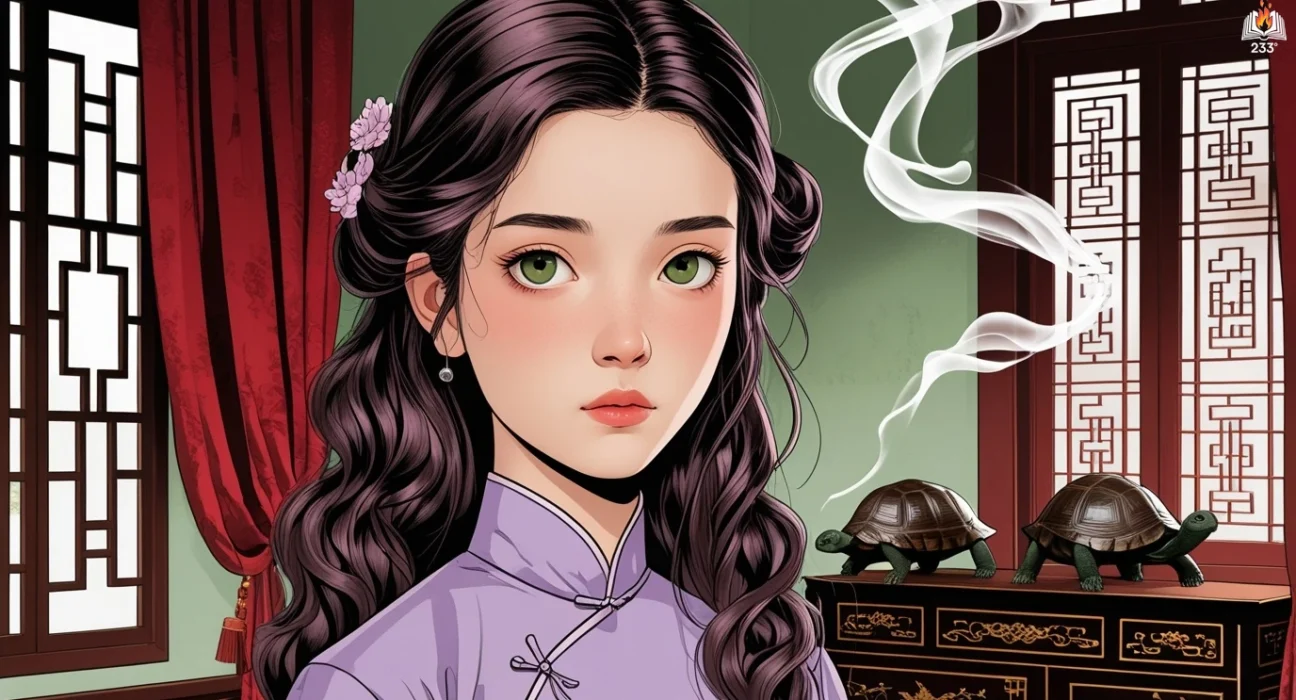
In the flickering opulence of early 20th century Shanghai, amidst carved tortoises and velvet-draped balconies, a young girl named Violet grows up inside the storied walls of Hidden Jade Path. The courtesan house – run by her American mother Lulu Minturn – hums with the elegant chaos of East meeting West, business cloaked in the silk of seduction, and whispered secrets wrapped in smoky veils of opium and jasmine. Violet, with her brown curls and green eyes, navigates this layered world with the keenness of a child born into spectacle, yet set apart by the one thing she yearns for most: her mother’s full attention.
Lulu, the enigmatic proprietress of the house, commands respect with a shrewd mind and unparalleled guile. Her social club welcomes Chinese and Western businessmen alike, but it is not the cigars, card games, or brandy that bind them – it is Lulu herself. Her magnetism builds fortunes. Yet for all her brilliance, Lulu is emotionally distant, her affection rationed between her Cloud Beauties and the whispers of powerful men. Violet, both daughter and shadow, watches from her perch, longing for the warmth of her mother’s love, sensing that her presence is becoming inconvenient.
Amid a house filled with artful deception and fleeting loyalty, Violet finds companionship in Carlotta, her feral cat with pirate lineage, and in Magic Cloud, a courtesan whose flights of fancy include moonlit conversations with the ghost of a long-dead poet. But even magic has its price. When Magic Cloud is expelled for violating the sacred contract between client and courtesan, Violet’s childish defiance erupts. She threatens to betray her mother, unleashing a cold finality in Lulu’s gaze. From that moment, something breaks between them – not in words, but in absence.
Lulu’s decisions, always cloaked in necessity, soon take a devastating turn. Believing she is protecting Violet from chaos in a politically trembling China, she arranges for her daughter to flee Shanghai. But treachery intervenes. Violet is instead sold into a rival courtesan house, her American identity stripped away with her possessions, her name lost to the whim of others. Betrayed and abandoned, she is trained and renamed in the ways of the courtesan, under a false promise of rescue that never arrives.
As years drift by, Violet is no longer the rebellious girl with lace-snagging cat claws. She becomes a commodity in a world she once watched with detached curiosity. Her body becomes the price of survival, her laughter a tool. Yet, even within captivity, Violet clings to the remnants of her spirit. She bears a daughter – Flora – and in the instant of her birth, feels the primal force of a love she had long believed was absent from the world. That love, however, is soon stolen. Flora is taken from her arms, spirited away by the father’s family who dismiss Violet as an unworthy mother.
Grief becomes Violet’s constant companion. Yet it does not break her. She escapes the life forced upon her and begins the long search for her daughter. Through countryside villages and city shadows, she follows the elusive threads of Flora’s whereabouts, her own past now a haunting fog she must navigate to reclaim any piece of the future.
In parallel, Lulu’s own journey unfurls in silence. She returns to America, broken by the belief that Violet is lost forever. Only later, through a cascade of letters, clues, and coincidences, does she uncover the truth of her daughter’s betrayal and captivity. The realization shatters her carefully constructed world. But where Violet’s fury had once erupted in shouts and sabotage, Lulu’s regret is quieter – a mourning of lost time, of the arrogance that convinced her she could orchestrate fate.
Years pass before their paths cross again, not in the lush salons of Shanghai but in quieter rooms, older bodies filled with more memory than anger. Reunited through tragedy and longing, mother and daughter unravel the distances between them. Violet, hardened by betrayal and softened by motherhood, comes to understand her mother’s choices. Lulu, long haunted by a daughter’s parting words, seeks a fragile redemption. Together, they begin the arduous work of knowing one another – not as the woman who left and the girl who was left behind, but as two survivors of a world that had little mercy for women, even less for those who dared to love too much.
And yet, the heart continues. Flora, the daughter once stolen, becomes a thread woven through this tapestry of women. Her return to Violet is neither immediate nor easy, but it carries the ache of recognition and the possibility of healing. The three women, bound by blood and silence, form an uneasy trio, each bearing the scars of secrets kept too long. But in their shared understanding, something new takes root – not forgiveness, perhaps, but the fragile architecture of connection.
Time, that silent thief, does not restore what was lost. But it teaches the rhythms of endurance, the weight of truth, the unpredictable swell of memory. Through courtesan halls, war-torn streets, and the cradling arms of motherhood, Violet’s journey is one of reclamation – of name, of voice, of family. Her valley of amazement is not one of splendor, but of survival – the quiet astonishment that a girl once forgotten could grow into a woman who remembers, rebuilds, and still dares to love.
Main Characters
Violet Minturn: Violet is the central figure of the novel, a biracial girl raised in her mother’s prestigious Shanghai courtesan house, Hidden Jade Path. Spirited, intelligent, and at times rebellious, Violet grows from a lonely, misunderstood child into a woman navigating betrayal, loss, and personal transformation. Her struggles with identity, abandonment, and control over her own fate make her arc deeply moving and pivotal to the novel’s emotional core.
Lulu Minturn (Lulu Mimi): Lulu is Violet’s mother, an independent and unconventional American woman who runs the only first-class courtesan house catering to both Chinese and Western men in Shanghai. Charismatic, business-savvy, and emotionally distant, Lulu’s decisions and mysterious past shape Violet’s life profoundly. Her enigmatic persona and eventual revelations about her own upbringing offer a poignant mirror to Violet’s journey.
Magic Cloud: One of the courtesans at Hidden Jade Path, Magic Cloud becomes a rare source of warmth and friendship for young Violet. She is imaginative, whimsical, and claims to communicate with the ghost of a long-dead poet. Her tragic departure from the house leaves an emotional void in Violet’s life and signifies the vulnerability of even the most beloved women in the courtesan world.
Golden Dove: A former courtesan and now the house manager, Golden Dove plays a vital role as both enforcer and protector within the Hidden Jade Path. Loyal to Lulu and a shrewd businesswoman, she shapes the lives of the courtesans with rigid rules, but also serves as a complicated mother figure for Violet. Her history of abuse and survival adds depth to her stoic demeanor.
Carlotta: Violet’s beloved cat, a fierce and unpredictable creature gifted by her mother. Carlotta symbolizes Violet’s desire for loyalty and unconditional love in a world fraught with betrayal. Their bond represents the purest connection in Violet’s early life.
Theme
Identity and Belonging: Violet’s biracial heritage makes her an outsider in both Western and Chinese communities. Her lifelong search for identity – racial, cultural, and familial – echoes the broader theme of belonging in a world that resists duality. Language, appearance, and social roles all factor into this exploration of self.
Mother-Daughter Relationships: The emotional core of the novel lies in the fractured and evolving bond between Violet and Lulu. Misunderstandings, secrets, and deep longing drive their relationship. Tan examines how maternal love can be both a source of profound comfort and deep pain.
Female Autonomy and Oppression: Through the lives of courtesans, the novel explores how women navigate limited options in patriarchal societies. While courtesans possess influence and beauty, they remain trapped in systems of economic and emotional dependency. Violet’s struggle to control her destiny reflects this tension between power and powerlessness.
Performance and Illusion: From the orchestrated glamour of Hidden Jade Path to the emotional facades its courtesans wear, the novel is saturated with the theme of performance. The divide between appearance and reality—especially in love, loyalty, and social interaction—is a recurring motif that challenges characters’ perceptions and choices.
Betrayal and Forgiveness: Violet’s life is shaped by betrayals – perceived and real – from her mother, suitors, and even herself. The question of who betrayed whom and whether forgiveness is possible pulses through the story, enriching the emotional complexity of the characters.
Writing Style and Tone
Amy Tan employs a lyrical, immersive style that blends historical detail with emotional nuance. The narrative is richly descriptive, with a vivid sense of place and culture – especially in her depictions of the Hidden Jade Path and early 20th-century Shanghai. Her prose often interlaces humor and heartbreak, allowing even the darkest scenes to be laced with irony or quiet reflection. Through Violet’s voice, Tan captures a blend of innocence, sarcasm, and emotional rawness that matures with the character.
Tan’s tone is intimate and empathetic, often oscillating between wistfulness and brutal honesty. She crafts emotional truths with precision, giving voice to women’s desires, frustrations, and dreams with tenderness and clarity. Dialogues feel authentic and culturally grounded, while the use of first-person narration in parts of the book gives the reader a deep internal view of Violet’s evolving psyche. Overall, Tan’s tone allows readers to feel both the grandeur of the historical setting and the intimate heartbreak of personal loss.
Quotes
The Valley of Amazement – Amy Tan (2013) Quotes
“Hardships can harden even the best person.”
“To save myself, I destroyed another, and in doing so, I destroyed myself.”
“Suffer more now, suffer less later.”
“I, not anyone else can travel that road for you. You must travel if by yourself. It is not far. It is within reach. Perhaps you have been on it since you were born, and did not know. Perhaps it is everywhere—on water and land.”
“The life we receive is not always what we choose.”
“To keep false hopes is to prolong misery.”
“Our love would be solace, companionship, and the mending of wounds.”
“i'm not saying fate happens without blame. but when fate turns out well, everyone should forget the bad road that got us here.”
“Accept love when it is offered, Violet. Return love and not suspicion. Then you'll receive more. - Loyalty Tang”
“Do you know what morals are Violet? They're other people's rules. Do you know what a conscience is? Freedom to use your own intelligence to determine what is right or wrong. You possess that freedom and no one can remove it from you”
“Whenever others disapprove of you, you must disregard them and be the only”
“Fate changes when you change your clothes.”
“The best life you can have as you get into old age is good food, good teeth to eat it with, and few worries when you go to bed at night.”
“Later they will remember those moments with you. But they are not memories of you, but the feeling they were immortal because you made them gods.”
“A moment is not the same as time.”
“Maybe the kind of love that would comfort me did not exist. Perhaps I expected too much of love and no one existed who could ever meet my unceasing and bottomless need for it.”
“If I stopped running and stood still, I would be accepting that what I had was all I would ever have. And then I would no longer be lost, because there would nowhere else to go”
“The moment is altered as soon as I try to capture it, so for me, it’s impossible.” How true, I thought. Moments are gone as soon as you think about them.”
“This Shanghai was not a place but a feeling of contentment. I was returning with myself whole and unbroken—limbs, mind, and spirit. I had discarded pride,”
“I hope you don’t suffer forever from keeping love from your heart”
“when fate turns out well, everyone should forget the bad road that got us here.”
“Our meeting each other could not possibly be as random as two leaves from two trees being blown together.”
“What I realized about the dreamland, however, was the power it once held simply by being withheld from me. It created yearning—and also purpose. It demanded the best of me to meet my purpose: diligence, intelligence, and an understanding of”
“I was returning with myself whole and unbroken—limbs, mind, and spirit. I had discarded pride, that useless burden of self-importance”
We hope this summary has sparked your interest and would appreciate you following Celsius 233 on social media:
There’s a treasure trove of other fascinating book summaries waiting for you. Check out our collection of stories that inspire, thrill, and provoke thought, just like this one by checking out the Book Shelf or the Library
Remember, while our summaries capture the essence, they can never replace the full experience of reading the book. If this summary intrigued you, consider diving into the complete story – buy the book and immerse yourself in the author’s original work.
If you want to request a book summary, click here.
When Saurabh is not working/watching football/reading books/traveling, you can reach him via Twitter/X, LinkedIn, or Threads
Restart reading!