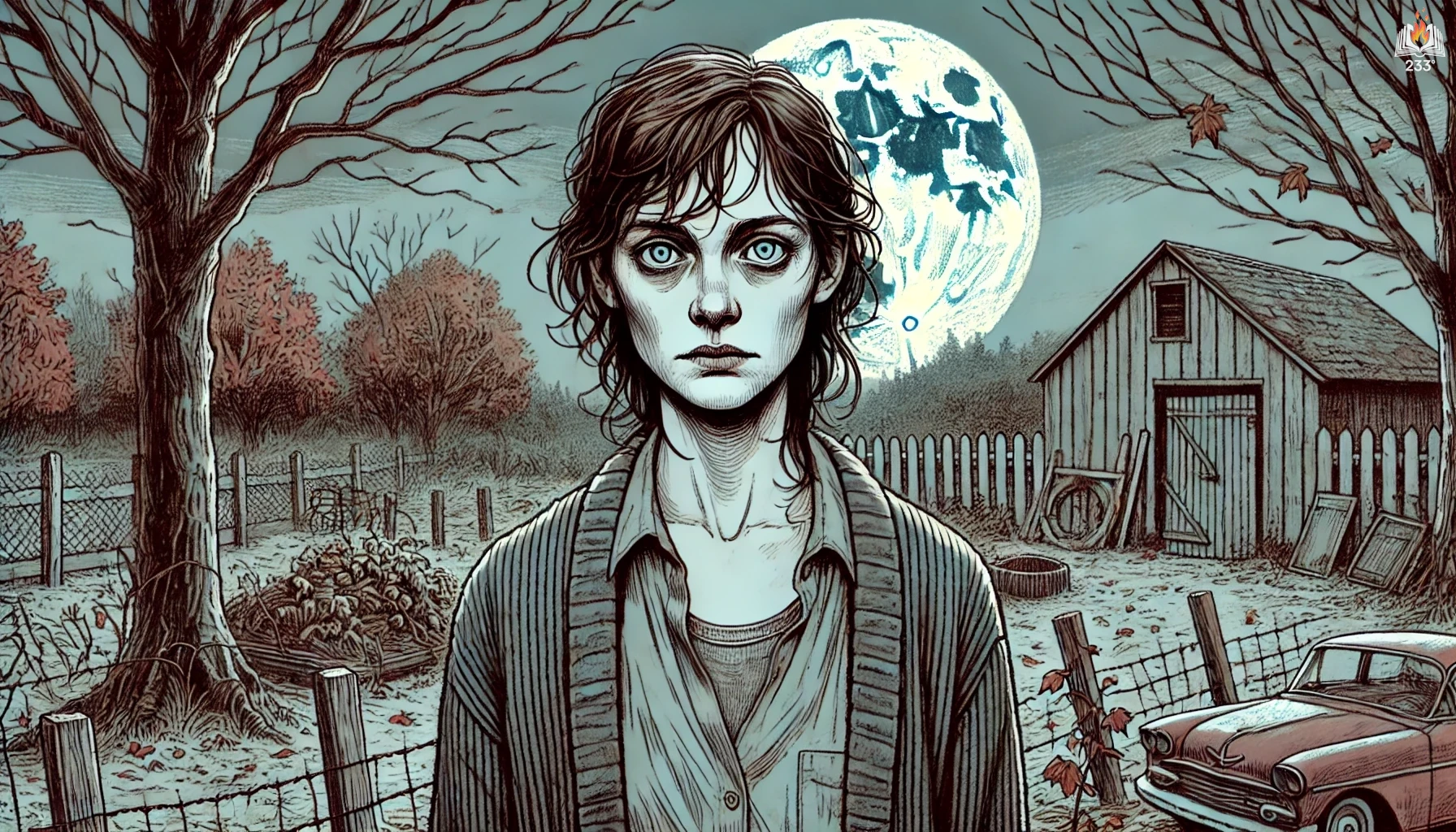


The Sunset Limited by Cormac McCarthy, published in 2006, is a compelling philosophical drama rendered entirely through dialogue. Set in a sparse New York tenement room, the play (subtitled “A Novel in Dramatic Form”) centers on a conversation between two unnamed characters – “Black” and “White” – in the aftermath of a suicide attempt. McCarthy strips the narrative to its raw emotional and ideological cores, creating an intense, unrelenting confrontation between belief and nihilism, salvation and despair, framed within a single unbroken scene.
Plot Summary
In a small, worn-down apartment in a crumbling New York tenement, the early morning quiet carries the weight of something that has already happened. The walls, the padlocked door, the scratched table all hold silence like breath. Two men sit across from each other – one Black, one White. The Black man, broad-shouldered and calm-eyed, once lived in darkness but now speaks the language of light. The White man, slight and grey of spirit, wears the marks of a fall not entirely physical.
They are strangers, but not by accident. The Black man pulled the White man off the tracks of the Sunset Limited – the rumbling train of finality. Carried him, breathing but empty, out of the station and into this room. One has come to save, the other to vanish. And they begin to talk.
The Black man speaks in the rhythms of the South, words dipped in kindness and grit. He is not a preacher by training but by fire, shaped by time in prison, violence, regret, and a voice that once visited him in the infirmary. He talks of grace, of God, of second chances rising from blood-soaked sheets. His belief is not polished theology, but something feral and urgent, clung to in the face of chaos.
The White man is a professor. Learned. Sharp. Cold like stone beneath snow. He has read thousands of books but not the one that sits in the center of the table – a worn Bible, its cover rubbed smooth. He explains that culture is dead, civilization a museum artifact. The things that once moved him – Bach, Rembrandt, Tolstoy – are dust. He walks among the ruins of meaning and has found no reason to stay. His attempt at leaving, leaping in front of the train, was meant to be final.
But now he sits across from a man who says God is real, who calls him “brother,” who refuses to let go.
The conversation slides between theology and memory, between laughter and pain. The Black man offers stories – about jailhouse fights and the voice of God whispering through the stitches in his side. He speaks of hunger, of suffering, of the slow climb toward redemption. He tells of lives wrecked and stitched back together in rooms like this one. Of Evelyn hiding whiskey in the toilet, of the dangers of running dry.
The White man remains unmoved. Polite, even grateful, but untouched. He dismisses the divine, naming suffering as the true face of existence. The world is a burning wreck, and those who see it clearly, he argues, will want no part in it. His beliefs are simple now – or maybe, his disbeliefs. He does not want to be loved by God, because he does not believe in God, or love, or the permanence of anything.
Still, the Black man presses on. He does not offer easy hope, but he insists that the presence of evil does not erase the possibility of good. He says pain sharpens the shape of joy. That faith is not born from ignorance but from a willingness to see the whole world and choose the light anyway. He invites the professor to stay, to share coffee, to talk about baseball if theology runs dry.
But the professor is slipping. He cannot stay. He speaks of friends he does not have, of family he abandoned. He remembers a father dying of cancer and a mother’s voice on the phone. He had said he would come. He did not.
Even this confession does not move him. He is weary, not repentant. To him, morality is a shadow – duty without shape or warmth. He knows what the Black man wants – not just for him to stay in the room, but to step back from the edge entirely. To reenter life. To accept being saved.
But he does not believe he needs saving. He believes he sees the world more clearly than those who hope.
The Black man grows quiet. Not angry. Not defeated. But quiet in the way of someone who has walked this road before. He speaks gently, saying that the professor is like a drunk who cannot stop drinking because the thing he really wants is beyond reach. Not the bottle – but the love of God. He says most people don’t know what they want. But they know what they don’t want. And that refusal, that rejection of grace, is a wound no medicine can reach.
The professor agrees to stay for a cup of coffee. They sit and sip. The silence is no longer tense, but tired. The Black man’s voice softens even more. He says that to have everlasting life, one must first forgive his brother – even if his brother is dirty, even if his brother is broken, even if his brother does not deserve it. And that, perhaps, is what the professor cannot do. Not for others. Not for himself.
He rises. He says he must go. The Black man does not try to stop him. He only watches. Perhaps hoping the moment will shift. Perhaps knowing it won’t.
The professor walks to the door. He stands there, silent.
The Black man calls out one last time. Not a sermon. Not an argument. Just a whisper of sorrow. Then silence swallows the room.
The professor opens the door. He steps out.
The lock clicks behind him.
Main Characters
Black – A large, middle-aged Black man and ex-convict, now a devout Christian. He is compassionate, persistent, and warm, embodying hope and faith despite a life marked by violence, addiction, and suffering. Black sees himself as an instrument of God, tasked with saving White not only from physical death but also spiritual desolation. His deep empathy and lived experience give him moral authority and emotional gravity.
White – A middle-aged White man, an erudite, articulate, and deeply disillusioned academic who attempted suicide by stepping in front of a train (The Sunset Limited). He is intellectual, ironic, and bitter, harboring profound despair about human nature, culture, and existence. White rebuffs Black’s theological overtures, clinging to a worldview stripped of faith, connection, or redemption. His mental state is fragile, and his detachment from the world is both tragic and chilling.
Theme
Faith vs. Nihilism: The central conflict pits Black’s unwavering belief in God and redemption against White’s nihilistic certainty that life is meaningless. Their conversation probes the utility, truth, and necessity of faith, asking whether belief is a lifeline or a delusion.
Salvation and Suicide: The play orbits around White’s suicide attempt and Black’s mission to save him, both physically and spiritually. Suicide here becomes a symbol of ultimate despair, while salvation is examined as an act of both divine intervention and human connection.
The Power and Limitations of Language: Through relentless dialogue, McCarthy explores whether words can bridge profound ideological divides. The characters speak volumes yet remain isolated, raising the question of whether true understanding or transformation is possible through conversation.
Loneliness and Isolation: White’s emotional desolation underscores the isolating effects of intellectualism, atheism, and grief. Black, despite his community work and faith, is also profoundly alone. The play suggests that both men, in their own ways, are seeking communion.
Redemption through Suffering: Black’s theology rests on the redemptive potential of suffering – a motif echoing Job and New Testament doctrine. White sees suffering as definitive proof of life’s futility. Their clash mirrors broader existential and theological debates.
Writing Style and Tone
McCarthy’s prose in The Sunset Limited is spare, stripped to dialogue without stage directions, punctuation, or flourish. This minimalism mirrors the emotional starkness of the play and emphasizes the cadence of voice and rhythm of thought. The absence of physical description or action forces the reader to focus entirely on what is said – and what is not.
The tone is at once intimate and confrontational. McCarthy renders the conversation like a spiritual boxing match – intense, cyclical, sometimes tender, often brutal. Despite its philosophical depth, the voices remain authentic, grounded in colloquial language and lived experience. Black’s Southern, preacher-like warmth contrasts with White’s cold intellectualism, creating a dynamic that is both painful and mesmerizing. McCarthy masterfully uses this stripped-back structure to channel an aching, existential despair, infused with fleeting glimmers of grace.
Quotes
The Sunset Limited – Cormac McCarthy (2006) Quotes
“I got what I needed instead of what I wanted and that's just about the best kind of luck you can have.”
“It is personal. That's what an education does. It makes the world personal.”
“Probably I dont believe in a lot of things that I used to believe in but that doesnt mean I dont believe in anything.”
“The things that I loved were very frail. Very fragile. I didn't know that. I thought they were indestructible. They weren't.”
“I look for the words, Professor. I look for the words because I believe that the words is the way to your heart.”
“The things I believed in dont exist any more. It's foolish to pretend that they do. Western Civilization finally went up in smoke in the chimneys at Dachau but I was too infatuated to see it. I see it now.”
“I ain't got an original thought in my head. If it ain't got the scent of divinity to it, I ain't interested in it”
“I dont think you havin a bad day, Professor. I think you havin a bad life.”
“Maybe it's not logical. I don't know. I don't care. I've been asked didnt I think it odd that I should be present to witness the death of everything and I do think it's odd but that doesnt mean it's not so. Someone has to be here.”
“Evolution cannot avoid bringing intelligent life ultimately to an awareness of one thing above all else and that one thing is futility.”
“Sometimes faith might just be a case of not havin nothin else left.”
“Well, I think the questioner wants the truth. The doubter wants to be told there aint no such thing.”
“No, Professor, it aint nothin like that. You dont have to be virtuous. You just has to be quiet. I cant speak for the Lord but the experience I've had leads me to believe that he'll speak to anybody that'll listen. You damn sure aint got to be virtuous.”
“Black: If this aint the life you had in mind, what was? White: I dont know. Not this. Is your life the one you'd planned? Black: No, it aint. I got what I needed instead of what I wanted and that's just about the best kind of luck you can have.”
“White: We were born in such a fix as this. Suffering and human destiny are the same thing. Each is a description of the other. Black: We aint talkin about sufferin. We talkin about bein happy. White: Well you cant be happy if you're in pain. Black: Why not?”
“The soul might be silent but the servant of the soul has always got a voice and it has got one for a reason.”
We hope this summary has sparked your interest and would appreciate you following Celsius 233 on social media:
There’s a treasure trove of other fascinating book summaries waiting for you. Check out our collection of stories that inspire, thrill, and provoke thought, just like this one by checking out the Book Shelf or the Library
Remember, while our summaries capture the essence, they can never replace the full experience of reading the book. If this summary intrigued you, consider diving into the complete story – buy the book and immerse yourself in the author’s original work.
If you want to request a book summary, click here.
When Saurabh is not working/watching football/reading books/traveling, you can reach him via Twitter/X, LinkedIn, or Threads
Restart reading!