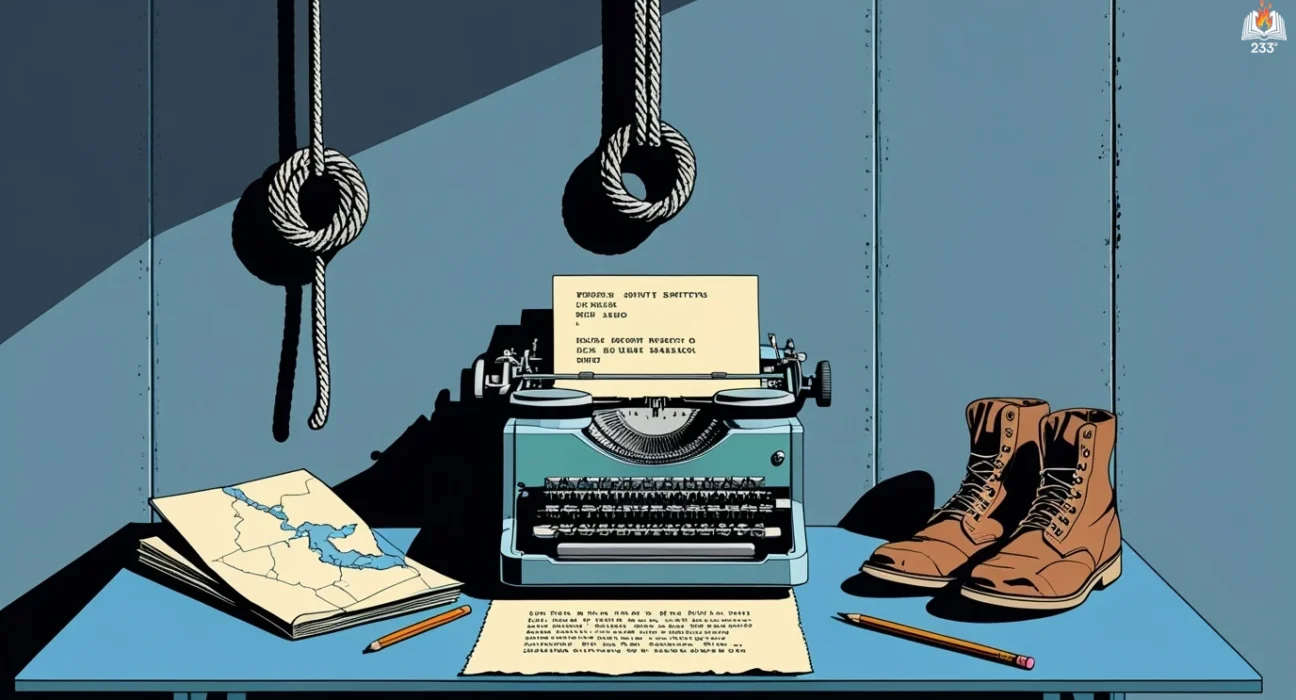
In Cold Blood, written by Truman Capote and published in 1966, is a pioneering work of narrative nonfiction that reconstructs the brutal 1959 murder of the Clutter family in Holcomb, Kansas. This meticulously crafted chronicle follows the events before and after the crime, exploring the lives of both the victims and the killers, and delves into the psychological, social, and moral dimensions of the case. With haunting clarity and literary finesse, Capote fuses journalistic investigation with the emotive depth of a novel.
Plot Summary
In the quiet reaches of western Kansas, the town of Holcomb basked in its own solitude, a place of wheat fields, ranches, and the unspoken trust of neighbors who never felt the need to lock their doors. Among them stood the Clutter family – Herbert Clutter, a prosperous and respected farmer; his gentle, ailing wife Bonnie; their bright and beloved teenage daughter Nancy; and their youngest, Kenyon, a boy with a quiet soul and mechanical gifts. Their days flowed with the rhythm of rural life, disciplined and uneventful. Until a morning in mid-November shattered their world and sent a tremor through the soul of the nation.
It began with a plan, hatched by two ex-convicts bound not by friendship, but by a shared desperation. Richard Hickock – confident, careless, a man with schemes but no conscience – believed he had discovered the perfect target: a wealthy farmer who kept thousands in a safe. His partner, Perry Smith – delicate and unpredictable, haunted by dreams and old pain – followed not the money but the promise of escape, of change, of meaning. The Clutters were strangers, chosen not for vengeance but for myth – the myth of easy riches, told and retold behind prison walls.
They drove across the plains, carrying a shotgun and a knife, dressed in ordinary clothes, speaking of Mexico and treasure and fresh starts. As Holcomb slept under a clean November sky, they reached the farmhouse, slipped through its unlocked door, and dismantled four lives with four shotgun blasts. There was no safe. No fortune. Only the echo of violence and the stillness of death.
The next day, the town stirred into disbelief. The Clutters were found by friends who came calling, by a sheriff who could not make sense of the scene. Herbert, Bonnie, Nancy, and Kenyon lay scattered in their own home – bound, gagged, silenced. The horror was surgical, senseless, intimate. Nothing was stolen but everything was taken. Grief spread through the prairie like wildfire under dry wind, and fear followed close behind.
Perry and Dick vanished down the road, leaving no trail but their memories. They moved through the states like shadows, robbing, hitching rides, sleeping in cheap motels, and always speaking of Cozumel, of sunshine and saltwater and a life unclaimed. Perry clung to his notebook of dreams, his suitcase of maps and letters. Dick hunted for the next score, the next gullible face to charm. But beneath the talk, tension grew. They were tethered by a deed that neither could fully bear. One had imagined it with cold clarity; the other had delivered it with trembling hands. In the spaces between them, the ghosts of Holcomb stirred.
While the killers drifted, Kansas stood vigil. Lawmen sifted through fragments – footprints, a bootprint, a receipt, a whispered name. Weeks turned into months. The town buried its dead and bolted its doors. At the heart of the case was Alvin Dewey, an agent with the Kansas Bureau of Investigation, methodical and sleepless, burdened by the weight of the crime. He traced leads through cold trails, waited on hunches, and carried the faces of the Clutters with him through each long night.
Then, from another prison cell, came the break. A former inmate recognized the pattern. He spoke of Perry and Dick, of plans whispered in the dark, of a name mentioned too many times. The net drew tighter. The fugitives, unaware of the crack forming beneath them, reached Las Vegas, where a stolen car and carelessness sealed their fate. They were arrested without fanfare, two men who had traveled halfway to nowhere.
Back in Kansas, the truth unfolded under fluorescent lights. The confessions came in pieces – Dick’s version full of blame and bravado, Perry’s filled with halts and trembling details. He remembered Bonnie’s whisper, Nancy’s glance, the cluttered silence of the basement. He spoke of mercy interrupted, of rage and fog. The motive lay dead with the victims. No money, no revenge – only the slow unraveling of two broken minds.
The trial came swiftly. Kansas demanded justice. The defense, unprepared and overwhelmed, could not counter the weight of the evidence, the horror of the crime. Perry’s notebooks, his childhood wounds, his dreams of music and oceans, found no place in the courtroom. Dick’s smirk and easy lies were met with the silence of the Clutters’ friends and neighbors. A jury of twelve delivered the verdict that seemed inevitable.
In a gray cell at the Kansas State Penitentiary, the two men waited. Years passed. Appeals were filed and denied. Perry painted and wrote. Dick joked and schemed. Outside the walls, seasons turned, lives moved on. The Clutters were remembered in Sunday services, in school yearbooks, in the sudden stillness that came with memory. Holcomb did not forget, but it learned to live again.
The morning came, as all mornings do. Perry was quiet. Dick still talked. The guards led them down a hallway to a chamber lined with witnesses and a single trapdoor. The rope was measured, the knot checked. There were no final speeches worth remembering. Only the hush of bodies falling, and the sound of boots on concrete.
And then, only silence.
Main Characters
Herbert Clutter – A prosperous, respected farmer and devout Methodist, Herb is the patriarch of the Clutter family. His success, discipline, and community leadership establish him as a pillar of Holcomb society. He is exacting but deeply principled, living by rigid moral codes. His structured life and strong sense of responsibility underscore the shocking randomness of his family’s fate.
Bonnie Clutter – Herbert’s wife, Bonnie is frail and emotionally troubled, suffering from chronic depression and anxiety. Her isolation within the family home contrasts sharply with her husband’s public life. Despite her illness, she retains a gentle presence and maternal vulnerability that deepen the reader’s sympathy.
Nancy Clutter – The beloved teenage daughter, Nancy is bright, talented, and universally admired in her community. Her sense of responsibility and optimism mark her as a girl on the cusp of a promising future. Her tragic end adds a poignant note to the narrative.
Kenyon Clutter – The youngest of the Clutter children, Kenyon is a quiet, inventive 15-year-old boy who prefers machines to people. His introspective nature and innocence make his fate particularly devastating.
Perry Smith – One of the two killers, Perry is an intelligent, artistic man with a traumatic past. Crippled in a motorcycle accident and emotionally scarred by abuse and neglect, he is introspective and delusional, alternating between vulnerability and volatile rage. Perry’s complex psyche and poetic musings make him both terrifying and pitiable.
Richard “Dick” Hickock – Perry’s partner in crime, Dick is charming, manipulative, and pragmatic. His cold, calculating demeanor contrasts with Perry’s sensitivity. Driven by greed and narcissism, he masterminds the crime with chilling nonchalance.
Theme
The Illusion of Safety and Normalcy: Holcomb’s idyllic calm is shattered by an act of unimaginable violence. Capote contrasts pastoral serenity with sudden horror, exploring how evil can infiltrate the most unsuspecting places.
Justice and Morality: The novel wrestles with capital punishment, the nature of guilt, and the moral implications of retribution. Capote offers a balanced view of the legal process, inviting readers to question whether true justice can ever be achieved.
The Psychology of Violence: Through the backgrounds of Perry and Dick, Capote explores how childhood trauma, mental illness, and societal neglect can mold a killer. This psychological depth complicates traditional notions of villainy.
Isolation and Alienation: Both the Clutters and their killers experience forms of loneliness. For the Clutters, it’s emotional detachment and private sorrow; for Perry and Dick, it’s the alienation of poverty, prison, and fractured families.
Fate and Chance: The Clutters’ murder appears random, underscoring life’s fragility. Capote suggests that seemingly trivial decisions—like answering the door or trusting a stranger—can have monumental consequences.
Writing Style and Tone
Capote’s prose in In Cold Blood is lyrical, exacting, and deeply immersive. He employs a third-person omniscient narrative that switches perspectives with fluidity, allowing readers to inhabit the minds of both victims and perpetrators. His descriptive passages are vivid and cinematic, often lingering on details to evoke mood or foreshadow events. Despite being rooted in factual reportage, the writing is evocative and novelistic in its structure and pacing.
The tone is restrained and elegiac, with undercurrents of dread that build steadily throughout the book. Capote maintains a measured detachment, rarely inserting his own judgment, yet the narrative brims with empathy—for the slain Clutters and even for their killers. This haunting impartiality compels readers to grapple with the uncomfortable duality of horror and humanity. The overall mood is one of quiet devastation, marked by a profound sense of loss and futility.
Quotes
In Cold Blood – Truman Capote (1966) Quotes
“The village of Holcomb stands on the high wheat plains of western Kansas, a lonesome area that other Kansans call “out there.”
“It is no shame to have a dirty face- the shame comes when you keep it dirty.”
“Imagination, of course, can open any door - turn the key and let terror walk right in.”
“As long as you live, there's always something waiting; and even if it's bad, and you know it's bad, what can you do? You can't stop living.”
“Just remember: If one bird carried every grain of sand, grain by grain, across the ocean, by the time he got them all on the other side, that would only be the beginning of eternity. ”
“I thought that Mr. Clutter was a very nice gentleman. I thought so right up to the moment that I cut his throat.”
“It is easy to ignore the rain if you have a raincoat”
“I despise people who can't control themselves.”
“I've tried to believe, but I don't, I can't, and there's no use pretending.”
“Once a thing is set to happen, all you can do is hope it won't. Or will-depending. As long as you live, there’s always something waiting, and even if it’s bad, and you know it's bad, what can you do? You can’t stop living.”
“There’s got to be something wrong with us. To do what we did. ”
“The enemy was anyone who was someone he wanted to be or who had anything he wanted to have.”
“They shared a doom against which virtue was no defense”
“I believe in hanging. Just so long as I'm not the one being hanged.”
“One day she told the class, ‘Nancy Clutter is always in a hurry, but she always has time. And that’s one definition of a lady.’ ”
“Like the waters of the river, like the motorists on the highway, and like the yellow trains streaking down the Santa Fe tracks, drama, in the shape of exceptional happenings, had never stopped there.”
“Those fellows, they're always crying over killers. Never a thought for the victims.”
“In school we only learn to recognize the words and to spell but the application of these words to real life is another thing that only life and living can give us.”
“Imagination, of course, can open any door—turn the key and let terror walk right in.”
“You want not to give a damn, to exist without responsibility, without faith or friends or warmth.”
“Then starting home, he walked toward the trees, and under them, leaving behind him the big sky, the whisper of wind voices in the wind-bent wheat.”
“The walls of the cell fell away, the sky came down, I saw the big yellow bird.”
“Nothing is more usual than to feel that others have shared in our failures, just as it is an ordinary reaction to forget those who have shared in our achievements.”
“Time rarely weighed upon him, for he had many methods of passing it.”
“You exist in a half-world suspended between two superstructures, one self-expression and the other self-destruction. You are strong, but there is a flaw in your strength, and unless you can learn how to control it the flaw will prove stronger than your strength and defeat you.”
We hope this summary has sparked your interest and would appreciate you following Celsius 233 on social media:
There’s a treasure trove of other fascinating book summaries waiting for you. Check out our collection of stories that inspire, thrill, and provoke thought, just like this one by checking out the Book Shelf or the Library
Remember, while our summaries capture the essence, they can never replace the full experience of reading the book. If this summary intrigued you, consider diving into the complete story – buy the book and immerse yourself in the author’s original work.
If you want to request a book summary, click here.
When Saurabh is not working/watching football/reading books/traveling, you can reach him via Twitter/X, LinkedIn, or Threads
Restart reading!