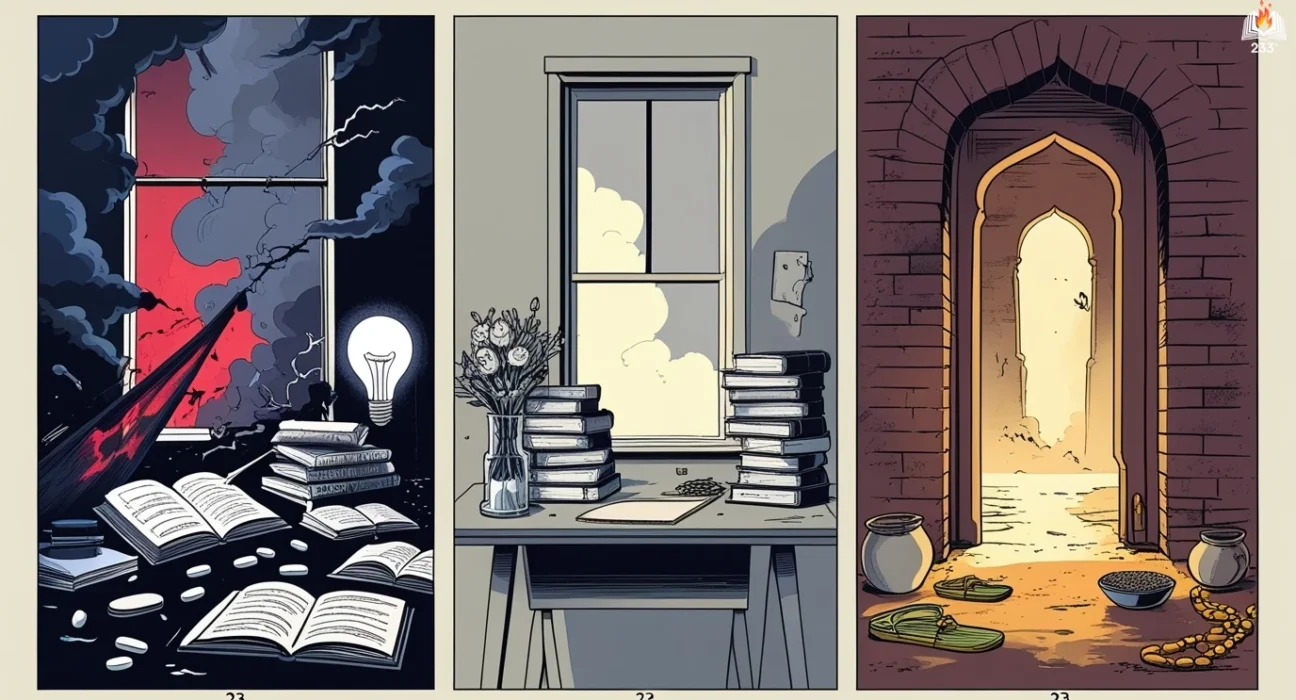
The Marriage Plot, written by Pulitzer Prize-winning author Jeffrey Eugenides and published in 2011, is a rich, cerebral exploration of love, mental illness, and intellectual awakening, set in the early 1980s. Known for his earlier works Middlesex and The Virgin Suicides, Eugenides returns here with a sharply observed coming-of-age story that follows a trio of college graduates as they navigate the murky terrain of post-collegiate life. The novel is deeply rooted in literary tradition, especially Victorian romance, and plays with the conventions of the classic “marriage plot” found in novels by Austen, Eliot, and James, while bringing it into contemporary focus.
Plot Summary
On the morning of her graduation from Brown University, Madeleine Hanna wakes with a hangover and the thick fog of uncertainty pressing on her. Her English honors thesis, a meditation on the marriage plot in Victorian literature, sits complete, but her future is shapeless. Surrounded by a carefully curated library of Austen, Eliot, and the Brontës, Madeleine lies in bed unwilling to face the day, haunted by her recent breakup and the possibility that her life will not unfold like the pages of the novels she loves.
Outside, the sun fights through the Rhode Island clouds, and her doorbell buzzes with the punctual insistence of her parents, Alton and Phyllida. Dressed in last night’s dress and carrying the heaviness of emotional fatigue, she joins them for breakfast, where they discuss post-graduation plans and her relationship with Leonard Bankhead – a brilliant, troubled philosophy major whose mind alternates between soaring clarity and shadowed despair. Across the street, Mitchell Grammaticus, her old friend and secret admirer, sits in the grass outside the First Baptist Church, meditating and mumbling prayers.
Mitchell had loved Madeleine for years, ever since a semester abroad in Europe. Religious and introspective, he had devoted himself to spiritual inquiry, convinced that his love for her was somehow part of a divine plan. But she chose Leonard – tall, magnetic, intellectually formidable, and burdened with manic depression. Leonard’s charisma and depth had captivated her, offering a kind of emotional and philosophical gravity that Mitchell’s steady reverence could not.
As Madeleine’s relationship with Leonard deepens, she moves with him to Cape Cod, where he’s accepted a fellowship at a biological research institute. The promise of shared independence and intellectual life slowly corrodes under the pressure of Leonard’s bipolar episodes. At first, there is the euphoria – Leonard expansive, inspired, unstoppable. But it doesn’t last. The highs crash into darkness, and Madeleine becomes caretaker, companion, and witness to his unraveling. Her romantic idealism, shaped by literary heroines, is tested as she tries to hold Leonard together while losing sight of herself.
Meanwhile, Mitchell, adrift after graduation, rejects the expectations of adulthood and travels to India with his friend Larry. Hoping to find spiritual enlightenment, he volunteers at a home for dying destitutes in Calcutta, coming face to face with suffering that intellectualism cannot explain. He feeds the sick, carries corpses, and struggles with revulsion and detachment. His soul is no closer to clarity, and God remains distant. Yet through the visceral, unglamorous experience of service, something in Mitchell begins to shift. He realizes that love, the kind he once believed to be cosmic and absolute, might also be flawed and human.
Back in the States, Madeleine’s life with Leonard deteriorates. He stops taking his medication. Paranoia sets in. Delusions bloom. One night, he disappears, and when he returns, he is not the same man. Madeleine, exhausted and frightened, continues to stay, still clinging to the shape of the life she thought she was building. The marriage plot she had devoted her thesis to – the arc from courtship to union – provides no guidance for what comes after.
Mitchell returns from India transformed but directionless. He reenters Madeleine’s orbit during Leonard’s worst decline, offering her not love, but an escape. They travel together, drifting between places, between identities. Mitchell believes, perhaps naively, that their time together might finally evolve into the love he has long dreamed of. But Madeleine is grieving – for Leonard, for herself, for the illusions that once propped up her choices. She sees in Mitchell not a romantic resolution, but a kindness she can lean on until she can stand alone.
Leonard, recognizing that his illness has devoured their relationship, releases Madeleine in a moment of lucidity. He withdraws from the Cape and from her life, understanding that love cannot survive in the ruins of untreated madness. He walks away with no promise of stability, only the quiet dignity of letting her go.
Madeleine and Mitchell part ways in New York. Their final moment is simple, unmarked by grand gestures or declarations. Mitchell offers her a gift – a sign that he has stopped trying to possess her and instead honors the person she has become. Madeleine, no longer the incurably romantic girl who dreamed of fictional courtships, accepts the gesture not as a prelude to love, but as an act of friendship, of respect.
The streets buzz with life around her. There is no clarity, no definitive answer to what love means or what adulthood should look like. But there is forward motion. And that, for now, is enough.
Main Characters
Madeleine Hanna: Madeleine is a bright, literature-obsessed English major at Brown University, whose honors thesis centers on the marriage plot in 19th-century fiction. Romantic, idealistic, and often introspective, Madeleine struggles with the contradictions between the literary ideals she cherishes and the chaotic reality of modern love. Her journey is a search for emotional authenticity and intellectual self-definition, shaped by her entanglements with Leonard and Mitchell.
Leonard Bankhead: A brilliant, enigmatic philosophy student with a magnetic personality and a deeply troubled mind. Leonard’s manic-depressive illness (bipolar disorder) dramatically impacts both his academic promise and his personal relationships. His romance with Madeleine is intense and intellectual, but ultimately tragic, as his mental illness becomes a consuming force. Leonard is both charismatic and destructive – a character whose arc embodies the collision of genius and fragility.
Mitchell Grammaticus: Thoughtful, religiously curious, and somewhat adrift, Mitchell is a Religious Studies major secretly in love with Madeleine. His journey after college takes him from India to spiritual crisis, as he searches for meaning, faith, and identity. Mitchell’s unrequited love and philosophical inner life contrast sharply with Leonard’s dramatic presence, and his growth is marked by introspection rather than passion.
Theme
The Evolution of Love and Romance: Central to the novel is its exploration of how love functions in the postmodern era, where traditional narratives (especially the marriage plot) no longer hold sway. Eugenides critiques and reimagines the classic romantic arc, showing how modern relationships are shaped by self-doubt, intellectualism, and existential fragmentation.
Mental Illness and Identity: Through Leonard’s bipolar disorder, the novel deeply examines how mental illness affects self-perception, creativity, and intimacy. Eugenides treats the subject with nuance, neither romanticizing nor condemning Leonard’s condition, but instead portraying the realistic toll it takes on both Leonard and those around him.
Faith, Philosophy, and the Search for Meaning: Mitchell’s storyline acts as a spiritual counterpoint to Madeleine and Leonard’s secular intellectualism. His travels to India and his engagement with Christian mysticism highlight a thematic exploration of belief, suffering, and the human desire for transcendence in a disenchanted world.
The Role of Literature and Theory: The novel is saturated with references to Victorian literature, poststructuralist theory, and semiotics. It raises questions about the purpose of literature in a modern age, critiquing the dominance of deconstruction while celebrating the emotional and moral clarity offered by classic storytelling.
Writing Style and Tone
Jeffrey Eugenides crafts The Marriage Plot with an eloquent, intelligent, and often playful prose style. His language is rich in literary allusion and layered with irony, yet always grounded in emotional veracity. He employs a close third-person narrative that shifts perspectives between Madeleine, Leonard, and Mitchell, giving readers access to each character’s inner life with equal sympathy and insight. The novel’s dialogue is sharp, and the internal monologues are filled with psychological depth, demonstrating Eugenides’ skill in blending character-driven storytelling with philosophical inquiry.
The tone of the novel balances literary homage with critical skepticism. Eugenides is affectionate toward the novels of Austen and Eliot, yet aware of their limitations in capturing modern complexities. The mood shifts between romantic melancholy, cerebral wit, and, at times, devastating realism. Eugenides never veers into sentimentality, even when addressing themes of love and loss. Instead, he maintains a reflective, probing tone, inviting readers to consider the tension between narrative closure and real-life ambiguity.
Quotes
The Marriage Plot – Jeffrey Eugenides (2011) Quotes
“Depression is like a bruise that never goes away. A bruise in your mind. You just got to be careful not to touch it where it hurts. It's always there, though.”
“She'd become an English major for the purest and dullest of reasons: because she loved to read.”
“There are some books that reached through the noise of life to grab you by the collar and speak only of the truest things.”
“That was when Leonard realized something crucial about depression. The smarter you were, the worse it was. The sharper your brain, the more it cut you up.”
“She may have looked normal on the outside, but once you'd seen her handwriting you knew she was deliciously complicated inside.”
“People don't save other people. People save themselves.”
“In Madeleine's face was a stupidity Mitchell had never seen before. It was the stupidity of all normal people. It was the stupidity of the fortunate and the beautiful, of everybody who got what they wanted in life and so remained unremarkable.”
“She wanted a book to take her places she couldn't get to herself.”
“He remained heartbroken, which meant one of two things: either his love was pure and true and earthshakingly significant; or he was addicted to feeling forlorn, he liked being heartbroken.”
“It was possible to feel superior to other people and feel like a misfit at the same time.”
“The lover`s discourse was of an extreme solitude. The solitude was extreme because it wasn`t physical. It was extreme because you felt it while in the company of the person you loved. It was extreme because it was in your head, the most solitary of places.”
“College wasn't like the real world. In the real world people dropped names based on their renown. In college, people dropped names based on their obscurity.”
“Every letter was a love letter.”
“There comes a moment, when you get lost in the woods, when the woods begin to feel like home.”
“-Who are you, anyway? -Just someone who knows, from personal experience, how attractive it can be to think you can save somebody else by loving them.”
“To start with, look at all the books.”
“It took courage to let things fall apart so beautifully.”
“But, like anyone in love, Madeleine believed that her own relationship was different from every other relationship, immune from typical problems.”
“Paris was a museum displaying exactly itself.”
“She could become a spinster, like Emily Dickinson, writing poems full of dashes and brilliance, and never gaining weight.”
“There were some books that reached through the noise of life to grab you by the collar and speak only of the truest things.”
“Dieting fooled you into thinking you could control your life.”
“What if you had faith and performed good works, what if you died and went to heaven, and what if all the people you met there were people you didn't like?”
“She thought a writer should work harder writing a book than she did reading it.”
We hope this summary has sparked your interest and would appreciate you following Celsius 233 on social media:
There’s a treasure trove of other fascinating book summaries waiting for you. Check out our collection of stories that inspire, thrill, and provoke thought, just like this one by checking out the Book Shelf or the Library
Remember, while our summaries capture the essence, they can never replace the full experience of reading the book. If this summary intrigued you, consider diving into the complete story – buy the book and immerse yourself in the author’s original work.
If you want to request a book summary, click here.
When Saurabh is not working/watching football/reading books/traveling, you can reach him via Twitter/X, LinkedIn, or Threads
Restart reading!