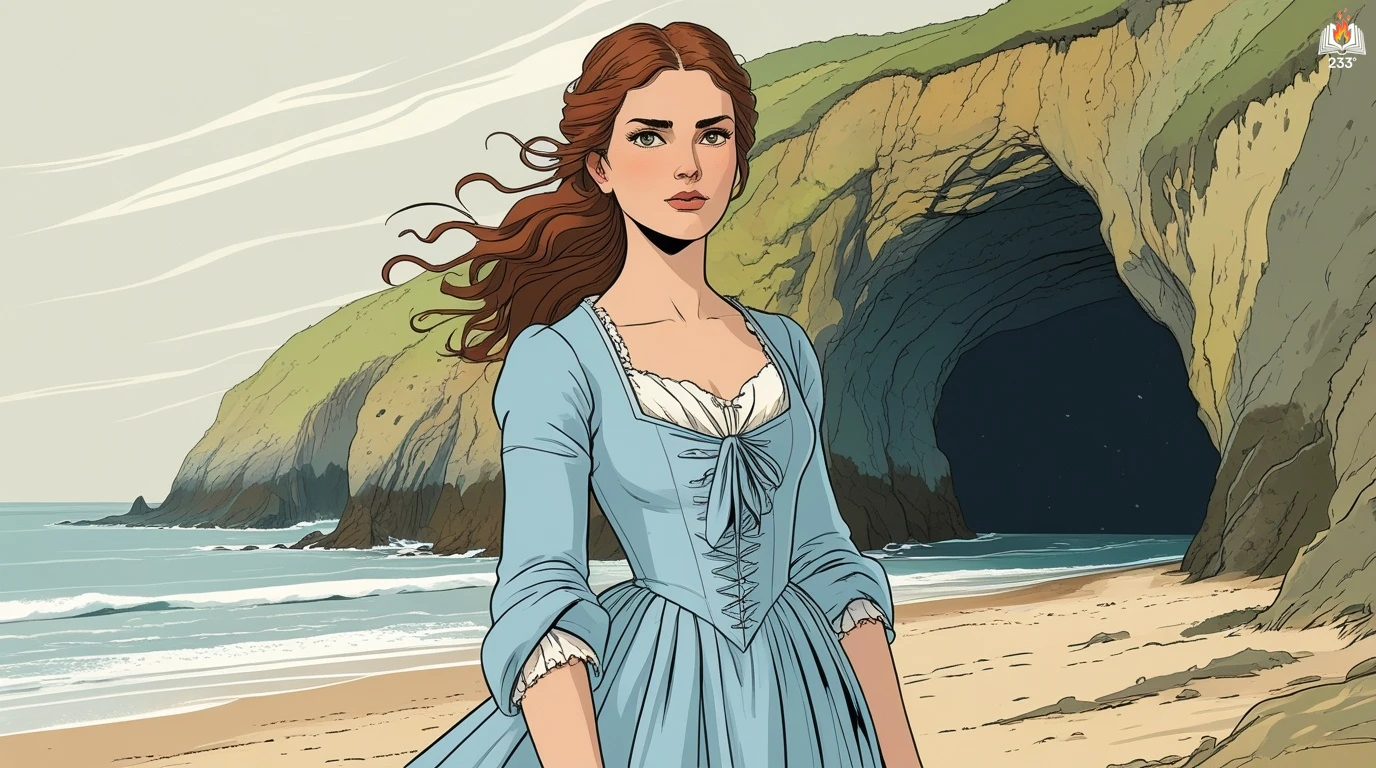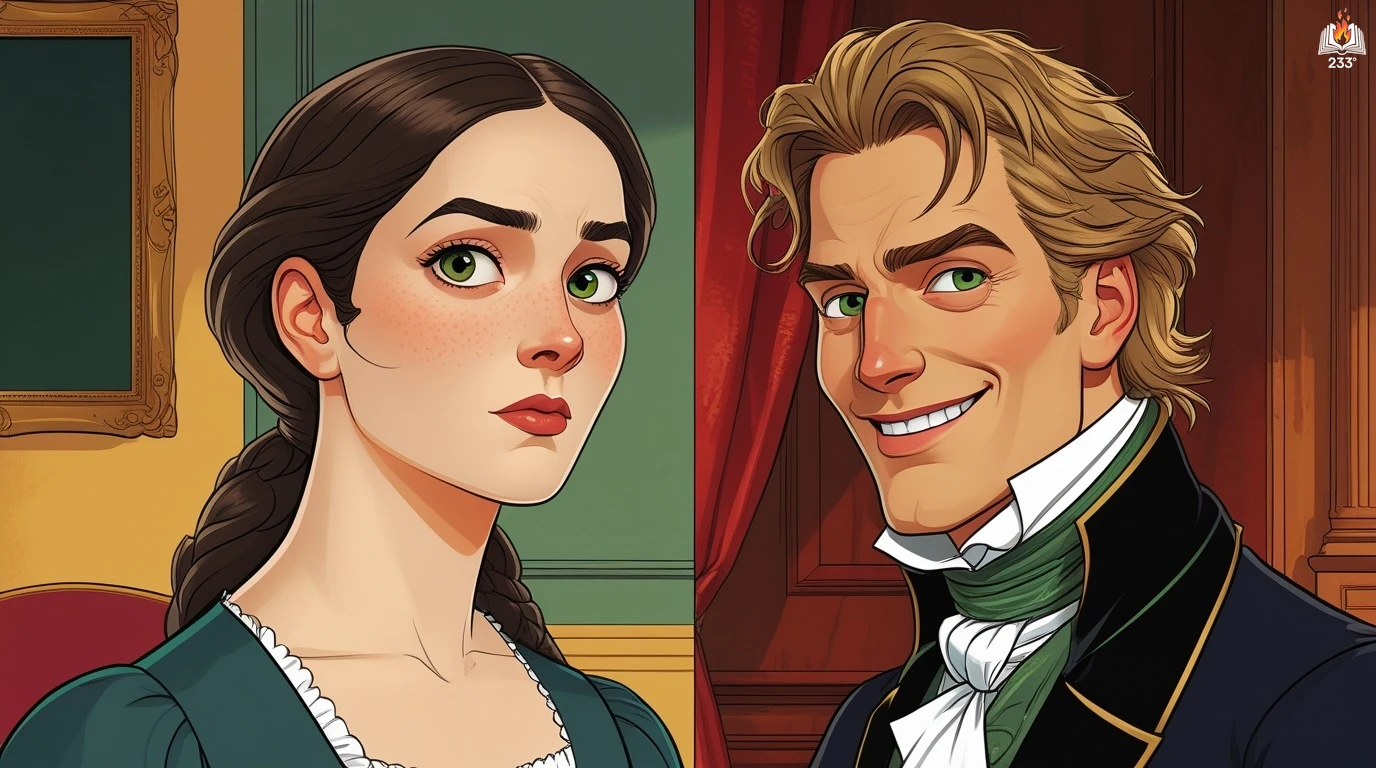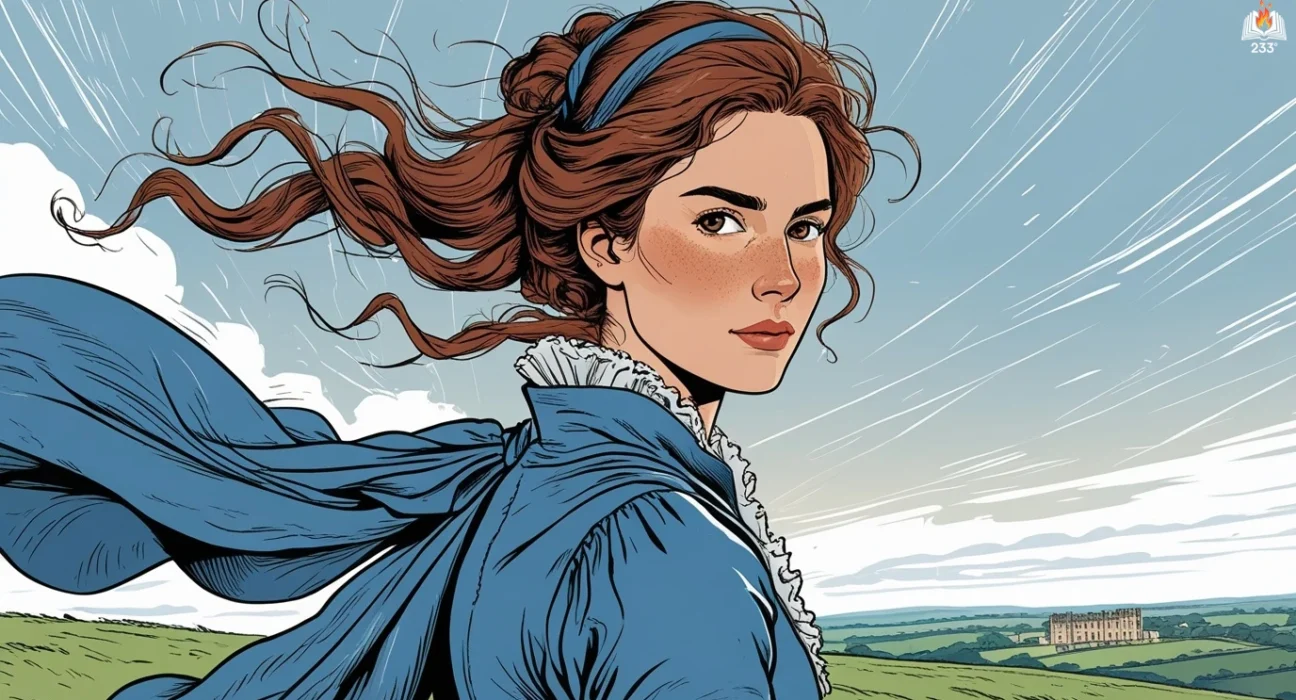
Because of Miss Bridgerton by Julia Quinn, published in 2016, is a lively historical romance set in late 18th-century Kent, England. Part of Quinn’s beloved Bridgerton universe, this prequel to the main series introduces readers to an earlier generation of Bridgertons and their close ties with the neighboring Rokesby family. The story centers on the spirited and unconventional Billie Bridgerton and her evolving relationship with the steadfast George Rokesby, heir to an earldom. What begins as a tale of mutual exasperation slowly blossoms into something deeper as childhood antagonism gives way to adult passion.
Plot Summary
On the roof of a long-abandoned farmhouse, Sybilla “Billie” Bridgerton found herself stranded with a twisted ankle, a ruined stocking, and a smug, ungrateful cat. Sensible as she usually was, her sense had fled the moment she heard the feline’s cries from a high tree limb. Now, she sat injured and irritated, her only hope of rescue arriving in the infuriating form of George Rokesby.
George, eldest son of the Earl of Manston, was everything Billie was not – composed, conventional, and maddeningly calm. As children, they had circled each other like rivals forced to coexist, their households bound by centuries of familial ties and geographic closeness. The Bridgertons of Aubrey Hall and the Rokesbys of Crake House were practically kin, though Billie had always felt more kinship with George’s younger, more mischievous brothers. George, with his carefully measured words and ever-watchful eyes, had always been a thorn in her side – upright and unbearably self-possessed.
Their rooftop reunion, however, lacked any hint of childhood teasing. Billie, stuck and injured, had no choice but to accept his help. As he fetched a ladder and climbed to her aid, their familiar antagonism resurfaced in sharp jabs and half-serious threats. Yet beneath the banter was something quieter, more unspoken. Their disdain had always carried heat, and now, stranded together above the world, it began to smolder.
The rescue, of course, did not go smoothly. The ladder, aged and groaning, held just long enough for the cat to dash underfoot and send it crashing to the ground. They were trapped. George’s irritation reached its peak while Billie fumed at the indignity of needing his help. They argued, joked, and glowered through the creeping afternoon, their barbs softening into hesitant admissions of mutual reliance. When Billie pointed out the risk to her reputation if they weren’t discovered soon, the reality struck them both – being alone together overnight might force their hand into marriage, a fate neither had ever considered, let alone welcomed.
But rescue came in the form of George’s younger brother Andrew, whose amused smile promised mockery for years to come. With one arm in a sling and the other barely strong enough to lift the ladder, Andrew still managed to help them down. George guided Billie with uncharacteristic gentleness, catching her when her ankle gave way and carrying her across the fields without complaint. The proximity unsettled them both. Billie, usually so composed in her independence, found herself leaning into him. George, so burdened by duty and appearances, carried her as if she belonged in his arms.
They reached Crake House, where Billie changed into a gown borrowed from her absent friend Mary and joined the Rokesbys for supper. Yet the air between her and George had shifted. Something had stirred on that rooftop, something neither of them dared name.
Their interactions took on a new texture in the days that followed. Billie, ever the estate manager in breeches, began noticing George not just as the future earl but as a man – steady, reliable, quietly handsome. And George, who had always dismissed Billie as an unruly distraction, now found himself drawn to her unpredictability, her fire, her stubborn pride. She challenged him like no one else. And she cared – fiercely, deeply – about her land, her family, and even stray cats she didn’t like.
The change was subtle but constant. George found himself watching her at dinner, wondering at the shape of her freckles, noting the curve of her smile. Billie caught herself looking for him when she entered a room. Every moment seemed to buzz with the possibility of more, though neither admitted it aloud.
Then came the evening that brought them together not by accident but intention. Billie had joined the Rokesbys again, limping still but recovering. The conversation flowed with ease, laughter rising from every corner of the room. And yet, when George offered to escort her back to Aubrey Hall, silence fell between them as they walked into the cool night.
Their dialogue, once filled with jabs and jests, grew quieter, more contemplative. They spoke of family, of duty, of paths not chosen. Billie confessed that she had never truly imagined marriage – not to anyone, and certainly not to someone like George. He, in turn, admitted his own loneliness, the pressure of a future carved out for him since birth. And somehow, between the moonlight and the lingering scent of spring, the distance between them vanished.
The kiss came without ceremony. No pretense, no protest. Just a moment long in the making, born of history and newfound tenderness. It surprised them both, not for its fire, but for its certainty. There was no fanfare, no dramatic revelation. Just the quiet understanding that they fit – not despite their differences, but because of them.
They did not speak of marriage right away. Billie was too proud to be won without her own consent, and George too honorable to offer anything less than sincerity. But the days unfolded with the soft rhythm of inevitability. What had begun as discord had grown into partnership. She still rode too fast and spoke too bluntly. He still overthought and brooded. But together, they balanced – her energy matched by his calm, his stability brightened by her spark.
When George finally proposed, it was not beneath fireworks or fanfare. It was in the stables, as she argued over a horse’s tack and he watched her, exasperated and utterly in love. She said yes with a shrug, as if it had never been in question. He smiled like a man who had finally found home.
They married in spring. Not because they had to, not because of reputation or pressure, but because somewhere between rooftops and runaway cats, arguments and admiration, they had found the rarest kind of love – the kind rooted not in perfection, but in knowing each other completely and choosing it anyway.
Main Characters
Billie Bridgerton: Independent, bold, and delightfully rebellious, Billie defies societal expectations of a proper lady. She rides astride, manages estate affairs, and favors breeches over gowns. Her sharp wit and impulsive nature often land her in trouble, but her loyalty and heart make her immensely endearing. Over the course of the story, she grapples with the tension between her nonconformity and the emotional vulnerability that love demands.
George Rokesby: The eldest Rokesby son and future Earl of Manston, George is level-headed, reserved, and honor-bound. Often burdened by the weight of responsibility, he contrasts starkly with Billie’s wild spirit. Yet beneath his composed exterior lies a deeply observant and quietly affectionate man. His feelings for Billie evolve from begrudging tolerance to undeniable love, forcing him to question long-held assumptions about duty and desire.
Andrew Rokesby: George’s younger brother and a spirited naval officer, Andrew is playful, charming, and a known instigator. His light-heartedness often brings levity to tense moments, and he plays a critical role in nudging George and Billie toward emotional honesty. His teasing, though relentless, is rooted in love and insight.
Mary Rokesby: Billie’s best friend since infancy, Mary serves as a foil to Billie’s impulsiveness. Though she doesn’t feature heavily in the narrative, her past presence in Billie’s life reinforces Billie’s strong ties to the Rokesby family.
Theme
Enemies to Lovers / Opposites Attract: The central romantic arc plays out through the classic trope of childhood adversaries discovering unexpected affection. Billie and George’s banter masks deeper respect and attraction, showing how love can emerge from friction.
Duty vs. Desire: George’s struggle between his public role as heir and his private longing for Billie reflects the theme of internal conflict. Similarly, Billie must reconcile her desire for independence with the emotional surrender love often requires.
Family and Belonging: The story emphasizes the strength of familial bonds. The Bridgertons and Rokesbys are more than neighbors—they’re an extended family. This tight-knit web of relationships grounds the characters and reinforces the idea that love and community are interwoven.
Gender Expectations and Rebellion: Billie’s behavior consistently challenges traditional notions of femininity. Her refusal to adhere to society’s expectations—whether in dress, speech, or conduct—spotlights the limitations placed on women and the courage it takes to defy them.
Growth Through Adversity: A twisted ankle on a rooftop becomes a metaphor for the unpredictable accidents that force emotional reckonings. Through physical vulnerability, both Billie and George reveal truths they’ve long kept hidden.
Writing Style and Tone
Julia Quinn’s writing in Because of Miss Bridgerton is effervescent and dialogue-driven, marked by her signature blend of humor, heart, and sharp observation. She crafts characters with distinct voices, allowing witty banter and charged silences to carry much of the emotional weight. The prose is brisk and elegant, suited to both the historical setting and the romantic tension. Scenes often unfold with cinematic flair—whether it’s a rooftop rescue or a quiet fireside exchange—and each moment serves to deepen character relationships.
The tone oscillates gracefully between lighthearted mischief and poignant introspection. Even during arguments or moments of frustration, there is an underlying warmth and affection that prevents the tension from feeling cruel or overwrought. Quinn balances romance with realism, portraying both the ache and the ecstasy of falling in love with someone who knows you better than you know yourself. While the story is set in 1779, the emotional dynamics and conflicts feel timeless.
Quotes
Because of Miss Bridgerton – Julia Quinn (2016) Quotes
“You have asked her to marry you, I hope'' ''I might have demanded it'', he admitted. ''Even better”
“I should thank you'', she said. His lips stilled, and she felt him smile against his skin. ''For what?'' ''Everything, really. But mostly for being you”
“Standing still is always more tiring than walking”
“she could not bear to let someone else perform a task when she could do it better herself.”
“He touched her cheek, and he looked into her eyes. He saw his whole world there”
“He was always dependable, she realized. She was usually too busy being irritated by him to notice.”
“Billie laughed at that, full and throaty, and once again she became so incandescently beautiful that George was half-tempted to throw a blanket over her, just to stop anyone else from wanting her.”
“Would you care to dance?” he blurted. “Now?” She smiled adorably. “Is there music?” There wasn’t. It was some testament to how foolish in love he’d become that he did not even feel embarrassed.”
“I'm home'', he said against her skin, and she realized it was the truth. ''I'm home, too''.”
“Everything tastes better with quite a lot of butter.” “We”
“He was just . . . George. And she loved him. She loved him, and—OH DEAR GOD, SHE HAD JUST STOPPED HIM FROM ASKING HER TO MARRY HIM. What had she done? And more importantly, how could she undo it?”
“It isn’t wisdom to repeat platitudes.” “It is wisdom to know which ones bear repeating.”
“You’re wearing breeches,” George said with a heavy sigh. “Of course you’re wearing breeches.” “I would hardly have attempted the tree in a dress.” “No,” he said dryly, “you’re much too sensible for that.”
“Billie tried not to think of George. But she wasn’t successful. Like it or not, he was her who.”
“It was all mad, so completely wrong and yet so deliciously perfect.”
“don’t think any of us knows how we will react to a crisis until we are forced into one.”
We hope this summary has sparked your interest and would appreciate you following Celsius 233 on social media:
There’s a treasure trove of other fascinating book summaries waiting for you. Check out our collection of stories that inspire, thrill, and provoke thought, just like this one by checking out the Book Shelf or the Library
Remember, while our summaries capture the essence, they can never replace the full experience of reading the book. If this summary intrigued you, consider diving into the complete story – buy the book and immerse yourself in the author’s original work.
If you want to request a book summary, click here.
When Saurabh is not working/watching football/reading books/traveling, you can reach him via Twitter/X, LinkedIn, or Threads
Restart reading!