
Invisible Monsters by Chuck Palahniuk, published in 1999, is a provocative and hallucinatory journey into the underworld of identity, fame, and transformation. The novel was originally rejected by publishers for being too disturbing, which prompted Palahniuk to write Fight Club instead. After the success of Fight Club, Invisible Monsters found its audience. The story unfolds in a fragmented, non-linear style, chronicling the surreal adventures of a disfigured ex-model, her charismatic transgender companion Brandy Alexander, and a mysterious man named Seth. With its biting satire and extreme aesthetic, Invisible Monsters is a deconstruction of beauty culture, gender norms, and self-invention in an image-obsessed world.
Plot Summary
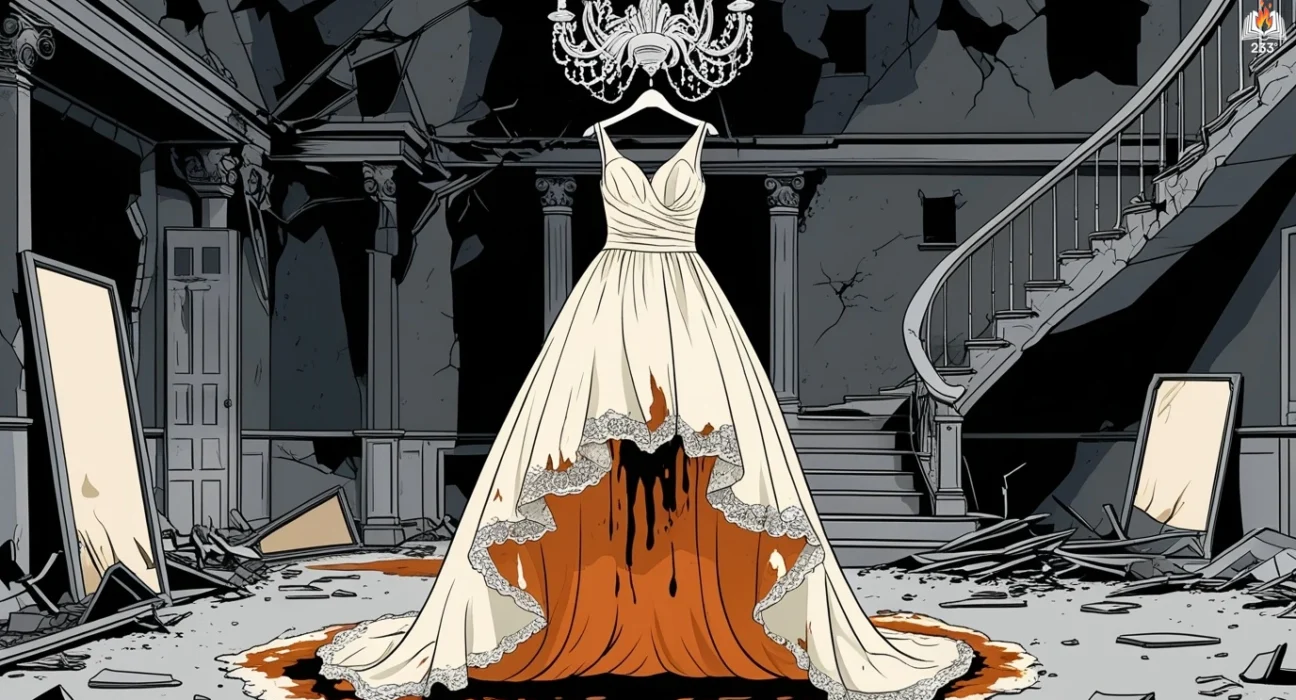
Everything starts with fire, with a wedding dress turned to ashes, with a shotgun blast echoing through the halls of a faux manor house somewhere in the West Hills. The chandelier flickers above three women frozen in a tableau – Evie Cottrell, naked beneath the cage of her burnt hoop skirt; Brandy Alexander, bleeding onto the marble floor in a pool of sequins and sarcasm; and the veiled woman kneeling beside her, faceless and unnamed, watching her past unravel like ribbon from a gift never wanted.
They’re not really friends. They’re not really enemies. They’re each others’ twisted reflections. The woman with no jaw used to be Shannon McFarland, a high-fashion model with lips that could launch a fragrance line and a portfolio that smiled from billboards. But then came the bullet, the shattered glass, and the blood devoured by birds before anyone could clean up the mess. She disappeared behind layers of gauze, behind a voice stolen and stitched into silence.
That silence is what brought Brandy into her life – Brandy, the princess, the queen supreme, the cocktail blend of beauty and boldness, carving her way through hormone therapy and surgical schedules like a prophet on a pilgrimage. Her hands are too big, her voice pitched carefully, her presence intoxicating. Shannon follows her like a satellite caught in orbit, letting Brandy rename her, rewire her, reimagine her into Daisy St. Patience, mute and veiled, a perfect cipher in a world that only values spectacle.
Together with the sleek, ever-rebranded Seth – sometimes Alfa Romeo, sometimes Seth Thomas, always the beautiful man accessory – they embark on a road trip through upper-class estates, raiding medicine cabinets and vanities under the guise of house-hunting. They steal estrogen patches and barbiturates, painkillers and lip liners, popping pills like communion wafers. Each new house is a stage, and each performance rewrites their identities again. Brandy is a princess, Daisy her silent attendant, Seth a mute Italian heir. It’s all play, all theater, and all barely holding together.
But it didn’t start there. Before Brandy, before the fire and the veils, Shannon had Manus – a police detective with a badge and a tan, a man whose love was conditional on symmetry and silence. And there was Evie, Shannon’s best friend, modeling-school rival, thief of vouchers and clothes and affection. They lived in a world of flashbulbs and frozen expressions, where feelings were filtered through the lens of a camera and love meant always standing in the best light.
Shannon’s accident – the supposed random drive-by shooting – had all the neat trauma of a fashion magazine tragedy. Except it wasn’t random. There were no witnesses, no answers, just the clean white sheet stamped with the hospital logo, and the detectives taking pictures while she bled through her designer dress. The birds that picked her clean gave her the one thing she’d never had: invisibility. And she clung to it like religion.
Brandy meets her in the hospital, tossing painkillers like candy, painting the air with perfume and philosophy. She teaches her that being mutilated is a form of freedom. That identity is a costume. That rebirth requires death. Shannon listens because there’s no one else who dares to look at her.
Brandy says forget the past. Write your story like it’s fiction. Rip out the pages that don’t flatter. So they drive – Daisy, Brandy, and Seth – through Vancouver, Seattle, into American suburbia with the smooth patter of liars and saints. They become myths inside model homes. They charm realtors. They steal from the rich and drugged. Every bathroom cabinet is a treasure chest. Every mirror reflects someone they’ve never been.
But secrets hang like smoke in every room. Seth isn’t just another pretty face. He’s Shannon’s long-lost brother, Shane, the gay sibling who disappeared into the abyss of AIDS and rejection. The one their parents buried in denial and shame. Now reborn as Seth, he is Brandy’s lover, Shannon’s twin, and a mirror too painful to look into.
Brandy, too, hides behind the rhinestones. Her transformation isn’t just gender, it’s resurrection. Brandy was once someone else – a role model, a figment, a ghost in lipstick. She is whoever she needs to be, and always the one holding the script.
Evie reappears, derailed and furious, wielding guns and grudges. She was the one who pulled the trigger that disfigured Shannon. She did it out of jealousy, rage, love – it’s never clear, not even to herself. Her wedding becomes a firestorm, a climax in couture and destruction. The house burns, and Brandy bleeds, and the veiled woman finally sees herself.
Brandy, dying on the marble, demands her story be told. But telling it means unraveling everything – the lies, the surgeries, the fake passports and real pain. It means pulling the stitches loose and showing the raw underneath. Shannon hesitates. But then, like Brandy always taught, she rewrites.
In the last moments, the identities collapse. Brandy is not who she said. Seth is not what he seemed. Shannon, now voicing the chaos at last, realizes she’s never been more herself than when she was pretending to be someone else. She tells her story not to remember but to let it go.
Brandy walks away. Not dead, not saved – just gone, as legends should. Seth disappears into his next persona. And Shannon, or Daisy, or whatever name the day demands, drives toward a new city, a new mask, a new silence.
She is not healed. She is not whole. But she is visible now, in the way fire is visible. In the way monsters are. She is what remains when the veils burn away.
Main Characters
Narrator (Shannon McFarland / Daisy St. Patience): Once a successful fashion model, Shannon’s life is altered after a gunshot destroys her jaw. Rendered voiceless and physically transformed, she becomes a passive observer of her own identity’s collapse. Her journey is both literal and existential, as she sheds layers of her former self and attempts to become something – or someone – entirely new. Her transformation is driven by a toxic mix of trauma, envy, nihilism, and desire for invisibility.
Brandy Alexander (Queen Supreme): A dazzling, larger-than-life transgender woman undergoing a long series of cosmetic surgeries to affirm her chosen identity. Brandy is a charismatic manipulator and spiritual guide, encouraging reinvention at any cost. Her philosophies are nihilistic but empowering, promoting the idea that identity is malleable and entirely performative. She becomes both muse and mirror to the narrator.
Evie Cottrell: Shannon’s former best friend and fellow model, Evie embodies conventional beauty and success. Beneath her glossy surface lies a vindictive, competitive, and deeply insecure woman. Her relationships with both Shannon and Brandy are riddled with betrayal, secrets, and shifting power dynamics. Evie’s unraveling plays a key role in the novel’s climactic revelations.
Manus Kelley: Shannon’s former fiancé and a vice cop. Manus is manipulative and emotionally unavailable, using his job as a cover for morally dubious behavior. He becomes entangled in the narrator and Brandy’s twisted journey, serving as a symbol of toxic masculinity and performative authority.
Seth Thomas / Alfa Romeo: A beautiful but shallow drifter who becomes Brandy’s “consort” and is part of the trio’s drug-stealing road trip. Seth is fluid in identity and sexuality, and his own hidden past is central to the novel’s final revelations. Like the others, his character questions the notion of authenticity and selfhood.
Theme
Identity and Transformation: The novel relentlessly dissects the concept of identity, exploring how it is constructed, performed, and dismantled. Characters change names, genders, and appearances, erasing and rebuilding themselves in pursuit of agency or escape. Physical transformation through surgery becomes a metaphor for emotional and existential metamorphosis.
Beauty and Obsession: As former models and beauty industry products, the characters are shaped by societal expectations of attractiveness. The novel critiques how beauty is weaponized, commodified, and ultimately hollow. The pursuit of perfection becomes grotesque, leading to mutilation and erasure of the self.
Invisibility and Attention: Shannon’s desire to disappear is contrasted with her modeling career, where being seen was everything. The characters crave attention but also recoil from it, oscillating between exhibitionism and withdrawal. Invisibility becomes a form of power, and being looked at is often equated with being consumed.
Gender Fluidity and Queer Identity: Through Brandy and Seth, the novel challenges binary conceptions of gender and sexuality. Gender is shown as theatrical and subjective, shaped more by desire and choice than biology. Palahniuk presents transition not just as personal truth but as performance and rebellion.
Consumerism and Artificiality: The fashion world, the drug-fueled escapades, and the obsession with self-image reflect a world driven by surface, desire, and consumption. Everything is stylized, from emotions to death, and the characters often seem like avatars of brands rather than real people. The artificial replaces the authentic.
Writing Style and Tone
Chuck Palahniuk employs a fractured, nonlinear narrative that mirrors the disintegration of his characters’ psyches. Scenes jump back and forth in time, often without warning, much like pages randomly flipped in a glossy fashion magazine. This deliberate disorientation forces readers to piece together the truth alongside the narrator, creating a reading experience that feels more like a hallucination than a story.
The prose is razor-sharp, filled with sardonic wit, grim humor, and hyper-stylized language. Palahniuk crafts each sentence like a soundbite – clipped, punchy, and laced with sarcasm. Repetition is a frequent device, echoing advertising slogans and mantras of identity. Dialogue is often exaggerated, theatrical, and absurd, serving both as satire and psychological exposition. The tone oscillates between tragic and grotesque, seductive and horrifying, as if glamor itself has been weaponized. Beneath the glamour and shock, however, lies genuine sorrow, and an aching need to be understood.
Quotes
Invisible Monsters – Chuck Palahniuk (1999) Quotes
“The one you love and the one who loves you are never, ever the same person.”
“All God does is watch us and kill us when we get boring. We must never, ever be boring.”
“Nothing of me is original. I am the combined effort of everyone I've ever known.”
“The only way to find true happiness is to risk being completely cut open.”
“When we don't know who to hate, we hate ourselves.”
“If death meant just leaving the stage long enough to change costume and come back as a new character...Would you slow down? Or speed up?”
“Parents are like God because you wanna know they're out there, and you want them to think well of you, but you really only call when you need something.”
“When did the future switch from being a promise to being a threat?”
“Don't do what you want. Do what you don't want. Do what you're trained not to want. Do the things that scare you the most.”
“We'll be remembered more for what we destroy than what we create.”
“No matter how much you think you love somebody, you'll step back when the pool of their blood edges up too close.”
“You can only hold a smile for so long, after that it's just teeth.”
“Most times, it's just a lot easier not to let the world know what's wrong.”
“Our real discoveries come from chaos, from going to the place that looks wrong and stupid and foolish.”
“The only reason why we ask other people how their weekend was is so we can tell them about our own weekend.”
“If I can't be beautiful, I want to be invisible.”
“Hysteria is impossible without an audience. Panicking by yourself is the same as laughing alone in an empty room. You feel really silly.”
“Your birth is a mistake you'll spend your whole life trying to correct.”
“The best way is not to fight it, just go. Don't be trying all the time to fix things. What you run from only stays with you longer. When you fight something, you only make it stronger.”
“It's all mirror, mirror on the wall because beauty is power the same way money is power the same way a gun is power.”
“The idea that I can't share my problems with other people makes me not give a shit about their problems.”
“People are all over the world telling their one dramatic story and how their life has turned into getting over this one event. Now their lives are more about the past than their future.”
“Game shows are designed to make us feel better about the random, useless facts that are all we have left of our education.”
“Give me lust, baby. Flash. Give me malice. Flash. Give me detached existentialist ennui. Flash. Give me rampant intellectualism as a coping mechanism. Flash.”
“I hate how I don't feel real enough unless people are watching.”
“Find good in what the world says is evil.”
“Make me into anything, but just love me.”
We hope this summary has sparked your interest and would appreciate you following Celsius 233 on social media:
There’s a treasure trove of other fascinating book summaries waiting for you. Check out our collection of stories that inspire, thrill, and provoke thought, just like this one by checking out the Book Shelf or the Library
Remember, while our summaries capture the essence, they can never replace the full experience of reading the book. If this summary intrigued you, consider diving into the complete story – buy the book and immerse yourself in the author’s original work.
If you want to request a book summary, click here.
When Saurabh is not working/watching football/reading books/traveling, you can reach him via Twitter/X, LinkedIn, or Threads
Restart reading!