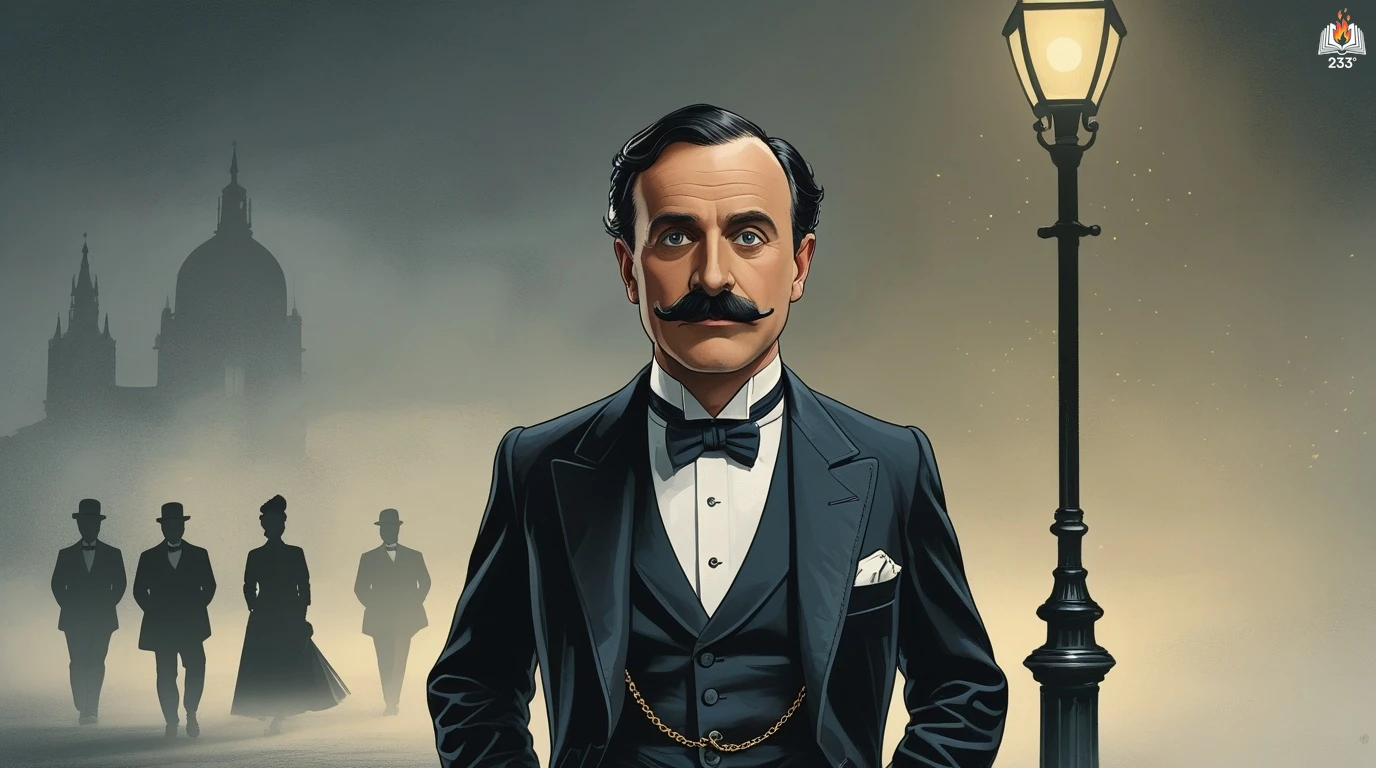
The Luzhin Defense, written by Vladimir Nabokov and published in 1929, is one of his early Russian-language novels and a significant work in his émigré period. The novel tells the haunting story of Alexander Ivanovich Luzhin, a chess prodigy whose intense obsession with the game slowly erodes his connection to reality. It is a psychologically rich and stylistically intricate portrait of genius, madness, and the suffocating burden of identity. This novel is often regarded as a precursor to Nabokov’s later masterpieces and showcases the emergence of his signature narrative sophistication and metaphysical depth.
Plot Summary
In the high-walled silence of a privileged Russian childhood, Alexander Ivanovich Luzhin moved like a shadow – awkward, ungainly, quiet. His parents, genteel and emotionally aloof, puzzled over their boy. He neither played nor laughed like other children, seemed dulled in spirit, and recoiled from affection as if it were a trick. His father, a minor literary figure, imagined his son’s peculiarity might be the mark of buried genius. There were dreams of music, of drawing, of literature – all suggested and abandoned. But it was chess, discovered not through ambition but accident, that unfolded a hidden passageway in the boy’s mind.
It came in a dusty room during a musical gathering, where he stumbled upon an ornate box of carved pieces. The smooth movement, the secretive logic, the quiet violence of one piece claiming another – something shimmered in him. At first he only watched. Soon he devoured the rules, invented problems, replayed games in his mind. A dangerous brightness lit behind his eyes. The world, once confusing and cruel, began to resemble a chessboard. Order took root where chaos had reigned. And from that point forward, his life bent wholly toward the black and white.
Chess consumed him. School faded. His parents vanished into the periphery. Valentinov, a calculating figure with the smell of a businessman and the air of a magician, took charge of the boy’s emerging genius. Tournaments followed – train rides, hotel rooms, crowds. Luzhin moved with robotic precision, his awkward limbs stilled only when bent over the board. He became known, admired, whispered about. Newspapers praised his “Luzhin Defense” – a pattern of strategy, a folding inward of power that confused and entrapped his opponents. But behind his quiet fame grew something dense and hidden. The pressure of perfection, the solitude of genius, the endless anticipation of patterns yet to come – they nested in his mind like tumors.
Then came a pause – not by choice but collapse. His health shattered under the strain. Valentinov, bored of his pawn’s fragility, moved on. Luzhin was taken abroad by relatives. For a time, he disappeared into silence. And when he emerged, years later, it was in a mountain resort, older, weary, still tethered to the game but floating at its edge like a ghost.
There, by the flickering grace of chance, he met her. She had no name for readers, only presence – gentle, inquisitive, bold in her own quiet way. She was the daughter of a General, educated, perceptive, accustomed to luxury and gentle society. Yet she saw in Luzhin something worth rescuing. Not charm – he had none – nor even passion, but a certain tragic beauty, an echo of something almost holy in his brokenness. She did not understand chess, did not want to, but she understood him, or at least his need to be protected. Against her mother’s scorn and her father’s coldness, she chose him.
They married. He wore new suits, she managed the house. There was hope, briefly. Luzhin tried to abandon the board. The pieces remained locked in their box. The couple returned to Petersburg. Life became delicate, gentle, timed with tea and evening walks. But silence stalked him still. The patterns refused to fade. Shadows of unfinished games moved behind his eyelids. Days felt incomplete without the sharp ritual of attack and defense. His wife, loving and watchful, noticed the fraying edges of his peace.
Then Valentinov returned, older, smoother, with a new idea. He had brought a film project – a biopic centered on chess, with Luzhin as the model for its fictional hero. The lure was subtle, but devastating. It pulled Luzhin back, not into the public, but into memory. He began to relive games, analyze past moves. His fingers twitched. Patterns returned, flooding his sleep. He tried to resist, begged for escape, but the game had returned without a board. It swelled in him like an infection.
At a gathering, someone casually placed a chess set on the table. He watched others play, and something opened in him – not joy, but clarity. The positions gleamed like divine language. He joined a match, then another. His wife, appalled and helpless, tried to pull him away. But he was no longer husband, no longer man – only player.
The spirals tightened. Reality bent. He began to see life as a game – events like moves, people like pawns, fate unfolding in preordained patterns. He believed he was trapped in a massive, invisible chess match where unknown opponents sought to corner and destroy him. Everything became suspect – doorways, shadows, glances. In this metaphysical delirium, chess ceased to be a game and became the law of the universe.
Desperate, his wife arranged for his complete removal from the game. No boards, no pieces, no books, no discussion. The word itself was forbidden in their home. Doctors were summoned, soothing phrases were spoken. He hovered at the edge of recovery, or at least docile silence.
But the defense had begun again – not the strategic pattern, but the psychological recoil. Luzhin believed the game was continuing without his consent, played by others across invisible planes. If he refused to move, they would strike anyway. He began to unravel, silently. In the hallway, he saw patterns in wallpaper. In the pages of books, traps lay hidden. Every action became a move in a grand defense. He stopped speaking. He paced, stared, listened.
One day, alone in his apartment while his wife was out, he found a way to escape. The opponent was advancing. He had no more defenses left. There was only one way to end the match. A window stood open, the air cold and absolute. The board dissolved beneath him.
Far below, the city shimmered in silence. Nothing moved. The game was over.
Main Characters
Alexander Ivanovich Luzhin – A shy, socially awkward boy who grows into a chess grandmaster. Luzhin is introverted, misunderstood, and increasingly dissociated from reality. His obsession with chess becomes both his sanctuary and his curse. The game consumes him entirely, and as he loses his grip on reality, he spirals into psychological collapse. Luzhin’s character is a study in the burdens of talent and the fragility of the mind.
Luzhin’s Father – A well-meaning but emotionally distant writer of books for youth, he struggles to understand his son’s inner life. His aspirations for Luzhin are filtered through idealized notions of genius, and he remains blind to the destructive nature of Luzhin’s inner torment.
Luzhin’s Wife (Unnamed) – A sensitive and caring woman who attempts to ground Luzhin in reality and shield him from the intensity of his inner world. Despite her efforts, she remains helpless against the gravitational pull of Luzhin’s psychological descent. Her role is marked by emotional endurance and an increasingly tragic helplessness.
Valentinov – Luzhin’s early chess mentor and manager, who exploits his talent for personal gain. His utilitarian attitude toward Luzhin’s genius contrasts sharply with the human cost of that brilliance. He is emblematic of the cold, calculating world that prizes Luzhin’s intellect while disregarding his humanity.
Theme
Obsession and Madness – Central to the novel is the theme of obsession, as Luzhin becomes consumed by chess. What begins as a refuge from the cruelty of the outside world transforms into a metaphysical trap. His obsessive pursuit of perfection leads to the disintegration of his psyche, illuminating the thin line between genius and madness.
Alienation and Isolation – Luzhin is portrayed as deeply estranged from both his peers and his family. His retreat into the abstract world of chess mirrors his increasing disconnection from human relationships and tangible reality. This motif explores how isolation can both foster brilliance and precipitate collapse.
The Game as Metaphor – Chess is not merely a game in the novel but a symbolic structure that governs Luzhin’s entire worldview. It becomes a metaphor for fate, control, and the inescapable patterns of existence. This theme underscores Nabokov’s fascination with structured artifice and the human longing for order in chaos.
The Fragility of Identity – Luzhin’s identity is inseparable from his role as a chess master. Once he is removed from the game, he loses all sense of self. Nabokov examines how external definitions of identity can implode when divorced from internal coherence.
Writing Style and Tone
Nabokov’s prose in The Luzhin Defense is lush, lyrical, and psychologically penetrating. His use of free indirect discourse offers deep access to Luzhin’s inner life while maintaining an ironic distance that critiques and mourns the protagonist’s fate. The language is ornate yet precise, with vivid imagery and metaphoric richness that transform mundane events into psychological landscapes. Chess becomes a poetic and philosophical lexicon through which Nabokov renders Luzhin’s slow descent into psychosis.
The tone shifts seamlessly between the whimsical and the tragic. Nabokov imbues scenes of childhood with nostalgic tenderness, only to pivot toward an atmosphere of foreboding and unease. As Luzhin’s mind deteriorates, the prose becomes more fragmented and surreal, echoing his mental state. The narrative maintains a subtle irony throughout, never descending into melodrama, but always aware of the absurdity and poignancy of human frailty.
Quotes
The Luzhin Defense – Vladimir Nabokov (1929) Quotes
“Any future is unknown – but sometimes it acquires a particular fogginess, as if some other force had come to the aid of destiny's natural reticence and distributed this resilient fog, from which thought rebounds.”
“The game of the gods. Infinite possibilities.”
“And perhaps it was precisely because she knew nothing at all about chess that chess for her was not simply a parlor game or a pleasant pastime, but a mysterious art equal to all the recognized arts. She had never been in close contact with such people
“I may as well confess that I gave Luzhin my French governess, my pocket chess set, my sweet temper, and the stone of the peach I plucked in my own walled garden.”
We hope this summary has sparked your interest and would appreciate you following Celsius 233 on social media:
There’s a treasure trove of other fascinating book summaries waiting for you. Check out our collection of stories that inspire, thrill, and provoke thought, just like this one by checking out the Book Shelf or the Library
Remember, while our summaries capture the essence, they can never replace the full experience of reading the book. If this summary intrigued you, consider diving into the complete story – buy the book and immerse yourself in the author’s original work.
If you want to request a book summary, click here.
When Saurabh is not working/watching football/reading books/traveling, you can reach him via Twitter/X, LinkedIn, or Threads
Restart reading!