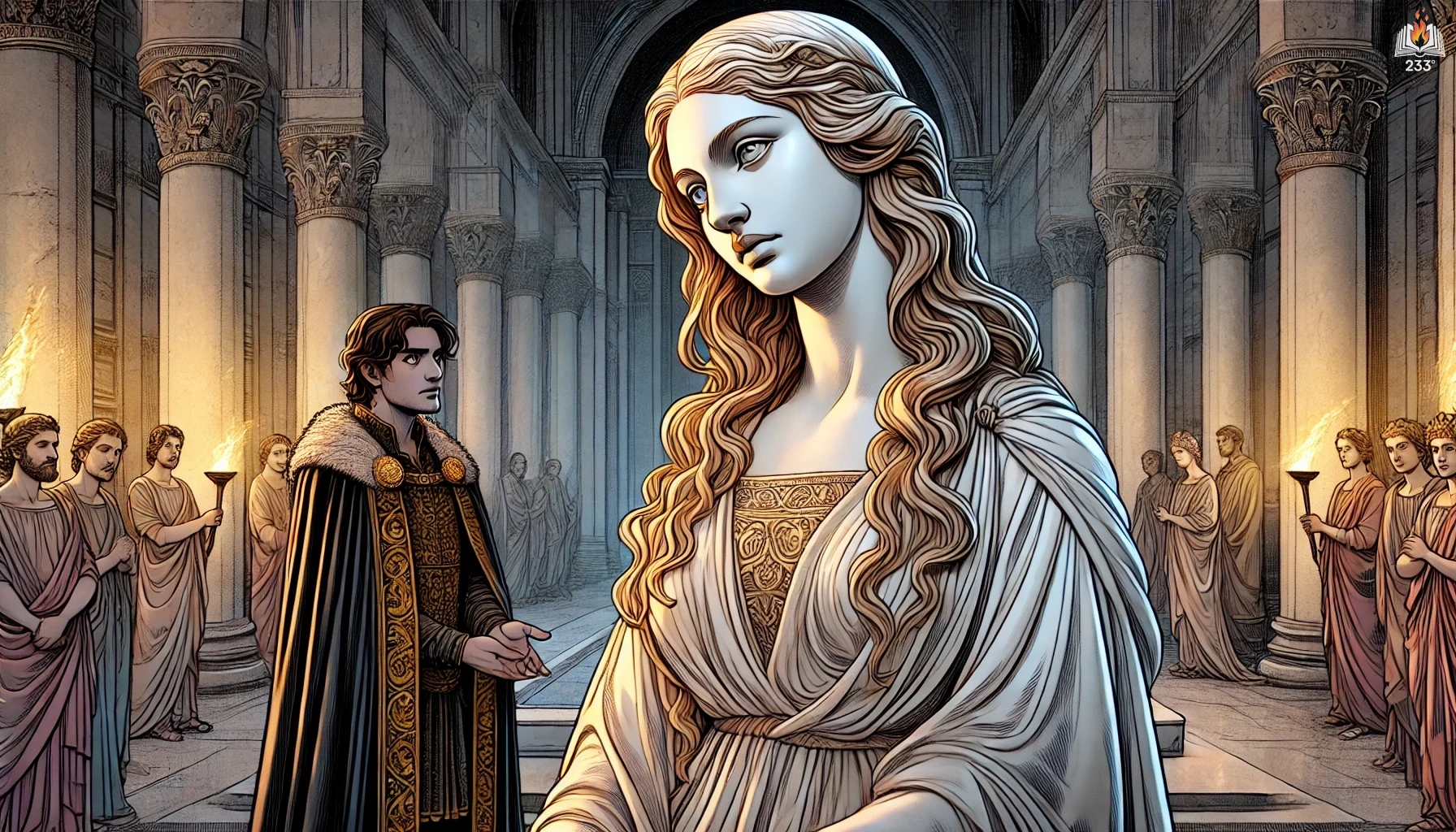
Mary, written by Vladimir Nabokov and first published in 1926, is Nabokov’s debut novel, originally titled Mashenka in Russian. Set in a boarding house for Russian émigrés in Berlin, the story follows the inner life of Lev Ganin, a young Russian exile haunted by memories of a past love. In this early work, Nabokov intricately weaves themes of nostalgia, loss, and identity into a compact narrative that explores the tension between memory and present reality. Though compact in length, Mary offers a richly poetic exploration of the émigré experience and the bittersweet power of remembrance.
Plot Summary
In a crumbling Berlin boarding house vibrating with the dull roar of passing trains, Lev Ganin lived among fellow exiles – a cast of displaced Russians clinging to the tatters of memory and routine. The pension was shabby, a place that seemed always on the verge of motion, its very walls trembling with the passage of locomotives that hinted at escape. Ganin, athletic once and full of vigor, now found himself in a state of inertia, his energies withered by boredom, his present marked by an affair with Lyudmila, a woman whose every word and gesture grated against his soul. He endured her painted lips, her practiced coquetry, the scent of her perfume that clung like stale nostalgia. He had meant to leave her many times. He had meant to leave Berlin. Yet days passed, and he remained still, haunted by a restless fog of dissatisfaction.
The boarding house was filled with characters, each marooned in their own pocket of exile – the talkative Alfyorov, an officious man waiting joyfully for his wife’s arrival from Russia; Klara, the quiet, full-busted girl with wistful eyes and a secret love for Ganin; Podtyagin, the gentle old poet endlessly seeking a visa to join his niece in Paris. It was in a stalled elevator, surrounded by darkness and Alfyorov’s incessant chatter, that Ganin heard the name – Mary. Alfyorov’s wife, arriving on Saturday, was named Mary.
A chill ran through Ganin at that moment. Mary – the name alone was enough to peel back the years. Suddenly, the still surface of his stagnant life broke open, and memories rushed upward like reeds from a riverbed. That Mary. His Mary. The Mary of his youth, of sun-drenched Russian summers, of delirious love and whispered touches. His mind, once dulled by Lyudmila’s oppressive presence, began to blaze with clarity.
He wandered the streets of Berlin like a man half-possessed, retracing the corridors of memory. The present dimmed, and in its place surged visions of his adolescence – the room where he recovered from typhus, the distant sound of birds beyond gauzy curtains, the ache of limbs slowly returning to life. He saw her again, not as Alfyorov’s wife but as the Mary he had once known – with her long hair, her smile, her silent understanding. He remembered the dappled light on her dress, the heady rush of young love before time and war tore them apart.
In those days, he had been whole. He and Mary had shared stolen hours in the countryside, their world held in fragile petals and glances. Now, Ganin found himself a stranger in his own body, clinging to the ideal of a love preserved in amber. Alfyorov, oblivious to Ganin’s mounting revelation, spoke fondly of Mary’s return, her letters, her delicate handwriting. But for Ganin, her return was not a domestic event – it was a resurrection. A collision of past and present too great to ignore.
He began to reconstruct their world, piece by fragile piece. The garden, the summer evenings, the quiet hum of her voice. Every café, every street corner in Berlin became a portal to that vanished Russia. He withdrew further from Lyudmila, her presence now intolerable. At last, with calm resolve, he ended the affair. There was no violence in it, only the soft finality of truth. Lyudmila wept into her pillow, but Ganin no longer belonged to the present. He had slipped into a reverie, into a time where Mary still waited by the birch trees, untouched by years.
As Saturday approached, his obsession grew into purpose. He would see her again, reclaim what was lost. The Mary of his memories would disembark from the train and step into his life once more. He rehearsed their meeting, imagined every word, every breath. But even as he clung to the dream, doubt coiled beneath it. Was she still that girl? Or had time remade her, just as it had remade him?
The others in the boarding house remained unaware of the storm gathering within Ganin. Klara watched him quietly, her affections buried under propriety. Alfyorov bustled with anticipation, brushing his old coat and preparing the room for Mary’s arrival. Ganin, meanwhile, paced through Berlin, his mind spiraling through recollections too perfect to be real.
On Friday night, with the room empty and Alfyorov away, Ganin entered quietly and opened the drawer. He found the photograph. Mary – not the phantom of memory, but the woman as she was. The image stunned him. There was a strange familiarity, yet also a veil, a dissonance between what had been and what was now. She had aged, just as he had. The truth pressed into him with sobering clarity – the Mary of his memory no longer existed. Only he had preserved her in an illusion. The woman arriving on Saturday was someone else, shaped by other years, by a life lived apart from him.
Saturday dawned with a pale sky. The train would soon arrive. Ganin sat quietly, watching his fellow boarders bustle with preparations. And then, without fanfare, he gathered his things and left. There was no confrontation, no farewell. He simply vanished, stepping out into the wide Berlin streets.
The train arrived. Alfyorov waited on the platform, beaming. The station hummed with travelers and reunions. Somewhere in the crowd, Mary descended, her footsteps light upon the platform. But Ganin was gone. He had chosen to let her remain untouched by disappointment, preserved in the perfection of memory. In leaving, he gave up the illusion to preserve the dream – not of Mary, but of what they had once shared, what could never be recaptured in the flesh.
As the trains continued their endless passage past the pension, shaking the walls with whispers of departure, the room once filled with longing stood empty. A chair rocked faintly, a curtain fluttered. And the shadow of a man who once loved a girl walked beyond the reach of recollection, into a new day.
Main Characters
Lev Ganin – The protagonist, a young Russian émigré living in Berlin, whose introspective and restless nature drives the narrative. Ganin is characterized by his physical vitality, former optimism, and a brooding dissatisfaction with his present life. His discovery that his first love, Mary, is arriving in Berlin reignites a flood of memories, prompting a psychological journey through nostalgia, identity, and emotional closure.
Mary (Mashenka) – Though absent in the present narrative, Mary exists vividly in Ganin’s memory. She represents an idealized past, youthful love, and a lost Russia. Her image haunts Ganin, serving as both a comfort and a torment, as he comes to question whether his love for her is real or merely the projection of a long-lost fantasy.
Aleksey Ivanovich Alfyorov – A fellow boarder in the pension and the unsuspecting husband of Mary. His garrulous nature and naïve optimism contrast sharply with Ganin’s brooding introspection. Alfyorov embodies the mundane reality that clashes with Ganin’s romantic ideals.
Lyudmila – Ganin’s current lover, whom he finds emotionally and physically repulsive. Her falsity and superficiality sharply contrast with Ganin’s idealized memory of Mary. Lyudmila represents everything oppressive and unfulfilling about Ganin’s present.
Klara – A young fellow boarder who quietly harbors feelings for Ganin. She is modest, observant, and quietly disapproving of Lyudmila’s behavior. Klara’s understated presence serves as a gentle, though largely unnoticed, moral anchor in the boarding house.
Anton Sergeyevich Podtyagin – An elderly poet and fellow émigré, he represents the defeated intellectuals of the Russian diaspora. His quiet wisdom and longing to reunite with his niece in Paris reflect the sadness and helplessness of exile.
Theme
Nostalgia and the Illusion of Memory – The central theme of Mary is the seductive, often deceptive, pull of nostalgia. Ganin’s memories of Mary are drenched in romanticism, yet as the narrative progresses, it becomes clear that he may be more in love with the idea of the past than with the real woman.
Exile and Displacement – The novel captures the disorientation and disconnection experienced by Russian émigrés in post-revolutionary Europe. The pension in Berlin becomes a microcosm of a dislocated world where the characters live half-lives suspended between a lost homeland and an uncertain future.
The Fragmentation of Identity – Through Ganin’s inner turmoil and detachment from his present self, Nabokov explores how memory fragments personal identity. Ganin’s inability to reconcile past and present renders him both passive and incapable of meaningful action.
Time and Impermanence – The inexorable passage of time is depicted not as healing, but as corrosive to both memory and meaning. Ganin’s journey through his memories serves as a meditation on the impossibility of returning to a moment or self that no longer exists.
Freedom and Renunciation – The novel’s culmination in Ganin’s decision to not meet Mary is a poignant act of renunciation. It is a moment of liberation from illusion, suggesting that freedom can come only through letting go of the past.
Writing Style and Tone
Nabokov’s prose in Mary is lush, lyrical, and highly introspective. Even in this early work, his linguistic precision and poetic sensitivity are evident. He employs rich sensory descriptions, especially in recollections of the Russian countryside, infusing the narrative with an almost dreamlike quality. His style merges emotional depth with painterly detail, often blurring the line between memory and hallucination. The inner landscapes of Ganin’s mind are depicted with vivid intimacy, demonstrating Nabokov’s early mastery of psychological nuance.
The tone of the novel is simultaneously melancholic and ironic. While the subject matter evokes sadness — the loss of love, home, and youth — Nabokov avoids sentimentality through subtle irony and occasional detachment. This duality creates a complex emotional texture, where the beauty of recollection is tempered by its futility. The tone fluctuates between romantic idealism and existential resignation, mirroring Ganin’s internal conflict and the broader émigré experience.
Quotes
Mary – Vladimir Nabokov (1926) Quotes
“Nostalgia in reverse, the longing for yet another strange land, grew especially strong in spring.”
“He was powerless because he had no precise desire, and this tortured him because he was vainly seeking something to desire. He could not even make himself stretch out his hand to switch on the light. The simple transition from intention to action seemed an unimaginable miracle.”
“...memory can restore to life everything except smells, although nothing revives the past so completely as a smell that was once associated with it.”
“The day, like the previous days, dragged sluggishly by in a kind of insipid idleness, devoid even of that dreamy expectancy which can make idleness so enchanting.”
“He was powerless because he had no precise desire, and this tortured him because he was vainly seeking something to desire.”
“emotions of that kind ought to be more restrained, without violet irises and crying violins.”
“And when he went to bed and listened to the trains passing through that cheerless house in which lived several Russian lost shades, the whole of life seemed like a piece of film-making where heedless extras knew nothing of the picture in which they were taking part.”
“every love demands privacy, shelter, refuge━ and they had no such refuge.”
“Really, what a strange man he is,” thought Klara, with that aching feeling of loneliness which always overcomes us when someone dear to us surrenders to а daydream in which we have no place.”
We hope this summary has sparked your interest and would appreciate you following Celsius 233 on social media:
There’s a treasure trove of other fascinating book summaries waiting for you. Check out our collection of stories that inspire, thrill, and provoke thought, just like this one by checking out the Book Shelf or the Library
Remember, while our summaries capture the essence, they can never replace the full experience of reading the book. If this summary intrigued you, consider diving into the complete story – buy the book and immerse yourself in the author’s original work.
If you want to request a book summary, click here.
When Saurabh is not working/watching football/reading books/traveling, you can reach him via Twitter/X, LinkedIn, or Threads
Restart reading!