

What Men Live By by Leo Tolstoy, published in 1885, is a profound moral and spiritual tale that reflects the author’s deep Christian beliefs and philosophical ideals. Set in rural Russia, this short story explores the mysteries of human existence through the interactions between a humble shoemaker and a mysterious stranger. Infused with biblical allusions and parables, the story forms part of Tolstoy’s later works that seek to communicate simple yet powerful truths about life, love, and divine purpose.
Plot Summary
On the edge of a Russian village lived Simon, a poor shoemaker who owned neither house nor land, scraping together a meager living through his trade. Winter approached, and Simon had saved just enough money to buy sheepskins for a new coat. With the money tucked in his pocket and a walking stick in hand, he set out to the village, hoping to collect what was owed to him by customers. But fortune turned cold like the air – one man was absent, another gave excuses, and a third could offer only a few kopeks. With nothing gained, Simon spent his last coins on a drink to warm his body, though it could not warm his heart.
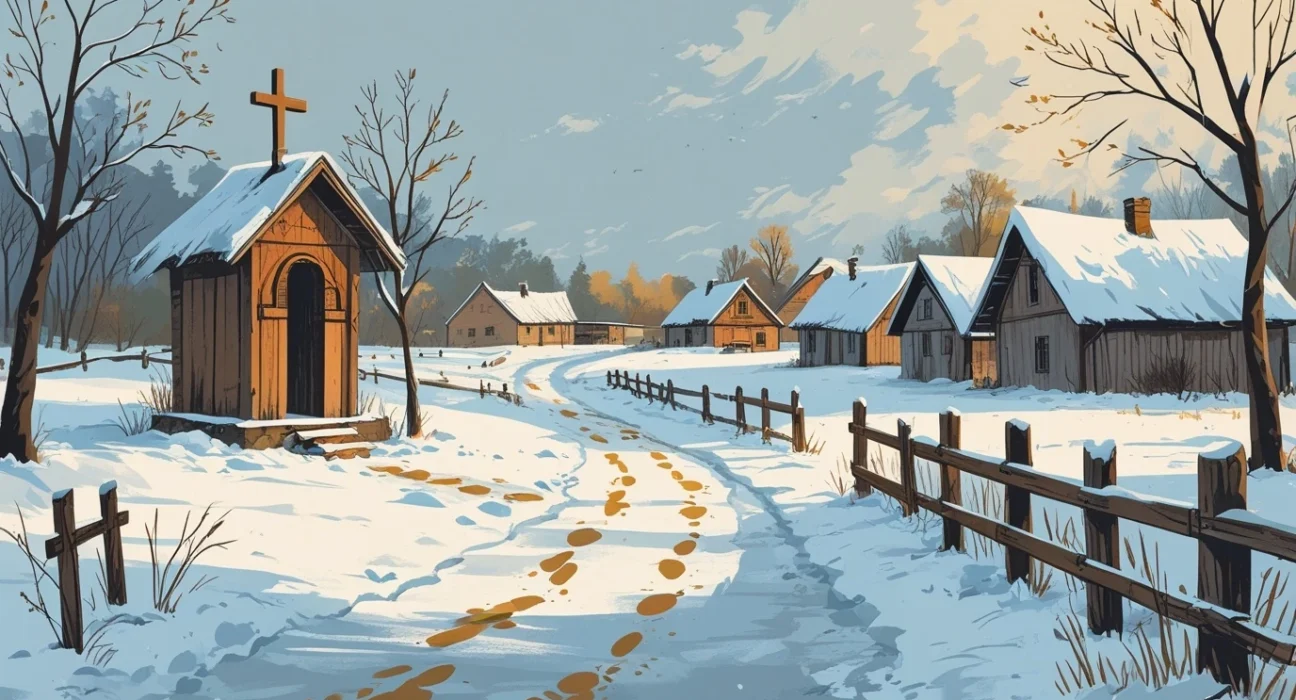
As he made his way back, he passed a roadside shrine and caught sight of a white figure slumped behind it. Drawing near, he saw a naked man, silent and still, as though frozen by the cold. Fear prickled Simon’s spine – was this man a criminal, or perhaps mad? He walked past, but guilt gripped him by the shoulders. Turning back, he approached the stranger and saw kindness in his eyes, not madness. Wrapping his own coat around the man’s bare shoulders, Simon offered his boots, took the man by the arm, and led him home.
Matryona, Simon’s wife, was already troubled when her husband returned without the sheepskins. When she saw him coatless and accompanied by a silent stranger, her temper flared. Anger poured from her in words – sharp, bitter, and unrelenting. But when she saw the man’s face, pale and exhausted, her heart softened. She fetched what little food they had and gave him bread and broth. When the stranger looked up at her and smiled, his face lit up with a quiet peace, and for the first time, he seemed not merely human but something radiant. That smile settled her spirit, and from then on, the stranger was accepted into their home.
He gave his name as Michael but revealed little more. He worked hard without complaint, quickly learning the trade. Simon marveled at how swiftly he mastered the needle, thread, and awl. Though Michael was quiet, his hands moved with purpose and precision, and word of his craftsmanship spread through the village. Yet he smiled only once – that evening at supper, when Matryona gave him food.
Years passed, and Michael worked with tireless devotion, never speaking of his past. Then, one winter day, a wealthy nobleman arrived at Simon’s home in a grand sledge. Large and red-faced, the man handed Simon a parcel of expensive German leather, demanding that it be made into boots strong enough to last a year. If they failed, the nobleman warned, the shoemaker would answer for it. If they endured, he promised a handsome reward.
Simon hesitated, but Michael, silent and still as ever, nodded. The nobleman left, and Simon handed the job to Michael, trusting his skill. But instead of cutting the leather for boots, Michael shaped soft slippers with a single sole. Simon was dismayed. It was a grave mistake, and the leather was too fine to replace. But before he could voice his fury, a servant arrived with news that chilled the room – the nobleman had died that very day. He had not reached his home alive. The slippers, not the boots, were needed for his corpse.
Simon was struck silent, but Michael only worked quietly, binding the slippers and handing them over. And again, he smiled – faintly, as if seeing something beyond the walls of their humble hut.
Another year passed, then another. Michael remained with Simon and Matryona, unchanged, diligent, ever watchful. He never smiled, save for those two moments. Then, one morning, as they worked near the fire, a woman entered their home, leading two young girls by the hand. The girls were twins, bright-eyed and gentle, but one walked with a limp. The woman ordered shoes for them and asked that one pair be made specially, to fit the girl’s twisted leg.
As Simon took their measurements, Matryona asked the woman if the children were hers. She shook her head and told them her tale. The girls had been born just after their father died and their mother had passed the next day. Alone in the village, the mother had no one. The speaker, a neighbor who had just lost her own child, had taken pity on the orphans. She nursed both girls with the same milk that had once fed her son and raised them as her own. She wept as she recalled the years she had cared for them, and said she loved them more than she had loved her own flesh.
As she spoke, a soft light filled the room. Simon turned toward Michael and saw his face transformed. Light radiated from him – a golden warmth, gentle but bright. His hands folded in his lap, his gaze fixed on something above, he smiled again – for the third time.
Michael rose. He bowed low to Simon and Matryona and asked their forgiveness. A light surrounded him now, no longer hidden. He revealed that he was once an angel, sent from heaven to take the soul of a dying mother. But when he saw her newborn twins clinging to life, he disobeyed God and spared her. For this, his wings were stripped, and he was cast to earth to learn three truths: what dwells in man, what is not given to man, and what men live by.
From Matryona’s act of mercy, he learned that what dwells in man is love. From the nobleman, who planned for a year but died that very day, he learned that it is not given to man to know his own needs. And from the woman who nurtured children not her own, he saw that men live not by care for themselves, but by love. With these three truths fulfilled, Michael was forgiven. Light burst from him like dawn, and his body rose, glowing with fire, wings unfurled once more.
Simon, Matryona, and their children fell to the ground as the angel soared upward, vanishing into the heavens. The room fell silent again. Only their family remained, and the memory of the light that had once dwelled among them.
Main Characters
Simon – A poor but honest and kindhearted shoemaker, Simon serves as the human conduit through whom divine truth is revealed. His compassion and innate goodness lead him to help a naked man he finds in the cold, an act that sets the story in motion. Over time, his openness and trust offer him a spiritual reward beyond material needs.
Matryona – Simon’s wife, Matryona initially reacts with suspicion and anger when Simon brings home the mysterious man. However, her transformation into a generous and loving hostess reflects the theme of divine love awakening through human empathy. Her development underscores the capacity for moral growth and redemption.
Michael – The central mysterious figure, later revealed to be a fallen angel sent to learn three truths about humanity. His silence and subtle observations give him an ethereal presence, and through his interactions with Simon and Matryona, he discovers the essential truth of what sustains human life.
Theme
Divine Love and Compassion: The cornerstone of the narrative, love is portrayed not as sentiment but as a divine force that sustains humanity. The story suggests that man does not live by bread alone but by love – the kind that prompts self-sacrifice, forgiveness, and care for others.
Mystery of Human Existence: Through Michael’s divine mission to learn what dwells in man, what is not given to man, and what men live by, Tolstoy engages the reader in a metaphysical journey. Each revelation emphasizes the unknowability of personal fate and the redemptive power of living for others.
Transformation Through Mercy: Both Simon and Matryona undergo moral elevation through their acts of kindness. This motif of transformation through mercy highlights Tolstoy’s belief in the capacity for ordinary individuals to achieve spiritual enlightenment.
Faith and Providence: Implicit throughout the story is a belief in divine providence. Michael’s punishment, his eventual forgiveness, and the survival of the orphaned girls all point to a world guided by a higher moral order that values compassion over rational calculation.
Writing Style and Tone
Tolstoy’s prose in What Men Live By is marked by simplicity and clarity, qualities that reflect his intention to communicate profound moral truths to a broad audience. The language is straightforward, grounded in everyday speech, yet it carries a lyrical and spiritual resonance that elevates the ordinary to the divine. Tolstoy’s mastery lies in embedding theological and ethical complexity within seemingly simple folk narratives.
The tone of the story is reverent, reflective, and quietly dramatic. Though set in a humble environment, the narrative unfolds with a sense of spiritual urgency and emotional depth. Tolstoy strikes a balance between warmth and solemnity, allowing readers to feel both the weight of Michael’s penance and the warmth of human kindness. The ending is luminous and transcendent, imbuing the story with a tone of grace and divine affirmation.
Quotes
What Men Live By? – Leo Tolstoy (1885) Quotes
“I know now that people only seem to live when they care only for themselves, and that it is by love for others that they really live. He who has Love has God in him, and is in God - - because God is Love. ”
“I have learned that men live not by selfishness, but by love.”
“All men love live not by what they may intend for their own well-being, but by the love that dwells in others.”
“He continued to read every night, and the more he read the more clearly he understood what God required of him, and how he might live for God. And his heart grew lighter and lighter.”
“And all men are kept alive, not by their own forethought, but because there is love in men.”
“And all men live not by the thought they spend on their own welfare, but because love exists in man.”
“There is only one time that is important--Now! It is the most important time because it is the only time when we have any power.”
“Therefore, let him who sees the sun’s whole light filling the world, refrain from blaming or despising the superstitious man, who in his own idol sees one ray of that same light. Let him not despise even the unbeliever who is blind and cannot see the sun at all.”
We hope this summary has sparked your interest and would appreciate you following Celsius 233 on social media:
There’s a treasure trove of other fascinating book summaries waiting for you. Check out our collection of stories that inspire, thrill, and provoke thought, just like this one by checking out the Book Shelf or the Library
Remember, while our summaries capture the essence, they can never replace the full experience of reading the book. If this summary intrigued you, consider diving into the complete story – buy the book and immerse yourself in the author’s original work.
If you want to request a book summary, click here.
When Saurabh is not working/watching football/reading books/traveling, you can reach him via Twitter/X, LinkedIn, or Threads
Restart reading!


