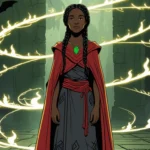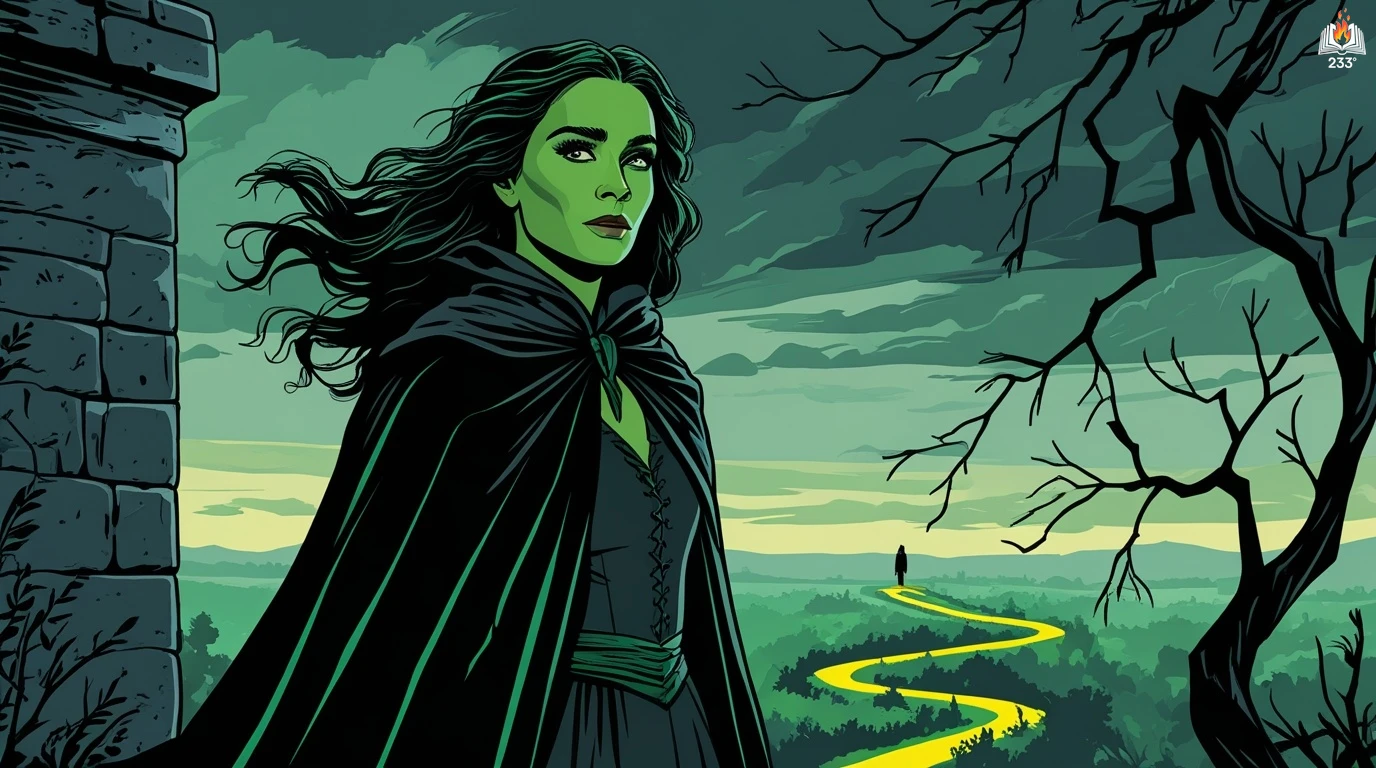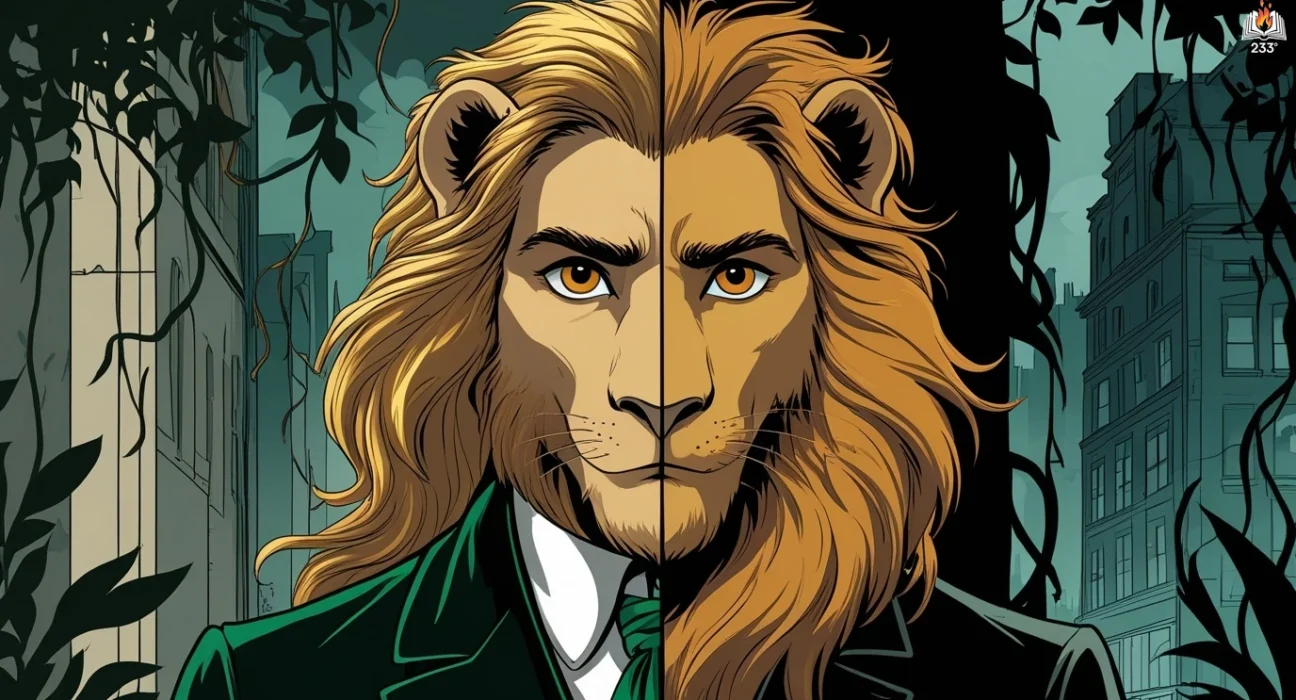
A Lion Among Men by Gregory Maguire, published in 2008, is the third installment in The Wicked Years series, a revisionist retelling of the classic Oz mythology. This volume shifts focus from the infamous Elphaba, the so-called Wicked Witch of the West, to Brrr, the Cowardly Lion. As political tensions rise in Oz and war looms, Brrr is sent on a secret mission by the Emerald City’s government to uncover the mysterious past of a prophetic old woman named Yackle. Through a blend of biography, confession, and interrogation, the story uncovers not only the Lion’s hidden history but also the moral ambiguity at the heart of courage and the troubling cost of self-preservation in a divided world.
Plot Summary
In the unsettled land of Oz, where empires tremble and alliances crumble like parchment in fire, a lion named Brrr walks through the ruins of memory, pride, and cowardice. Once a cub trembling in the hands of men, now a seasoned figure cloaked in regret, Brrr is dispatched as a court emissary to investigate the mystery of an ancient seer named Yackle. War is afoot, devouring fields, prayers, and civility alike, but the lion’s task cuts deeper than mere bureaucratic inquiry. He is a witness to time itself, and the testimony he seeks may implicate far more than the past.
Yackle, presumed dead, refuses to die properly. Entombed in the crypt of a remote mauntery, she stirs again, more dust than flesh, but with a tongue sharp enough to slice through illusion. Brrr finds her not only alive but prepared – even eager – to recount her life. She remembers the rise and fall of witches, emperors, and forgotten gods. Her tale is no confession but a blade drawn across the veil that separates the living from the lived. The lion, notebook in paw, becomes less interrogator than disciple.
Yet Yackle will not unspool her memories for free. She demands Brrr offer his own in return – not the official record but the marrow of his past, his youth, his cowardice. So the lion tells of the forest where he first opened his eyes, abandoned by a mother he cannot remember and a tribe that never claimed him. He lived alone in the thick shadows of the Gillikin woods, learning language from the Lurlinist mystics he spied on, shaping thoughts from the liturgy of strangers. Without companionship, he fashioned civility like armor, fragile and proud.
One day, deep in the forest, he stumbled upon a dying soldier caught in a hunter’s trap – Jemmsy, young and wounded, his leg crushed and fevered. Brrr could have helped him. He might have. But fear curled around his instincts like frost on new leaves. He spoke, hesitated, watched. Jemmsy begged. The lion walked away. He carried the soldier’s books and badge to the nearest town, and in return received admiration, and a medal for courage. Thus began a long dance between silence and survival.
The medal became his calling card in the Emerald City, where his reputation as a civilized Animal opened doors but also built walls. He was lion enough to be exotic, but tame enough to be trusted. When Munchkinland seceded and the laws of Animal Courtesy unraveled, Brrr played both sides, offering no resistance, betraying no loyalty. He wandered through uprisings and executions, a guest at too many tables, his silence earning him invitations and distrust alike.
In Shiz, the academic city now crumbling under war’s threat, Brrr searched for traces of Madame Morrible, a long-dead sorceress whose name still pricked the ears of the magistrates. Yackle’s name appeared in those brittle papers, scribbled like a curse or a prayer. And so he was sent to the mauntery, to question a ghost. He expected nothing but rot and silence. Instead, he found an old woman whose vision pierced darkness as if death had sharpened her senses.
Yackle, reclining like a corpse rehearsing resurrection, demanded truth. She asked Brrr not what he had done, but what he had failed to do. He had joined rebel causes only when they were fashionable, aided freedom fighters just long enough to abandon them. In the battle at Tenniken, he’d stood behind a wall of fire, roaring not in courage but in fear. And yet he kept his court title, polished his spectacles, and let the world believe he was better than he knew himself to be.
As Yackle shared her own murky past – part midwife, part prophet, possibly immortal, possibly mad – Brrr began to see how fate and accident twisted together like vines in a ruined orchard. Yackle had served Morrible, then escaped her grasp, only to watch from the margins as Elphaba rose and fell, and the Thropps devoured themselves in pursuit of power. She had lived through ages of war, revolutions of theology and ideology, and now, as the Empire tightened its grip on the fractured land, she watched the same mistakes bloom again in different disguises.
Outside the mauntery, war thundered like a prelude. Soldiers from Loyal Oz and Munchkinland traded skirmishes in fields where children once played. Inside, the sisters whispered prayers to gods that no longer answered. The old sanctity of Oz – the Emerald City’s shimmer, the magic of sorcery, the dream of unity – lay in tatters. Even time, once a steady river, began to ripple and distort.
In the end, Yackle offered not prophecy but a mirror. She asked what kind of creature Brrr would be when all the medals and manners were stripped away. Would he choose action, or remain a shadow behind courtly phrases? She urged him to see that cowardice was not the absence of bravery but the refusal of responsibility. Before he left, she guided him to a book buried in the mauntery’s catacombs – a rare artifact possibly linked to the Grimmerie, the book of spells that once unmade empires. It was wrapped in secrecy, and he could barely read it, but it pulsed with potential.
As the Lion departed, shadowed by his translucent cat, he did not roar. He walked with the weight of revelations pressing against his back like a second mane. He had not found absolution, nor had he truly repented. But he had looked into the face of his own past, and it had not blinked. And perhaps, in Oz, where kings fall and oracles refuse to die, that was a beginning of its own.
Main Characters
Brrr (The Cowardly Lion): Once introduced in Wicked as a trembling cub, Brrr is now a complex figure navigating his guilt, loneliness, and legacy. A self-proclaimed coward turned reluctant investigator, he struggles with questions of morality, identity, and justice. His journey across Oz – from battlefield to monastery to personal recollections – forces him to confront the consequences of his past inaction and complicity.
Yackle: An enigmatic and nearly immortal woman who defies death and seems to possess arcane knowledge. Blind and frail, she is as sharp-witted as ever, challenging Brrr with riddles and memories that peel back the layers of history in Oz. Her cryptic nature raises questions about fate, prophecy, and the blurred lines between madness and insight.
Shadowpuppet (Brrr’s Cat): A spectral, ancient feline that follows Brrr loyally. While silent, it symbolizes both the fragility and persistence of memory and possibly serves as a metaphor for Brrr’s lost innocence and his attempts at quiet companionship.
Sister Hospitality: A member of the Mauntery who is practical and skeptical. She serves as a foil to Brrr’s philosophical musings and provides grounded resistance to the unfolding revelations.
Jemmsy: A young soldier Brrr encounters in the past whose fate is deeply intertwined with Brrr’s moral development. Their interaction becomes a pivotal moment in Brrr’s life, forcing him to choose between cowardice and action.
Theme
Courage and Cowardice: Central to Brrr’s arc is the examination of what it truly means to be brave. Rather than valor in battle, the novel critiques passive complicity and explores how cowardice can wear a civilized face – polite, educated, and avoidant.
Memory and History: The novel explores how personal and collective histories are recorded, erased, or reinterpreted. Through Brrr’s memories and Yackle’s testimony, we see how truth becomes a shifting narrative shaped by time, guilt, and political agendas.
Moral Ambiguity: In a war-torn Oz, there are no clear heroes or villains. The novel underscores the complexity of ethical decisions, where even kindness can be self-serving, and silence can become complicity.
The Nature of Prophecy: Through Yackle’s mysterious past and role as a possible oracle, the novel questions the validity and danger of foresight. Prophecy, like memory, is shown to be open to manipulation and interpretation.
Loneliness and Belonging: Brrr’s isolation, stemming from his abandonment and outsider status, runs parallel to the fractured state of Oz itself. His desire for acceptance is a microcosm of a larger societal longing for unity amid chaos.
Writing Style and Tone
Gregory Maguire’s prose in A Lion Among Men is lyrical, dense, and introspective, favoring a psychological depth over action. He crafts his sentences with a musicality and layered irony that invite readers to linger on both the beauty and the burden of language. The dialogue is often laden with double meanings, and the narrative voice shifts between mordant observation and tender reflection. Maguire embeds philosophical asides and historical exposition within character monologues, creating a narrative that reads like a theatrical confession or courtroom testimony.
The tone is elegiac and cerebral, tempered by moments of sly humor and bleak absurdity. Brrr’s inner voice is marked by self-deprecation and philosophical musings, making him both sympathetic and maddeningly passive. The setting – a decaying Oz caught between regimes – mirrors this atmosphere of entropy and ambiguity. Through richly textured language and layered storytelling, Maguire transforms what could be a simple fantasy retelling into a meditation on memory, morality, and the stories we tell ourselves to survive.
Quotes
A Lion Among Men – Gregory Maguire (2008) Quotes
“Waking up was a daily cruelty, an affront, and she avoided it by not sleeping.”
“Remember to breathe. It is after all, the secret of life.”
“A male usually had made up his mind before you began to talk to him -so why bother?- but a female, because her mind was more supple, was always prepared to become more disappointed in you than she had yet suspected possible.”
“Indeed, she often wondered if she were dead, or dying from the inside out, and that was the root of her calm, the reason she could surrender her character.”
“The future reshapes the memory of the past in the way it recalibrates significance; some episodes are advanced, others lose purchase.”
“He knew about being alone. The weather was always cold there.”
“Perhaps family itself, like beauty, is temporary, and no discredit need attach to impermanence.”
“The momentum of the mind can be vexingly, involuntarily capricious.”
“Just my luck, if I believed in luck. I only believe in the opposite of luck, whatever that is.”
“He hadn't yet had enough experience with humans to know that the thing they hold dearest to their hearts, the last thing they relinquish when all else is fading, is the consoling belief in the inferiority of others.”
“Children played at those stories; they dreamed about them. They took them to heart and acted as if to live inside them.”
“Your transparency is just another one of your disguises, isn't it?”
“The future reshapes the memory of the past in the way it recalibrates significance: some episodes are advanced, others lose purchase.”
“Are you an aberration to your species?' she cried. 'Cats don't look for approval!”
“I have the distinct feeling I'm not in Oz anymore,' said Brrr.”
“We live in our tales of ourselves, she thought, and ignore as best we can the contradictions, and the lapses, and the abrasions of plot against our mortal souls...”
“When you can't die, she thought, everything sounds like a clock ticking.”
“I'm not involved in shame. Morals are learned in childhood, and I didn't have any such holiday called childhood.”
“And what new life can emerge from a book. Any book, maybe.”
“We live in our tales of ourselves. . . and ignore as best we can the contradictions, and the lapses, and the abrasions of plot against our mortal souls. . .”
“Men were beasts. Everyone knew that.”
“He was not so lucky. He hadn't yet had enough experience with humans to know that the thing the hold dearest to their hearts, the last thing they relinquish when all else is fading, is the consoling belief in the inferiority of others.”
“What goes unnamed remains hard to correct.”
“I was quite a looker in my time," she said. Was she reading his mind, or only being smart, to know she must be hideous? "Oh, had they invented time as long ago as that?”
We hope this summary has sparked your interest and would appreciate you following Celsius 233 on social media:
There’s a treasure trove of other fascinating book summaries waiting for you. Check out our collection of stories that inspire, thrill, and provoke thought, just like this one by checking out the Book Shelf or the Library
Remember, while our summaries capture the essence, they can never replace the full experience of reading the book. If this summary intrigued you, consider diving into the complete story – buy the book and immerse yourself in the author’s original work.
If you want to request a book summary, click here.
When Saurabh is not working/watching football/reading books/traveling, you can reach him via Twitter/X, LinkedIn, or Threads
Restart reading!