Bury Our Bones in the Midnight Soil by V.E. Schwab, published in 2025, is a hauntingly lyrical and emotionally intricate novel that bridges centuries through the interwoven stories of five women whose lives—and deaths—span from 16th-century Spain to modern-day Massachusetts. Blending historical fiction, gothic horror, and queer romance, Schwab delivers a multigenerational ghost story rooted in longing, identity, and legacy. The novel, while not part of a series, is expansive in scope, following characters across time who are tied together by threads of power, memory, and feminine resilience.
Plot Summary
In a sun-drenched village on the Camino de Santiago, a girl named María lives like kindling awaiting a spark. Her hair burns red against the earth tones of Santo Domingo, a color her mother says invites ruin. Born too wild, too willful, María lives by instinct – climbing rooftops, assigning imaginary sins to pilgrims, dancing on the edge of the life set before her. When a veiled widow arrives with a crate full of bottles and a gaze sharp enough to cut silence, María is drawn as if by spell. The woman speaks like no one in town, hands deep in roots and herbs, answering fear with knowledge, medicine with mystery. The town gossips. María lingers. A man dies. And by dawn, the widow vanishes.
Years pass like a river under ice. María grows into a flame wrapped in skin, her hair defiantly bright, her beauty unordinary. Men watch. Her brother arranges. When the viscount Andrés de Guzmán arrives, she does not resist. She has seen the narrow future waiting in her mother’s hands, in her sister-in-law’s swollen belly. She wants more – and if marriage is the price, she will pay it. The wedding is a spectacle of gold thread and salted meats, wine-soaked prayers and veiled bargains. She leaves as a wife, not knowing she will never return.
But her husband’s estate is a place of shadows. The land is wide, the corridors long, but María finds herself shrinking within them. Andrés is generous in public and cruel in private. Her bruises bloom beneath her dress, her laughter withers in his silence. The housekeeper, Doña Pilar, watches with eyes that see too much, while the maids whisper behind closed doors. In the silence between storms, María hears the earth whisper.
She finds the widow again, or perhaps the widow finds her. Ten years older, no less strange, no less sharp. The woman’s bottles are lined in careful rows, and her touch is colder now, like moonlight on stone. María returns to the woods. She learns the difference between root and rot, between healing and harm. Her hands remember. The whispers in the house shift from gossip to warning.
The viscount takes ill. A wasting sickness that eats from the inside. Some say it is punishment. Some say it is a curse. María feeds him tonics with a steady hand, listens to his delirium, and watches as his hold weakens. She wears widowhood before the bell has tolled.
Across time, another girl walks into a different night. Alice arrives at university with a head full of longing and a heart full of noise. In a house pulsing with music and sweat, she searches for a place to begin. Her past clings like wet fabric – a sister too far, a life too small, a self half-formed. She enters the bathroom to escape and emerges reborn, smudged eyeliner and brave mask in place. She walks into the night pretending to be someone else, and in the moment between beats, she sees her.
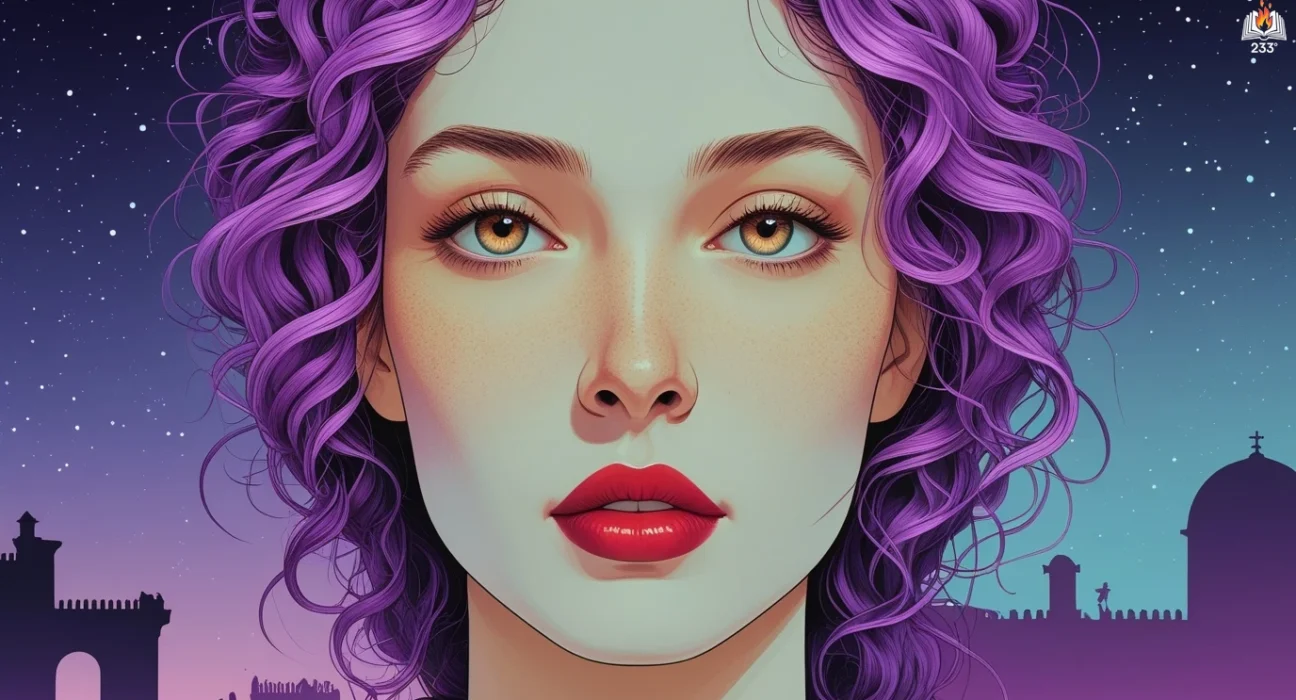
The girl on the bed is made of violet and silver, light-drenched and dark-eyed. Lottie. She moves like a dream with weight, like gravity in a dress. She doesn’t flinch when Alice stares. She doesn’t flinch when Alice steps close. Their hands find each other in the crush of dancers. The music drowns the names. The house catches fire – or perhaps just the alarm – and the storm outside bursts open.
They run. They kiss in the rain. Water smears the dye from Lottie’s curls, purple running like ink. Her voice carries the scent of another country. She asks permission with a glance, and Alice says yes with her mouth, her body, her open door.
In a dark dorm room, they undress slowly and all at once. Lottie moves like she’s done this before, like she’s seen it all and still wants to see more. Alice trembles under her touch, her thoughts too loud until they’re not. Everything folds – time, skin, breath. They become the only two people in the world. They don’t sleep. They drift.
Morning threatens but doesn’t arrive. Lottie slips away, quiet as mist. She brushes a lock of hair between her fingers, traces a bruise like a signature, and disappears. Alice wakes alone. Her roommate doesn’t return. The party’s remains are swept into silence. But the echo of that night hums in her bones.
María, too, is alone. Her husband buried with full honors. The estate now hers in name, if not in peace. She walks the halls where he once shouted, where she once bled, and breathes in the quiet. The widow is gone. Her crate of bottles left behind, each labeled in looping script. Some heal. Some harm. María learns the difference. She hosts women now – widows, wives, girls with trembling hands. They arrive sick, afraid, curious. They leave stronger.
Charlotte appears next, in a different time, a different skin. She walks between worlds, between years. Sometimes she is Lottie, with violet curls and pomegranate lips. Sometimes she is memory. Sometimes ghost. She carries their names. María. Alice. Sabine. The ones who bled and burned and kissed in dark corners. She remembers.
Alice cannot forget. She searches for Lottie on campus, in streets, in dreams. But the girl was never on the roster. The photo is gone. The sheets hold no trace. Only Alice’s skin remembers. She leaves notes folded into books. Carries keys without locks. Looks twice at every stranger.
María plants roses along the garden wall. Feral things with soft petals and sharp teeth. She names them after the ones she’s lost. After herself.
Lottie appears again. Not in flesh, but in feeling. In the hush between raindrops. In the curve of a root. In the brush of lips against skin. She is story and shadow. She is memory and more.
Time spirals. Bones buried in midnight soil bloom into roses. Some soft. Some sharp. All red.
Main Characters
María (D. 1532): A fiery, defiant girl growing up in 16th-century Spain, María is marked by her striking red hair and indomitable spirit. She hungers for more than the small life carved out for her—restless, clever, and bold, she resists the roles prescribed to her. Her relationship with a mysterious widow sets in motion a chain of events that reverberates across centuries.
Alice (D. 2019): A young Scottish woman beginning her university life in Boston, Alice is uncertain, self-conscious, and striving to become someone new. Through a spontaneous encounter with a magnetic girl named Lottie, she explores her identity and sexuality. Alice’s arc is both intimate and tragic, a portrait of someone on the cusp of transformation who doesn’t get the time she thinks she has.
Lottie (D. ???): Enigmatic and luminous, Lottie is both a real presence and a spectral one. She appears in different timelines, linking the living to the dead, the past to the present. Her violet curls and golden-brown eyes make her unforgettable, but it’s her timelessness and mystery that hint at a deeper purpose—one that transcends mortality.
Sabine (D. 1532): A woman of knowledge and hidden strength in María’s timeline, Sabine is both feared and revered. She understands the power of names, of medicine, of the unseen. Her role threads through the others like a whispered secret, and her influence reaches long after her death.
Charlotte / “Lottie” (D. 1827): A ghost who becomes a recurring, central presence, Lottie links timelines and women through memory, longing, and unresolved desire. She embodies themes of agency, autonomy, and love that defies both gender and time.
Theme
Legacy and Memory: The novel is deeply preoccupied with how memories endure—and how women’s stories are preserved or erased. Each character carries the weight of the past, whether in the form of familial expectation, cultural judgment, or literal ghosts. This legacy binds them across time.
Feminine Power and Witchcraft: Schwab weaves together historical suspicion of female independence with modern queer expression, using witchcraft as a motif for both danger and empowerment. The women who are labeled witches—María, Sabine, even Alice metaphorically—are those who refuse to conform.
Desire and Identity: Queerness pulses through the novel’s emotional core. The characters’ relationships—especially between Alice and Lottie—explore love not just as romance but as recognition. The story leans into the liberating and terrifying experience of being truly seen.
Death and Transformation: Every chapter is steeped in death—not just literal, but symbolic. The deaths of innocence, of former selves, of illusions. Yet Schwab presents death as a threshold, not an end. It’s through death that many characters begin again, or ripple forward into someone else’s story.
Time as a Spiral: Rather than treating time linearly, Schwab constructs it as layered and cyclical. Characters live, die, and are reborn in one another’s narratives. Past, present, and future are not separate but fluid, interacting constantly.
Writing Style and Tone
V.E. Schwab’s prose in this novel is lush, poetic, and emotionally immersive. She uses language like incantation, layering images and metaphors to build mood and atmosphere. Her sentences often thrum with internal rhythm—long, lyrical, and breathless—capturing the fevered pulse of youth, desire, and fear. Schwab balances sensual intimacy with visceral dread, pulling readers into a world that feels tactile and haunting.
The tone shifts subtly across time periods—María’s chapters are filled with old-world textures, folk horror, and slow-burning tension, while Alice’s sections are modern, fragmented, and pulsating with the anxieties of youth. Yet a unified tone persists: elegiac, ghostly, and feral. Schwab does not separate the sacred from the profane, the living from the dead, or the romantic from the tragic. Instead, she binds them in a tapestry of yearning and quiet violence, letting her female characters speak in all their rage and tenderness.
Quotes
Bury Our Bones in the Midnight Soil – VE Schwab (2025) Quotes
“Bury my bones in the midnight soil, plant them shallow and water them deep, and in my place will grow a feral rose, soft red petals hiding sharp white teeth.”
“To the ones who hunger
“You are the kind of bloom that thrives in any soil.”
“Careful. In nature, beauty is a warning. The pretty ones are often poisonous.”
“But María has known, all her life, that she is not meant for common paths, for humble houses and modest men. If she must walk a woman's road then it will take her somewhere new.”
“One can be alone without feeling lonely,” she muses. “One can feel lonely without being alone.”
“Some people keep their heart tucked so deep, they hardly know it’s there. But you, you have always worn it like a second skin. Open to the world. You feel it all. The love and pain. The joy and hope and sorrow. It will make your life harder, but it will also make it beautiful.”
“What is the point, she thinks, of loving something you are doomed to lose? Of holding on to someone who cannot hold on to you?”
“A name is like a dress. It might be by nature pretty or plain, but it is the person wearing it who matters most.”
“and it drives her mad, the idea that the shape of her body determines the shape her life must take. That her beauty is something she is expected to pass on instead of keep.”
“The highest cards have men on them.” María can see that. There are men holding clubs. Men holding swords. Men holding coins. Men holding cups. “Where are the women?” she asks, and Ysabel only laughs, as if it were a joke.”
“And how is a miracle different from a spell? Who is to say the saint was not a witch?”
“More and more she thinks of cutting it off. Her hair. His hand. Depending on the day.”
“But you cannot have what you want until you know what you want. And once you do know,” she adds, “it’s only a matter of what you’re willing to do to get it.”
“From that moment on she insisted she would only read romance, as if love and horror could not go hand-in-hand”
“And there it is, that feeling the men have tried and failed to stir in her, that heady, ground-tipping mix of hope and fear, the hunger to move closer, and to shrink away.”
“Death comes, and sometimes it is kind, and often it is cruel, and very rarely it is welcome. But it comes all the same.”
“She is tired of keeping up appearances, of pretending this lonely life isn't wearing her from stone to sand”
“No—disappearing would be better, because maybe in the absence of Alice she could become someone else.”
“She looked at her life and found it small. Saw the road that lay ahead, and there were no curves, no bends; it ran straight and narrow all the way to its end.”
“Stories matter, Alice. When you live long enough, they're all you have.”
“And here is the awful thing about belief. It is a current, like compulsion. Hard to forge when it goes against your will, but easy enough when it carries you the way you want to go.”
“Nothing fits, even if it’s fitted, because it’s not really about the size of the body or how it fills the clothes, but how much space it takes up in the world.”
“Did you know,” she would say brightly, “that sometimes I think of the cemetery plot where you will lie, beneath all that dirt and stone, and it brings me joy. And if by some unlucky spot I ever get with child, I will take them there, and let them frolic on your bones.”
“But María has known, all her life, that she is not meant for common paths, for humble houses and modest men. If she must walk a woman’s road, then it will take her somewhere new.”
“A name is like a dress. It might be by nature pretty or plain, but it is the person wearing it who matters most.” María considers, looking through a jar of herbs. Studying the face beyond. “If names are dresses, mine simply does not fit.”
“she tries to leave, and learns the hard way that, among their kind, promises are binding.”
We hope this summary has sparked your interest and would appreciate you following Celsius 233 on social media:
There’s a treasure trove of other fascinating book summaries waiting for you. Check out our collection of stories that inspire, thrill, and provoke thought, just like this one by checking out the Book Shelf or the Library
Remember, while our summaries capture the essence, they can never replace the full experience of reading the book. If this summary intrigued you, consider diving into the complete story – buy the book and immerse yourself in the author’s original work.
If you want to request a book summary, click here.
When Saurabh is not working/watching football/reading books/traveling, you can reach him via Twitter/X, LinkedIn, or Threads
Restart reading!