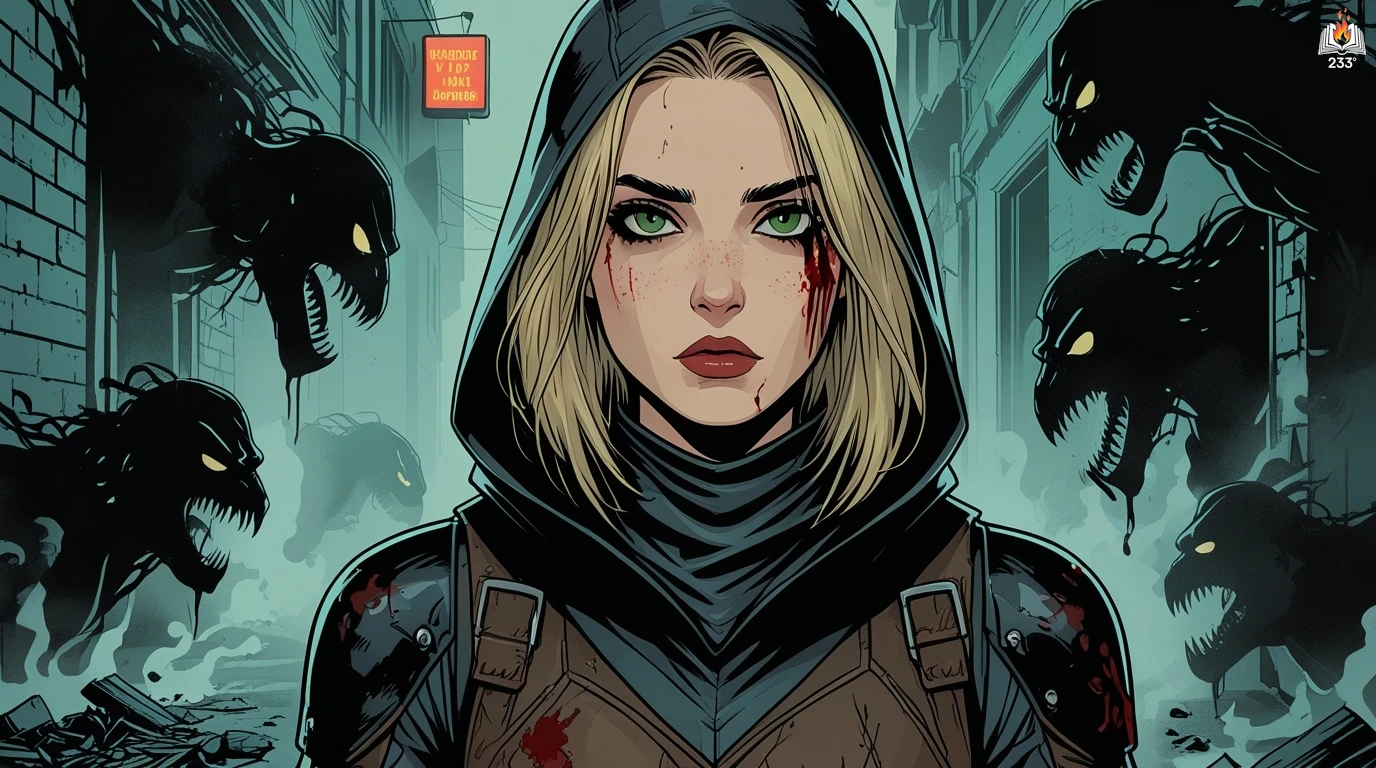
The Unbound by V.E. Schwab, published in 2014, is the second installment in the Archived series, continuing the story of Mackenzie Bishop as she grapples with the haunting aftermath of trauma, the fragile balance between the worlds of the living and the dead, and her uncertain footing in both. As a Keeper for the Archive, Mac’s duty is to hunt down “Histories” – restless spirits of the dead – and return them before they disrupt the living world. But in the wake of a brutal confrontation with a rogue History named Owen, Mac finds herself trying to navigate private school life, PTSD-induced nightmares, and a new, unstable position within the shadowy Archive. The novel blurs the line between reality and memory, with high emotional stakes, an eerie atmosphere, and a deeply personal journey of identity and recovery.
Plot Summary
In the shadowed stillness before dawn, Mackenzie Bishop perches on the roof of the Coronado, the chill of stone beneath her and the ghost of a blade between her shoulder blades. Sleep is not a comfort anymore. Every time her eyes close, Owen returns – silver-haired and knife-happy, whispering that he’ll find her true self hidden beneath layers of flesh. It has been three weeks since she cast him into the void, yet he lingers in her dreams like smoke clinging to fabric. The void door, invisible but unforgettable, has scorched the memories from the rooftop, but not from her mind. She’s not allowed to forget. She chose to remember.
She trains with bloody knuckles and stiff limbs, the pain a tether to the present. Down below, the city stretches awake, and so does her new life. The Archive, which governs the dead and commands the Keepers, has put her under quiet scrutiny. Her old key was taken. Her grandfather’s legacy severed. In its place, Agatha, all smiles and ice, gave her a new one – a key that feels foreign and conditional, as though it could be snatched back at any moment.
At home, her parents are fragile with hope. Their daughter survived something she cannot speak of, and they are moving on, dragging her behind them like an overstuffed suitcase. Hyde School stands as her new start – a polished, prestigious place that demands order and offers no sanctuary. The students wear black and silver and gold, their smiles guarded, their eyes too sharp. Among them, Cash Graham extends a hand, a grin, and a coffee. He knows the halls by heart and moves through them like royalty. He’s warm, but his sister, Safia, is colder, and her suspicion of Mackenzie has teeth.
Wesley Ayers, eyeliner-smeared and all charm, should be far away on a family vacation. He should not be here. But there he is, in Hyde’s training ring, masked and golden-striped, sweeping opponents off their feet with fluid precision. When Mac steps up to face him, the crowd hushes, and sparks fly not just from fists and feet, but from betrayal and bruised trust. Wesley has been hiding this part of himself – the polished Hyde student – and Mac, already splintered by secrets, doesn’t know where to place him anymore.
Their fight ends in no clear victory, just bruises and breathlessness, and the unspoken tension of things unsaid. Later, he finds her beneath ivy-covered walls and admits his fear: that she would judge him, that the boy she knew and the boy who wears gold thread might not align. But Mackenzie carries heavier things than schoolboy secrets. The Archive’s list keeps appearing in her pocket, names of the dead demanding return, including one she cannot reach – Harker Blane, a number without a face, an echo growing louder.
As she navigates the days at Hyde, the nightmares press harder. Owen begins to appear when she is awake, folding himself into shadows, curling fingers around her fear. No one else sees him. No one else hears the phantom whispers. Is he real? Has he somehow escaped the void? Or has her grip on the real world grown too thin?
Mac’s territories, once firmly mapped, begin to blur. The Archive is losing control. Doors flicker and falter. Histories slip through cracks in time. Some are just confused. Others are violent. And then there are the ones who vanish.
Names begin to appear on her list that are not tied to her territory – a breach in the Archive’s tight-laced protocols. Someone is tampering. Someone is hunting.
A boy named Peter vanishes from Hyde. The scene he leaves behind is chaotic, staged to look like an abduction, but wrong in all the quiet ways that Mac has learned to read. The timing is precise. Too precise. Then, another student disappears. Another empty room. Another absence with no trace.
In the Narrows, Mac finds fragments of memories – ripped and frayed – that don’t belong. Shadows that shouldn’t exist. She follows the trail, deeper and deeper, until the walls begin to whisper truths she doesn’t want to hear.
Owen is not dead.
He clawed his way out of the void.
And now, he is watching.
He knows her routines. He knows her patterns. He knows Hyde. Each vanishing student is a warning. Each ghost returned is a breadcrumb. And Owen is leading her somewhere.
Mac cannot turn to the Archive. They doubt her stability. Agatha’s thin smile holds an edge. If Mac admits what she suspects, they will erase her memories, strip her of everything she’s bled for, and leave her hollow.
Wes is the only person who believes her, and even then, belief falters when the impossible drips like water through cracks. Together, they search the seams between the living world and the Archive’s crumbling walls. They find the truth in blood and silence.
Owen has created a door of his own – one that shouldn’t exist – a scar on the Archive’s skin. He is building something, warping the system, gathering Histories and forcing them into obedience. He believes the Archive is a prison. He believes he is freeing the dead.
When Mac finally finds him, it is not in fury but in despair. He speaks of liberation, of clarity, of her role in all of it. He wants her to open the doors, to tear down the Archive’s sanctum, to unbind it all. But she is not the same girl he once held a knife to. She is cracked, yes, but not broken.
The final confrontation is not clean. It is not heroic. It is a messy storm of memory, pain, and reckoning. Wesley bleeds again. Mac does what she must. Owen is pushed back – not with force, but with understanding that cuts deeper than any blade. She sees him for what he is: a boy who lost himself and chose to take others down with him.
Afterward, the air does not clear. The wounds do not vanish. The Archive does not thank her. Agatha watches with those unreadable eyes. Trust is not restored. But Mac has her key. She has Wesley. And she has herself – still whole, still standing, even if the world she belongs to is falling apart at the seams.
Main Characters
Mackenzie “Mac” Bishop – A strong-willed yet psychologically burdened teenager, Mac is a Keeper for the Archive, tasked with tracking down rogue spirits. Haunted by memories of Owen’s attack and the death of her brother Ben, she struggles with sleeplessness, flashbacks, and an identity split between the Archive and the Outer world. Her narrative is introspective, filled with tension between duty and personal healing.
Wesley Ayers – Mac’s partner in crime and friend, Wesley provides levity and emotional support, even as their relationship becomes more complicated. With his dark clothes, eyeliner, and affable charm, Wes hides layers of pain and loyalty. As a fellow Keeper, he shares Mac’s burdens more deeply than anyone else, and his presence becomes both a comfort and a source of unresolved tension.
Owen Chris Clarke – Though ostensibly dead, Owen’s psychological grip on Mac persists. A rogue History from the previous novel, his presence looms through dreams and hallucinations, symbolizing unresolved trauma. His manipulation and obsession with Mac leave lasting scars that continue to impact her emotional state.
Cash Graham – A charismatic senior at Hyde School, Cash befriends Mac early in her transfer. With charm and confidence, he serves as both a social anchor and a point of subtle tension, especially as his sister becomes antagonistic. His presence highlights Mac’s increasing conflict between her public and private selves.
Safia Graham – Cash’s younger sister and Mac’s subtle antagonist at Hyde. Protective and perceptive, she views Mac’s relationship with Cash and Wes with suspicion. Safia adds layers of social complexity to Mac’s school life and challenges her emotional armor.
Agatha – A high-ranking Librarian in the Archive, Agatha embodies the cold, controlling nature of the institution. Her interrogation of Mac and the confiscation of her original key mark a turning point in Mac’s loss of agency and growing mistrust of the Archive’s morality.
Theme
Memory and Identity – At the heart of the novel lies a tension between memory and selfhood. Mac’s role as a Keeper requires her to interact with literal records of people’s lives, yet her own memories are unreliable, haunted by trauma and overexposure to the Archive’s shadows. The struggle to maintain a coherent identity under psychological strain is constant and painful.
Trauma and Recovery – Mac’s PTSD following Owen’s attack forms the emotional core of the novel. Nightmares, flashbacks, physical pain, and her reluctance to trust even close allies reflect a raw and realistic portrayal of post-traumatic recovery. This theme underpins her every action, from avoiding sleep to mistrusting the Archive and her own emotions.
Institutional Power and Control – The Archive is a metaphor for cold bureaucracy and surveillance. Through Agatha’s calculated oversight and the threat of having memories erased, Schwab critiques systems that prioritize control over compassion. Mac’s growing awareness of the Archive’s flaws reflects a broader theme of resisting oppressive institutions.
Isolation vs. Connection – Mac’s desire to be self-reliant constantly battles her need for connection, particularly with Wes. Her tendency to push people away, to hide pain behind sarcasm or silence, contrasts with moments of intimacy that reveal her vulnerability. The novel explores the courage it takes to accept help without surrendering independence.
The Duality of Lives – The contrast between Mac’s “Outer” life as a student at Hyde and her “Inner” life as a Keeper underscores the broader theme of leading a double life. This motif extends to Wesley, who also navigates different personas, and to the histories themselves, who are trapped between life and death.
Writing Style and Tone
V.E. Schwab’s writing in The Unbound is atmospheric, lyrical, and emotionally intimate. She masterfully interweaves internal monologue with tense external conflict, drawing readers deep into Mac’s psychological state. Short, clipped sentences are used to evoke anxiety and urgency, especially during scenes of confrontation or trauma. In contrast, slower, more reflective passages create space for the emotional weight of grief and vulnerability to settle in. The balance between introspection and action keeps the narrative sharp and engaging.
The tone of the novel is somber, laced with tension and unease, yet it is also threaded with moments of hope and dark humor. Mac’s voice is distinctive – guarded, wry, and perceptive – revealing both strength and fragility. Schwab avoids melodrama, opting instead for a nuanced portrayal of psychological pain and resilience. The emotional intensity is never overstated, and this restraint allows the reader to feel every flicker of fear, longing, and resolve that Mac experiences. It’s a tone that lingers, as quiet and persistent as a heartbeat beneath the surface of the story.
Quotes
The Unbound – VE Schwab (2014) Quotes
“The funny thing about armor is that it doesn't just keep other people out. It keeps us in. We build it up around us, not realizing that we're trapping ourselves.”
“It’s okay to not be okay,” she says. “When you’ve been through things—whatever those things are—and you don’t allow yourself to not be okay, then you only make it worse. Our problems will tear us apart if we try to ignore them. They demand attention because they need it.”
“Having something and losing it, it's so much crueler than never having had it.”
“You can't be two people. You end up being neither.”
“He leans in, resting his weathered hand on the bed. "Treat all the bad things like dreams, Kenzie. That way, no matter how scary or dark they get, you just have to survive until you wake up.”
“Caring about someone is scary, Mac. I know. Especially when you’ve lost people. It’s easy to think it’s not worth it. It’s easy to think life will hurt less if you don’t. But it’s not life unless you care about it.”
“I am not afraid of nightmares, because mine came true and I lived through them.”
“Da used to say that lies were easy, but trust was hard. Trust is like faith: it can turn people into believers, but every time it's lost, trust becomes harder and harder to win back.”
“Doubt is like a current you have to swim against, one that saps your strength.”
“But the fact is, dreams catch us with our armor off.”
“WESLEY AYERS is the stranger in the halls of the Coronado. He is the Keeper in the garden who shares my secret. He is the boy who reads me books. He is the one who teaches me how to touch.”
“I have to wonder if he has masks he wears, too. Maybe we all do.”
“Imagine a place where the dead rest on shelves like books. Each body has a story to tell...”
“The world isn’t that black-and-white, is it? It doesn’t all boil down to with or against. Some of us just want to stay alive.”
“People are made up of so many small details. Some—like the smell of cookies baking—we can recreate. Or at least try.”
“He used to tell me there were no bad dreams. Just dreams. That when we call them good or bad, we give importance to them. I know that doesn't make it better, Mac. I know it's easy to talk like that when you're awake. But the fact is, dreams catch us with our armor off.”
“There have been times when I've wavered. When I thought maybe I wanted to be normal. But the thing is, what we do, it's in our blood. It's who we are. Normal wouldn't fit us, even if we wanted to wear it.”
“The shared secret of our second lives hangs between us, not like a weight, but like a lifeline.”
“Da thought of people as books to be read, but I've always thought of them more as formulas- full of variables, but always the sum of their parts.”
“The worse thing you can do in a fight is stop moving. When someone attacks, they create force, movement, momentum, but you'll be okay as long as you can see and feel the direction of that force and travel with it.”
“Wesley's touch lingers on my skin. His music echoes through my head. I remind myself as I scrub my skin that we are both liars and con artists. That we will always have secrets, some that bind us and some that cut between us, slicing us into pieces.”
“Lies are easy, but trust is hard. Trust is like faith: it can turn people into believers, but every time it's lost, trust becomes harder and harder to win back. And doubt, Da warned, is like a current you have to swim against, one that saps your strength.”
“I never liked bad weather. Not until I met you.”
“Trust is like faith: it can turn people into believers, but every time it's lost, trust becomes harder and harder to win back”
“Stare too long at anything and you start to wonder. And where does wondering get you? Nowhere good.”
We hope this summary has sparked your interest and would appreciate you following Celsius 233 on social media:
There’s a treasure trove of other fascinating book summaries waiting for you. Check out our collection of stories that inspire, thrill, and provoke thought, just like this one by checking out the Book Shelf or the Library
Remember, while our summaries capture the essence, they can never replace the full experience of reading the book. If this summary intrigued you, consider diving into the complete story – buy the book and immerse yourself in the author’s original work.
If you want to request a book summary, click here.
When Saurabh is not working/watching football/reading books/traveling, you can reach him via Twitter/X, LinkedIn, or Threads
Restart reading!