

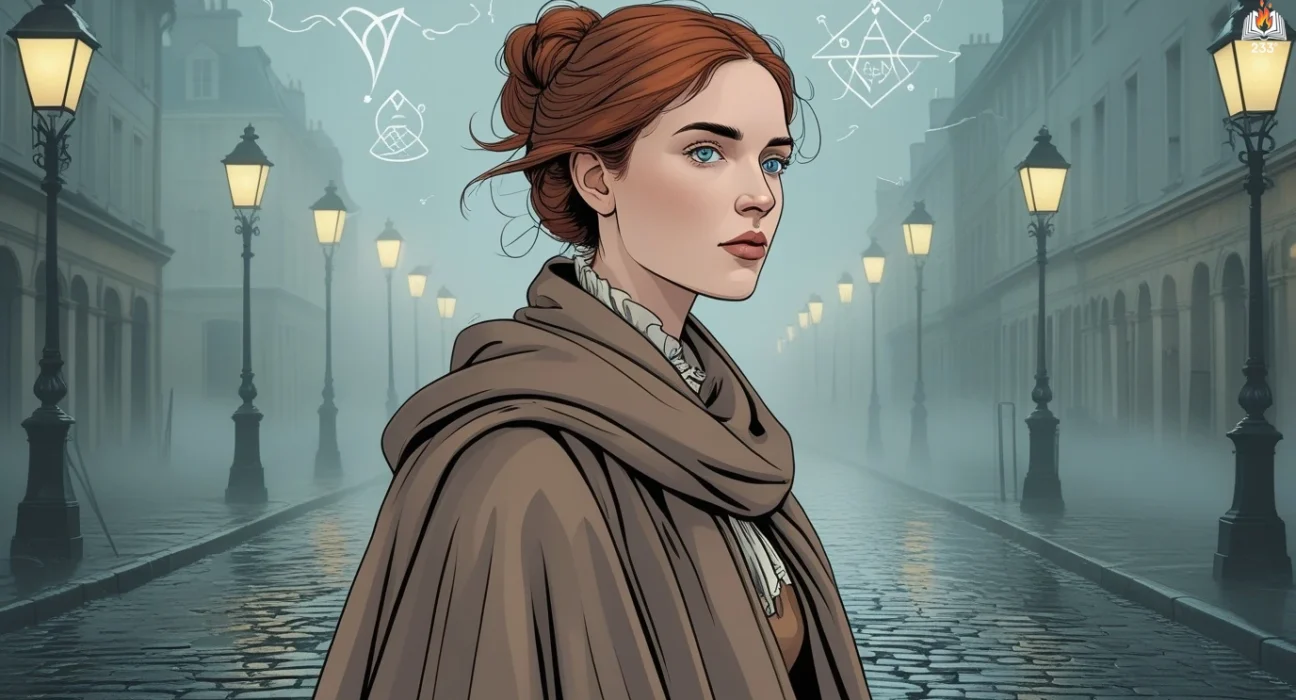
The Space Between by Diana Gabaldon, published in 2012, is a novella set within the rich and immersive world of the Outlander series. The story unfolds in 1778 Paris, a familiar yet shadowed setting from previous works, and bridges the mystical and the historical through characters from both the main Outlander saga and the Lord John spin-offs. Centered on Michael Murray and Joan MacKimmie, relatives of Jamie Fraser, and the enigmatic Comte St. Germain, the novella blends time travel, alchemical mystery, grief, faith, and identity in a compact but resonant narrative.
Plot Summary
The wind off the English Channel was sharp, slicing through skirts and wool as Joan MacKimmie stood on the deck of the ship bound for France, her future wrapped tightly around her like her cloak. At twenty-five, she had chosen a life devoted to God, leaving behind the moors of Scotland and her mother’s tearful figure on the quay. Her escort, Michael Murray – wine merchant, son of Jenny Fraser and Ian Murray – had the sorrowful eyes of a man who had buried both father and wife within a single month. The voyage was meant to be simple, but Joan carried more than her crucifix. She heard voices. She saw things others could not. And that second sight stirred when she looked at a young man across the deck, a gray mist cloaking his face. Death, she knew, was upon him.
Michael, too, bore ghosts. His wife Lilliane had been taken by the influenza, along with the child she carried. Her memory clung to him in laughter, in sorrow, in the lingering scent of her on the pillows back in Paris. He took solace in caring for Joan, grateful for the distraction, though neither expected comfort to be found in one another. As France’s green coast emerged from the haze, Joan’s vision sharpened. The young man was not merely doomed – he was slipping. And when he climbed the ship’s rail and leapt into the sea with a cry, her prayers rang hollow against the endless waves.
In Paris, Michael could not bear to go straight home. The convent could wait, and so he brought Joan to his house – once warm with laughter, now hollow and steeped in memory. But even in grief, life intrudes. His sister-in-law Léonie was there, accompanied by a flamboyant gentleman named Charles Pépin. And as Joan looked upon Charles, the voice within her whispered again: Tell him not to do it. What it meant, she could not say. The voices never gave full answers, only warnings that clung like damp fog.
While Joan was swept into silk robes and warm baths, Michael endured the flood of affection and obligation. His late wife’s family offered both kindness and disruption, and amid the scent of wine and flowers, he clung to Joan’s quiet presence like a steadying post. For Joan, the city was overwhelming. The stench of the cemeteries, the kaleidoscope of market stalls, and the noise of lives lived at full speed all pressed against her. Yet she watched, listened, and waited – for clarity, for peace, for some sign of what her strange gifts meant.
Far across the city, behind locked doors and under the amber glow of dying afternoon light, Paul Rakoczy – the Comte St. Germain – studied the body of a rat. Dead, yet perhaps not entirely. He had once died and risen again, and the dragon’s blood that had restored him still haunted his thoughts. The powder Mélisande had sent him – afile, they called it in the West Indies – might hold the key to overcoming death’s tether. But he had to know if it worked, and more urgently, if the one known as the Frog had returned. Maître Raymond, the alchemist, the impossible man. If the Frog still lived and had not aged, then perhaps Rakoczy’s own path was not yet sealed.
The Court of Miracles murmured of his return, and so Rakoczy walked the streets of Paris, slipping in and out of bars, brothels, and whispers. He fed rats to Madame Fabienne’s albino python Leopold, drank rough arrack, and let coins do the talking. He asked after the Frog and left word where he could be found. What he did not expect was to hear that the Frog was asking after him.
Joan, meanwhile, made her slow approach to peace. She prayed in Michael’s bath, fasted in penance for forgetting the man on the ship, and fought her guilt with every bead of the rosary. Her decision to become Sister Gregory was not without fear, but the convent offered silence, structure, and sanctuary from voices she could not explain. And still, she remembered the gray mist around the boy’s face. She remembered the sickly shimmer that settled over Charles Pépin when she shook his hand. Not evil, perhaps, but something poised on the edge of misdeed. What could she say? To Michael? To anyone?
Letters were promised. Michael would make sure her mother’s words reached her, and perhaps Joan could write back. That hope gave her comfort as they journeyed toward the Convent of Angels. Michael, too, found a strange solace in her presence. In protecting her, he postponed his collapse. His brother Ian had said to live one more minute, then another. In Joan’s quiet resolve, he found minutes he could survive.
At Madame Fabienne’s, Rakoczy plotted deeper. He offered gold for arrangements involving a girl named Madeleine, who glowed faintly blue when he touched her. He spoke of bloodlines and futures, of alchemical blood and time’s passage. Fabienne spoke of Mystères and spirits from the West Indies, her eyes sharp as ever. And when Rakoczy mentioned Maître Raymond, she smiled slyly and said the Frog was looking for him. The rat in Rakoczy’s hand bit him just then – a sharp reminder that death was never quite tamed. The rat survived. Resurrection, perhaps. Or something older, darker.
In the end, it was not transformation that held sway in Paris, but grief. Grief unites as much as it isolates. Michael let himself cry over Lillie once more, in private, whispering love into the open air. Joan prepared to leave his home for the convent, unaware of the forces still circling in the city’s underbelly. Rakoczy, marked by a rat’s bite and a whisper of the Frog’s return, stood on the cusp of revelation. And somewhere in the swirling mists between the seen and the unseen, voices waited, silent for now, but not forever.
Main Characters
Michael Murray – A wine merchant in Paris and the son of Jenny Fraser and Ian Murray. Grieving the recent death of his wife, Lilliane, and his father, Michael is portrayed as compassionate, quietly suffering, and determined to find solace and purpose. His journey with Joan is as much emotional as it is physical, offering moments of gentle humor, sorrow, and hope.
Joan MacKimmie – Jamie Fraser’s daughter by Laoghaire and a young woman on the verge of taking holy orders in France. Joan is thoughtful, spiritually conflicted, and deeply intuitive, capable of hearing voices and sensing impending death. Her inner turmoil and spiritual calling drive much of the emotional weight of the story.
Comte St. Germain (Paul Rakoczy) – A shadowy alchemist and time traveler who has seemingly returned from death. Driven by curiosity and fear of mortality, he experiments with resurrection and seeks out the mysterious Maître Raymond. Cold, calculating, and oddly sympathetic, the Comte adds a layer of mysticism and threat to the tale.
Maître Raymond (The Frog) – Though elusive and mostly referenced, his presence looms large as a mystical figure of immense knowledge and power. His connection to time travel and alchemical secrets places him at the thematic and philosophical center of the novella.
Léonie – Michael’s sister-in-law, still mourning her sister Lilliane. Her presence in Paris intertwines personal grief and familial obligation, anchoring Michael to his recent past.
Charles Pépin – Léonie’s flamboyant companion. Though charming and seemingly benign, a supernatural warning regarding him unsettles Joan, suggesting hidden danger or unforeseen consequence.
Theme
Grief and Healing: The novella is steeped in loss, from Michael’s sorrow over his wife’s death to Joan’s confusion about her future. Grief is presented as a bridge between characters, creating space for shared vulnerability, mutual understanding, and spiritual growth.
Faith, Doubt, and Divine Purpose: Joan’s struggle with her calling to become a nun, paired with her unbidden visions and voices, questions the nature of divine intervention and religious identity. Her journey reflects a yearning for meaning amidst uncertainty.
Mysticism and Alchemy: With the Comte’s resurrection experiments and Maître Raymond’s mythic presence, the story leans heavily into arcane sciences and the metaphysical. These elements evoke a sense of the uncanny, connecting past, present, and future through unknown energies.
Time and Transformation: Time travel is subtly threaded through the narrative, not as a plot device but as a thematic force. The title itself, The Space Between, symbolizes emotional liminality—between life and death, past and future, faith and fear.
Destiny and Free Will: Both Michael and Joan are caught between personal desires and perceived obligations. Their choices suggest that destiny may be malleable, shaped by courage, conviction, and human connection.
Writing Style and Tone
Diana Gabaldon’s prose in The Space Between is lush, atmospheric, and richly descriptive. With an ear for historical dialogue and a flair for character voice, she captures the elegance and filth of 18th-century Paris with remarkable ease. The tone is both intimate and expansive, shifting between quiet introspection and grand mystical speculation. Gabaldon uses alternating points of view to deepen the emotional resonance of each character, allowing readers to experience grief, confusion, and hope from multiple angles.
Gabaldon’s strength lies in her ability to make even the fantastical feel grounded. Her blend of the sacred and profane, sensuality and spirituality, evokes a world that feels simultaneously enchanted and authentic. Subtle humor and poignant emotional beats balance the darker philosophical inquiries into mortality and purpose. The novella, while short, contains the layered texture and immersive detail typical of her longer works, showcasing her command over mood, pacing, and the ineffable tension between science and faith.
Quotes
The Space Between – Diana Gabaldon (2012) Quotes
“He still didn’t know why the frog hadn’t killed him.”
“It took two days, and God kens well that I recall every second of those days—yet it seems that I lost her between one heartbeat and the next. And I—I keep lookin’ for her there, in that space between.”
“sweeping off his hat. Taking her hand, he bowed”
We hope this summary has sparked your interest and would appreciate you following Celsius 233 on social media:
There’s a treasure trove of other fascinating book summaries waiting for you. Check out our collection of stories that inspire, thrill, and provoke thought, just like this one by checking out the Book Shelf or the Library
Remember, while our summaries capture the essence, they can never replace the full experience of reading the book. If this summary intrigued you, consider diving into the complete story – buy the book and immerse yourself in the author’s original work.
If you want to request a book summary, click here.
When Saurabh is not working/watching football/reading books/traveling, you can reach him via Twitter/X, LinkedIn, or Threads
Restart reading!


