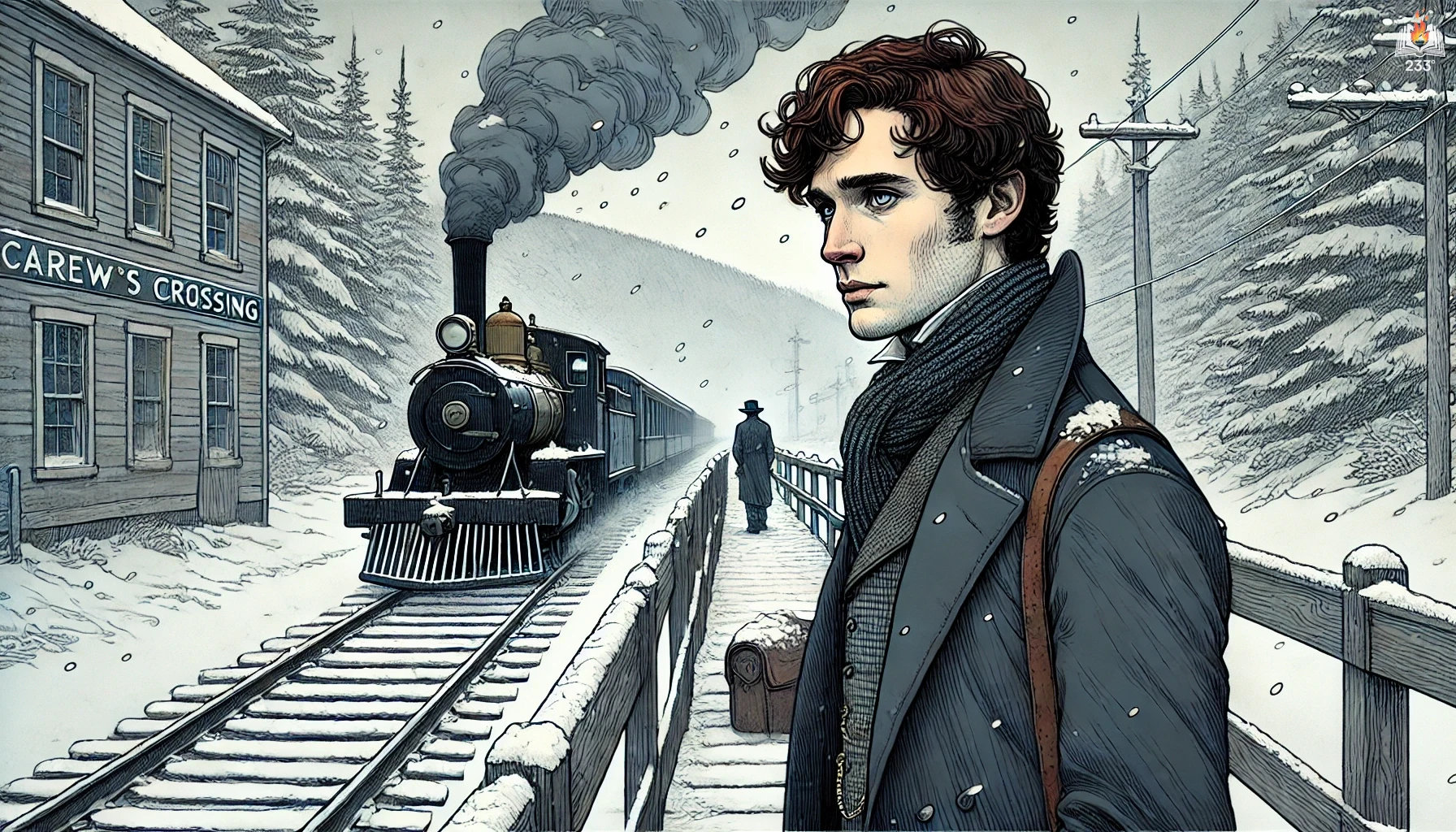


Just One Year by Gayle Forman, published in 2013, is the emotionally resonant companion to Just One Day and part of a well-known duology. It shifts the perspective from Allyson to Willem, following his search for the girl he spent one magical day with in Paris. A story about fate, identity, grief, and love, it maps a young man’s literal and metaphorical journey across continents and emotional terrain in the aftermath of loss and unexpected connection.
Plot Summary
Willem de Ruiter wakes to sirens, a throbbing head, and a name – Lulu – pulsing through his fractured memory. He is in a Paris hospital, battered and bloodied after a street fight he barely remembers. A stranger’s shirt clings to his skin, and a watch, bright gold with a cracked crystal, ticks on his wrist. It’s not his, but he knows it belongs to someone who matters. Lulu. The girl he spent a day with. The girl who made him feel known. The girl he lost.
She had been there the night before, in the white room, waiting. They had shared something undeniable, a connection carved in silence and breath. But Willem was late. Too late. And now she is gone.
Determined to find her, he leaves the hospital against medical advice, his memory stitched together only by fragments and names. With little more than a notebook, a foggy recollection of a Chinese character – double happiness – and the heartbeat of a city he knows too well, he roams Paris. He finds the building where they last were together, Ganterie, and believes she might still be inside. But time betrays him again. She’s gone, and all that remains is the weight of her absence.
A wrong Lulu appears, delicate and kind, but not the one he longs for. He is escorted away, his body failing under the pressure of his need to find her. He returns to a former lover, Céline, hoping for a place to rest. But her affection only reminds him of what he had and what he can no longer pretend to want. He leaves again, carrying nothing but a suitcase – Lulu’s suitcase, the last thread that ties him to her.
Inside the suitcase, there is no address, no name. Just the scent of her, the ghost of her handwriting, a journal filled with ellipses and silence. He finds blank postcards, and in desperation, fills each with his name, phone number, and hope. On one, a Shakespeare card, he writes what he cannot bring himself to say aloud – please, I’m sorry. He leaves them there, waiting for a hand that might never return.
He heads home, or what used to be home. Amsterdam greets him not with warmth, but bureaucracy. He meets with Marjolein, the family’s lawyer, to sign away the houseboat his father built – a floating sanctuary of glass and steel that once anchored his family. His mother, Yael, is gone. She left long ago, to India, to escape a life she could no longer inhabit after Bram, Willem’s father, died suddenly. Willem had left too, with no destination and no intention of returning. But life, like travel, winds back to the beginning.
He receives his inheritance – one hundred thousand euros, a fortune that feels heavier than it is worth. He contemplates disappearing again, somewhere warm, far, and anonymous. The idea of vanishing is seductive. But paperwork delays his plans. He needs a new passport. And in the liminal space between waiting and escaping, something changes.
Willem visits Broodje, his childhood friend, in Utrecht. Broodje, all open arms and nostalgia, welcomes him back without question. For a moment, Willem breathes easier. Here, at least, someone remembers him as he was – before grief, before Lulu, before the world felt like it spun in reverse.
But the questions remain. Who is Lulu? Where is she now? What did that day mean? And what does it mean if he lets it go?
He follows clues like a traveler chases border stamps. Mexico. India. He hears whispers of where she might have been, follows fading trails to dead ends. Yet with each step, he begins to see his journey differently. He is not just searching for a girl. He is searching for himself – the self that vanished in the wake of Bram’s death, the self that wandered city to city, never daring to return, never brave enough to confront what he left behind.
In India, he finds his mother. The reunion is brittle, a mosaic of silence and unspoken sorrow. But he stays. They speak at last, honestly, not as parent and child but as two people who lost the same man and ran in opposite directions. Yael, with all her steel and detachment, reveals the depths of her grief. Willem, once resentful of her distance, begins to understand the pain that shaped her.
Later, he returns to Amsterdam, this time not to hide. He joins a small theater group, acting once more, letting Shakespeare’s words rebuild the parts of him that were hollowed by longing. He lives simply, works with his hands, mends boats and broken sets. Slowly, life begins to resemble something he can carry.
Time, the quiet architect of change, shapes him. He stops chasing ghosts and begins living in the present. But Lulu never leaves him entirely. Her name softens into memory, no longer a wound but a possibility.
And then, months later, she appears.
She is there, in front of him, in Amsterdam. No more clues, no more riddles. Just her, in the flesh, looking for him as he once looked for her. Their eyes meet, and time folds. All the moments lost, all the detours and questions, resolve in the space between them. They do not speak at first. They do not need to. The watch is still ticking. And now, at last, so are they.
Main Characters
Willem de Ruiter – A Dutch actor and wanderer, Willem is haunted by the death of his father and the resulting distance from his mother. After a transformative 24-hour romance with a mysterious girl he calls Lulu, he embarks on a globe-spanning search to find her again. Quietly introspective, emotionally conflicted, and often impulsive, Willem’s journey is as much about self-discovery as it is about reuniting with Lulu.
Yael – Willem’s emotionally distant mother, a former Israeli soldier who processes grief and love through detachment. Her strained relationship with Willem highlights generational and cultural gaps, and her choices leave Willem grappling with abandonment.
Bram – Willem’s late father, an architect and an emotionally grounded force in Willem’s memory. Bram’s death is a turning point in Willem’s life, and his legacy shadows Willem’s sense of identity and his unresolved feelings of grief.
Broodje – Willem’s steadfast childhood friend in the Netherlands. Loyal and easygoing, Broodje offers a safe emotional harbor for Willem when he returns to Utrecht. His grounded presence contrasts Willem’s rootlessness.
Céline – A former romantic entanglement in Paris, Céline is intense and passionate, clinging to Willem more than he can reciprocate. Her reappearance brings conflict as Willem searches for Lulu.
Lulu (Allyson) – Though not physically present for most of the narrative, Lulu (as Willem calls her) is the driving force of the story. Her memory shapes Willem’s emotional journey. She remains a symbol of possibility, transformation, and the promise of genuine connection.
Theme
Search for Identity: Willem’s journey is largely internal. He seeks more than just a girl – he seeks who he is after grief has unmoored him. His travels become an external projection of an inner desire for belonging and self-definition.
Fate vs. Choice: Forman frequently explores the tension between chance and intention. The story’s foundation – a missed connection turned epic pursuit – revolves around what can and cannot be controlled in life and love.
Grief and Healing: The death of Willem’s father and his fractured family relationships form the backdrop of his journey. His grief is quiet but profound, influencing his reluctance to return home and his inability to fully commit until he begins to heal.
The Power of a Single Day: The entire plot is driven by the impact of one extraordinary day spent with a stranger. This motif underscores how singular moments can irrevocably alter lives, reinforcing the idea that deep emotional truths can emerge in fleeting experiences.
Cultural Displacement and Wanderlust: Set across Europe, India, and Mexico, the novel uses its diverse locations to highlight themes of dislocation and the search for connection. Willem’s identity is in flux, shaped by each place and person he encounters.
Writing Style and Tone
Gayle Forman’s prose is introspective, poetic, and richly atmospheric. She infuses the narrative with sensory detail and quiet emotional resonance, allowing the reader to fully inhabit Willem’s disoriented and contemplative headspace. The internal monologue is persistent and immersive, capturing the nuances of grief, longing, and wonder with authenticity. Her use of different cultures and languages feels organic, adding realism and complexity to Willem’s journey.
The tone of Just One Year is wistful and searching, punctuated with bursts of joy, confusion, and melancholy. There is a consistent undercurrent of yearning that mirrors Willem’s own unsettled heart. Unlike a traditional romance, the novel doesn’t promise closure early on; instead, it dwells in uncertainty, mirroring the genuine unpredictability of life. The narrative voice is intimate and lyrical, offering readers a window into the soul of a young man learning how to live with loss and pursue love bravely.
Quotes
Just One Year – Gayle Forman (2013) Quotes
“There’s a difference between losing something you knew you had and losing something you discovered you had. One is a disappointment. The other feels like losing a piece of yourself.”
“Love is not something you protect. It’s something you risk.”
“Loving someone is such an inherently dangerous act. And yet, love, that’s where safety lives.”
“Saba used to say there was a difference between bravery and courage. Bravery was doing something dangerous without thinking. Courage was walking into danger, knowing full well the risks.”
“Leaving people to jumped conclusions is sometimes simpler than explaining a complicated truth”
“And something tells me if it matters, maybe it shouldn't be easy.”
“Sometimes the wind blows you places you weren't expecting: sometimes it blows you away from those places, too.”
“Because I understand all the ways of trying to escape, how sometimes you escape one prison only to find you've built yourself a different one.”
“Accidents. It's all about the accidents.”
“I’ve since come to understand that the universe operates on the same general equilibrium theory as markets.It never gives you something without making you pay for it somehow.”
“Because you don’t ever find things when you’re looking for them. You find them when you’re not.” “If that were true, nobody would ever find their keys.”
“Can you move on from something when you're not sure what it is you're moving on from?”
“It takes certain kind of naiveté, or perhaps just stupidity, to know things will end and still hope otherwise.”
“I'm so tired of missing things I don't have.”
“It was just one day and it's been just one year. But maybe one day is enough. Maybe one hour is enough. Maybe time has nothing at all to do with it". Willem”
“By that point, it’ll have been more than year since I met Lulu. Any sane person would say it’s too late. It already felt too late that first day, when I woke up in the hospital. But even so, I’ve kept looking. I’m still looking.”
“When you make such a large withdrawal of happiness, somewhere you'll have to make an equally large deposit. It all goes back to the universal law of equilibrium.”
“Nothing happens without intention, Willem. Nothing. This theory of yours - life is rules by accidents - isn't that just one huge excuse for passivity?”
“Something given, something taken away. Does it always have to work like that?”
“Doubt is part of searching. Same as faith.”
“Somethings you don't know you want until they're gone. Other things you think want, but don't understand you already have them.”
“But it's a big ocean. It's an even bigger world. And maybe we've gotten as close as we're supposed to get.”
“A long flight. Jetlag. Immigration. Customs. And then finally, that first step into a new place, that moment of exhilaration and disorientation, each feeding the other. That moment when anything can happen”
“Days like these go on for years. It's the ones you want to last that slip away - one, two, three - in seconds.”
“Once the options increase, settling on one becomes harder.”
“A truth and its opposite are flip sides of the same coin.”
“I don’t discount a magical hand of fate. I am an actor, after all, and a Shakespearian, no less. But it can’t be the ruling force of your life. You have to be the driver.”
We hope this summary has sparked your interest and would appreciate you following Celsius 233 on social media:
There’s a treasure trove of other fascinating book summaries waiting for you. Check out our collection of stories that inspire, thrill, and provoke thought, just like this one by checking out the Book Shelf or the Library
Remember, while our summaries capture the essence, they can never replace the full experience of reading the book. If this summary intrigued you, consider diving into the complete story – buy the book and immerse yourself in the author’s original work.
If you want to request a book summary, click here.
When Saurabh is not working/watching football/reading books/traveling, you can reach him via Twitter/X, LinkedIn, or Threads
Restart reading!