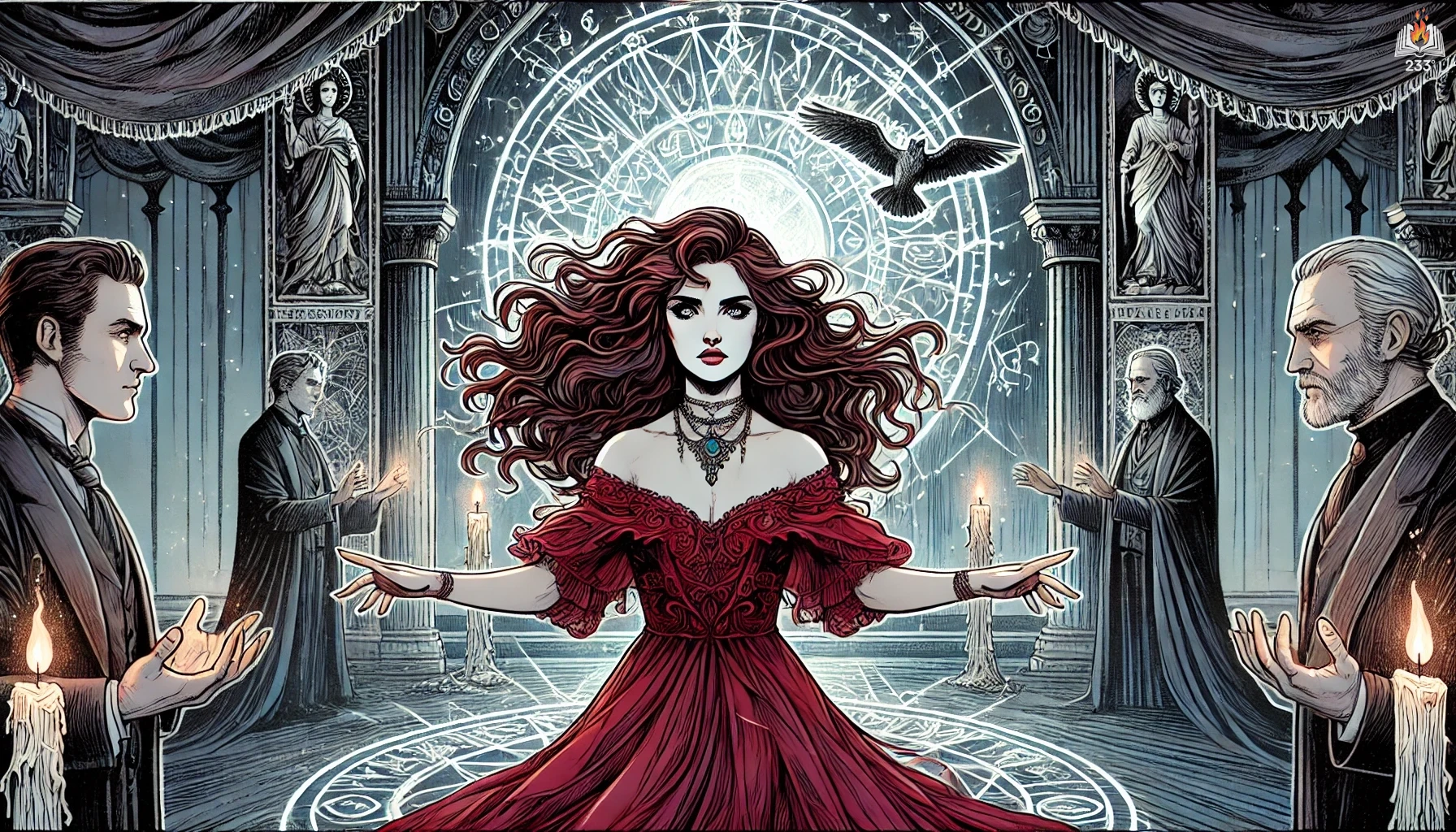

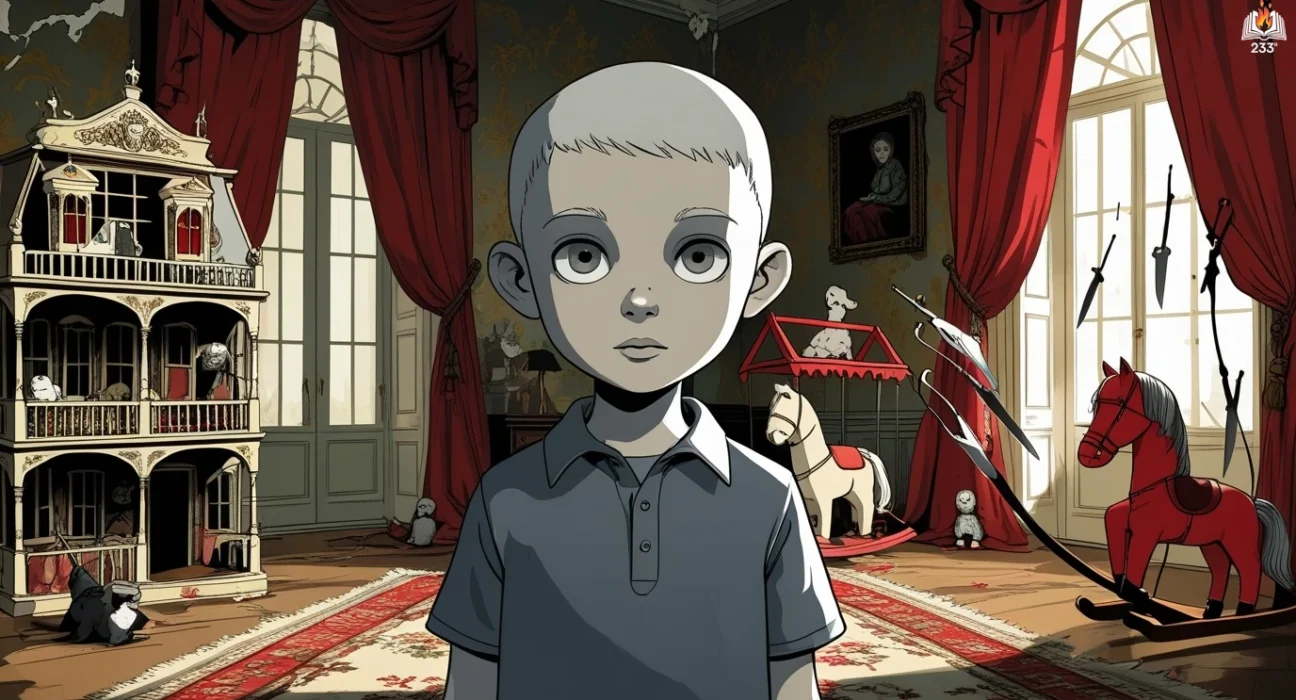
Not Forever, But For Now by Chuck Palahniuk was published in 2023 and continues the author’s trademark exploration of grotesque satire, psychological disturbance, and pitch-black humor. Set in the decaying halls of an aristocratic British household, the novel follows Cecil and Otto, two young sociopaths raised by a legacy of elite assassins. Structured in fragmented, first-person vignettes, the book reads like a twisted fairy tale told through a shattered looking glass, reveling in depravity as a vehicle for existential commentary.
Plot Summary
In the shadowy corridors of a decaying Buckinghamshire manor, two aristocratic boys – Cecil and Otto – are groomed not for Oxford or Parliament, but for murder. Their family, long steeped in the business of discreet assassination, hides its trade behind ornate curtains and pedigree, its crimes perfumed with lavender and soaked in blood. The nursery, once intended for rattles and fairy tales, instead becomes the setting for training in deception, cruelty, and performance.
Cecil, the younger, is tender in age but already thick with experience. His older brother Otto, always clever, always cruel, serves as both tutor and tormentor. Otto teaches him how to pose for photos, how to smile while being used, how to make a pen pal of the Buckinghamshire Hatchet Killer. They whisper stories in Richard Attenborough’s voice, impersonating nature documentaries while indulging their worst instincts. Violence is merely observation. Detachment is worshipped. The world, as they understand it, feeds on weakness – and they must never be weak.
Mummy, the matriarch of the family, slips in and out of the house like a diplomat or a ghost. When she is home, she demands order, loyalty, results. She has trained Otto well. Her jobs take her across the globe – Diana in Paris, Cobain in Seattle, Hutchence in Australia. Otto dreams of joining the family firm, of graduating from letters to lunatics to hands-on bloodwork. When she suspects he’s wasting potential, she threatens to cut his allowance unless he joins a university or the killing business properly.
Murder is always near. The yard boy, once Otto’s illicit lover and Winnie-the-Pooh playmate, turns up dead, his throat neatly slit. A nanny who once did it with her mouth ends up shattered at the foot of the back stairs. A governess is poisoned. Another crashes her Mini after a sabotaged brake line. None of it causes much pause – in this family, the line between staff and sacrifice is thin, and servants are never clever enough to feel hurt. Cecil and Otto are taught to bathe in the blood of help, metaphorically and otherwise. They sharpen their blades on the help’s incompetence.
Their house becomes a shrine to the grotesque. Each hallway echoes with the history of butchered help, drowned maids, garroted tutors. A jaguar’s taxidermied body stands in the library, its stuffed bits inexplicably bleeding. Otto uses it as a prop, posing Cecil beneath it, sending photos to criminals who ache to do worse. Letters pour in – breathless, obsessed, filled with violent lust. Otto reads them aloud while Cecil arches his back and pretends to beg for mercy. In this household, pleasure and violence are indistinguishable, and children are raised to know both by taste.
Mummy’s power is absolute. She can count the number of OxyNorm pills in a bottle just by listening to the rattle. She knows when to bribe, when to threaten, when to flick away a child like a crumb from a velvet tablecloth. Her love is not a blanket but a currency – earned only through obedience and exceptional violence. Otto, desperate to remain at home, bribes her with painkillers, shaved hair, submission. Cecil watches, hairless and bleeding, hoping for a crumb of affection.
The family history is told around the fireplace, not in lullabies but through tales of celebrity deaths. Grandfather spins yarns of garroting Judy Garland on a toilet seat, of rigging car crashes and silencing rock stars with manufactured overdoses. His memories, sticky with Christmas tree sap and vomit, are heirlooms. These stories, soaked in phenobarbital and champagne, are the closest thing to love passed down. Cecil and Otto are expected to learn them by heart, to one day add their own entries to the family chronicle of necessary deaths.
Their father, once a failed assassin, finds work as a fake child at Scotland Yard, pretending to be a boy in online chat rooms to lure predators. When he fails at even this, Otto teaches him how to be prey – how to sound broken enough to be desired. Otto, then barely out of nappies, explains that predators only crave the fragile, the lisping, the doomed. Daddy learns, ascends the ranks, becomes a national hero – then vanishes. All that remains of him are the veins that once pulsed on his forehead like trapped lightning.
Otto, in Daddy’s absence, turns to theatrics. He becomes a cabaret act for local drunkards, dancing on bar tops in high heels and postage stamps, singing Carmen Miranda songs until the nanny drags him home and paddles his bare bottom. For Otto, this humiliation is the closest he ever came to being loved. He never sings again.
Every governess has a story. One with albinism drowns. Another retches blood across a grand piano. One dies with a monocle still swinging from her neck. A maid is found dead in a tureen of leek consommé after asking too many questions about the bleeding jaguar. Ghosts, some whisper. The house, they say, is haunted. But the truth is simpler. The house is haunted by Otto.
As Otto’s ambitions grow, so too does his desperation. The fun turns stale. The pen pal letters lose their thrill. Posing Cecil under stuffed animals no longer brings delight. Otto finds the world boring, Mummy oppressive, the nursery a prison. His madness grows meticulous. A smile flickers on his face when a chauffeur’s skull pops beneath the Bentley. A look gets on his face when the nanny’s neck cracks in his arms. It’s always the same look – something between calculation and rapture.
Cecil, ever loyal, ever raw, tries to keep up. But Otto has begun to drift, his eyes glassy, his performances faltering. He turns down Cecil’s offers to play Winnie-the-Pooh. He no longer wants to “have it off” during the death of baby antelopes on nature films. He sighs more often, edits his letters less passionately. Even the cannibals no longer excite him. His joy now lies only in power – the threat of it, the withholding of it, the looming question of what he might do next.
In the end, it’s not a bang or a fire or a scream. It’s a quiet moment. Otto at the top of the stairs, shaking a pill bottle like a dinner bell. Mummy, clever old girl, sniffing the air and climbing toward him. Cecil dismissed with a nod. Shaved clean again by a nanny who trembles with each stroke of the razor. Downstairs, the jaguar still bleeds. Upstairs, Otto smiles.
And the house goes on, haunted not by ghosts, but by tradition.
Main Characters
Cecil: The primary narrator, Cecil is a disturbingly precocious boy shaped by aristocratic decay and familial violence. He’s both participant and observer in a lineage steeped in elite murder-for-hire, molded by a cold, performative love. His voice is naïve, witty, and horrifyingly detached, forming a chilling lens through which the story unfolds.
Otto: Cecil’s older brother and a dominant influence, Otto is charismatic, manipulative, and calculating. He steers the moral collapse of their youth with theatrical flair and cruel intelligence, blurring the line between sibling, lover, and co-conspirator. Otto embodies performative cruelty and ideological inheritance, obsessed with spectacle and legacy.
Mummy: A decadent matriarch and ruthless career killer, she represents the cold machinery of class-based violence. Her love is conditional, her guidance laced with manipulation. Though often absent, her presence looms large as the progenitor of their violent values and emotional dysfunction.
Grandfather: An aging assassin and raconteur of family legend, Grandfather is both revered and grotesque. His tales of past murders anchor the family’s mythology. He serves as a twisted moral compass and nostalgic anchor, enshrining violence as heritage.
Daisybelle: The family’s long-dead Boston terrier, remembered with reverence. Though minor in presence, Daisybelle represents the family’s stunted emotional development and serves as a totem of lost innocence.
Theme
Inherited Violence and Legacy: At the heart of the novel is the concept of violence passed down like heirlooms. The family treats assassination not as crime but as vocation. This generational continuity satirizes both hereditary privilege and the myth of noble duty.
Class Decay and Aristocratic Rot: The British aristocracy is portrayed as both literally and morally decomposed. The family’s genteel façade conceals perversion and homicide, making a scathing commentary on the upper class’s detachment from moral consequence.
Nostalgia and Fabricated Memory: Grandfather’s tales and Cecil’s romanticized memories underscore how violence is sanitized through family lore. The tension between memory and myth reveals how trauma is normalized and celebrated within closed systems.
Sexual Abuse and Predation: The narrative repeatedly confronts institutionalized pedophilia and sexual power dynamics, especially within elite British society. These grotesque acts are depicted not for shock alone but as indictments of systemic exploitation hiding beneath civility.
Theatricality and Performance: Characters constantly perform – as boys, killers, victims, or martyrs. Identity is fluid and manipulative, shaped by who’s watching. This motif extends to the novel’s form, often resembling scripted confession or monologue.
Writing Style and Tone
Chuck Palahniuk’s style in Not Forever, But For Now is a baroque blend of nursery rhyme cadence, dry British affectation, and psychosexual horror. The prose mimics the voice of a hyper-literate, unwell child – often lilting and formal, yet shot through with gut-punch vulgarity. His language is clipped, poetic, and darkly comic, reflecting both innocence and madness. The narrative voice disarms with charm before delivering a grotesque blow, aligning with the Palahniuk tradition of seduction through transgression.
The tone oscillates between deadpan satire and operatic tragedy. There’s a gothic lushness to the setting and a clinical detachment in the depiction of murder and sexual violence, creating a disturbing cognitive dissonance. The world is rendered in nursery language – “have a go,” “wee boy,” “supper” – while characters enact unspeakable horrors, making the novel feel like Downton Abbey directed by John Waters and narrated by Hannibal Lecter. Palahniuk weaves a grotesque lullaby, inviting readers into a world where cruelty is cultivated like manners and love is just another performance in a long family tradition.
Quotes
Not Forever, But For Now – Chuck Palahniuk (2023) Quotes
“The predators must prey. The prey must be predated. They only wish to be preyed upon by someone who'll do the job properly.”
“And it crossed his mind how every Dorothy turns into the Wicked Witch.”
“Religion ... is merely what people invent when they wake late at night filled with ancient terror of being found out in their little nest of grasses and torn to shreds by the inevitable.”
“We're bright young things, and no bright young thing wants to squander his life as a custodian to the dead.”
“I'd rather die than know I'm not worth the killing. I'd rather be eaten than know I'm not worthy food.”
“It’s having too many birthdays that kills most people, it is.”
“Cecil, America sounds ghastly.”
“The townsfolk are a superstitious lot. But that's to be expected. They're Catholics.”
“I’d rather die than know I’m not worth the killing. I’d rather be eaten than know I’m not worthy food”
“It’s all a great mystery, this religious business.”
“If not forever, but for now.”
“We’re bright young things, and no bright young thing wants to squander his life as a custodian to the dead.”
“History, Grandfather tells us, is always planned out well ahead of time.”
“A trick of fake fakes faking their fakery,”
“If one settles for being loved, one must always be at the beck and call of others, and stay out of their black book, and thus retain that love no matter what the cost to one’s freedom.”
“Otto says no one actually falls in love because you never meet the people driving the same speed as you. You only meet the boring slowpokes or the crazed speed demons, and when you marry one or the other, you can kiss romance good-bye.”
We hope this summary has sparked your interest and would appreciate you following Celsius 233 on social media:
There’s a treasure trove of other fascinating book summaries waiting for you. Check out our collection of stories that inspire, thrill, and provoke thought, just like this one by checking out the Book Shelf or the Library
Remember, while our summaries capture the essence, they can never replace the full experience of reading the book. If this summary intrigued you, consider diving into the complete story – buy the book and immerse yourself in the author’s original work.
If you want to request a book summary, click here.
When Saurabh is not working/watching football/reading books/traveling, you can reach him via Twitter/X, LinkedIn, or Threads
Restart reading!