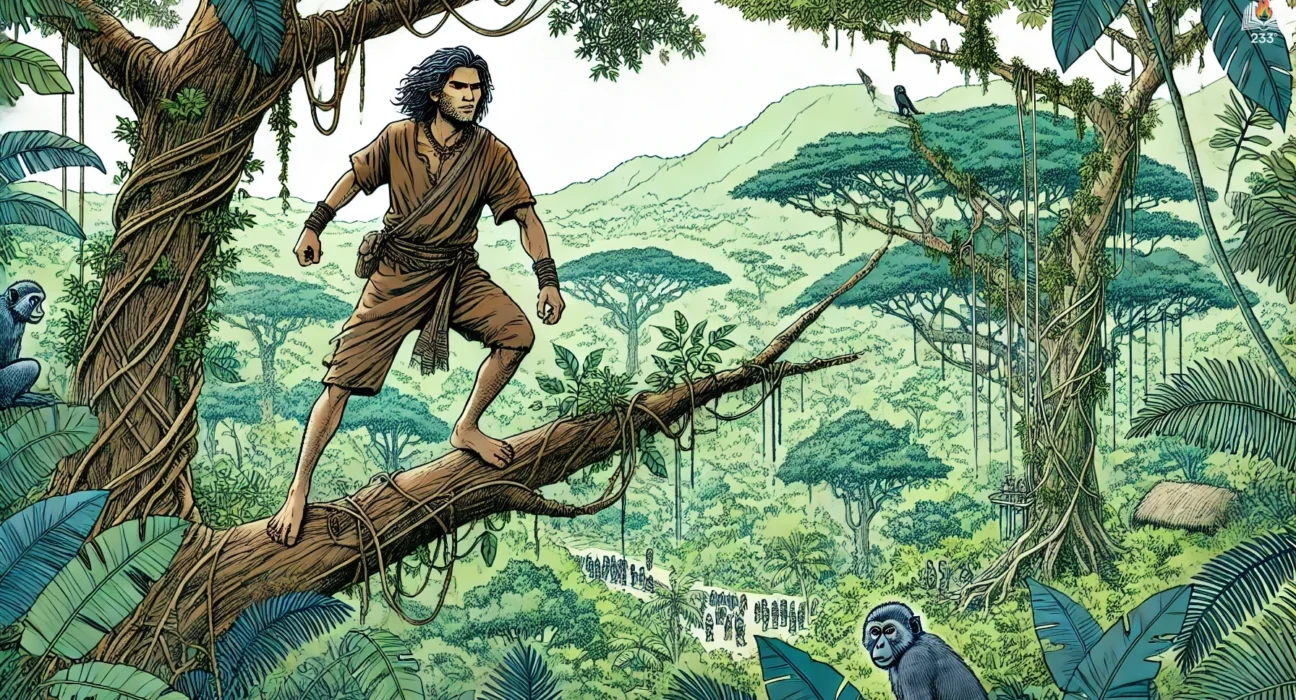
Tarzan of the Apes, written by Edgar Rice Burroughs and first published in 1912, is the iconic tale of a young boy raised by apes in the African jungle. The novel introduces readers to Tarzan, an English lord who, after being orphaned in the wilderness, grows up among a tribe of apes. The story blends action, adventure, and romance, creating one of the most enduring and recognizable characters in literary history. Burroughs’ novel is a commentary on civilization, nature, and identity, and it sparked a franchise that includes numerous sequels, films, and adaptations.
Plot Summary
In the late 19th century, an English nobleman, Lord John Greystoke, and his pregnant wife, Lady Alice, set sail for Africa on a diplomatic mission. Tragedy strikes when their ship is taken over by mutineers, forcing the couple to be abandoned on a desolate jungle shore. There, in the unforgiving wilderness, they build a crude cabin as they await rescue. Time passes, and Lady Alice gives birth to a son. However, the hardships of jungle life soon take their toll. Alice dies of illness, and John Greystoke is killed in an attack by a tribe of great apes.
In a curious twist of fate, a female ape named Kala, mourning the loss of her own infant, finds the abandoned English baby in the cabin. She takes the child into her arms, naming him Tarzan, meaning “white-skin” in the ape language, and raises him as her own. The boy grows up among the tribe, learning the ways of the jungle, developing extraordinary strength, agility, and survival instincts. He also faces constant struggles for survival, particularly against the tribe’s leader, the aggressive and tyrannical Kerchak, who distrusts Tarzan for his human differences.
As Tarzan matures, he begins to sense his differences from the apes. His intelligence surpasses theirs, and he discovers his parents’ cabin. There, he finds remnants of his true identity—books, tools, and a mirror. He teaches himself to read and write English by studying the books his father left behind, though he has no understanding of spoken language. Tarzan’s intellectual growth sets him even further apart from the apes, while his physical prowess makes him a formidable force in the jungle. In time, Tarzan asserts his dominance over the tribe, eventually challenging and killing Kerchak, becoming the leader of the apes.
Tarzan’s life changes irrevocably when a new group of humans arrives on the shores of his jungle. Among them is Jane Porter, a young American woman traveling with her father, Professor Archimedes Q. Porter, and their entourage, including William Cecil Clayton, a distant relative of Tarzan’s, and a French naval officer, Paul D’Arnot. The group becomes stranded after their ship is attacked by mutineers, just as Tarzan’s parents had been years earlier.
Jane’s beauty and intelligence immediately captivate Tarzan, awakening feelings in him he has never experienced. He watches over the group from a distance, intervening when danger strikes. When Jane is separated from the group and threatened by jungle predators, Tarzan saves her, carrying her to safety in his arms. Despite the barriers of language and culture, Tarzan and Jane form a deep, unspoken connection. Jane is both fascinated and bewildered by the wild man who seems both savage and noble.
While Tarzan protects Jane and her party, D’Arnot is captured by a hostile tribe. Tarzan tracks down and rescues him, nursing him back to health. Through D’Arnot, Tarzan learns to speak French, and eventually the two make plans to return to civilization. Before they leave, D’Arnot helps Tarzan uncover the truth about his heritage. By comparing the clues left in his parents’ cabin with the records in D’Arnot’s possession, Tarzan realizes that he is the rightful heir to the Greystoke title and estate. This discovery deepens his inner conflict, as Tarzan now knows he belongs to both the jungle and the aristocratic world.
Meanwhile, Jane faces her own dilemma. William Clayton, unaware of Tarzan’s true identity, has proposed to her. Clayton is a gentleman, offering her security and respectability, but Jane is drawn to Tarzan’s raw power and deep, primal connection to the natural world. Torn between the two men, Jane hesitates in making a choice.
As Tarzan prepares to follow Jane and the others back to civilization, he learns that she has agreed to marry Clayton. Heartbroken, Tarzan decides to sacrifice his own happiness for Jane’s well-being, believing that life in the human world is not for him. He chooses to remain in the jungle, relinquishing his claim to both his title and Jane’s love. He watches in silence as Jane and Clayton board a ship bound for America, leaving him behind in the wilderness that has been both his home and his prison.
Yet, even as the ship disappears over the horizon, Tarzan stands tall, a man caught between two worlds, fully aware of his power, his nobility, and the love he has lost. The jungle calls to him, but the knowledge of his true lineage remains a part of him, forever linking him to the world of men. As the wind rustles through the trees, Tarzan knows that his journey is far from over—he is a lord of the jungle, but also a man of flesh and blood, driven by love, loss, and an unquenchable thirst for understanding his place in the world.
Main Characters
Tarzan (John Clayton, Lord Greystoke): The protagonist, Tarzan is the orphaned son of British aristocrats who is raised by apes after his parents die in the African jungle. He is physically strong, agile, and highly intelligent. His character is defined by the tension between his primal instincts and his innate nobility. Over the course of the novel, Tarzan grows from a wild jungle child into a man who seeks to understand his true heritage.
Kala: A maternal ape who adopts the infant Tarzan after her own baby dies. She raises him as her own, showing deep affection for him, despite his human differences. Kala’s nurturing love plays a critical role in Tarzan’s development and survival in the jungle.
Kerchak: The fearsome leader of the ape tribe that raises Tarzan. He is aggressive, powerful, and distrustful of Tarzan due to his human differences. Kerchak’s leadership challenges Tarzan and represents the harsh, competitive side of the jungle.
Jane Porter: The love interest of Tarzan, Jane is an American woman who becomes stranded in the jungle. She is intelligent, kind-hearted, and represents the civilized world to which Tarzan must eventually return. Jane’s relationship with Tarzan is one of the emotional cores of the story, as Tarzan grapples with his place between the jungle and human society.
Professor Archimedes Q. Porter: Jane’s father, a scholarly and absent-minded professor. He is well-meaning but often oblivious to the dangers of the jungle.
John Clayton (Lord Greystoke, Tarzan’s father): A noble Englishman who, along with his wife, is stranded in the African jungle before Tarzan’s birth. He represents British dignity and moral rectitude. His death leaves Tarzan orphaned.
Alice Clayton (Lady Greystoke): Tarzan’s mother, who dies when he is an infant. Her death sets in motion the events that lead to Tarzan’s upbringing by apes.
Theme
Civilization vs. Nature: One of the central themes of Tarzan of the Apes is the tension between civilization and the untamed natural world. Tarzan’s existence on the boundary of these two realms mirrors a broader exploration of whether human beings are shaped more by their environment or their heritage. The novel portrays civilization both as a beacon of human progress and a corrupting force that strips people of their primal purity.
Identity and Heritage: Tarzan’s quest to discover who he truly is lies at the heart of the novel. Raised by apes but born to English nobility, Tarzan must navigate the complexities of his dual identity. His journey to understand his lineage and where he belongs—whether in the jungle or among civilized humans—forms a central narrative arc.
Survival and Instinct: The brutal realities of jungle life emphasize themes of survival and instinct. Burroughs describes Tarzan’s development as a warrior and hunter, showing his keen instincts, physical prowess, and his ability to thrive in a dangerous environment. The novel examines the balance between human intellect and animalistic survival.
Racism and Colonialism: Though Tarzan of the Apes is a product of its time, it reflects troubling colonial attitudes toward race. The depiction of native Africans as primitive or less civilized than Europeans mirrors the colonialist perspective that Western society is superior. These problematic elements have been the subject of much modern critique.
Love and Loyalty: Tarzan’s relationships with Kala and Jane demonstrate his capacity for deep love and loyalty. Kala’s maternal bond with Tarzan is pure and unconditional, and it mirrors Tarzan’s later affection for Jane. These emotional ties ground Tarzan, giving him a reason to care for both his ape family and the human world.
Writing Style and Tone
Edgar Rice Burroughs’ writing in Tarzan of the Apes is direct, fast-paced, and rich with vivid descriptions of the natural world. He expertly conveys the raw beauty and dangers of the jungle through his use of sensory details, bringing the setting to life with its sounds, sights, and smells. Burroughs’ narrative is both action-driven and philosophical, exploring the human condition in a primitive world. His prose tends to be clear and concise, fitting the adventure genre, yet he often delves into poetic descriptions when portraying the jungle and Tarzan’s interactions with nature.
The tone of the novel is one of wonder and excitement, mixed with elements of tension and danger. There is a sense of awe in Tarzan’s physical feats and the mystery of the jungle, but Burroughs does not shy away from portraying the brutal, violent aspects of both human and animal nature. The tone is also reflective, especially when Tarzan grapples with questions about his identity and place in the world. At its core, the novel strikes a balance between thrilling adventure and a deeper contemplation of what it means to be human.
Quotes
Tarzan of the Apes – Edgar Rice Burroughs (1912) Quotes
“The time has arrived when patience becomes a crime and mayhem appears garbed in a manner of virtue”
“I love you, and because I love you I believe in you. But if I did not believe, still should I love. Had you come back for me, and had there been no other way, I would have gone into the jungle with you - forever.”
“For myself, I always assume that a lion is ferocious, and so I am never caught off my guard.”
“I got this story from someone who had no business in the telling of it.”
“Beast?" Jane murmured. "Then God make me a beast; for, man or beast, I am yours.”
“When Tarzan killed he more often smiled than scowled, and smiles are the foundation of beauty.”
“As the body rolled to the ground Tarzan of the Apes placed his foot upon the neck of his lifelong enemy and, raising his eyes to the full moon, threw back his fierce young head and voiced the wild and terrible cry of his people.”
“Men were indeed more foolish and more cruel than the beasts of the jungle! How fortunate was he who lived in the peace and security of the great forest!”
“Captain Billings," he drawled finally, "if you will pardon my candor, I might remark that you are something of an ass, don't you know.”
“And could she love where she feared?”
“Teach me to speak the language of men.”
“His straight and perfect figure, muscled as the best of the ancient Roman gladiators must have been muscled, and yet with the soft and sinuous curves of a Greek god, told at a glance the wondrous combination of enormous strength with suppleness and speed.”
“[...] smiles are the foundation of beauty.”
“[..] it has remained for man alone among all creatures to kill senselessly and wantonly for the mere pleasure of inflicting suffering and death.”
“And so he learned to read. From then on his progress was rapid.”
“With man it is different. When he comes many of the larger animals instinctively leave the district entirely, seldom if ever to return; and thus it has always been with the great anthropoids. They flee man as man flees a pestilence.”
“Even brave men, and D'Arnot was a brave man, are sometimes frightened by solitude.”
“P33- the wail of the living had answered the call of universal motherhood within her wild beast which the dead could not still.”
“All he knew was that he could not eat the flesh of this black man, and thus hereditary instinct, ages old, usurped the functions of his untaught mind and saved him from transgressing a worldwide law of whose very existence he was ignorant.”
“She realized the spell that had been upon her in the depths of that far-off jungle, but there was no spell of enchantment now in prosaic Wisconsin.”
“Jane saw the little note and ignored it, for she was very angry and hurt and mortified, but—she was a woman, and so eventually she picked it up and read it. MY”
“p 18 - Hundreds of thousands of years ago our ancestors of the dim and distant past faced the same problems which we must face in the same primeval forest. That we are here today evidences their victory.”
“Tut, tut! I have often admonished my pupils to count ten before speaking. Were I you, Mr. Philander, I should count at least a thousand, and then maintain a discreet silence.”
“He killed for food most often, but, being a man, he sometimes killed for pleasure, a thing which no other animal does; for it has remained for man alone among all creatures to kill senselessly and wantonly for the mere pleasure of inflicting suffering and death.”
“From a lofty perch Tarzan viewed the village of thatched huts across the intervening plantation.”
We hope this summary has sparked your interest and would appreciate you following Celsius 233 on social media:
There’s a treasure trove of other fascinating book summaries waiting for you. Check out our collection of stories that inspire, thrill, and provoke thought, just like this one by checking out the Book Shelf or the Library
Remember, while our summaries capture the essence, they can never replace the full experience of reading the book. If this summary intrigued you, consider diving into the complete story – buy the book and immerse yourself in the author’s original work.
If you want to request a book summary, click here.
When Saurabh is not working/watching football/reading books/traveling, you can reach him via Twitter/X, LinkedIn, or Threads
Restart reading!