The Blythes Are Quoted by L. M. Montgomery, first published in its entirety in 2009, is the final installment of the iconic Anne of Green Gables series. Edited by Benjamin Lefebvre, this unique volume diverges from the structure of its predecessors by blending short stories, poems, and vignettes—many of which feature Anne Shirley Blythe and her family as peripheral yet emotionally resonant figures. Conceived just before Montgomery’s death in 1942, the book is deeply introspective and stylistically experimental. Divided into two parts—before and after World War I—it serves both as a continuation of Anne’s story and a meditation on memory, war, and human resilience, revisiting beloved characters through a mature and often somber lens.
Plot Summary
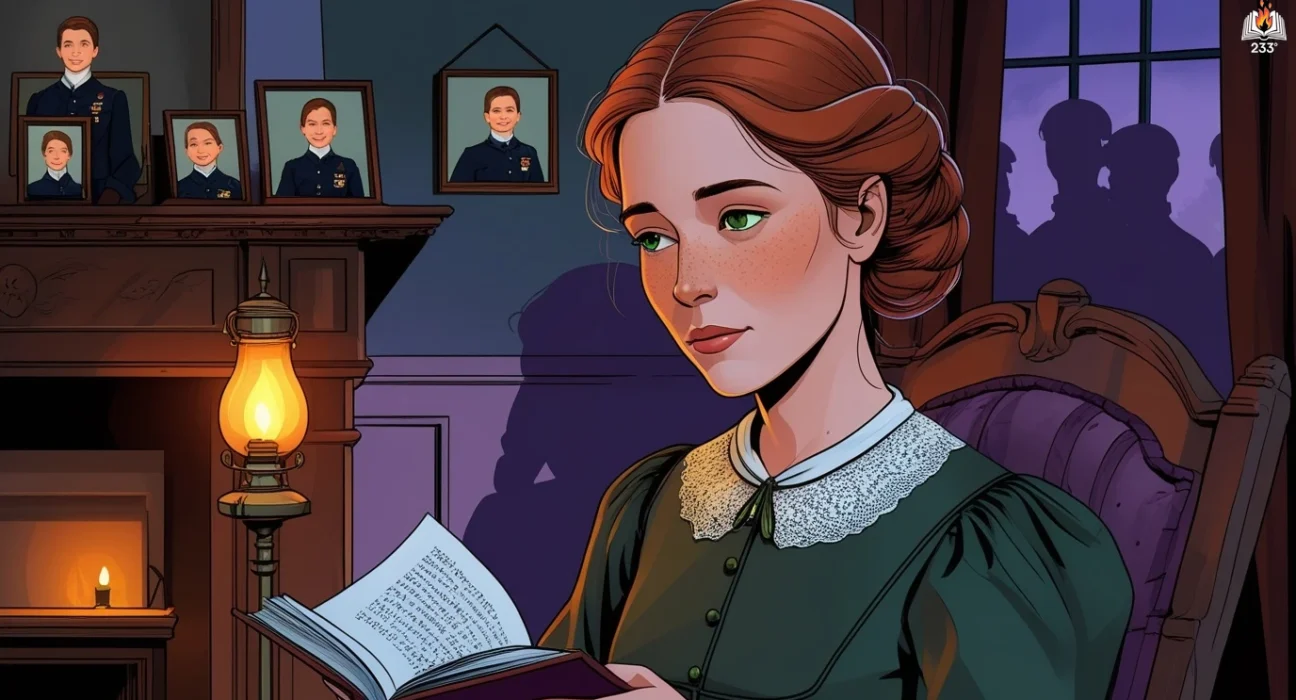
A hush had fallen over Ingleside. Time moved differently now, like the slow unwinding of a clock long cherished, its hands ticking gently through shadows and sunlight. The laughter of youth had softened into memory, and Anne Blythe – once the fiery-haired dreamer of Green Gables – now lived in the cadence of poems and twilight conversations. Each evening at Ingleside was a gathering of voices and verses, Anne reading aloud from her latest poems to her family, whose faces reflected both amusement and thought. These tender scenes, intimate and fleeting, drifted like smoke between the two world wars that framed their lives.
In one such evening, Anne recited The Piper, a poem long imagined to have been penned by her son Walter before he perished in the Great War. The verses carried the ache of sacrifice, a gentle dirge for innocence lost. Walter’s voice remained present, threaded through lines of poetry and recollection, his absence an echo that never truly faded.
As time passed, the world outside Ingleside was changing, uncertain and charged with the tremors of a second war. Within the community surrounding Glen St. Mary, smaller dramas unfolded, each one tethered – however faintly – to the Blythes. Curtis Burns arrived in Mowbray Narrows, a youthful and idealistic minister assigned to a new parish. With no parsonage of his own, he found lodging at the old Field place, a house tangled in local whispers and strange tales. There, Curtis encountered Lucia Field – brown-haired, gentle, and reserved – who kept house with quiet competence for her brother Alec and their invalid cousin, Alice Harper.
Curtis had been warned by the aging Mr. Sheldon, his predecessor, that the house was haunted. At first, Curtis dismissed the notion, amused and skeptical. Yet, as weeks passed, the oddities began to unravel the fabric of certainty. Rooms rearranged themselves, unseen hands played violins in the dark, and ghostly laughter crept through hallways. Eggs turned hard-boiled beneath brooding hens. A jug of molasses was poured across the parlor carpet. Cradles rocked in empty attics. The air itself seemed to sigh with secrets.
And always, there was Alice – wise, luminous, confined to her bed but brimming with humor and insight. She confided in Curtis, drawing him into the house’s quiet war against fear. Her voice, calm and clear, told of old promises and unspoken burdens, of family pride and unsolved mysteries. It was she who dared to suggest that the truth might not be found in the obvious. Something – someone – haunted the house, but whether it was a spirit or sorrow, no one could say.
Curtis soon found himself helplessly drawn to Lucia. Her calm grace was the counterpoint to the growing strangeness of his surroundings. He watched her bear the weight of household duties and ghostly humiliations with a patience that stirred his admiration into love. But Lucia kept her distance, shielded by duty and pride. She spoke little of the disturbances. Her only confession was weariness – not from fear, but from shame.
Suspicion lingered around Jock MacCree, a half-witted man with a child’s giggle and a cunning smile, who fed Alec’s pigs and wandered the farm with an eerie stillness. Others pointed fingers at Julia Marsh, the sulky maid with cat-like eyes and a sinister birthmark. Yet the phenomena continued even when they were absent. Notes written in blood appeared beneath pillows. Fires flickered where they should not. And sometimes, in the dead of night, voices returned – unmistakably familiar, undeniably dead.
Curtis investigated with determination. He watched. He listened. He spent sleepless nights waiting for a glimpse behind the veil. Once, he thought he saw someone watching him from the parsonage, empty and locked. Another night, he heard a cradle rocking above his head and found the garret empty, save for dust and moth-winged shadows. Each clue unraveled only into more uncertainty.
The community watched from afar, gossip humming at the edges. Some whispered that Lucia herself was the source, that her violin – once played in church to scandalous effect – was the root of the hauntings. Others murmured about the curse left behind by Anna Marsh, a servant girl whose illegitimate child had drowned in the barn cistern. Two weeks later, Anna had hung herself in the garret, and soon after, the disturbances began. A curse had been found in her hand, they said, and it read that any child born in the house would be accursed. But the writing was not hers.
Through it all, Anne and Gilbert Blythe remained touchstones of steadiness. They listened. They visited. They offered counsel, though even they could not penetrate the enigma of the Field place. Anne’s poetry, once dreamy and romantic, grew sharper, more melancholy. Her verses spoke of shadows beneath the maple trees, of laughter swallowed by war. Walter’s poetry, presented as his own, grew darker still – a mirror held up to the futility of sacrifice.
And then, the world darkened again. War loomed not only in the hearts of nations but within the Blythes’ own home. Jem, Anne’s eldest, spoke with her in the book’s final dialogue. Now a father himself, he stood at the threshold of another great sorrow, as his own sons prepared to march away. Anne, having lived through one war and mourned its devastation, offered no easy comfort. Only this – a quiet, aching acknowledgement that war devours generations, and peace, when it comes, is often only a fragile silence between storms.
The laughter at Ingleside grew softer. The evenings continued, and Anne still read her poems aloud, though sometimes her voice trembled with a grief so old it had grown gentle. In a world bruised by time, the Blythes endured – not untouched, not unbroken, but still, somehow, whole.
Main Characters
Anne Shirley Blythe – Now a mature matriarch and poet, Anne remains the emotional heart of the narrative. Her presence is mostly felt through the poems she reads and her intimate dialogues with family, particularly her children. Her enduring optimism is tempered by loss and reflection, making her voice both nostalgic and profoundly wise.
Gilbert Blythe – Anne’s husband, a respected doctor, plays a quieter but stabilizing role in the book’s framework. He offers wisdom and practical support, particularly in his influence on other characters like Mr. Sheldon, and serves as a counterbalance to Anne’s poetic nature.
Walter Blythe – Though deceased, Walter’s legacy lives on through his poetry. The pieces attributed to him capture the despair and disillusionment of war, contrasting his youthful idealism with the brutal realities of conflict. His death continues to shape the emotional landscape of the Blythe family.
Jem Blythe – Anne and Gilbert’s son, now a father himself, represents the next generation drawn into the cycle of war. His brief dialogue with Anne at the book’s end reflects the transmission of memory and moral struggle from one generation to another.
Curtis Burns – A young, idealistic minister newly arrived in Mowbray Narrows, Curtis becomes enmeshed in a gothic subplot involving a possibly haunted house. His investigation into the eerie disturbances at the Field place showcases his evolving maturity, romantic awakening, and ethical resolve.
Lucia Field – A quietly strong and reserved woman, Lucia cares for her family, including an invalid cousin, with grace and stoicism. Her mysterious connection to the house’s disturbances and her dignified suffering make her a compelling, enigmatic figure in Curtis’s life.
Alice Harper – Lucia’s cousin and a bed-ridden invalid, Alice is the spiritual center of the subplot. Wise, humorous, and emotionally perceptive, she plays a crucial role in guiding Curtis both in his pastoral duties and his search for truth within the Field household.
Theme
The Lingering Trauma of War: Spanning both World Wars, the book is deeply infused with the emotional and psychological aftermath of conflict. The poems and interludes underscore a profound sense of loss, futility, and the haunting permanence of grief. War is not glorified but examined through the eyes of those left behind—especially Anne and Walter.
Memory and the Passage of Time: The structure of the book, with its interwoven stories, poems, and dialogues, mirrors the fragmentary and layered nature of memory. Anne’s poetry and the Blythes’ reflections illustrate how personal and collective histories are remembered, reinterpreted, and passed on.
The Supernatural and the Psychological: Through the subplot of the haunted Field house, Montgomery explores themes of repression, guilt, and mental instability. The ambiguous nature of the ghostly events invites readers to question whether the cause is supernatural or psychological, adding layers of mystery and tension.
Isolation and Community: Many characters in the stories face loneliness, whether through physical illness, social stigma, or emotional disconnection. Yet these individuals also seek and sometimes find connection—through friendship, love, or communal acts—highlighting the importance and complexity of human bonds.
Truth and Deception: Several stories revolve around hidden truths, unspoken emotions, and mistaken identities. Montgomery is particularly interested in how people conceal their true selves from others—and sometimes from themselves—and what happens when those masks fall away.
Writing Style and Tone
Montgomery’s narrative voice in The Blythes Are Quoted is rich, layered, and markedly more somber than in her earlier Anne novels. Her lyrical prose continues to celebrate nature, love, and community, but here it is tinged with melancholy and philosophical inquiry. The poems, attributed alternately to Anne and Walter, provide an internal dialogue that reflects the psychological evolution of the characters. Anne’s early verses are light and romantic; Walter’s later works are stark and sorrowful, reflecting a shift from innocence to bitter experience. These shifts in tone mirror the generational impact of war and loss.
The tone of the book is complex, blending nostalgia with disquiet, idealism with cynicism, and affection with criticism. The interplay between the interludes—domestic, gentle, and reflective—and the short stories—often gothic, ironic, or tragic—creates a dissonance that underscores Montgomery’s thematic ambitions. She invites the reader to confront the darker undercurrents of rural life and the fragility of human happiness, all while preserving moments of humor, beauty, and insight.
Quotes
The Blythes Are Quoted – Lucy Maud Montgomery (2009) Quotes
“we lost our son, Anne, as did many others, but we have our memories of him and souls cannot die. We can still walk with Walter in the spring.”
“Oh, what would the world be without youth? And yet it passes so quickly. We are old before we know it. We never believe it ... and then some day we wake up and discover we are old.”
“You’ve been crying, Aunt Edith,” said a troubled Timothy. He got up out of his chair and hugged her. “Just you wait till I grow up and when I’m a man nothing’ll ever make you cry.”
“Anne always said that Esme Dalley had an iron will under all her sweetness and the doctor had a great deal of respect for the intuition of his wife.”
“her utter a word of complaint.” “Has she always been so?” “Oh, no. She fell from the barn loft ten years ago. Hunting”
We hope this summary has sparked your interest and would appreciate you following Celsius 233 on social media:
There’s a treasure trove of other fascinating book summaries waiting for you. Check out our collection of stories that inspire, thrill, and provoke thought, just like this one by checking out the Book Shelf or the Library
Remember, while our summaries capture the essence, they can never replace the full experience of reading the book. If this summary intrigued you, consider diving into the complete story – buy the book and immerse yourself in the author’s original work.
If you want to request a book summary, click here.
When Saurabh is not working/watching football/reading books/traveling, you can reach him via Twitter/X, LinkedIn, or Threads
Restart reading!