The Great Wall of China by Franz Kafka (1931) is a reflective and allegorical narrative that explores the absurdities and complexities of bureaucratic systems, national identity, and individual purpose. Though it shares thematic resonance with Kafka’s major novels like The Trial and The Castle, this story stands out for its meditative and fragmented structure, embodying Kafka’s philosophical style through the lens of a historical mythos – the construction of the Great Wall. First published posthumously in a collection curated by Max Brod, it remains a notable work in the canon of Kafkaesque literature.
Plot Summary
In a land where the magnitude of ambition rivaled the landscape’s vastness, the Great Wall began to rise – not as a seamless marvel, but as scattered fragments crawling across the earth like thoughts half-formed in a restless mind. It was a colossal task, yet it was not undertaken as one might imagine, in a measured, unified sweep. Rather, it unfurled in abrupt segments, built by isolated laborers who laid stones in regions distant and unconnected, often unaware of their counterparts’ progress or whether they labored toward anything coherent at all.
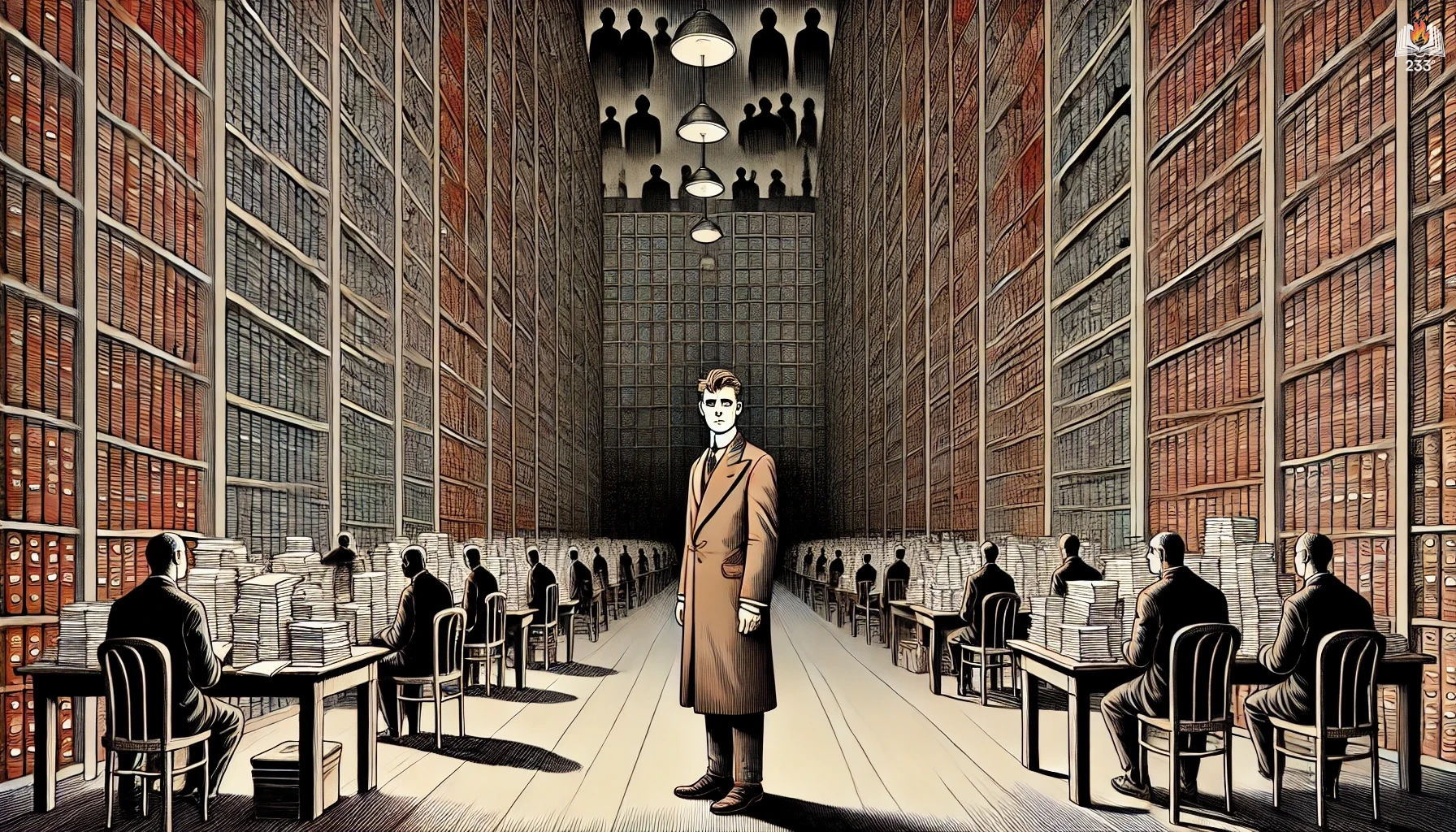
Among these men, there were students, architects, and masons – those who had immersed themselves in the labyrinth of knowledge before lifting a single stone. Their studies were vast and unrelated to engineering: astronomy, mathematics, ancient tongues, the philosophical logic of antiquity. They had been trained not to build walls, but to inhabit ideas. Their education spanned years, and yet, at its close, they found themselves sent to obscure corners of the empire to work with their hands in dust and sun.
What sense did it make, to learn of distant celestial bodies and then stoop to carve stone? It was explained to them in hushed, persuasive tones by the elders of the village – that the knowledge fortified them, that the Emperor required strength of mind as much as strength of limb, and that to build for the Empire was to build for eternity. Those explanations were accepted without challenge, as all imperial explanations are. Yet, even among the devoted, a gnawing uncertainty spread.
Builders constructed stretches of wall a few hundred yards long and then halted, sent to new assignments with no clarity as to the outcome of their efforts. Months passed. Sometimes years. When they returned, if they returned at all, it was often to find another segment built some miles distant, or none at all, or a barren patch that had devoured their earlier work like sand reclaiming a footprint. The wall’s continuity was an illusion, a hope, not a certainty.
Whispers traveled along the backs of workers like shadows. Was this a strategy or a symptom of confusion? Did the Emperor truly live, watching all from his throne beyond the mountains, or was he a myth nourished by a thousand generations of belief? Messengers were said to carry news from the outer provinces to the central palace, yet none could say if the messages were read or even arrived. The palace itself was a legend, its exact location unrecorded, its corridors imagined in gold and marble but never traced by any foot known to the builders.
Still, obedience prevailed. The Emperor’s command was not to be questioned, even if it was never heard. The people accepted the rationale delivered by wise men with long beards and ancient scrolls – that a continuous wall would invite complacency, whereas fragmented construction demanded perpetual vigilance. That unity could only emerge from disunity. That a wall built in fragments would, in time, mystically complete itself, as if the structure would feel its own incompleteness and grow toward wholeness.
In the villages, elders stood on raised platforms and recited ancient edicts from memory, their eyes lost in the fog of old loyalties. They reminded the people that their toil was not for the present generation, nor even the next. The true greatness of the Wall would be revealed only after centuries, perhaps millennia, when historians would speak of it as if it had always existed – a monolith that had birthed the Empire rather than the other way around.
For now, the builders had faith. They kept it alive through rituals and through the hypnotic rhythm of laying stone upon stone. And when faith trembled, they turned to tales: that the wall shielded them from barbarian hordes who rode in darkness beyond the Empire’s rim, that the Emperor was of divine blood and lived a thousand years, that the wall itself spoke in dreams to those who listened.
But some dared to question – quietly, between breaths. If the wall was truly for defense, why did it not encircle the Empire but trail across the land like a broken necklace? If the Emperor was eternal, why had none seen him since their grandfather’s time? If their work was sacred, why did it feel so forgotten?
In a remote province, a group of workers built tirelessly, their hands numbed by labor. One day, a messenger appeared, dusty and vague, bearing a scroll too worn to read. He claimed it was a proclamation from the throne. The workers wept in joy and disbelief. They knelt as he passed, as if the parchment itself had divine essence. Yet once he was gone, the words vanished from memory, as if the scroll had been written in disappearing ink, its meaning swallowed by distance.
In the shadow of the incomplete wall, generations rose and fell. The builders became fathers and grandfathers, their sons stepping into their places without question. Villages became towns, and towns were abandoned as rivers shifted and crops failed. Through it all, the wall remained partial, grand in places, vanished in others, like a god too vast to grasp.
The scholars who once taught the builders had vanished into bookshelves and dreams. Their theories, once recited with passion, were now muttered by drunken old men near dying fires. The logic of the wall had become myth, and myth had become the only logic.
And still, far to the north, or the east, or perhaps in some central land unmarked on any map, the Emperor was said to wait. He sat on a throne of jade, surrounded by silence, issuing commands no longer heard. His palace, they said, was larger than any city. Its gates had not opened in a thousand years. But if a man were to begin walking today toward that palace, it would not matter. The journey would outlast him, his son, and his grandson. The message would be carried through lifetimes, from one messenger to the next, and by the time it arrived, even if it ever did, the Emperor would be a name without a voice, a presence with no throne to return to.
So the wall continued to rise in fits and starts. Not for war, not for glory, not even for defense – but because men believed. Or because they did not know what else to do.
Main Characters
The Narrator – A former student of Chinese heritage reflecting on the rationale and process behind the building of the Great Wall. His tone is contemplative and speculative, often shifting between personal memory and philosophical inquiry. He serves as Kafka’s conduit for examining the contradictions in human systems and the limits of understanding. His struggle is intellectual and existential, as he attempts to impose meaning on seemingly irrational imperial orders.
The Emperor – Though never appearing directly, the Emperor looms large as a symbol of centralized power and divine authority. Representing the pinnacle of the vast and opaque bureaucracy, the Emperor is revered, yet his actual existence and influence are shrouded in doubt. The narrator and others act in his name, though they never receive direct communication from him, symbolizing the alienation of subjects from power.
The People (Builders and Scholars) – Collectively, these characters represent the dual nature of society: the laboring masses who build in fragmented efforts and the intellectual elite who rationalize or mythologize the chaos. Kafka uses them to illustrate the breakdown of communication and purpose across social hierarchies.
Theme
Fragmentation and Futility of Human Effort: The segmented construction of the Wall—built in disconnected sections rather than continuously—serves as a metaphor for the disjointed nature of human ambition. This fragmentation critiques bureaucratic inefficiency and suggests that grand endeavors often lose meaning amid procedural absurdities.
Power and the Illusion of Central Authority: The distant, almost mythical Emperor illustrates the separation between ruler and ruled. The people’s reverence for an inaccessible figure underscores the disconnection between governance and reality, revealing how belief can supplant actual communication or evidence.
Isolation and the Search for Meaning: The narrator’s introspective journey mirrors Kafka’s existential concerns. He seeks coherence in historical events and societal structures, but ultimately confronts the elusiveness of absolute truth. This motif parallels the human condition—our yearning for purpose in systems that may be inherently indifferent or irrational.
Time and Memory: The story plays with historical temporality, casting doubt on the linearity and coherence of collective memory. Kafka uses the narrator’s reflections to show how history is often constructed more from myth and ideology than from fact.
Writing Style and Tone
Kafka’s style in The Great Wall of China is characteristically intricate and philosophical, marked by digressive exposition and deliberate ambiguity. He crafts a narrative voice that is both analytical and uncertain, inviting readers into a contemplative space where clarity is persistently deferred. Long, winding sentences often mimic the narrator’s mental wanderings, while shifts between anecdotal recollection and abstract theorizing deepen the story’s sense of intellectual vertigo.
The tone is meditative and subtly ironic. Though the narrator earnestly seeks understanding, Kafka imbues the tale with a sense of quiet futility, undercutting grand theories with subtle absurdities. This creates a tension between the search for meaning and the story’s implicit recognition that such meaning may be unattainable. The tone balances reverence for tradition and authority with an undercurrent of skepticism, making the story both respectful and subversive in its handling of historical myth and imperial ideology.
Quotes
The Great Wall of China – Franz Kafka (1931) Quotes
“Human nature, essentially unchangeable, unstable as the dust, can endure no restraint; if it binds itself it soon begins to tear madly at its bonds, until it rends everything asunder, the wall, the bonds, and its very self.”
We hope this summary has sparked your interest and would appreciate you following Celsius 233 on social media:
There’s a treasure trove of other fascinating book summaries waiting for you. Check out our collection of stories that inspire, thrill, and provoke thought, just like this one by checking out the Book Shelf or the Library
Remember, while our summaries capture the essence, they can never replace the full experience of reading the book. If this summary intrigued you, consider diving into the complete story – buy the book and immerse yourself in the author’s original work.
If you want to request a book summary, click here.
When Saurabh is not working/watching football/reading books/traveling, you can reach him via Twitter/X, LinkedIn, or Threads
Restart reading!