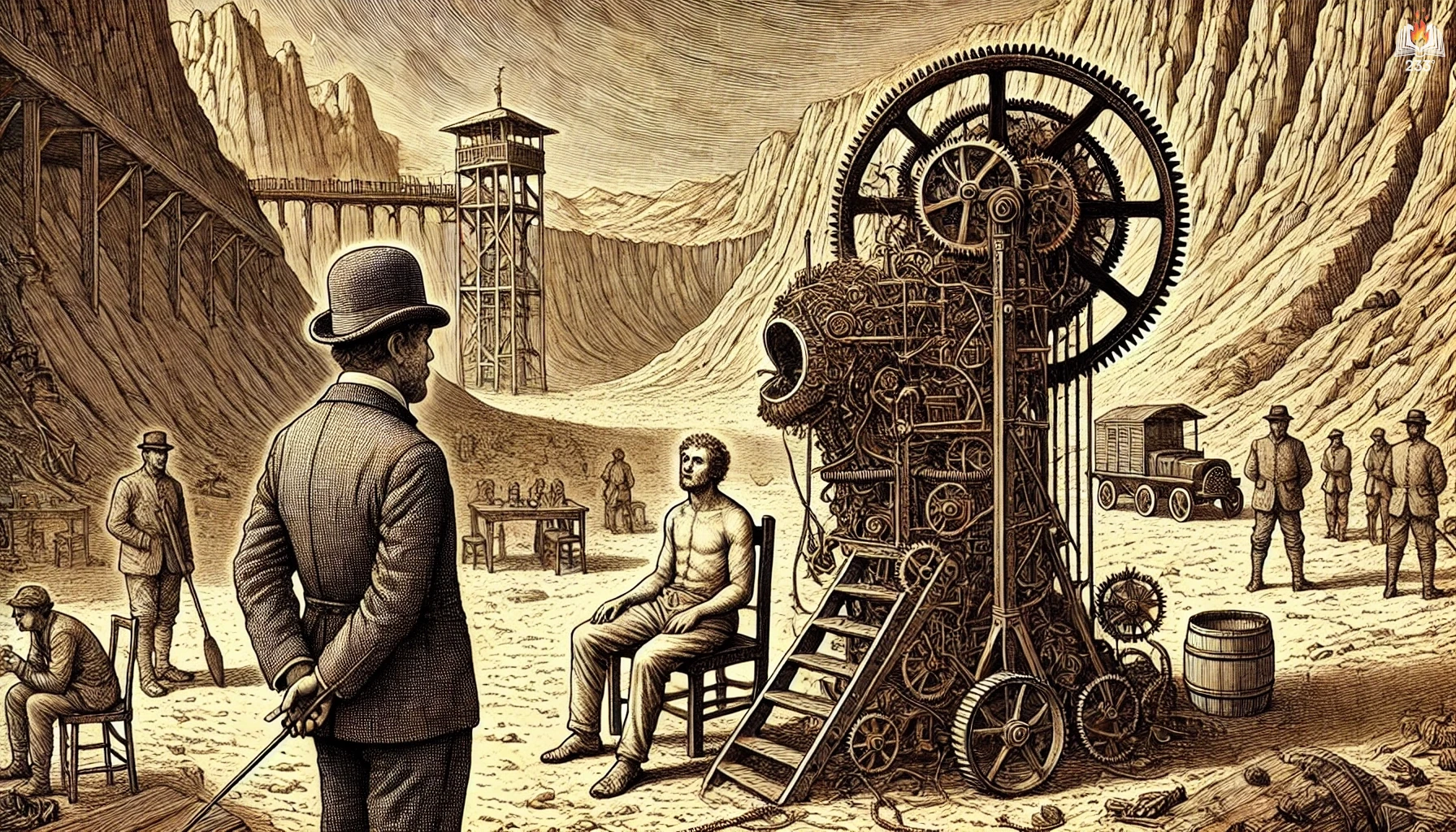
“A Report for an Academy” by Franz Kafka, first published in 1917, is a masterful short story that exemplifies Kafka’s unique brand of existential and philosophical fiction. Delivered in the form of a monologue to a scientific academy, the story recounts the remarkable transformation of an ape, Red Peter, into a man – not for the sake of human understanding or self-realization, but to escape the confines of captivity. This tale, though brief in length, is immense in metaphorical depth and intellectual rigor, a hallmark of Kafka’s celebrated literary repertoire.
Plot Summary
In the hush of a scholarly chamber, a peculiar figure rises before an esteemed assembly – not a man, not quite an animal, but something forged painfully in between. Red Peter, once an ape of the Gold Coast jungles, now stands upright, speaks fluently, and wears a suit tailored to disguise the body he never quite escaped. His voice is even, his gestures deliberate. He is here not to entertain or beg for admiration but to deliver what has been requested of him – a report of his transformation, an account of how an ape learned to live like a man.
He was not born into captivity but into the wild, among the trees and the freedom of instinct. His fall began with a bullet. One grazed his cheek, the other tore into his hip. The former left a red scar and a name that clung like a bad joke – Red Peter. The latter left him limping for life. Shot, subdued, and caged, he awoke below deck on a ship bound from Africa. There, in a cramped three-sided pen bolted against a wooden locker, too low to stand and too narrow to sit, he squatted day and night, facing the boards, trapped in a world that no longer offered exits.
In that cell, the old instincts collided with new barriers. He had once known many paths through the world, but now there was only one – and it was sealed. Escape was not impossible, but it was meaningless. Even if his strength returned and he chewed through the bars or the lock, he would be met by worse captivity or the cold indifference of the sea. Freedom, the kind men praise in songs and philosophy, held no allure for him. He sought not liberty, but a way out – anything other than the silent oppression of that locker’s boards.
Among the ship’s crew, Red Peter began to observe. They were crude, slow-moving men who smoked pipes, scratched themselves openly, and spit with theatrical boredom. But they were free. Or freer than he. Their lazy rituals, their indistinct identities – all of it became a field of study. He mimicked their spitting, then smoking. He learned to grasp a pipe and press tobacco into its bowl. Applause followed. Not praise, but approval. A door creaked, not open, but unlocked.
Most difficult was the schnapps. The mere scent repelled him, but under constant instruction – a sailor repeating the act again and again, each step a ritual, a lesson, a demand – Red Peter pushed himself to mimic, to drink, to become. There were failures, humiliations, regressions. He vomited, he flailed, he despaired. But one night, in front of a crowd distracted by music and light, he found the rhythm, uncorked the bottle, drank it dry, and spoke a single human word. That word struck the crowd like lightning, and it burned a path that he could follow.
By the time he reached Hamburg, he was no longer only an ape in a suit. He was a being with a direction. Presented with two options – a life on the variety stage or confinement in the zoological gardens – he chose the stage. Not because he desired performance, but because a stage was not a cage. There, behind footlights and velvet curtains, he could play the part men expected of him and claim, if not a life, then at least a form of peace.
He learned quickly, with the desperation of a creature who understands that forgetting who he was is the price for becoming something else. He burned through trainers, each one more exhausted than the last, until some lost their reason trying to shape him. Eventually, he hired his own teachers and took lessons in language, etiquette, gesture, and thought, darting between rooms like a student possessed. Knowledge, once foreign, poured in from all sides. And still he pressed forward, not from ambition, but necessity.
What he became was not extraordinary – by his own account, a cultural average, a middling European. But this was never about excellence. It was survival, bought with every act of mimicry, every compromise of self. He reached the stage, and with it, applause. Audiences laughed and clapped at the ape who smoked and spoke, who bowed and drank, who had cast off his jungle past like a coat no longer fit for wearing.
Years passed. The applause continued. Red Peter sat with his bottle of wine and his chair, wearing human habits like second skin. His manager waited in the anteroom, and he received visitors with the same reserved courtesy they offered him. He performed nightly and was, in every measurable sense, a success. Yet even in triumph, the old bars remained. Not visible, not literal, but felt – in the unnatural weight of trousers, the uncomfortable grip of language, the stillness required to be seen as civilized.
There was a companion now, a half-trained female chimpanzee who waited for him at home, offering him some fragment of recognition, a dim echo of what he once was. He took solace in her presence, but only at night. By day, her eyes reflected too clearly the madness and confusion that come from a life suspended between worlds.
He had found his way out, he told them. He had delivered his report. He did not ask for judgment or admiration. He spoke as one who had learned the language, adopted the customs, and walked the path – not because he wanted to, but because he could not remain where he was. And in leaving behind the cage, he had also left behind something more.
In the quiet after his words, there was no plea, no proclamation. Only the silence of a man – or what now passed for one – standing where once an ape crouched, staring at a wooden wall, imagining the smallest crack through which to slip.
Main Characters
Red Peter: The central figure and narrator, Red Peter is an ape who has undergone a forced metamorphosis into a human being. Once captured and caged, he methodically adopts human behaviors to gain his “way out” of captivity. His voice, marked by formal and philosophical candor, oscillates between pride in his achievements and a subtle, mournful detachment. His internal conflict and resignation underpin the story’s tragic undertones – despite his apparent success, he remains deeply alienated from both his origins and the world he now inhabits.
The Academy (as an abstract entity): Though not characterized individually, the members of the Academy represent institutional authority, the human gaze of judgment and scientific curiosity. They serve as silent listeners to Red Peter’s testimony, embodying the societal and intellectual forces that compel non-human subjects into anthropocentric frameworks of understanding and acceptance.
Theme
Adaptation and Identity: At the heart of the story lies the theme of adaptation – Red Peter’s transformation into a “man” is less about evolution than it is about survival. His mimicry of human behavior becomes a strategy to gain a measure of agency, but in doing so, he relinquishes a part of himself. The conflict between outward conformity and inner dissonance is central to the narrative.
Captivity and Freedom: Red Peter explicitly rejects the romantic notion of “freedom,” instead seeking only a “way out.” This subtle but crucial distinction reconfigures the reader’s understanding of liberty – not as an idealized state, but as pragmatic escape from suffering. The story critiques the illusion of freedom within systems of control.
Alienation and Performance: Though Red Peter integrates into human society, he never truly becomes human. His role on the variety stage and in scientific exhibitions underscores a life of continuous performance. The tragic irony is that his transformation earns him recognition and even admiration, yet it intensifies his estrangement from both apehood and humanity.
Language and Humanity: The acquisition of language, symbolized by Red Peter’s first spoken word – “Hallo!” – marks his symbolic entry into the human world. But Kafka questions whether language alone is enough to bestow humanity, or whether it simply masks deeper existential divides.
Writing Style and Tone
Kafka’s prose in “A Report for an Academy” is precise, formal, and philosophically dense. Written as an uninterrupted monologue, the narrative captures the cadence of a public address while weaving in moments of introspection, irony, and suppressed emotion. Kafka’s sentences are often complex and winding, reflecting the tangled consciousness of Red Peter and the existential entrapments he navigates.
The tone is paradoxically detached and emotionally charged – Red Peter speaks with the calm logic of a scholar recounting a scientific case study, yet the undertone is one of muted despair, bitterness, and suppressed rage. Kafka masterfully balances the absurdity of an ape delivering an academic report with a profound gravitas that unsettles the reader. The story evokes sympathy and unease simultaneously, revealing the brutal consequences of assimilation and the cost of enforced progress.
Quotes
A Report for an Academy – Franz Kafka (1917) Quotes
“Sometimes I'm overcome with such an aversion to human beings that I can barely refrain from retching.”
“Ah, one learns when one has to; one learns when one needs a way out; one learns at all costs. One stands over oneself with a whip; one flays oneself at the slightest opposition.”
“No, freedom was not what I wanted. Only a way out; right or left, or in any direction; I made no other demand; even should the way out prove to be an illusion; the demand was a small one, the disappointment could be no bigger.”
“And that too is human freedom," I thought, "self-controlled movement." What a mockery of holy Mother Nature! Were the apes to see such a spectacle, no theater walls could stand the shock of their laughter.”
“Promises are not made on seemingly impossible conditions. But if one satisfies the conditions, then the promises appear, as it were retrospectively, and in exactly where one had earlier looked for them in vain.”
We hope this summary has sparked your interest and would appreciate you following Celsius 233 on social media:
There’s a treasure trove of other fascinating book summaries waiting for you. Check out our collection of stories that inspire, thrill, and provoke thought, just like this one by checking out the Book Shelf or the Library
Remember, while our summaries capture the essence, they can never replace the full experience of reading the book. If this summary intrigued you, consider diving into the complete story – buy the book and immerse yourself in the author’s original work.
If you want to request a book summary, click here.
When Saurabh is not working/watching football/reading books/traveling, you can reach him via Twitter/X, LinkedIn, or Threads
Restart reading!