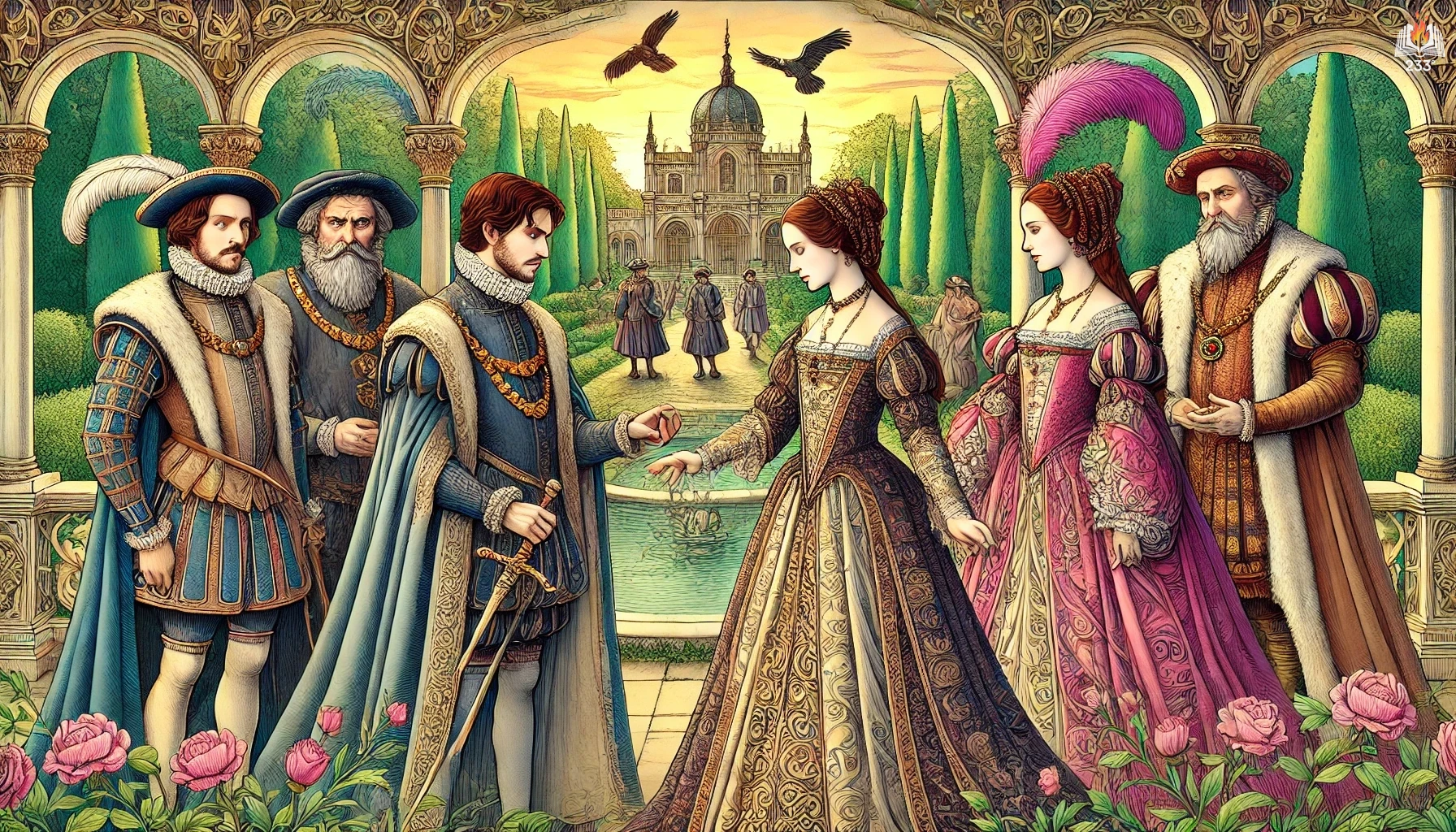
A Single Thread by Tracy Chevalier, published in 2019, is a quietly powerful historical novel set in the early 1930s, in the interwar years of England. The story follows Violet Speedwell, a “surplus woman” navigating life after the Great War in the ancient cathedral city of Winchester. Known for her evocative historical fiction, Chevalier crafts a deeply textured portrait of a woman searching for identity and purpose in a world reshaped by loss and tradition.
Plot Summary
Violet Speedwell stood in the hushed shadows of Winchester Cathedral, a place whose stone and glass whispered of centuries past. At thirty-eight, she was one of the many “surplus women” left adrift in the wake of the Great War – her fiancé lost to Passchendaele, her youth fading into spinsterhood under the watchful and critical gaze of her widowed mother. To escape a stifling household of grief and judgment, she had fled to Winchester, settling in a modest boarding house, typing insurance claims by day and counting pennies by night. There was little glamour in her independence, only the fragile dignity of choosing one’s own path.
It was curiosity that led her to stumble upon the embroidery service in the Cathedral, where dozens of kneelers – each richly stitched in color and purpose – were being blessed before the altar. A woman tapped her shoulder, asking if she had contributed one of the kneelers, and Violet, aching to belong to something beautiful, replied that she was new. That small defiance – that quiet lie – was the beginning of her thread.
Soon she found herself drawn into the world of the Cathedral broderers, a group of women tasked with creating cushions and kneelers to soften the hard stone and wood for worshippers. The group was overseen by the commanding yet warm Miss Louisa Pesel, whose serene presence and belief in craftsmanship cast a calming influence, and by the brusque, rule-bound Mrs. Biggins, whose standards allowed little room for error or sentimentality. Though Violet arrived with no experience, only a wish, she was granted a chance to learn. She began with the simplest tasks – sorting wool, straightening cupboards, enduring the critical eye of Mrs. Way, the officious woman who guarded the group like a sentry. But Violet did not turn away.
As stitches built into patterns and fingers learned the rhythm of needle and thread, her world quietly shifted. She befriended Gilda Hill, a fellow broderer whose bright spirit masked a life equally constricted by society’s expectations. Gilda, as it turned out, lived with another woman – Dorothy – in a bond as intimate as marriage, though they cloaked their companionship under the guise of spinsterhood. Their relationship, quietly defiant and deeply loyal, opened Violet’s eyes to forms of love and devotion that dared not speak their names aloud.
Each Thursday evening, Violet also found herself drawn to the bell tower, where the ringers practiced in sonorous unison. There she met Arthur Knight, a gentle, aging bellringer with a measured voice and tired eyes. They grew close in a way that felt safe yet thrilling, their conversations marked by restraint and unspoken longing. Arthur, it turned out, was married – his wife deeply unwell, confined to an institution, her mind unmoored from the world. The bond between Violet and Arthur hovered in a space just shy of scandal, and just past the edge of emotional fidelity.
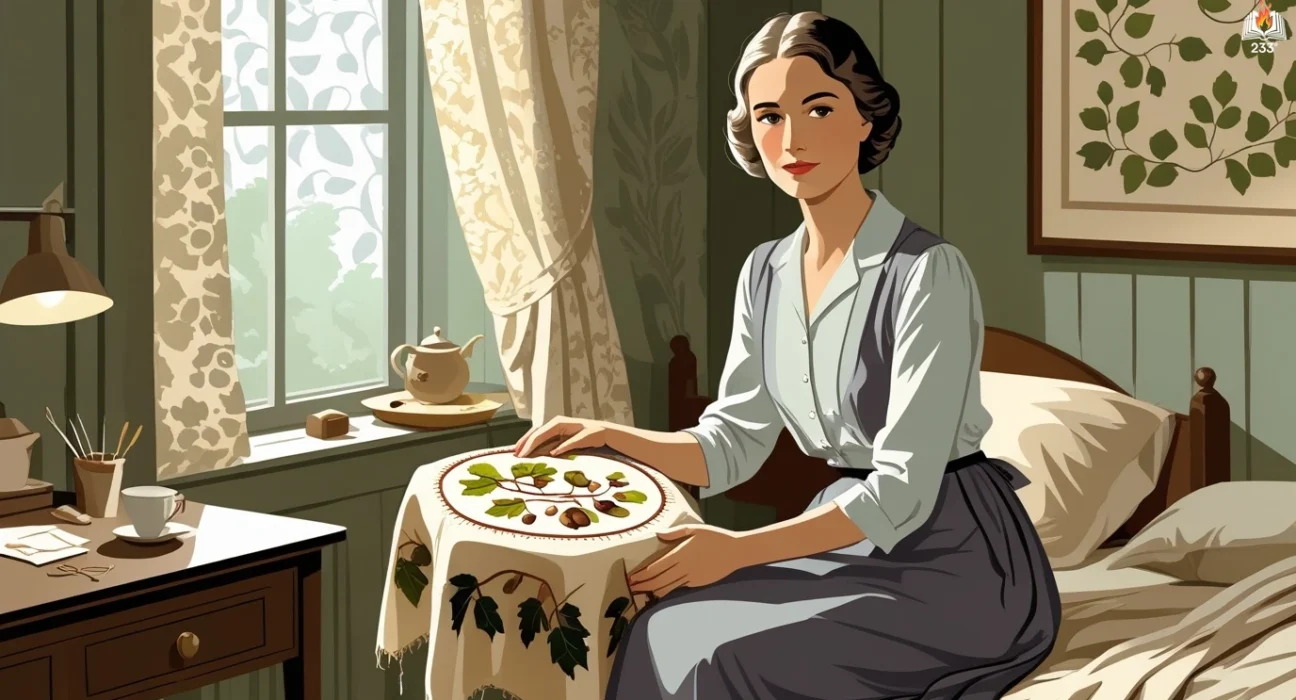
Violet’s life grew fuller, not from grand events, but from the slow accumulation of purpose. She began to embroider a kneeler of her own – a design stitched with acorns and oak leaves – symbols of growth and endurance. Her pride in her work deepened, even as she lived in constant calculation of every shilling, her meals frugal and her clothes worn thin. Yet she refused to return to her mother’s home in Southampton, choosing instead the hardships of independence over the comfort of submission.
Meanwhile, the broderers faced their own tensions. Gossip and rivalry pulsed beneath the surface – whispers about the women who spent too much time together, about the quality of stitching, about those who, like Violet, were new and presumed unworthy. When Dorothy and Gilda’s companionship came under threat – Dorothy’s job at risk from the suspicion of impropriety – Violet took a bold step. She agreed to a sham courtship with Gilda, to present themselves as heterosexual friends double-dating to deflect attention. The lie was not easy. Violet found herself slipping into a role she did not want, feigning affection to shield another’s truth. But her loyalty to Gilda outweighed the discomfort.
Her connection with Arthur also reached a turning point when they took a brief walking holiday together – under the guise of friendship. For two nights, they shared silence, scenery, and longing. In a moonlit hotel room, they lay together without touching, tethered more by grief and longing than lust. Violet understood that love, for her, might not come in traditional forms. Some doors, once closed, stayed that way.
Back in Winchester, her embroiderer’s reputation grew. Her kneeler – the one she’d labored over, restitched, and agonized into being – was accepted and placed in the Cathedral. The initials V.S. stitched at the edge marked her quiet triumph, her personal offering to a sacred space that had held her grief and now her recovery.
Her relationship with her mother remained brittle. Visits to Southampton were dutiful, filled with sighs and barbed comments. Yet even Mrs. Speedwell seemed to notice the change in her daughter – a firmer tone in her voice, a clearer line in her shoulders. Independence had made Violet sharper, not just in skill but in self-worth.
Tragedy hovered always near. Gilda’s arrangement with Violet fell apart when Dorothy, bruised by the deception, left her. Arthur’s wife passed away quietly, and though it opened a possibility for them, Violet did not step into it. Love that had waited too long had worn thin. She chose to remain alone, but not lonely. With the broderers, she stitched on. With her savings, she began to dream again – perhaps a room with a garden, perhaps another kneeler to mark another year.
In a world still mending from war, Violet learned that it was not grand gestures or heroic rescues that rebuilt a life. It was threads pulled taut, patterns repeated with care, friendships forged over wool and tea, and the quiet refusal to be dismissed or diminished. She had been expected to fade into obscurity, a surplus woman among many. Instead, she embroidered herself into history – one stitch, one defiant thread at a time.
Main Characters
Violet Speedwell – The 38-year-old protagonist, Violet is labeled a “surplus woman” due to the shortage of men after the Great War. Having lost both her fiancé Laurence and her elder brother George during the war, she seeks independence from her suffocating, emotionally manipulative mother. Violet’s journey is one of quiet rebellion and emotional reclamation, as she moves to Winchester, takes a job as a typist, and joins a group of broderers, discovering strength, community, and a new sense of purpose.
Mrs. Speedwell – Violet’s demanding and critical mother, Mrs. Speedwell is emblematic of the past that Violet is struggling to escape. Clinging to tradition, she uses guilt and melodrama to maintain control over Violet. Their relationship is fraught with emotional tension, but it is also the catalyst for Violet’s self-liberation.
Louisa Pesel – The quietly commanding and respected leader of the Cathedral broderers. A historical figure, Pesel is portrayed as a compassionate mentor who provides structure and vision for the embroidery project. Her calm, steady presence brings out a sense of discipline and purpose in the women around her.
Mrs. Biggins – A sharp-tongued, overbearing woman with a deep commitment to the embroidery guild, she initially dismisses Violet as inexperienced and unworthy. Her judgmental demeanor and rigid standards represent the social gatekeeping Violet must confront and overcome.
Gilda Hill – A fellow broderer and one of Violet’s first genuine connections in Winchester. Gilda is spirited, unfiltered, and eventually reveals herself as part of a same-sex relationship, presenting Violet with a different kind of bravery and unconventional life choice.
Arthur Knight – A bellringer at the Cathedral and a man Violet becomes emotionally close to. Trapped in a complex personal situation involving a mentally unstable wife, Arthur represents a possibility of love, but also the limits placed on relationships by social convention and moral constraints.
Theme
Female Independence and Surplus Identity: The aftermath of WWI left millions of women without prospective husbands. Violet embodies the struggles of these “surplus women,” seeking dignity, autonomy, and meaning in a society that defines women by marriage and family. Her defiance in living alone, working, and building her own community illustrates the subtle radicalism of personal agency.
Grief and the Aftermath of War: Though the war is over, its emotional scars permeate the story. Violet’s life is shaped by loss – of her fiancé, her brother, and her pre-war dreams. The novel captures the quiet, long-lasting reverberations of war trauma, not just for those who fought, but also for those who were left behind.
Craft as Healing and Legacy: Embroidery is not just a literal thread but a symbolic one – connecting women across time, generations, and class divides. The act of stitching kneelers and cushions becomes a meditative and collaborative form of legacy-building, giving the broderers both purpose and a lasting imprint on the Cathedral’s sacred space.
Resistance to Social Norms: Whether it’s Violet’s unmarried status, Gilda’s forbidden relationship, or Arthur’s emotional affair, the novel explores what it means to resist societal norms quietly and courageously. These personal rebellions are treated with empathy and nuance, highlighting the courage required to live truthfully.
Spirituality and Solace: The setting of Winchester Cathedral offers not just a physical refuge but also a spiritual one. For Violet, who has lost her faith in traditional religion, the beauty and permanence of the Cathedral offer a different kind of sanctuary – rooted not in dogma but in human connection and the endurance of art.
Writing Style and Tone
Tracy Chevalier’s prose is elegant and restrained, with a quiet observational quality that mirrors the introspective nature of her protagonist. She writes with clarity and empathy, capturing the domestic, emotional, and historical textures of Violet’s world. Descriptions of the cathedral and embroidery work are rich with detail, reflecting an immersive appreciation for craftsmanship, heritage, and the artistry of everyday life.
The tone throughout is meditative, reflective, and quietly assertive. Chevalier avoids melodrama, instead offering a deeply humane exploration of ordinary lives marked by resilience and quiet defiance. Her narrative voice is empathetic, respectful of the historical period, and grounded in psychological realism. The novel reads like a gentle, persistent whisper – full of strength, restraint, and an unshakeable belief in the power of small acts to shape larger meaning.
Quotes
A Single Thread – Tracy Chevalier (2019) Quotes
“She felt the strangeness of recognizing a place and yet not knowing it, of having a similar tone as if nothing had changed, yet everything had changed and aged, including Violet herself.”
“When Gilda appeared—out of”
“When a women wants a cup of tea, usually she has to make it for herself, and forthe others around her. There is no better taste than a cup of tea someone has made for you.”
“Father always said fishing is about not fishing as much as fishing.” Indeed. And about not thinking. We all need to do things that take us out of ourselves.”
“He was a man, and it was expected of him to achieve.”
“She was from an era when daughters were dutiful and deferential to their mothers, at least until they married and deferred to their husbands – not that Mrs. Speedwell had ever deferred much to hers.”
“As is often the case, a leader comfortable with her authority does not need to be strident, but can afford to be generous. It”
We hope this summary has sparked your interest and would appreciate you following Celsius 233 on social media:
There’s a treasure trove of other fascinating book summaries waiting for you. Check out our collection of stories that inspire, thrill, and provoke thought, just like this one by checking out the Book Shelf or the Library
Remember, while our summaries capture the essence, they can never replace the full experience of reading the book. If this summary intrigued you, consider diving into the complete story – buy the book and immerse yourself in the author’s original work.
If you want to request a book summary, click here.
When Saurabh is not working/watching football/reading books/traveling, you can reach him via Twitter/X, LinkedIn, or Threads
Restart reading!