The Virgin Blue by Tracy Chevalier, published in 1997, is a historical fiction novel that interlaces two women’s lives across centuries – one in 16th-century France and the other in the present day. The book tells the haunting, emotionally rich stories of Isabelle du Moulin, a midwife persecuted during the Protestant Reformation, and her modern-day descendant Ella Turner, who relocates to France and is drawn into a mysterious ancestral past. This dual narrative bridges history and contemporary life, exploring the legacy of family, trauma, and inherited memory.
Plot Summary
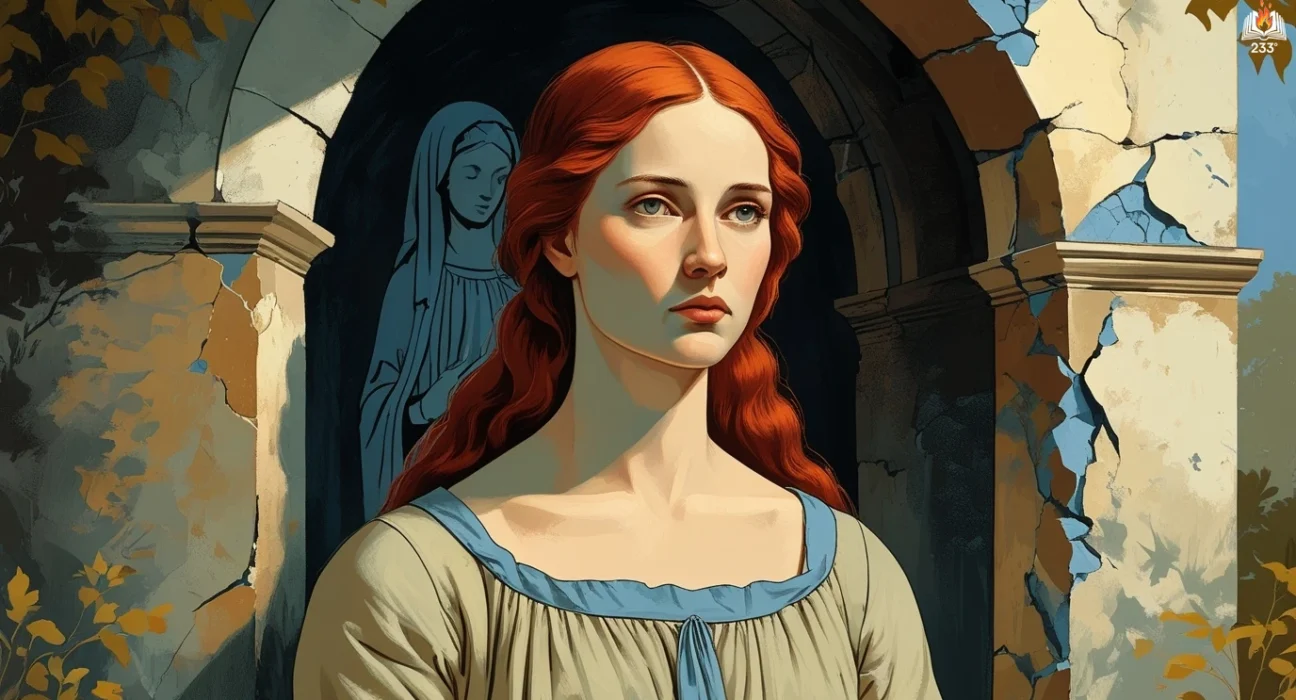
In a village high in the Cévennes, Isabelle du Moulin’s hair burned with the color of chestnuts under the sun’s blessing. They called her La Rousse, after the Virgin whose painted likeness watched silently from above the church door. But when the winds of reform swept through, brought by the cobbler-turned-Calvinist preacher Monsieur Marcel, reverence twisted into suspicion. The Virgin, they said, was idolatry. Isabelle, marked by her red hair and solitude, became an emblem of everything the new faith despised.
Her body learned pain early – a sister lost to childbirth, a mother’s fevered descent into madness after a wolf’s bite. Etienne Tournier, a boy with blue eyes like frost and ambition thick in his blood, offered the illusion of love. But what began with stolen kisses beneath chestnut trees ended in silence, in the blunt certainty of flesh pressed to stone, in a child seeded without tenderness.
Isabelle wore her shame beneath layers of cloth and obedience. When the Virgin’s statue was toppled by the village crowd – its face shattered, the child’s body split from the mother – it was Isabelle’s hands that held the rake, urged forward by jeers and fear. The Virgin fell, faceless and broken, as did Isabelle’s last claim to innocence.
She bore Etienne’s children, and in time, another child not his – a daughter she named Marie, after the sister whose name carried both sorrow and strength. Her sons, Petit Jean and Jacob, grew beneath the heavy air of secrets and sin. The blue of the Virgin’s cloak faded from memory, but Isabelle carried it in her eyes, in the soft invocations murmured during birthings, in the weight of every breath beneath the shadow of the past.
Centuries passed.
In the warmth of southern France, Ella Turner stepped off a plane and into a life she thought would be picturesque. A new house, new language, new soil. Her husband Rick chased architectural dreams while she wandered ancient streets, searching for belonging with a baguette in hand and fractured French on her tongue. The locals remained cool, unreadable, their politeness tinged with distance. But it was in sleep that the real distance cracked open.
Each night she was pulled into a dream – flickering blue, pressure like water, a voice chanting from some unknown past. She woke with her arms burning, a rash flaring across her skin. Psoriasis, the doctor said. But she knew the itch went deeper. She began to trace a thread through time, tugging on names, places, letters. Her father’s offhand mention of a Swiss cousin led her to dusty records and old towns with locked doors and closed shutters.
In Lisle-sur-Tarn, where silence clung to the walls of the square and the townspeople watched her with guarded eyes, she met Jean-Paul. Sardonic, sharp, unreadable – the local librarian with a gaze that sliced through politeness. It was he who gave her access to stories buried in parish records and family registries. The name Tournier emerged again and again, tangled with births, deaths, disappearances. Ella followed the trail like a pilgrim, each step deeper into the folds of her own blood.
Her dreams grew louder. She began to see a woman with red hair, hands stained with herbs and pain, children clinging to her skirts. The Virgin’s color, that deep Marian blue, wove through every vision. In a village chapel long abandoned, Ella stood before the hollow where the Virgin once watched, now nothing but a faded niche in crumbling stone. And there, she felt it – recognition, sorrow, something passed through flesh and bone.
She traveled north to Moutier, to a cousin distant in both blood and emotion. He had the same family name, though the vowels had shifted through time and immigration. From him she learned of the Huguenots – Protestants hunted in Catholic France – who fled persecution and carried their grief into the Alps. The Turners had once been Tourniers, fleeing flames and mobs, shedding vowels as they shed lives.
In the old records, she found Isabelle. Midwife. Heretic. La Rousse. A name scrawled beside baptismal entries, beside death records, beside the word excommunicata. A woman once real and now rising like smoke in Ella’s dreams. She read of Jacob, the quiet son born blue, and Marie, the girl who survived. The line stretched forward in time, marked by fear and survival, until it reached her.
Ella’s marriage frayed quietly. Rick, cheerful and distant, could not understand the pull of a woman four hundred years gone. She stopped explaining. At night she lay alone, her body calm now, the rash receding as if the truth had bled it out. The silence of the past, once oppressive, became a kind of comfort.
She returned to the place where Isabelle had once lived, climbed the mountain paths, followed the river’s curve. There, in a churchyard thick with lichen and stone, she found a marker carved with a cross and no name. The niche above still bore traces of the Virgin’s color – faded, but not gone.
Ella placed her hand on the stone and whispered the name aloud – Isabelle. And then, Marie. Not just one, but many. She understood now that memory was a thing the body carried. That names could echo across time, that sorrow could be inherited like hair or freckles, that healing sometimes came not with forgetting, but with remembering.
She returned home. The house was still small, still dim, but she opened the shutters wide. In the courtyard, she planted lavender. At night, she no longer dreamed of blue. Instead, she slept in silence, wrapped not in pressure, but in peace.
Main Characters
Isabelle du Moulin (“La Rousse”): A strong-willed, red-haired midwife in 16th-century rural France, Isabelle’s life is marked by suspicion, misogyny, religious fanaticism, and the violent shift from Catholicism to Protestantism. Nicknamed “La Rousse” for her striking red hair and connection to the Virgin Mary, she is shamed and isolated as religious reform grips her community. Isabelle endures brutal hardship – forced marriage, sexual violence, and social ostracism – yet her resilience becomes central to the generational legacy explored in the novel.
Ella Turner (née Tournier): A modern American woman who moves to France with her husband, Ella embarks on a journey to uncover her ancestral roots. Sensitive and increasingly alienated in her new environment, Ella experiences unsettling dreams and the reemergence of a mysterious rash. Her curiosity about the past and an increasing sense of personal dislocation propel her into a psychological and historical excavation that converges with Isabelle’s tragic life. Ella’s arc is one of self-discovery, identity reclamation, and spiritual reckoning.
Etienne Tournier: Isabelle’s manipulative and coercive lover who exploits her vulnerability. A son of a powerful Huguenot family, he uses Isabelle’s lower social standing and marginalization to dominate her emotionally and physically. His character embodies religious hypocrisy, entitlement, and control.
Jean-Paul: A modern-day librarian in Ella’s new town, Jean-Paul is reserved but perceptive. His initial aloofness evolves into a pivotal relationship with Ella, helping her unlock her family’s history. He is a symbolic contrast to Etienne – emotionally intelligent and quiet, he aids Ella’s transformation without force or expectation.
Theme
Heritage and Ancestral Memory: The novel delves deeply into the idea that trauma and identity are passed through generations. Ella’s journey is propelled by her dreams, her bodily reactions (like the rash), and a spiritual connection to Isabelle. This theme elevates the past as a living presence in the modern psyche, emphasizing how unresolved history can shape the present.
Female Agency and Oppression: Both Isabelle and Ella face societal constraints and gendered judgment. Isabelle suffers under religious patriarchy and communal fear of female independence, while Ella confronts more subtle, modern manifestations of isolation and dismissal. The novel critiques the historical and ongoing limitations imposed on women’s autonomy, especially regarding their bodies and choices.
Religious Conflict and Hypocrisy: The Reformation’s impact in Isabelle’s time is brutal and divisive. Through the shift from Catholicism to Calvinism, Chevalier explores how spiritual purity becomes an excuse for persecution, control, and fear. The theme highlights the dangerous intersections of faith, misogyny, and power.
Color Symbolism – The Virgin Blue: The color blue, especially in the niche behind the Virgin’s statue, recurs as a mystical, sacred motif. It represents the feminine divine, longing, repression, and transcendence. The Virgin Blue becomes a metaphor for purity, suffering, and spiritual identity across time.
Displacement and Belonging: Ella’s experience as a foreigner mirrors Isabelle’s experience as an outsider in her community. The novel uses geographical and emotional dislocation to interrogate what it means to belong – to a place, to a family, and to oneself.
Writing Style and Tone
Tracy Chevalier’s writing in The Virgin Blue is lyrical and intimate, weaving past and present with a delicate hand. Her prose is rich with sensory detail – the sharpness of herbs, the flicker of light on stone, the blood and breath of birth and death. She constructs each scene with painterly precision, allowing readers to inhabit not only her characters’ lives but the physical textures of their worlds. Chevalier shifts fluidly between historical and contemporary timelines without disrupting the novel’s emotional continuity.
The tone of the novel is one of quiet intensity. Beneath the surface beauty of rural France and vivid descriptions lies an undercurrent of dread, longing, and unresolved pain. Chevalier sustains a mood of haunting sorrow, particularly in Isabelle’s chapters, contrasting it with Ella’s growing urgency and discomfort. The narrative’s melancholic resonance never feels overwrought; instead, it simmers with the force of generational grief and personal awakening. Moments of tenderness, discovery, and connection shine through, providing emotional release amid the tension.
Quotes
The Virgin Blue – Tracy Chevalier (1997) Quotes
“Pregnant women often don't make the connection between their babies and sex. Neither do men. The two are so different, it is like magic.”
“It was a funny thing: once you tell your story to others it becomes more like fiction and less like truth. A layer of performance is added to it, removing you further from the real thing.”
“[TALK-TO-Person]#Is ”
We hope this summary has sparked your interest and would appreciate you following Celsius 233 on social media:
There’s a treasure trove of other fascinating book summaries waiting for you. Check out our collection of stories that inspire, thrill, and provoke thought, just like this one by checking out the Book Shelf or the Library
Remember, while our summaries capture the essence, they can never replace the full experience of reading the book. If this summary intrigued you, consider diving into the complete story – buy the book and immerse yourself in the author’s original work.
If you want to request a book summary, click here.
When Saurabh is not working/watching football/reading books/traveling, you can reach him via Twitter/X, LinkedIn, or Threads
Restart reading!