Eaters of the Dead by Michael Crichton, published in 1976, is a historical novel that fuses real-life manuscripts with fictional storytelling to deliver a gripping and visceral tale. Framed as a translation of the 10th-century account by Ahmad Ibn Fadlan, a real emissary from the Caliph of Baghdad, the novel recounts his journey north and his astonishing encounters with Viking warriors and a monstrous enemy known as the “mist monsters.” This novel is a daring blend of epic myth, anthropological realism, and imaginative adventure, inspired in part by the Beowulf saga.
Plot Summary
In the year 922, the Caliph of Baghdad dispatches Ahmad Ibn Fadlan, a refined and learned Arab courtier, on a mission to the King of the Bulgars. Though charged with diplomacy and religious instruction, his journey veers far from its original path. Across vast deserts and snowbound plains, Ibn Fadlan encounters a world wholly unlike his own – savage, cold, and ruled by unfamiliar laws. He is swept into the wilds of the North, where the customs of men are raw and death walks openly.
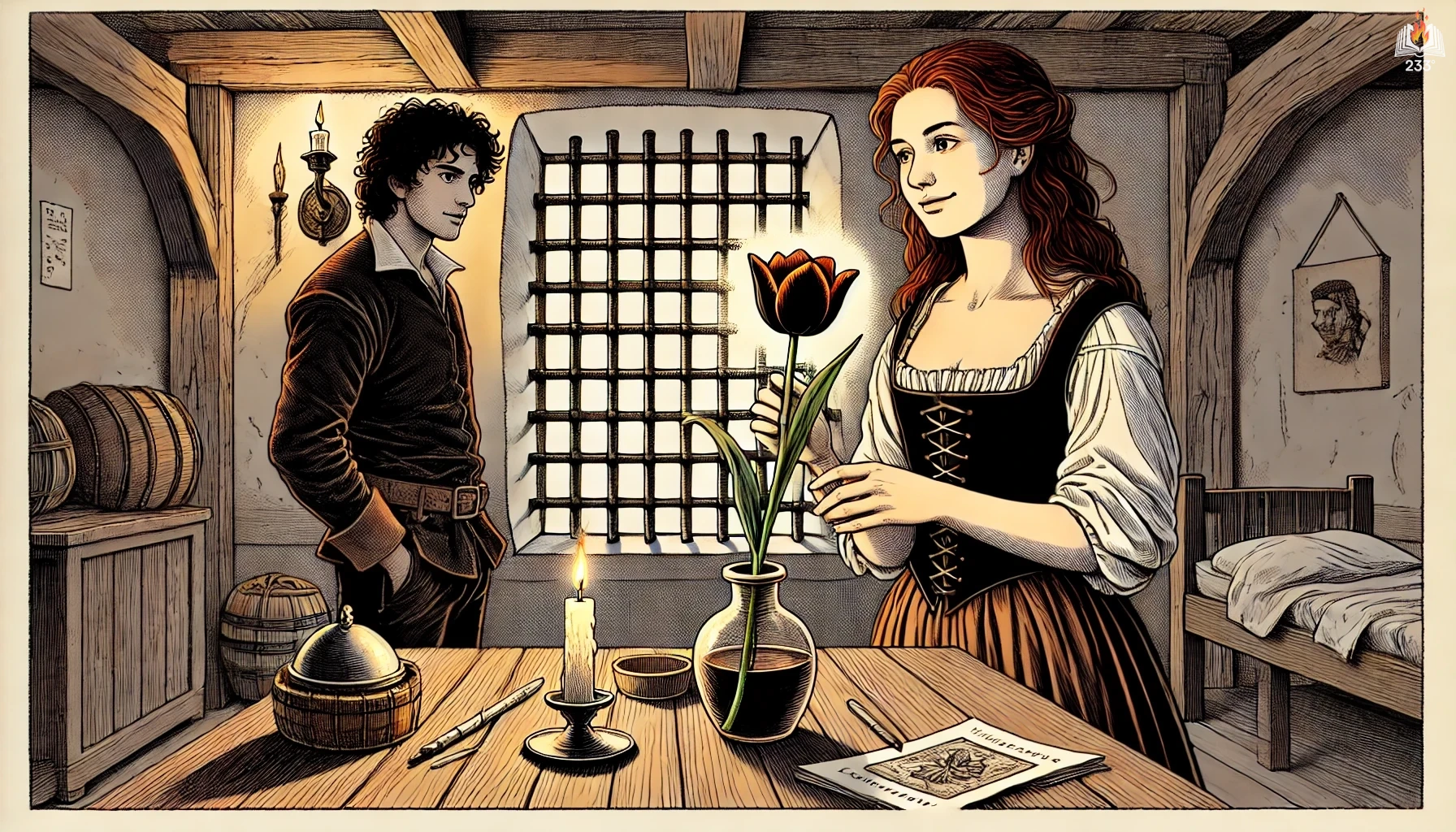
When Ibn Fadlan reaches the Volga River, he finds the encampment of the Northmen – tall, ferocious warriors covered in tattoos, armed with swords and axes, and driven by ritual and violence. To his shock, he witnesses their strange funeral rites, where a dead chieftain is burned alongside his possessions and a willing slave girl, sacrificed to accompany her master into the afterlife. It is a world unfiltered by modesty or shame, bound by a brutal code of honor and mythic valor. And it is into this world that Ibn Fadlan is drawn.
The chieftain Buliwyf, newly called to lead, is summoned by a desperate emissary from a distant northern kingdom. Wulfgar, a kin of Buliwyf, arrives at the camp with a plea – his father Rothgar’s domain is beset by a nameless terror, creatures from the mists that strike with claw and fang, devour flesh, and vanish without a trace. The mist-born devourers leave behind only silence, unease, and blood. A shadow of ancient dread spreads across the land.
An old soothsayer casts bones to determine the path. The gods demand thirteen warriors to confront the terror. But one of them must not be a Northman. Ibn Fadlan, the outsider, the scholar, is chosen by fate – unwilling and unarmed, he becomes the thirteenth.
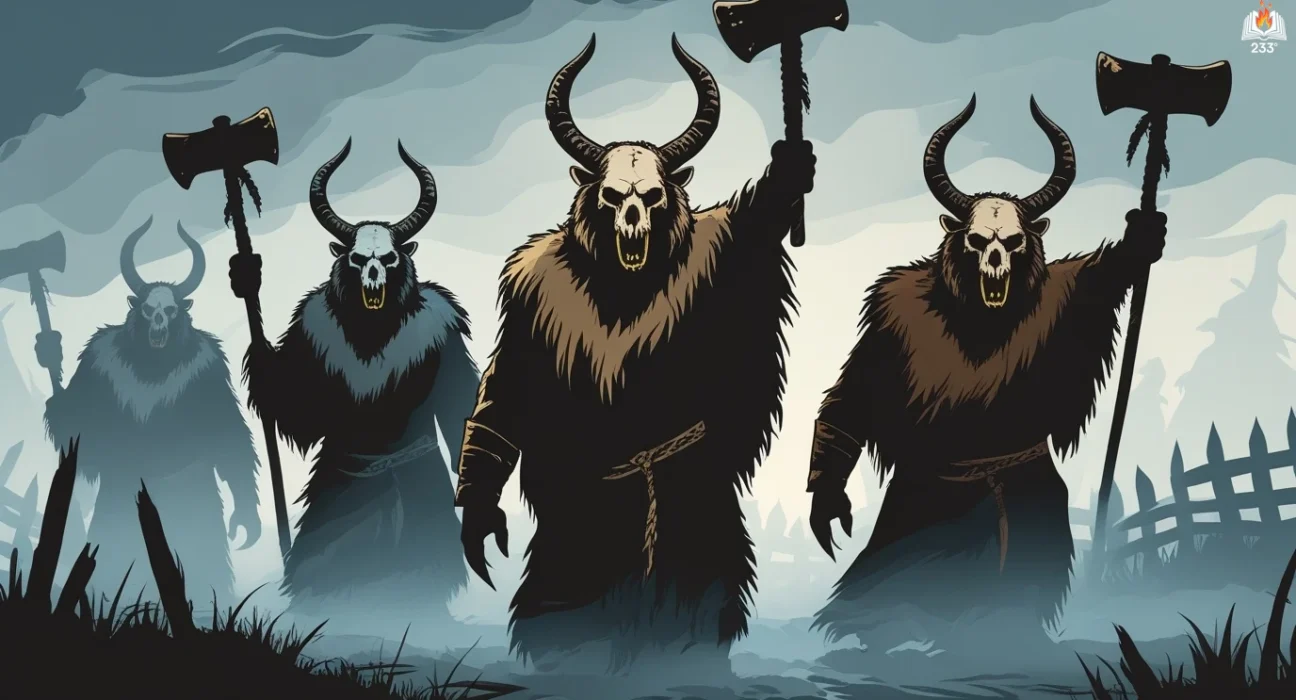
They travel by ship and then across the bleak wilderness, past crags and forests, until they reach Rothgar’s keep, a forlorn stronghold near the edge of the known world. The people there live in terror. The mist descends like a breath from the underworld, and from it come the Eaters of the Dead – creatures shrouded in fur, wielding crude weapons, crowned with the heads of bears. They leave gnawed bones and severed limbs in their wake. Villagers whisper of Wendol – demons or beasts, they cannot be named without invoking doom.
Buliwyf and his warriors assess the keep’s defenses and find them lacking. Their first encounter with the mist creatures confirms the worst – the attackers move with ghostlike stealth and savage force. A young watchman is slain, his corpse grotesquely displayed, and the warriors barely repel the assault. They learn that the Wendol attack at night, striking fear into hearts and cutting through defenses with feral cunning. The Northmen, undaunted, begin to reinforce the stronghold, shaping a bulwark against the night.
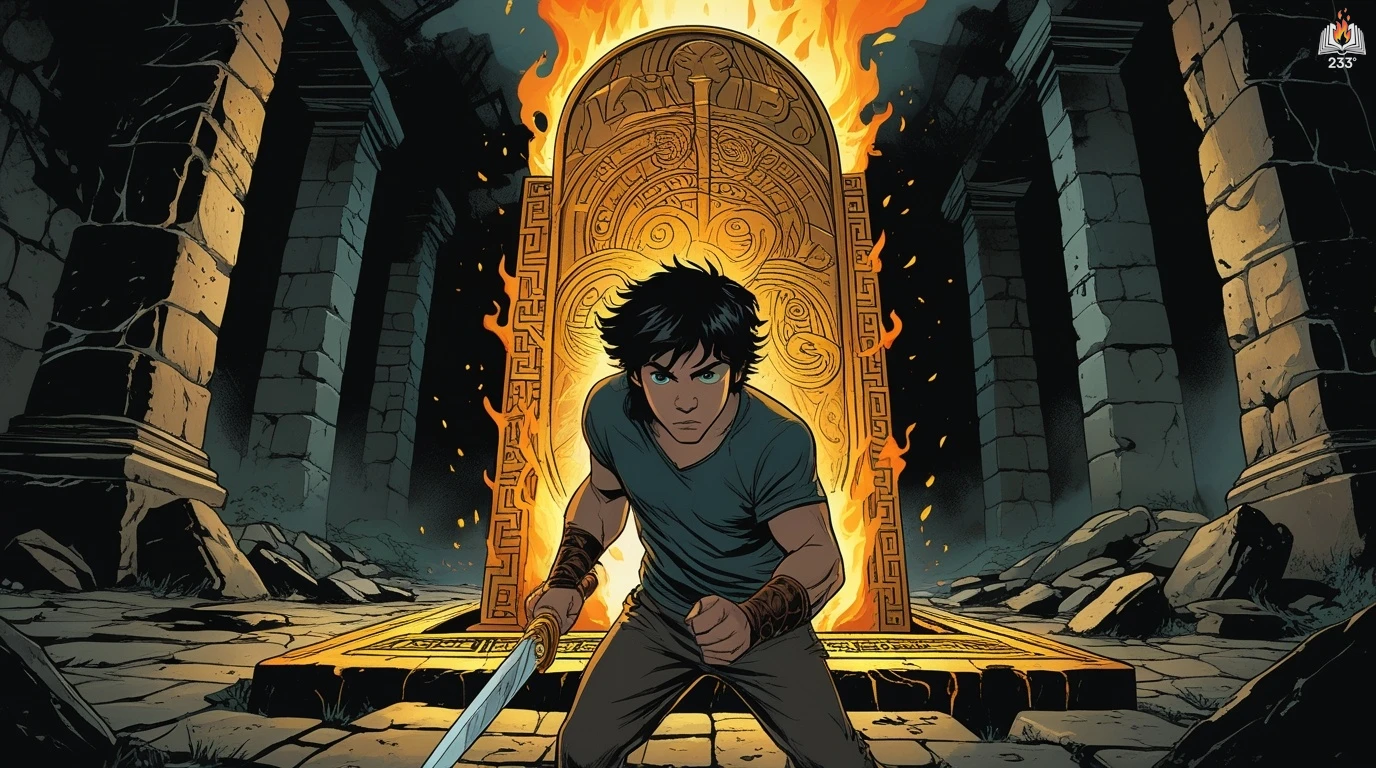
In this cold crucible, Ibn Fadlan sheds his courtly robes for armor and blade. Herger, a cheerful and perceptive warrior, teaches him to speak the Norse tongue and wield a sword. Slowly, the Arab transforms. No longer merely an observer, he becomes one of the thirteen, bound by shared battle and the silent understanding of men who have seen death together.
Despite the fortifications, the Wendol breach the walls again, slaughtering and disappearing like phantoms. Among their victims is the keep’s wise woman, who hints that the creatures may be more than mere beasts. A deeper knowledge lurks in the mists, ancient and vile.
The Northmen seek answers and track the attackers to their lair. They discover a cave complex hidden in the mountains – a place of darkness and bone, guarded by sentinels and the stench of death. Within lies the heart of the Wendol – a matriarch draped in serpents and soot, the Mother of the Mist. She is no beast but woman, blind and ancient, a queen ruling from the shadows.
Buliwyf and his warriors stage a daring assault. They descend into the cave, where torchlight flickers off glistening walls and the air stinks of blood. In the chaos, Buliwyf strikes down the Mother, but not before she wounds him with a poisoned claw. Her death sends the Wendol into disarray, but the poison festers in Buliwyf’s veins.
Weakened but unyielding, Buliwyf returns to the keep. The warriors know the battle is not yet done. The remnants of the Wendol, enraged and wild without their queen, prepare for a final assault. On the morning of the last stand, the mist rolls down the hills once more. From it comes the host of the devourers, howling and clad in bear-skin armor, wielding crude blades and primal fury.
The Northmen form their defense, chanting songs of war. Ibn Fadlan stands among them, sword in hand, a scholar turned warrior. Buliwyf, pale with death upon his brow, leads the defense with iron will. The two forces clash beneath the grey sky – flesh tears, bone breaks, and blood runs black on the frost. Buliwyf fights as though possessed, slaying the Wendol chieftain in single combat before succumbing to his wounds.
When the mist lifts, only the living remain. The Wendol are broken, scattered into myth once more. The people of Rothgar’s hall emerge from fear and rebuild what was nearly lost. In their hearts, they carry the memory of the thirteen who stood against the devourers of men.
Buliwyf is laid to rest according to the rites of his people. A great ship, filled with treasures and the body of their fallen king, is set aflame and cast to the sea. Fire and smoke rise to meet the sky as the warriors chant songs of his name, the name that will live on in tale and memory.
Ibn Fadlan departs, changed forever. He has seen the heart of darkness and the soul of courage, and he returns to his people not merely as a messenger, but as one who has touched the edge of myth.
Main Characters
Ahmad Ibn Fadlan – The narrator and protagonist, Ibn Fadlan is a refined and scholarly Arab envoy thrust into the raw, chaotic world of Viking warriors. His logical and observant nature serves as the lens through which the story unfolds. His evolution from a reluctant outsider to a culturally adaptive participant highlights his resilience and humanity.
Buliwyf – The Viking chieftain and central heroic figure, Buliwyf embodies stoic valor and solemn leadership. A towering presence among his people, his sense of honor, duty, and fatalism is reminiscent of legendary epic heroes. His journey is both physical and symbolic, as he confronts an enemy believed to be myth.
Herger – A lively and perceptive Norse warrior who becomes Ibn Fadlan’s translator and friend. Herger bridges the cultural divide between the Arab scholar and the Norsemen with humor and loyalty. He plays a crucial role in Ibn Fadlan’s understanding and eventual acceptance within the group.
Wulfgar – The messenger and kin of Buliwyf who seeks help for his besieged homeland. His desperation and youth make him the herald of the core quest, catalyzing the group’s mission.
The Angel of Death – A mysterious and grim figure among the Northmen, responsible for funeral rites and symbolic of their ritualistic culture. She represents the fatalistic and mystical aspects of Viking belief.
Thorkel – A rival to Buliwyf, Thorkel represents internal Viking discord and the fragile nature of leadership. His ambition and opposition add tension to the story’s political undertones.
Theme
Cultural Clash and Mutual Respect – The novel thrives on the friction and eventual understanding between Ibn Fadlan’s Islamic worldview and the pagan Viking ethos. This contrast reveals broader truths about fear, valor, and the shared human experience, showing how cultural barriers can be crossed through trust and necessity.
Heroism and Fate – Drawing heavily from Beowulf, Crichton explores the Norse concept of fate (wyrd) and the honor in facing death bravely. Buliwyf and his companions embody a code of courage that transcends their inevitable demise, reflecting on the nature of true heroism.
Myth versus Reality – A central motif is the transformation of legend into lived experience. The “monsters” the warriors face may be real or mythological, but Crichton blurs these boundaries to question what constitutes a monster and how societies shape their own narratives of fear.
Survival and Adaptation – Ibn Fadlan’s physical and cultural survival among the Vikings emphasizes adaptability and intelligence. His journey is a tale of endurance as much as it is a cultural awakening.
Writing Style and Tone
Michael Crichton employs a pseudo-scholarly narrative style that mimics an academic translation of a lost manuscript. This stylistic device lends an air of historical authenticity, complete with footnotes, editorial remarks, and textual commentary that ground the fantastical events in a realistic framework. The archaic tone and meticulous detail mirror the cadence of ancient travelogues and epic poetry, enhancing immersion while also satirizing the academic obsession with source reliability.
The tone is clinical yet enthralling, as Crichton juxtaposes Ibn Fadlan’s dry, matter-of-fact narration with the barbaric vigor of the Norse world. This contrast generates dark humor, cultural irony, and a slow-burning sense of dread. As the story progresses, the tone shifts from anthropological curiosity to heroic gravity, culminating in a climactic blend of myth and realism that reinforces the novel’s dual identity as both historical fiction and epic allegory.
Quotes
Eaters of the Dead – Michael Crichton (1976) Quotes
“Praise not the day until evening has come, a woman until she is burnt, a sword until it is tried, a maiden until she is married, ice until it has been crossed, beer until it has been drunk.”
“The risk is too great. A man cannot place too much faith in any one thing, neither a woman, nor a horse, nor a weapon, nor any single thing.”
“Animals die, friends die, and I shall die, but one thing never dies, and that is the reputation we leave behind at our death.”
“Herger said to me, "Be thankful, for you are fortunate." I inquired the source of my fortune. Herger said in reply, "If you have the fear of high places, than this day you shall overcome it; and so you shall have faced a great challenge; and so you shall be adjudged a hero.”
“In the eyes of all of them was the hollow stare of fear, and there was hollowness in their merriment, too.”
“...thus do strange things cease to be strange upon repetition.”
“You have done the work of a mere man," the tengol continued, “and not a proper hero. A hero does what no man dares to undertake.”
“Yet I have discovered that if all those around you believe some particular thing, you will soon be tempted to share in that belief...”
“The meaning of these discoveries has not yet been sorted out, but it is certainly now impossible to regard the prehistoric Europeans as savages idly”
“Herger said to me, “Be thankful, for you are fortunate.” I inquired the source of my fortune. Herger said in reply, “If you have the fear of high places, then this day you shall overcome it; and so you shall have faced a great challenge; and so you shall be adjudged a hero.”
“The meaning of these discoveries has not yet been sorted out, but it is certainly now impossible to regard the prehistoric Europeans as savages idly awaiting the blessings of Eastern civilization.”
We hope this summary has sparked your interest and would appreciate you following Celsius 233 on social media:
There’s a treasure trove of other fascinating book summaries waiting for you. Check out our collection of stories that inspire, thrill, and provoke thought, just like this one by checking out the Book Shelf or the Library
Remember, while our summaries capture the essence, they can never replace the full experience of reading the book. If this summary intrigued you, consider diving into the complete story – buy the book and immerse yourself in the author’s original work.
If you want to request a book summary, click here.
When Saurabh is not working/watching football/reading books/traveling, you can reach him via Twitter/X, LinkedIn, or Threads
Restart reading!