The Moon Is Down by John Steinbeck, published in 1942, is a poignant tale of resistance and occupation during World War II. Set in a small, unnamed town overtaken by foreign forces, the novel explores the psychological and moral struggles of both the invaders and the oppressed. Despite its seemingly simple premise, the book delves deeply into the human spirit’s resilience and the cost of war.
Plot Summary
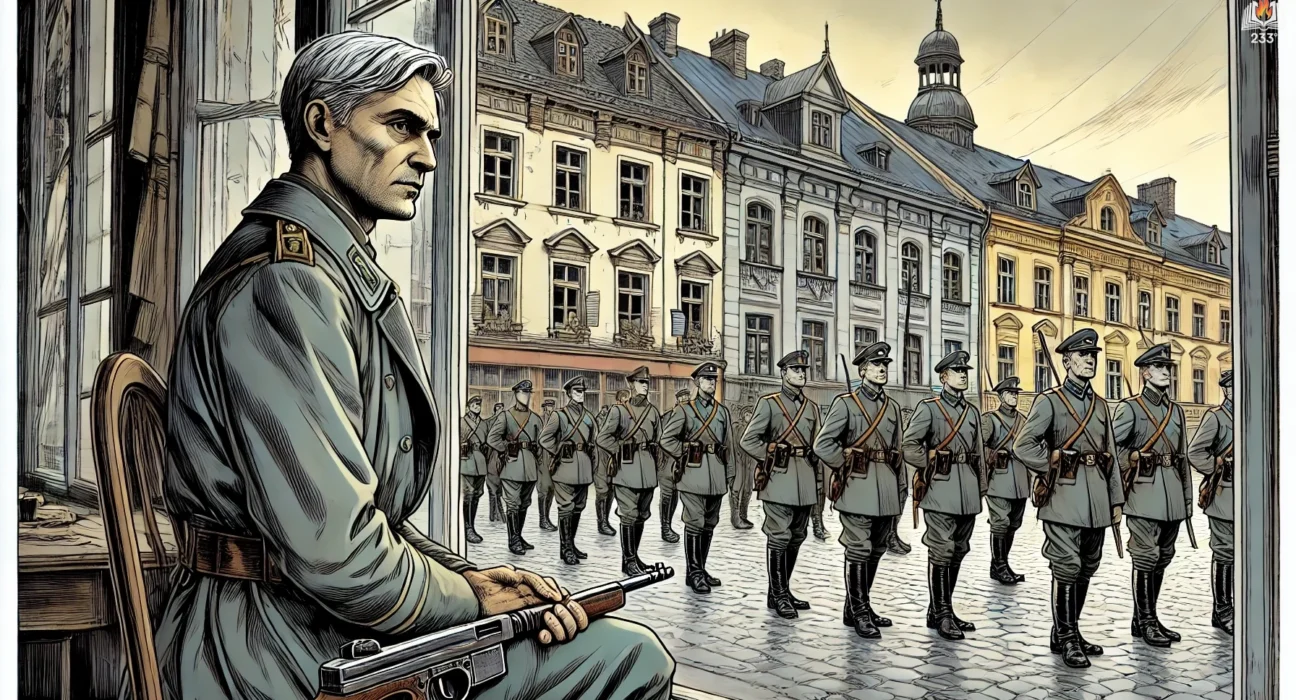
By mid-morning, the quiet town lay subdued under a gray sky, its cobblestone streets deserted but for the measured strides of foreign soldiers. The invaders, clad in steel-gray uniforms, had descended upon the unsuspecting town with precision, their preparations carefully concealed until the moment they struck. By the time the postman and the policeman—sent off to sea on a fishing expedition—could return to shore, the town had already fallen. The occupiers, a battalion of armed men, settled into the town square, their submachine guns gleaming ominously as their brass band played cheerful, sentimental tunes.
The invaders, led by the weathered Colonel Lanser, moved with cold efficiency. They commandeered the modest five-room residence of Mayor Orden, who, though gripped by a quiet dread, prepared to meet the Colonel. Lanser, though pragmatic and experienced in war, hoped to maintain order with minimal resistance. His orders were clear: the coal from the nearby mines was to flow to the occupiers’ homeland without delay. To this end, he sought the cooperation of the Mayor, believing that the townspeople’s loyalty to their elected leader would quell dissent.
But the Mayor, though outwardly polite, knew his people’s spirit was not easily broken. He understood that his position was precarious—torn between the occupiers’ demands and his allegiance to his townsfolk. His confidant, Doctor Winter, the town’s historian, watched the unfolding events with quiet skepticism, recognizing that the seemingly tranquil surface of the town concealed a deep and growing resentment.
Among the invaders, a sense of unease simmered beneath the surface. Lieutenant Tonder, a young romantic, spoke often of his longing for idealized love and poetry, while Lieutenant Prackle clung to shallow notions of heroism. Their superior, Captain Loft, rigid and ambitious, embodied the blind obedience of military discipline, while Major Hunter, an engineer more at home with calculations than men, viewed the occupation as a mechanical problem to be solved.
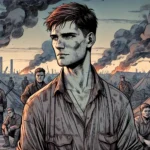
The occupiers’ sense of control began to fray when Alexander Morden, a coal miner, openly defied their orders. When instructed to work under the occupiers’ command, Morden lashed out, killing Captain Bentick with a pickaxe in an impulsive act of rebellion. The town was horrified, but beneath their fear, a flicker of pride stirred. Alexander’s act, rash as it was, symbolized a defiance the people had not dared to express.
Colonel Lanser, understanding the delicate balance of fear and respect needed to maintain control, decreed that Morden must stand trial. Yet the trial was a sham, a grim performance to assert authority. Morden’s guilt was never in question, and the sentence of execution was preordained. Mayor Orden was compelled to preside over the proceedings, a cruel manipulation by the occupiers to legitimize their justice. Orden, deeply pained, maintained his dignity, but the act further alienated him from the invaders and bound him closer to his people.
As Morden faced his sentence with quiet resolve, the townsfolk began to stir. The murder of Captain Bentick and the execution of Morden became rallying cries, whispers of rebellion traveling like wildfire through the streets and into the countryside. The townspeople, once bewildered and passive, began to find subtle ways to resist. Workers in the coal mines slowed their pace. Women, including the fiery Annie, sabotaged the occupiers with small acts of defiance. The townsfolk passed information in coded messages, their network of resistance growing ever stronger.
Meanwhile, the invaders faced their own struggles. The soldiers, initially confident in their mission, began to feel the weight of their isolation. Tonder, idealistic and sensitive, found himself drawn to Molly Morden, Alexander’s widow, in a misguided attempt at human connection. But Molly, embittered by her husband’s death, spurned his advances, and Tonder’s fragile psyche crumbled. The soldiers, who had entered the town with a sense of invincibility, began to sense the hostility seeping through the walls of every house and shadowing every corner.
Lanser, weary and aware of the futility of his position, struggled to maintain control over his men and the town. He understood that occupation was more than a matter of military might; it was a psychological war, one that he was losing. The townspeople’s resistance, though quiet and fragmented, wore on the occupiers, who longed for home and normalcy.
The final blow to the invaders’ illusion of dominance came as the townspeople’s defiance grew bolder. Acts of sabotage disrupted the coal shipments, and the occupiers’ attempts to root out resistance only deepened the townsfolk’s resolve. Orden and Winter, though confined by their roles, became symbols of quiet defiance. Orden’s calm refusal to betray his people or submit to the invaders’ demands became a rallying point, his presence a reminder of the strength of collective will.
In the closing moments, the people’s resistance reached a crescendo. Whispers of rebellion turned into action as explosives, smuggled into the mines by the resistance, detonated, halting the coal production entirely. The occupiers, increasingly paranoid and demoralized, faced not only the physical challenges of occupation but also the psychological toll of their moral decay.
Mayor Orden, in his final act of defiance, reminded the occupiers that their power was fleeting, and that the spirit of free people could not be conquered. The invaders, trapped in their own cycle of fear and repression, began to crumble under the weight of their hollow victory. The townsfolk, though battered, remained unbroken, their quiet rebellion a testament to the enduring strength of the human spirit.
The Moon Is Down ends not with a roar of triumph, but with the steady, unyielding determination of a people who refuse to surrender their humanity.
Main Characters
- Mayor Orden: The steadfast and wise leader of the town, Orden is a symbol of moral strength and the voice of his people. His loyalty to the townsfolk and his sense of justice remain unshaken despite his personal fears.
- Colonel Lanser: The weary yet dutiful commander of the invading forces. Lanser is pragmatic, understanding the futility of occupation yet bound by his orders.
- Dr. Winter: The town historian and physician, a close confidant of Mayor Orden. Winter offers philosophical insight and underscores the cultural significance of resistance.
- George Corell: A local traitor who aids the occupiers in taking control of the town. His collaboration brands him as a pariah.
- Lieutenant Tonder and Lieutenant Prackle: Young, naive officers of the occupying army. Tonder is a romantic dreamer, while Prackle embodies blind loyalty to propaganda.
- Annie: The Mayor’s fiery and fiercely loyal cook, a minor character who represents the simmering defiance of ordinary people.
- Alexander Morden (Alex): A coal miner who resists the occupiers and kills a soldier, becoming a martyr for the town’s resistance.
Theme
- Resistance and Rebellion: The novel underscores the inevitability of resistance against oppression. Despite initial submission, the townspeople find strength in their unity.
- The Morality of War: Steinbeck examines the moral ambiguities of war, exploring the humanity and fallibility of both the oppressors and the oppressed.
- Freedom and Dignity: The book highlights the indomitable human desire for freedom and the lengths people will go to preserve their dignity under tyranny.
- Isolation of Power: Both the invaders and their collaborators experience alienation, revealing the moral and emotional toll of betrayal and forced authority.
- Symbolism of the Moon: The moon represents hope and perseverance, its phases paralleling the waxing and waning of the townspeople’s resolve.
Writing Style and Tone
John Steinbeck employs a stark yet lyrical style, blending straightforward prose with symbolic and philosophical undertones. His concise descriptions capture the bleakness of the occupied town, while his character-driven dialogue conveys depth and emotional nuance. Steinbeck’s writing carries a restrained elegance, avoiding melodrama while delivering a powerful emotional impact.
The tone is somber and contemplative, reflecting the grim realities of occupation and war. However, it is also suffused with quiet optimism, showcasing the resilience of the human spirit. Steinbeck’s masterful use of irony—especially in the interactions between the occupiers and the townsfolk—adds layers of meaning, enhancing the narrative’s depth.
Quotes
The Moon Is Down – John Steinbeck (1942) Quotes
“Free men cannot start a war, but once it is started, they can fight on in defeat. Herd men, followers of a leader, cannot do that, and so it is always the herd men who win battles and the free men who win wars.”
“I am a little man and this is a little town, but there must be a spark in little men that can burst into flame.”
“I have no choice of living or dying, you see, sir--but I do have a choice of how I do it. If I tell them not to fight, they will be sorry, but they will fight. If I tell them to fight, they will be glad, and I who am not a very brave man will have made them a little braver.”
“The flies have conquered the flypaper.”
“I'm tired of people who have not been at war who know all about it.”
“Defeat is a momentary thing. A defeat doesn't last. We were defeated and now we attack. Defeat means nothing. Can't you understand that? Do you know what they are whispering behind doors?”
“They think that just because they have only one leader and one head, we are all like that. They know that ten heads lopped off will destroy them, but we are a free people; we have as many heads as we have people, and in a time of need leaders pop up among us like mushrooms.”
“war is treachery and hatred, the muddling of incompetent generals, the torture and killing and sickness and tiredness, until at last it is over and nothing has changed except for new weariness and new hatreds.”
“I have no choice of living or dying, you see, sir, but I do have a choice of how I do it.”
“They know that ten heads lopped off will destroy them, but we are a free people; we have as many heads as we have people, and in a time of need leaders pop up among us like mushrooms.”
“And the girl,' Lanser continued, 'the girl, Lieutenant, you may rape her, or protect her, or marry her--that is of no importance so long as you shoot her when it is ordered.”
“Lanser said, "There are no peaceful people, when will you learn it? There are no friendly people, can't you understand that?”
“That is a great mystery,” said Doctor Winter. “That is a mystery that has disturbed rulers all over the world—how the people know. It disturbs the invaders now, I am told, how news runs through censorships, how the truth of things fights free of control. It is a great mystery.”
“The fool supply was controlled...”
“It is always the herd men who win battles and the free men who win wars.”
“The paintings on the wall were largely preoccupied with the amazing heroism of large dogs faced with imperiled children. Nor water nor fire nor earthquake could do in a child so long as a big dog was available.”
“And the hatred was deep in the eyes of the people, beneath the surface.”
“If he considered God at all, he thought of Him as an old and honored general, retired and gray, living among remembered battles and putting wreaths on the graves of his lieutenants several times a year.”
“Flies conquer the flypaper.”
“Joseph habitually scowled at furniture, expecting it to be impertinent, mischievous, or dusty.”
“a man who is good for anything ought not to calculate the chance of living or dying; he ought only to consider whether he is doing right or wrong.”
“There's so much talk about justice, injustice, conquest. Our people are invaded, but I don't think they're conquered.”
“That is a mystery that has disturbed rulers all over the world—how the people know. It disturbs the invaders now, I am told, how news runs through censorships, how the truth of things fights free of control. It is a great mystery.” The”
“Captain Loft believed that all women fall in love with a uniform and he did not see how it could be otherwise.”
We hope this summary has sparked your interest and would appreciate you following Celsius 233 on social media:
There’s a treasure trove of other fascinating book summaries waiting for you. Check out our collection of stories that inspire, thrill, and provoke thought, just like this one by checking out the Book Shelf or the Library
Remember, while our summaries capture the essence, they can never replace the full experience of reading the book. If this summary intrigued you, consider diving into the complete story – buy the book and immerse yourself in the author’s original work.
If you want to request a book summary, click here.
When Saurabh is not working/watching football/reading books/traveling, you can reach him via Twitter/X, LinkedIn, or Threads
Restart reading!