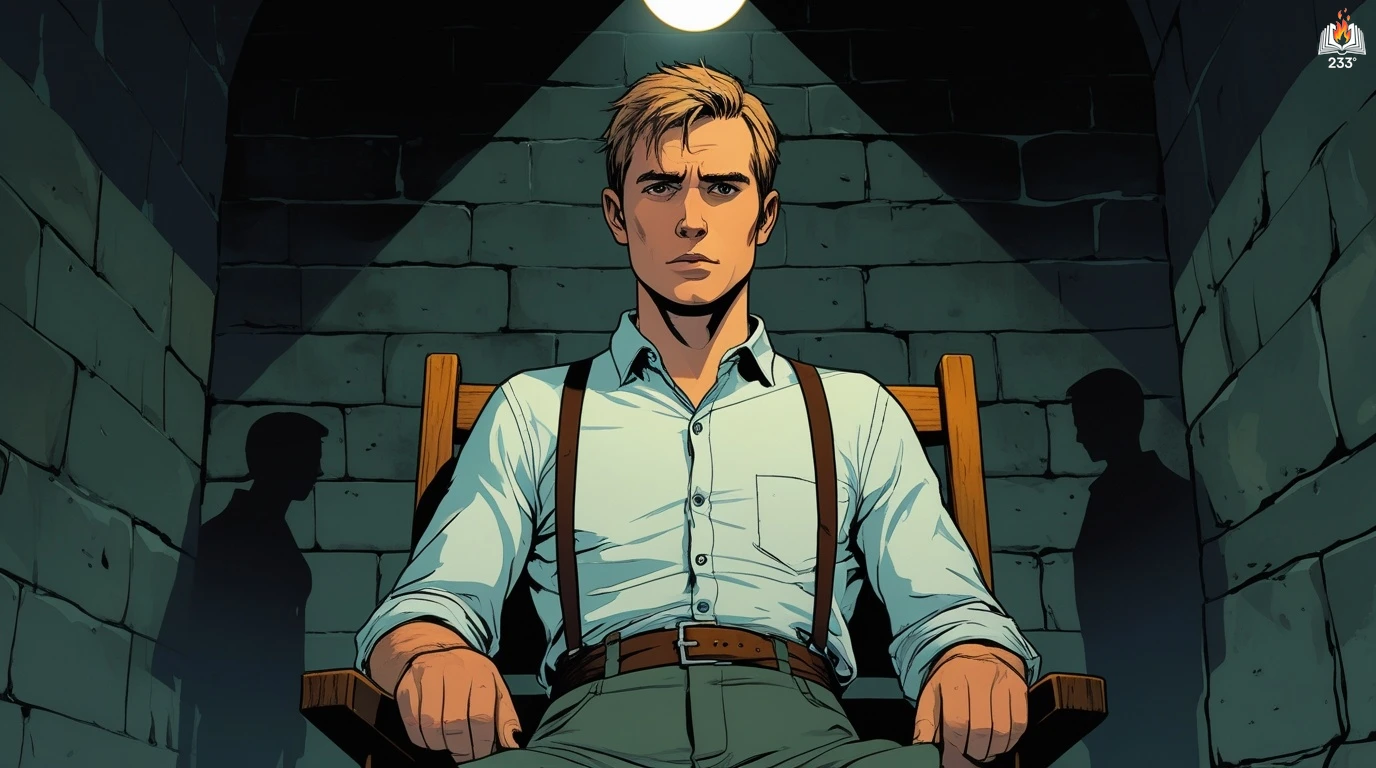
Why Didn’t They Ask Evans? is a 1934 mystery novel by Agatha Christie that showcases her signature blend of suspense, wit, and intrigue. The novel follows Bobby Jones and Lady Frances “Frankie” Derwent as they stumble upon a dying man whose cryptic final words—“Why didn’t they ask Evans?”—set them on a dangerous investigation. Though not part of Christie’s famous Poirot or Marple series, this novel stands as a clever, charming, and fast-paced whodunit.
Plot Summary
Bobby Jones, the unambitious son of a Welsh vicar, was finishing up a game of golf near the cliffs of Marchbolt when a sudden cry pierced the air. Rushing to the edge, Bobby found a man lying broken on the rocks below. Kneeling beside him, Bobby waited anxiously as the stranger, barely clinging to life, stirred and whispered a puzzling question: Why didn’t they ask Evans? Then, with a faint shudder, the man died.
Though the police chalked it up as a tragic accident, Bobby’s curiosity itched. Even more curious was the appearance of a mysterious stranger who identified the body as Alex Pritchard, presenting a photo of a woman Bobby had never seen before. Bobby, distracted by life and obligations, might have let the whole matter drift away if not for an unsettling event: after drinking a pint at the local pub, he fell violently ill, discovering later it had been laced with a lethal dose of morphia. That attempt on his life snapped his sense of adventure to attention.
Enter Lady Frances Derwent – Frankie to her friends – a spirited aristocrat and childhood companion of Bobby’s, whose thrill for adventure matched his newfound determination. Frankie wasted no time. She proposed they investigate the dead man’s last words, tracing his path and uncovering his true identity. Their first clues led them to the Bassington-ffrench family, a well-to-do household at Merroway Court. Roger Bassington-ffrench, the charming and elusive brother, had been seen near the cliffs at the time of the death and immediately sparked Frankie’s suspicion. To get closer to the family, Frankie devised an elaborate scheme: staging a car crash outside Merroway Court, faking an injury, and embedding herself as a houseguest.
The plan unfolded flawlessly. Frankie, bruised but unbowed, was taken in by Sylvia Bassington-ffrench, the gracious yet anxious mistress of the house, and Henry, her brooding, morphia-addicted husband. Roger’s arrival added to the intrigue – handsome, sympathetic, and utterly disarming, he confounded Frankie’s suspicions. Meanwhile, Bobby disguised himself as Frankie’s chauffeur, slipping into the village and gathering local gossip.
As the days passed, Frankie’s doubts swelled. The household revealed cracks beneath its polished surface. Henry’s mood swings and Sylvia’s nervous glances hinted at unspoken troubles. Roger, once the prime suspect, began to feel less like a villain and more like an ally. Frankie’s instincts sharpened when she learned of Dr Nicholson, a severe man running a nearby clinic for addicts, and his delicate wife, Moira. The dark-blue Talbot Nicholson drove matched the description of a suspicious car spotted near the scene when Bobby had been poisoned.
Frankie and Bobby’s pursuit led them next to a critical discovery: the dead man was not Alex Pritchard but Alan Carstairs, a resourceful adventurer investigating a missing heiress. Carstairs’s investigation had threatened to expose a dark conspiracy, and it became clear that his murder was no random fall but a deliberate silencing. The key to the mystery lay in Carstairs’s last words. But who was Evans, and why had no one asked?
The turning point came when Frankie, rifling through conversation and observation, unearthed a past accident involving the Bassington-ffrench child, Tommy. Roger had been swinging Tommy high when the branch snapped, a near-fatal incident Sylvia recalled with unease. Layer by layer, the portrait of the household shifted. Frankie began to suspect that Sylvia’s marriage was not as tranquil as it appeared, that Henry’s addictions masked deeper shadows, and that Roger’s restlessness concealed hidden motives.
Bobby, on his end, followed a trail of questions about Carstairs’s connection to the missing heiress. It was among Carstairs’s papers that the final link emerged – the inheritance of a vast fortune, tied up with a series of legal manipulations, and a key servant: Evans. The servant had once worked for the heiress’s family and held knowledge crucial to unraveling the scheme.
The mystery deepened as Bobby and Frankie traced Evans to a modest home, only to find that the forces shadowing them had reached first. Evans had been silenced, and time was running out. It was Frankie’s sharp eye and unflappable courage that turned the tide. She confronted Roger, who admitted to his presence at the cliff but denied murder, his alibi fraying at the edges. Frankie pressed further, drawing the attention of Dr Nicholson, whose sinister fascination with suffering and control cast a dark cloud over the investigation.
The final revelation cracked open with astonishing simplicity. It had been Sylvia who, with quiet resolve, knew the truth all along. Evans was her former maid, privy to the hidden details of the heiress’s will and the dark plot to divert her fortune. The conspirators, fearing exposure, had orchestrated Carstairs’s death, Bobby’s poisoning, and Evans’s disappearance. But Sylvia, overshadowed and underestimated, provided the last, crucial pieces of the puzzle.
With the conspirators unmasked, the household at Merroway Court fractured under the weight of its secrets. Henry, crumbling under addiction and guilt, faced his collapse, while Roger, surprisingly free of blood on his hands, drifted once more into the horizon. Dr Nicholson’s reputation cracked, his clinic falling under harsh scrutiny. Frankie, triumphant, allowed herself a moment of rare vulnerability, sensing the quiet pull between herself and Bobby. For Bobby, the vicar’s son who had once swung a golf club without a care, life had irrevocably changed. He had faced death, deception, and danger and had emerged with more than just answers – he had found his own mettle.
As spring softened into summer, the ripples of the mystery faded from the countryside. Frankie and Bobby stood at the edge of the cliff where it had all begun, the wind teasing their hair. The question that had haunted them – why didn’t they ask Evans? – had been answered at last, its echoes carried away by the sea below. Together, they walked back toward the village, laughter trailing behind them, the weight of danger lifted but the bond between them newly forged.
Main Characters
Bobby Jones: The easygoing, golf-loving son of a Welsh vicar, Bobby is pulled into the mystery after discovering the dying man. His sense of loyalty, curiosity, and moral courage drive much of the investigation, and his partnership with Frankie reveals his growth from casual bystander to determined amateur sleuth.
Lady Frances “Frankie” Derwent: Spirited, wealthy, and resourceful, Frankie is Bobby’s childhood friend and the true mastermind behind much of their detective work. Her aristocratic confidence and daring schemes push the investigation forward, adding humor and vitality to the narrative.
Roger Bassington-ffrench: A charming and enigmatic man, Roger becomes a central figure in the mystery. Though initially a suspect, his charisma and apparent innocence complicate the amateur detectives’ suspicions, highlighting themes of deception and trust.
Sylvia Bassington-ffrench: Roger’s sister-in-law, Sylvia is gentle, kind, and somewhat anxious, adding emotional depth to the household’s dynamics. Her subtle unhappiness and maternal devotion provide contrast to the more energetic Frankie.
Dr. Nicholson: A brooding and enigmatic figure, Dr. Nicholson runs a nearby sanatorium and is known for his “cures” of drug addiction. His cold intelligence and dark aura make him a figure of suspicion in the puzzle.
Henry Bassington-ffrench: Roger’s brother, Henry is depicted as moody and erratic, struggling with drug addiction. His unpredictable nature adds tension and complexity to the Bassington-ffrench household.
Theme
Amateur Sleuthing and Adventure: Bobby and Frankie’s transformation from ordinary citizens into detectives highlights the thrill of ordinary people thrust into extraordinary circumstances. Their amateur status creates moments of humor, error, and triumph.
Class and Social Structure: Christie deftly explores the British class system, contrasting Frankie’s aristocratic ease with Bobby’s middle-class roots. This dynamic shapes their investigation, granting them access to different social circles and perspectives.
Deception and Hidden Identities: False appearances, secret motives, and masked identities run through the novel, creating a web of suspicion. Christie challenges readers to question first impressions and to look beneath the surface.
Chance and Fate: The entire plot hinges on random coincidence—Bobby’s chance discovery of the body—and the tension between fate and free will lingers throughout. Small decisions lead to significant consequences, underscoring life’s unpredictability.
Writing Style and Tone
Agatha Christie’s writing in Why Didn’t They Ask Evans? sparkles with wit, lightheartedness, and sharp dialogue. Unlike her darker or more psychologically intense novels, this book leans into banter, clever repartee, and a breezy, almost romantic tone between Bobby and Frankie. Christie masterfully balances humor with suspense, allowing readers to feel both entertained and intellectually engaged. Her clear, accessible prose invites a wide readership, while her attention to detail and subtle clues reward the attentive.
The tone shifts fluidly between light comedy and genuine menace. While much of the book feels like a playful romp through the English countryside—with eccentric characters, disguises, and improbable schemes—there are underlying moments of real danger and moral gravity. Christie’s ability to oscillate between charm and menace keeps the reader guessing, sustaining tension without sacrificing warmth. Her use of setting, from cozy villages to imposing country houses, enhances the novel’s classic British atmosphere.
Quotes
Why Didn’t They Ask Evans – Agatha Christie (1934) Quotes
“Why didn't they ask the Evans?”
“Young men are sadly degenerate nowadays.”
“Time, thought Bobby suddenly, was a very frightening thing.”
“Nobody over fifty has got any sense.”
“The law. Lady Frances, is an uncertain animal. It has twists and turns that surprise the non-legal mind.”
“These older people were the limit... They harped on things so.”
“A woman would know all right about her own husband.”
“You can always depend on an Englishman to play the game”
“Sorry, Dad," he said. speaking cheerfully and breezily as was his habit no matter what the subject. "Not my fault this time. I was keeping guard over a corpse.”
We hope this summary has sparked your interest and would appreciate you following Celsius 233 on social media:
There’s a treasure trove of other fascinating book summaries waiting for you. Check out our collection of stories that inspire, thrill, and provoke thought, just like this one by checking out the Book Shelf or the Library
Remember, while our summaries capture the essence, they can never replace the full experience of reading the book. If this summary intrigued you, consider diving into the complete story – buy the book and immerse yourself in the author’s original work.
If you want to request a book summary, click here.
When Saurabh is not working/watching football/reading books/traveling, you can reach him via Twitter/X, LinkedIn, or Threads
Restart reading!