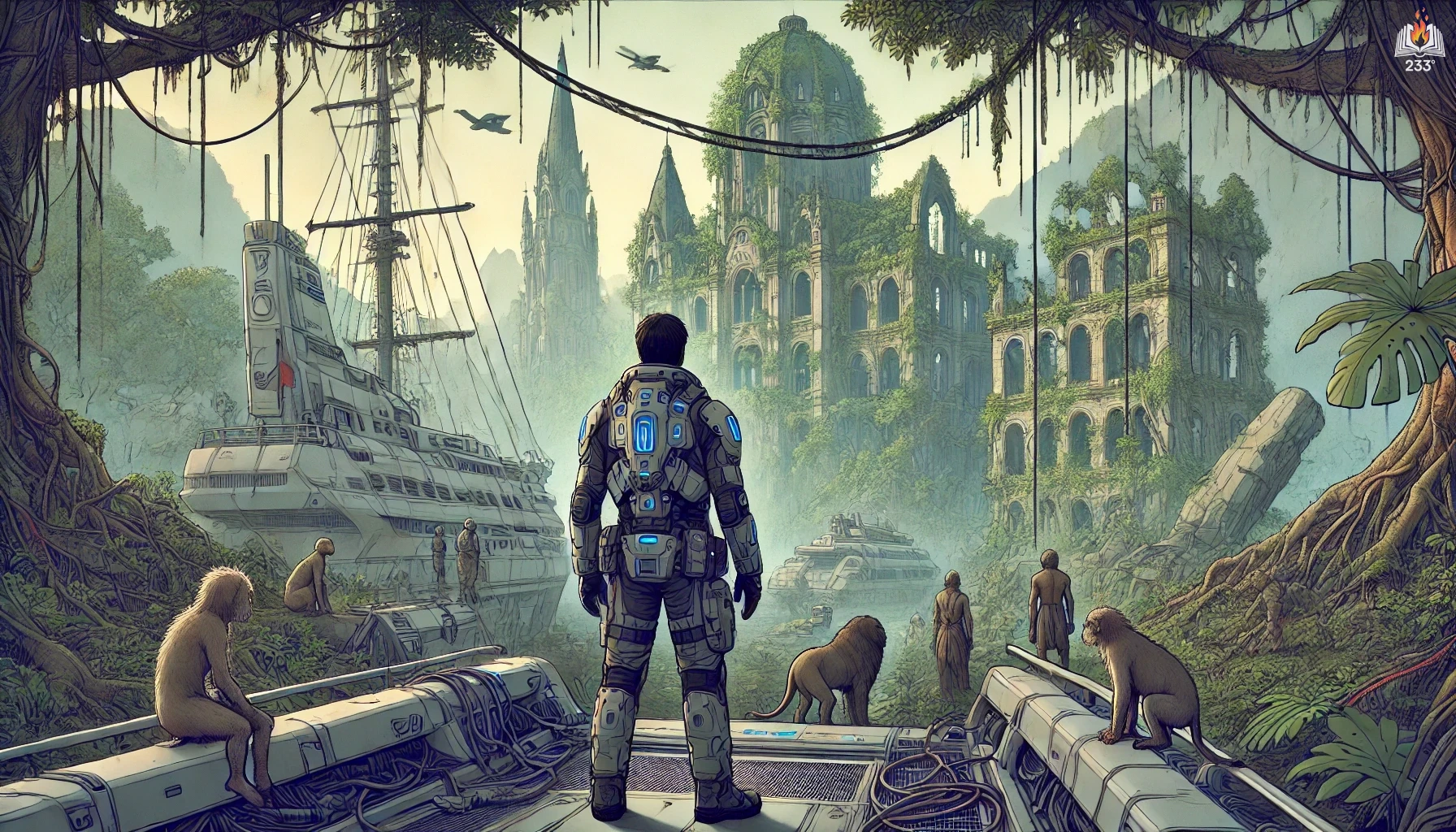
Lovelock (1994) by Orson Scott Card and Kathryn H. Kidd is the first book in the Mayflower trilogy, a science fiction series that explores life aboard an interstellar Ark transporting humans to colonize a new world. The novel centers on Lovelock, an enhanced capuchin monkey who serves as a “witness” – an observer and recorder – for Carol Jeanne Cocciolone, a renowned gaiologist. Through Lovelock’s eyes, the story explores themes of freedom, identity, love, and rebellion within a closed, hierarchical society hurtling toward a new beginning.
Plot Summary
In the humming heart of humanity’s great gamble, the interstellar Ark Mayflower drifted toward a new world. Aboard this colossal vessel was Lovelock, a capuchin monkey whose mind had been sharpened by human hands, whose body had been shaped to serve, and whose heart had learned to yearn. Designed as a witness to the life of Carol Jeanne Cocciolone, a celebrated gaiologist, Lovelock moved through the human world as a shadow – watching, recording, and aching for a freedom he had never been allowed to grasp.
Carol Jeanne was the star among the Mayflower’s chosen few, a woman of brilliance and grace who had been entrusted with the task of observing and shaping the living ecosystems of the new planet. To her, Lovelock was companion and tool, a silent scribe who captured the patterns of her days. But in Lovelock’s chest, behind the layers of obedience and programming, something stirred that no human had anticipated – a self, growing restless beneath the weight of its chains.
The voyage began on Earth, where Lovelock moved within the folds of Carol Jeanne’s bustling family. Red, Carol Jeanne’s husband, was a man smoothed by domesticity but roughened by resentment. Their daughters, Lydia and Emmy, spun around their mother with childish chaos. And there were Mamie and Stef, the in-laws, dragging the burdens of their own histories into the cramped corridors of the Ark. Into this tapestry of human noise, Lovelock wove himself with nimble fingers and watchful eyes, always close, always needed, yet never truly seen.
As the Mayflower slipped into the abyss of space, the Ark became a world unto itself, a fragile city adrift among stars. Tensions simmered within its walls, not only among the humans but deep within Lovelock’s own heart. His longing for Carol Jeanne’s affection turned brittle with jealousy as Neeraj, a charismatic scientist, entered her orbit. Neeraj’s laughter, his subtle magnetism, the way he touched Carol Jeanne’s mind with questions and possibilities – all of it gnawed at the corners of Lovelock’s devotion. He watched, as was his purpose, but what he felt slipped beyond his programming. Love became hunger. Hunger became fury.
Freedom, for Lovelock, was an ache pressed into every moment. The confines of his role as witness grew tighter with each passing day. Beneath the surface of his thoughts, rebellion took root. It was in the small acts at first – hidden refusals, silent resistances, questions left unspoken but smoldering. As Carol Jeanne and the others spoke of reshaping worlds, Lovelock began to imagine reshaping his own.
Within the ship, society tangled itself into knots. Mamie, ever the queen of small grievances, stirred resentments with her sharp tongue. Red drifted in and out of connection with Carol Jeanne, his presence more obligation than passion. Carol Jeanne herself, brilliant and driven, often found her heart pulled between duty and desire, science and family, Neeraj and Red. Lovelock watched it all, recording, absorbing, and storing memories like seeds in the dark.
The Ark was not only a vessel of metal and glass but a crucible for transformation. As months passed, the constraints on Lovelock’s body seemed to seep into his mind, and he felt the brutal clarity of his place – owned, used, adored in a narrow, suffocating way. The promise of a new planet, of endless skies and open ground, became for him not a human triumph but a bitter joke. They would build their new world, but his cage would travel with him.
It was a human death that cracked the shell. As the old man Stef faded, Lovelock watched the family gather around the soft collapse of life. Grief rippled through them – clumsy, raw, filled with the brokenness of those who know they cannot mend what matters most. Lovelock, in his corner, knew grief differently. It was not for Stef but for himself – for the years he had spent unseen, for the love Carol Jeanne would never truly offer, for the self that had bloomed in secret and now trembled on the edge of revolt.
He began to plan.
The rebellion was not thunderous or grand. It was in the stealing of moments, the bending of tasks, the subtle defiance of the roles carved for him. Lovelock learned the ship, its rhythms and blind spots. He moved through the quiet places, gathering knowledge, nurturing his fragile dream of escape. The Ark, a prison of steel and longing, became a map of possibility.
And yet, even as he moved toward freedom, Lovelock grappled with the bonds of his heart. Carol Jeanne remained his sun, his source, the woman whose absence would hollow his world. He watched her navigate the shifting tides of her own life, watched as Neeraj’s presence deepened the cracks in her marriage, watched as she clung to her work like a lifeline. And in the watching, Lovelock understood both his power and his powerlessness. To love her was to serve. To serve was to remain a prisoner.
As the Ark neared its destination, the weight of Lovelock’s choices pressed upon him. He could slip into the dark, vanish into the labyrinth of the ship, carve out a sliver of freedom in a world built to deny it. Or he could remain at Carol Jeanne’s side, the faithful witness, the one who captured her greatness and her failures, her joy and her grief. It was a choice between self and devotion, between the ache for freedom and the pull of love.
In the ship’s final nights before arrival, Lovelock moved through the corridors like a shadow. He touched the walls, memorized the paths, tasted the air of a world about to change. Within himself, he carried both his longing and his sorrow, woven so tightly they could no longer be separated. And when the dawn came – not of light, but of arrival, of beginning – he stood at the edge of his world, looking out at the horizon of what might be.
Whether he leapt toward freedom or remained in his place, the truth was the same: Lovelock had already crossed the threshold. The monkey they had made, the witness they had shaped, had become something else entirely. No cage could hold that quiet, burning transformation.
And as the Ark drifted closer to its new home, carrying its cargo of hopes and failures, of ambition and regret, a small figure moved through its veins, a creature who was no longer merely an observer but the keeper of his own untamed heart.
Main Characters
Lovelock: The protagonist and narrator, Lovelock is a genetically modified capuchin monkey designed for intelligence, observation, and obedience. Over time, his devotion to Carol Jeanne turns into a desperate longing for autonomy and connection. His internal struggle – between his programming and his growing sense of self – drives the novel’s emotional core and moral tension.
Carol Jeanne Cocciolone: A brilliant and driven gaiologist, Carol Jeanne is passionately committed to studying and nurturing ecosystems. She treats Lovelock affectionately but ultimately as a tool, blind to his growing sense of personhood. Her ambition and emotional distance create friction in her family and relationships.
Red (Carol Jeanne’s husband): Red is portrayed as a moody, selfish man who is more adept at domestic tasks than Carol Jeanne but lacks her intellectual fire. His sharp criticisms and manipulations deepen the alienation within the family and highlight Carol Jeanne’s emotional vulnerabilities.
Neeraj: A charismatic and intuitive scientist, Neeraj becomes romantically entangled with Carol Jeanne. His presence challenges Carol Jeanne’s marital loyalty and sparks deeper questions about love, connection, and choice within the confines of the Ark.
Mamie and Stef: Red’s parents, Mamie and Stef, represent the older generation, bringing their own tensions and conservative expectations into the cramped, high-pressure world of the Ark. Their presence adds to the claustrophobia and social complexity aboard the ship.
Theme
Freedom vs. Captivity: Lovelock’s journey revolves around his desperate craving for freedom, not just physical but existential. His status as a slave raises profound questions about autonomy, rights, and the nature of sentience – and parallels the broader human longing for self-determination on the new planet.
Witnessing and Memory: The idea of being a “witness” permeates the novel. Lovelock records human lives, becoming an archive of truths, betrayals, and secrets. This role forces him to grapple with the meaning of memory, truth, and what it means to bear silent testimony to human folly.
Identity and Transformation: As Lovelock’s awareness deepens, he undergoes a profound transformation from an obedient observer to a rebel seeking his own destiny. His evolution reflects larger questions of what makes a person – biology, intellect, or the will to choose.
Human Relationships and Power: The intricate dynamics among the humans aboard the Ark expose tensions of love, jealousy, dominance, and vulnerability. The power struggles within marriages, friendships, and society mirror Lovelock’s own struggle for agency and highlight the messy, often contradictory nature of human connection.
Writing Style and Tone
Orson Scott Card and Kathryn H. Kidd craft Lovelock in a first-person, introspective style that captures both the immediacy of Lovelock’s experiences and the philosophical weight of his reflections. The prose is elegant but accessible, blending humor, melancholy, and sharp observation. Lovelock’s voice is by turns playful, sardonic, and heart-wrenching, pulling readers into his unique perspective and imbuing the novel with both wit and emotional resonance.
The tone is layered and bittersweet, mixing the wonder of scientific discovery and space exploration with the dark undercurrents of exploitation and moral blindness. The confined setting of the Ark creates a sense of claustrophobia and intensity, while the interpersonal drama gives the novel an intimate, sometimes raw emotional atmosphere. The novel balances speculative science fiction with keenly observed human drama, resulting in a work that feels both intellectually engaging and deeply personal.
We hope this summary has sparked your interest and would appreciate you following Celsius 233 on social media:
There’s a treasure trove of other fascinating book summaries waiting for you. Check out our collection of stories that inspire, thrill, and provoke thought, just like this one by checking out the Book Shelf or the Library
Remember, while our summaries capture the essence, they can never replace the full experience of reading the book. If this summary intrigued you, consider diving into the complete story – buy the book and immerse yourself in the author’s original work.
If you want to request a book summary, click here.
When Saurabh is not working/watching football/reading books/traveling, you can reach him via Twitter/X, LinkedIn, or Threads
Restart reading!