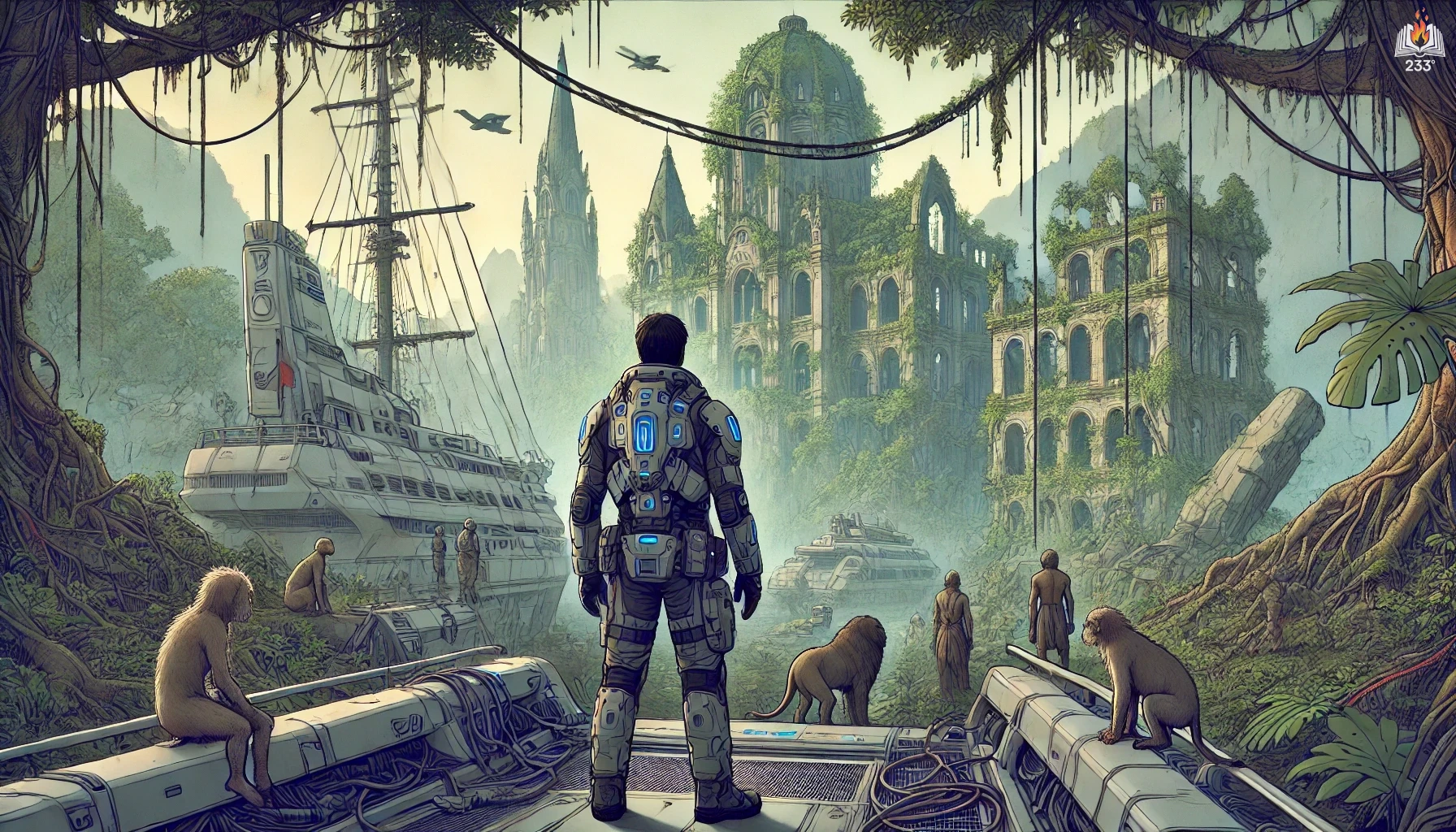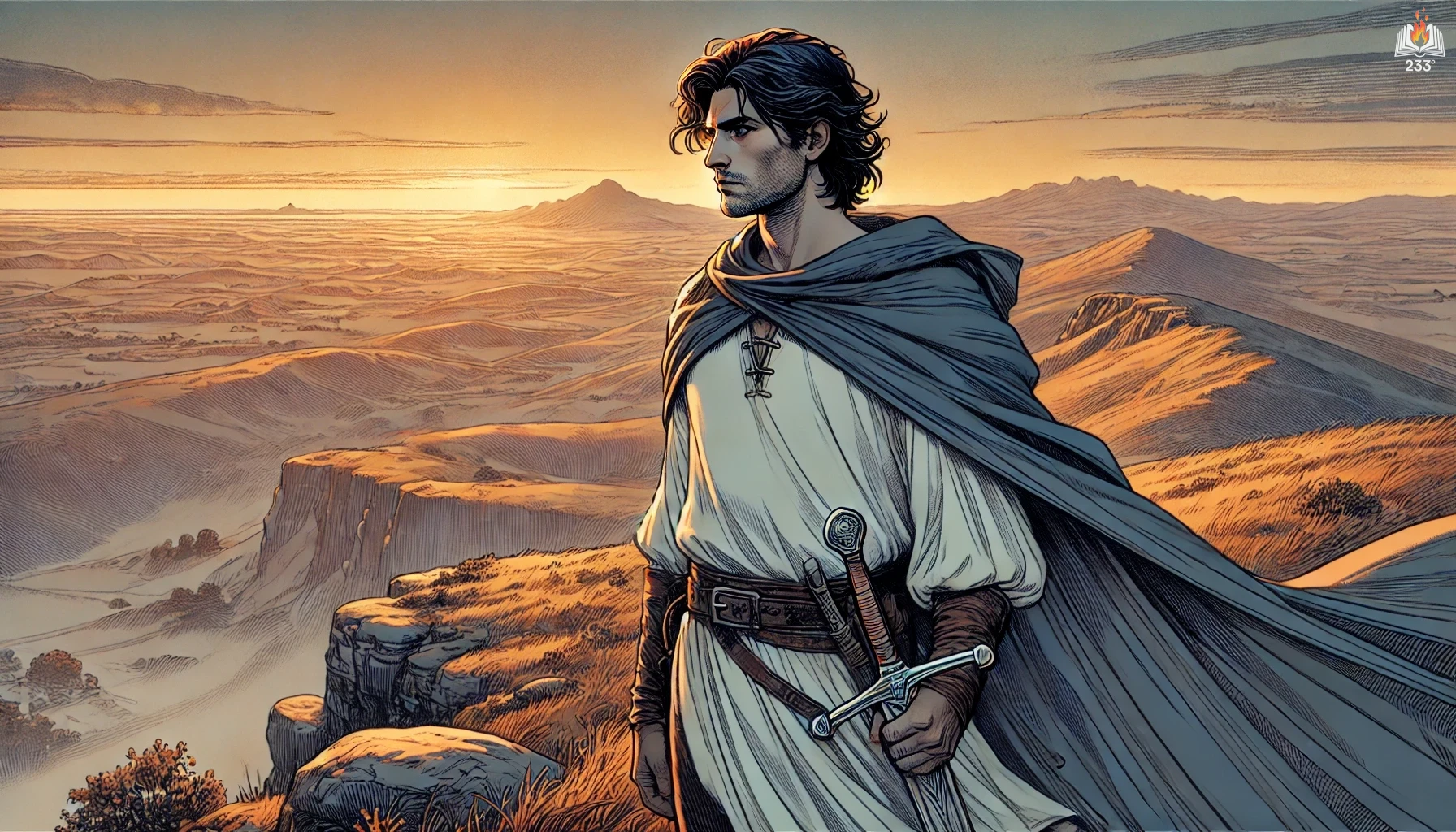


Swords of Mars, written by Edgar Rice Burroughs and published in 1935, is the eighth installment in the legendary Barsoom series, a classic science fantasy saga set on a romanticized version of Mars, known as Barsoom. The novel continues the adventures of John Carter, Warlord of Mars, as he embarks on a perilous quest driven by honor, loyalty, and love, traveling from the cities of Zodanga and Helium to the enigmatic moon Thuria in pursuit of his kidnapped wife, Dejah Thoris.
Plot Summary
Beneath the red skies of Barsoom, a plot of treachery and peril took shape in the shadowed alleys of Zodanga. From Helium to the nearer moon Thuria, the fate of Dejah Thoris, the Princess of Helium, trembled on the edge of a dagger’s point. When word reached John Carter that his beloved had been abducted, he knew at once who was behind it – Ur Jan, the brutal leader of the Zodangan guild of assassins, and Gar Nal, a genius driven mad by ambition and invention. Their scheme was daring: to steal the incomparable princess and transport her aboard an experimental vessel beyond the reach of Barsoom’s armies, to hide her on the distant, spinning moon.
Donning a disguise and adopting the name Vandor, John Carter infiltrated the corrupt city of Zodanga. Its darkened streets teemed with spies and killers, and it was among them that Carter walked with the composure of a panthan and the soul of a Warlord. He discovered the tangled web of power struggles between the rival scientists Gar Nal and Fal Sivas, each of whom had created ships capable of traversing the void. Ur Jan had allied with Gar Nal, promising him treasure in exchange for transportation to Thuria. Meanwhile, Fal Sivas, erratic and secretive, agreed to help Carter, but his cowardice proved deeper than his intellect. Faced with the dangers of the unknown, Fal Sivas recoiled from his own dream.
Within the house of Fal Sivas, Carter found horror hidden behind closed doors. The scientist had captured women and used them in grotesque brain experiments, revealing a soul as diseased as it was brilliant. Among the captives was Zanda, a servant girl who had grown fond of Carter. With sword in hand, Carter liberated her and turned on Fal Sivas, demanding use of his ship. But Sivas refused. His fear chained him to Barsoom while Dejah Thoris drifted farther into the stars.
Carter acted alone. Alongside him stood Jat Or, a young officer from Helium, loyal and untested. Together they set off, not for the known cities or kingdoms, but for the moon. Gar Nal’s ship had departed days earlier, and Carter followed its path across the heavens in Fal Sivas’s skycraft. Through thin atmosphere and silent darkness, the ship raced, guided by a man with no fear of death, only dread that he might be too late.
Thuria, the nearer moon, revealed herself not as a barren rock but a land of forests, seas, and strange cities. Creatures of peculiar form and size, adapted to the moon’s lesser gravity, populated her jungles. Carter and Jat Or descended amid these unknown lands, giants among the natives, whose own stature barely reached a Barsoomian’s waist. But what the Thurian people lacked in size, they made up in cunning, and soon Carter learned that Gar Nal had indeed brought Dejah Thoris here, and that she had been imprisoned in the hidden city of the Morgors – a cruel and secretive race with elongated heads and masked faces.
The Morgors, cold and efficient, had no use for compassion. They welcomed Gar Nal and Ur Jan, not out of alliance, but as tools for their own schemes. Dejah Thoris was held not merely as ransom, but as a specimen of beauty, a trophy to prove the might of their rule. Carter and Jat Or disguised themselves to enter the city, posing as emissaries from another world. There, under the silent towers and shadowed courtyards, they navigated a society ruled by fear and order.
Through risk and deception, Carter reached the chamber where Dejah Thoris was held. Her spirit remained unbroken, her faith in him unshaken. Their reunion was brief and perilous, for the Morgors soon discovered the truth. Carter and his allies battled through the winding corridors of the city, their swords flashing in the pale green light of Thuria’s skies. Jat Or fought beside his Warlord with the courage of a veteran, and the captives rose in revolt, led by Zanda, who had been taken again by the Morgors after fleeing Fal Sivas’s laboratory.
Gar Nal’s pride became his downfall. Attempting to claim glory and power for himself, he turned on Ur Jan and the Morgors alike, seeking to escape with the princess as leverage. But Ur Jan, the assassin, lived only for vengeance. Their clash was savage, and both fell, locked in mortal combat beneath the crashing domes of a collapsing Morgor stronghold.
Carter, with Dejah Thoris and a handful of allies, reached the experimental ship. Behind them, the city burned. The Morgors had triggered a self-destructive trap, unwilling to let their secrets fall into foreign hands. With Jat Or at the helm and Carter guarding the rear, they rose into the night sky of Thuria, leaving the shattered ambitions of tyrants in flame.
The return to Barsoom was no simple feat. The ship, damaged during the escape, faltered through space. At times it seemed as though it would fail entirely. But Carter’s will proved stronger than steel and wind. He guided it through the emptiness, determined to see Dejah Thoris safe once more on the soil of Helium.
When the towers of Helium finally came into view, the people rejoiced. Their princess, long feared lost, had returned. Tardos Mors, the jeddak, wept to see his granddaughter alive. Jat Or was honored for his bravery, and Zanda found new purpose among the nobles of Helium, her loyalty remembered.
Yet for John Carter, there was no reward greater than the silent smile of Dejah Thoris, who stood at his side once more, her hand in his, her gaze never faltering. On a world scarred by war and ruled by honor, there could be no greater triumph than love reclaimed.
Main Characters
John Carter – A legendary Earth-born warrior and the Warlord of Mars, Carter is noble, fiercely courageous, and unwaveringly devoted to his wife, Dejah Thoris. His unmatched combat prowess, strategic intellect, and innate sense of justice define his leadership. In this tale, his relentless pursuit to save Dejah Thoris propels him into the heart of danger, showcasing both his strength and emotional depth.
Dejah Thoris – The Princess of Helium and John Carter’s wife, Dejah Thoris is portrayed as the epitome of Martian beauty and dignity. Though her screen time is limited in this novel, her presence as the emotional and moral center of Carter’s quest emphasizes her importance as more than just a damsel in distress.
Ur Jan – The ruthless leader of the assassins’ guild of Zodanga, Ur Jan is cunning, sadistic, and driven by greed. His kidnapping of Dejah Thoris and collusion with the scientist Gar Nal showcase his ambition to leverage ransom for power. He is Carter’s primary human adversary in this story.
Gar Nal – A rival inventor and scientist, Gar Nal is intelligent and deeply unscrupulous. He has perfected an interplanetary ship capable of reaching Mars’s moons and allies himself with Ur Jan for personal gain. His ship becomes the vehicle of Dejah Thoris’s abduction.
Fal Sivas – Another scientist obsessed with interplanetary travel, Fal Sivas is brilliant but unstable and morally bankrupt. Though Carter initially seeks his help, Fal Sivas’s grotesque experiments and cowardice ultimately make him a twisted figure in the narrative.
Jat Or – A loyal young officer of Helium, Jat Or serves as John Carter’s companion in the rescue mission. Brave, earnest, and skilled with a sword, he provides dependable support and embodies the virtues of Martian honor and camaraderie.
Rapas the Ulsio – A scheming and cowardly informer, Rapas plays a double game between Carter and Ur Jan. His nickname, “the Rat,” reflects his duplicitous nature. His role adds layers of deception and intrigue.
Theme
Loyalty and Honor – The defining theme of the novel is loyalty: John Carter’s unshakable devotion to Dejah Thoris and Helium drives every action he takes. Honor, too, underpins his refusal to stoop to treachery even when facing assassins and spies.
Science vs. Morality – Through Fal Sivas and Gar Nal, Burroughs explores the dangers of scientific advancement unmoored from ethics. The horrifying experiments and the misuse of technology become symbols of knowledge without conscience.
Love as a Driving Force – The love between John Carter and Dejah Thoris remains a central motif throughout the Barsoom series. In Swords of Mars, it transcends even planetary boundaries, framing love as a powerful, unyielding force.
Identity and Disguise – John Carter frequently conceals his identity to infiltrate enemy ranks, allowing themes of duality and hidden truths to emerge. The novel questions how much of a person’s essence lies in their actions versus their name.
Heroism in the Face of Overwhelming Odds – As always in Burroughs’ work, courage in adversity is a hallmark. Carter’s journey to Thuria – a moon thought unreachable – epitomizes heroic perseverance.
Writing Style and Tone
Edgar Rice Burroughs crafts Swords of Mars with the same high-energy, swashbuckling flair that defines the Barsoom series. His narrative is brisk and vividly descriptive, filled with swordplay, espionage, daring escapes, and imaginative world-building. The prose leans toward the pulpy and melodramatic, but it suits the mythic nature of Carter’s exploits. Burroughs uses first-person narration, giving John Carter’s voice immediacy and clarity, which enhances the intimacy of his internal reflections and adds gravitas to his emotional journey.
The tone of the novel oscillates between grand adventure and grim urgency. As Carter infiltrates the criminal underworld and faces personal betrayal, the mood grows darker and more complex. Burroughs balances this with moments of heroism and chivalric romance, maintaining the optimistic spirit of the series. The inclusion of speculative science—moon travel, teleportation, and disembodied brains—lends a surreal, fantastical dimension to the Mars saga, marking the blend of science fiction and planetary romance that defines Burroughs’ legacy.
We hope this summary has sparked your interest and would appreciate you following Celsius 233 on social media:
There’s a treasure trove of other fascinating book summaries waiting for you. Check out our collection of stories that inspire, thrill, and provoke thought, just like this one by checking out the Book Shelf or the Library
Remember, while our summaries capture the essence, they can never replace the full experience of reading the book. If this summary intrigued you, consider diving into the complete story – buy the book and immerse yourself in the author’s original work.
If you want to request a book summary, click here.
When Saurabh is not working/watching football/reading books/traveling, you can reach him via Twitter/X, LinkedIn, or Threads
Restart reading!